Casa de Pilatos Visitor Guide: Ultimate Tips & What to See in Seville
Explore Casa de Pilatos with our essential visitor guide. Discover history, must-see rooms, gardens, opening hours, tickets, and insider tips for your Seville trip.
On this page
Casa de Pilatos Visitor Guide: Your Essential Tour & Tips
Casa de Pilatos is the palace most first-time visitors to Seville never plan for, and the one nearly everyone who finds it names as the highlight of their trip.
Built in stages between 1483 and the 1580s, it fuses Mudéjar tilework, Gothic vaulting, and Italian Renaissance sculpture inside a single private residence, the Dukes of Medinaceli's family still keep rooms here.
Because it draws a fraction of the Real Alcázar's crowds, you can actually stand still in its courtyards and look up.
This 2026 guide covers what to see room by room, how to plan tickets and timing, and the one booking mistake that trips up most first-time visitors.
History of Casa de Pilatos: A Blend of Styles
Construction began in 1483, when Don Pedro Enríquez, Andalusia's chief governor, and his wife Catalina de Ribera built a Mudéjar-style courtyard house tied into the Caños de Carmona, Seville's Roman aqueduct. Their son, Fadrique Enríquez de Ribera, inherited the property in 1505 and transformed it after a 1519 pilgrimage to Jerusalem, where he encountered what was then believed to be the ruins of Pontius Pilate's Praetorium.
Fadrique modeled his home's layout on that biblical building, which gives the palace its name and its Via Crucis theme, the Stations of the Cross procession he founded here in 1521 still starts from its chapel every Good Friday. His nephew, Per Afán de Ribera, later Duke of Alcalá and Viceroy of Naples, added the deepest Renaissance layer: Genoese marble columns, Italian statuary, and the palace's formal second name, Palacio de los Adelantados Mayores de Andalucía.
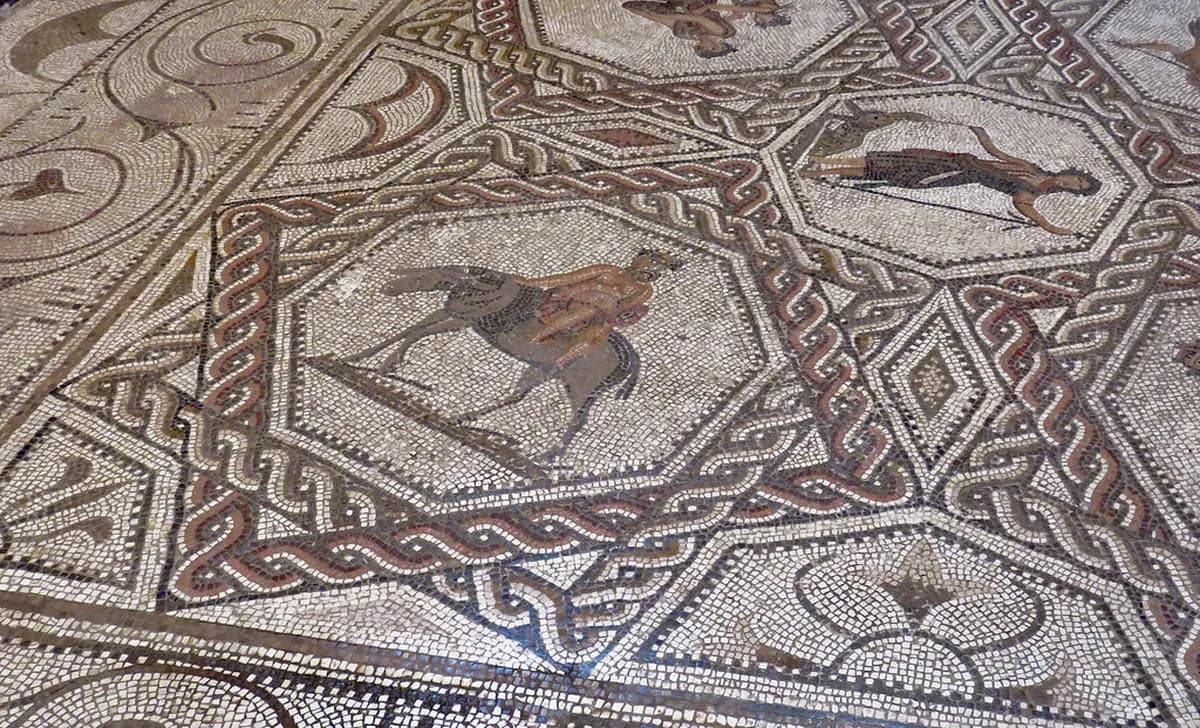
Mudéjar plasterwork and cuenca- and cuerda seca-technique tiles cover the lower walls throughout, Gothic ribbed vaulting survives intact only in the Flagellation Chapel, and Renaissance columns, fountains, and Roman-inspired sculpture define the courtyards and gardens added a generation later.
By the 17th century the palace was one of Seville's cultural salons, Francisco Pacheco, Velázquez's teacher, painted ceiling panels here, and the 19th-century Dukes of Medinaceli restored it during the Romantic revival. It remains a private family home today, part of why it feels different from Seville's other monuments.
Planning Your Visit: Tickets, Opening Hours & Best Time
Tickets are sold online and at the entrance for two tiers: the ground floor and gardens, or the Complete House ticket that adds the guided upper floor. Buy the Complete House ticket upfront if you want the upper floor, the guided add-on runs on a fixed timetable and is easiest to lock in before touring rather than after. For current prices and any seasonal closures, check the Casa de Pilatos official website before you go.
Opening hours run 9:00 AM to 6:00 PM from November to March and 9:00 AM to 7:00 PM from April to October, with the ticket office closing 30 minutes earlier. Confirm exact times on the official site, since the Medinaceli family occasionally closes rooms for private events with little notice, a quirk of a home that's still lived in rather than a pure museum. Budget 1.5 to 2 hours for a relaxed visit covering both floors and both gardens.
Spring (March-May) and fall (September-November) bring the best light and mildest temperatures for the open-air courtyards. Early morning, right at opening, is consistently the quietest window and the best time to photograph the Main Patio before tour groups arrive. Avoid Semana Santa week and the April Feria if you can, crowds spike and upper-floor slots sell out earlier than usual, outside those two weeks Casa de Pilatos rarely needs the Alcázar's timed-entry booking, so a same-day ticket is usually fine.
Decide on the Complete House ticket and upper-floor timing before you start touring. Guided slots run every 30 minutes and can book up quickly on busy days, so locking in your spot upfront avoids the frustration of finding the next slot 20–30 minutes away.
| Ticket Type | Price | What's Included |
|---|---|---|
| Ground Floor & Gardens | €12 | Self-guided tour of main floor and both gardens |
| Complete House | €18 | Ground floor, gardens, plus guided upper-floor tour |
| School Groups | €8 | Discounted ground floor entry for organized groups |
| Children Under 11 | Free | Free entry when accompanied by an adult |
| Visitors with Disability (50%+) | €6 | 50% discount on ground-floor admission |
The Main Patio & Courtyard: Architectural Masterpiece
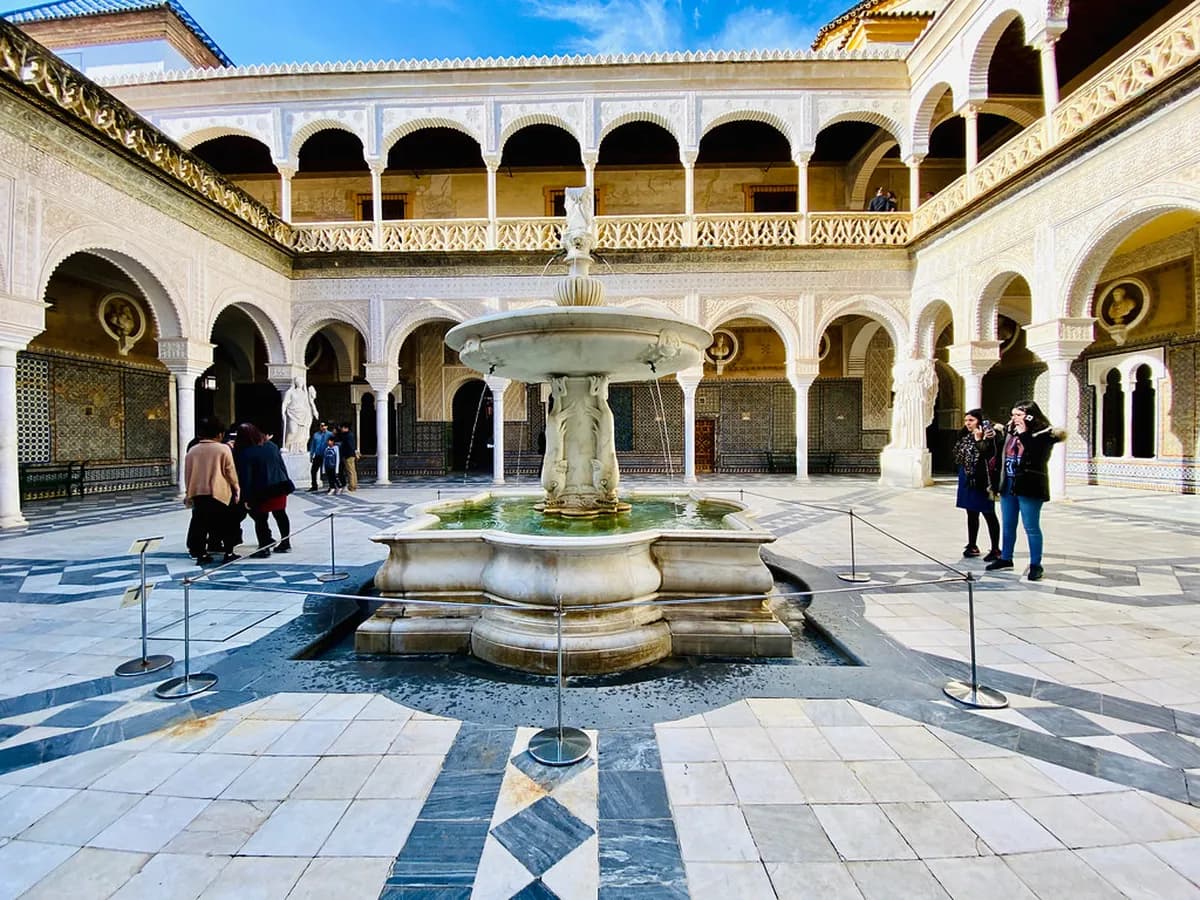
Start your self-guided tour here. The Main Patio began as a simpler Mudéjar courtyard under Pedro Enríquez and Catalina de Ribera, then Fadrique Enríquez de Ribera reshaped it in 1526, adding the gallery beside the Praetor's Room on marble Corinthian columns with distinctive "claw" bases and "ponytail" capitals, Seville's clearest example of Mudéjar, Gothic, and Renaissance styles sharing one space without competing.
Twenty-four Roman-era busts and statues line the arcades, part of the collection assembled by Per Afán de Ribera, Duke of Alcalá, after his years as Viceroy of Naples. Look in the northwest corner for the so-called Athena de Medici, a 2nd-century Roman copy of a lost Greek original and the only known statue of its type to retain its original Roman head, easy to walk past without noticing.
The central fountain, carved in 1529 by the Genoese workshop of Aprile da Carona from Carrara marble, rises four meters on a pedestal of four downturned dolphins, topped with a two-faced bust of Janus, the Roman god of transitions. Beneath it, cuenca-technique azulejo tiles cover the lower walls in patterns typical of 16th-century Sevillian workshops.
Give this room five to ten minutes before moving on, the contrast between Mudéjar arches and imported Italian statuary is easiest to read here, before the smaller rooms narrow your field of view.
Hall of Pretoria & Praetor’s Room: A Symbolic Journey
Named for the Praetorium of Pontius Pilate, this 132-square-meter hall on the east side of the courtyard was built between 1526 and 1539, part of Fadrique Enríquez de Ribera's renovation that squared off the patio. It is the only room in the palace that keeps every original decorative element intact, which makes it the best single stop for close-up craftsmanship.
Look for the taracea, inlaid wood carpentry using contrasting timber set into geometric patterns, on the original Mudéjar doors and window frames. The five-meter entrance doors carry the Lord's Prayer in Gothic script on the interior face and the Creed on the exterior, identical ornamentation on both sides was a deliberate flourish.
The coffered ceiling, attributed to the carpenter Andrés de Juara, arranges five rows of square panels in a layout that echoes the Pantheon's dome in Rome, a design Fadrique likely studied on his own pilgrimage through Italy. Eight heraldic shields run along its central axis, marking the family's marriage ties to the Mendoza, Quiñones, Figueroa, Portocarrero, and Toledo lineages.
Below the ceiling, cuenca-technique tilework and Arabic-inscribed stucco reliefs bridge the Islamic and Christian elements that define the whole palace. Two mullioned windows flood the room with light, worth timing your visit for if you want photographs of the plasterwork without shadows across the frescoes.
Jardín Chico (Small Garden): A Tranquil Oasis
Reached through the Zaquizamí Corridor, the Jardín Chico was one of Fadrique Enríquez de Ribera's final additions, laid out in 1539 as a private retreat rather than a public showpiece, and expanded to its current footprint between 1910 and 1920 when ancillary buildings on the site were demolished.
Casa de Pilatos was among roughly twenty Sevillian properties in the late 15th century granted "standing water" rights from the Caños de Carmona aqueduct, a Crown-controlled resource normally reserved for the Alcázar. That privilege is what made a private garden with running fountains possible here at all, and it is part of why the space still feels indulgent rather than merely decorative.
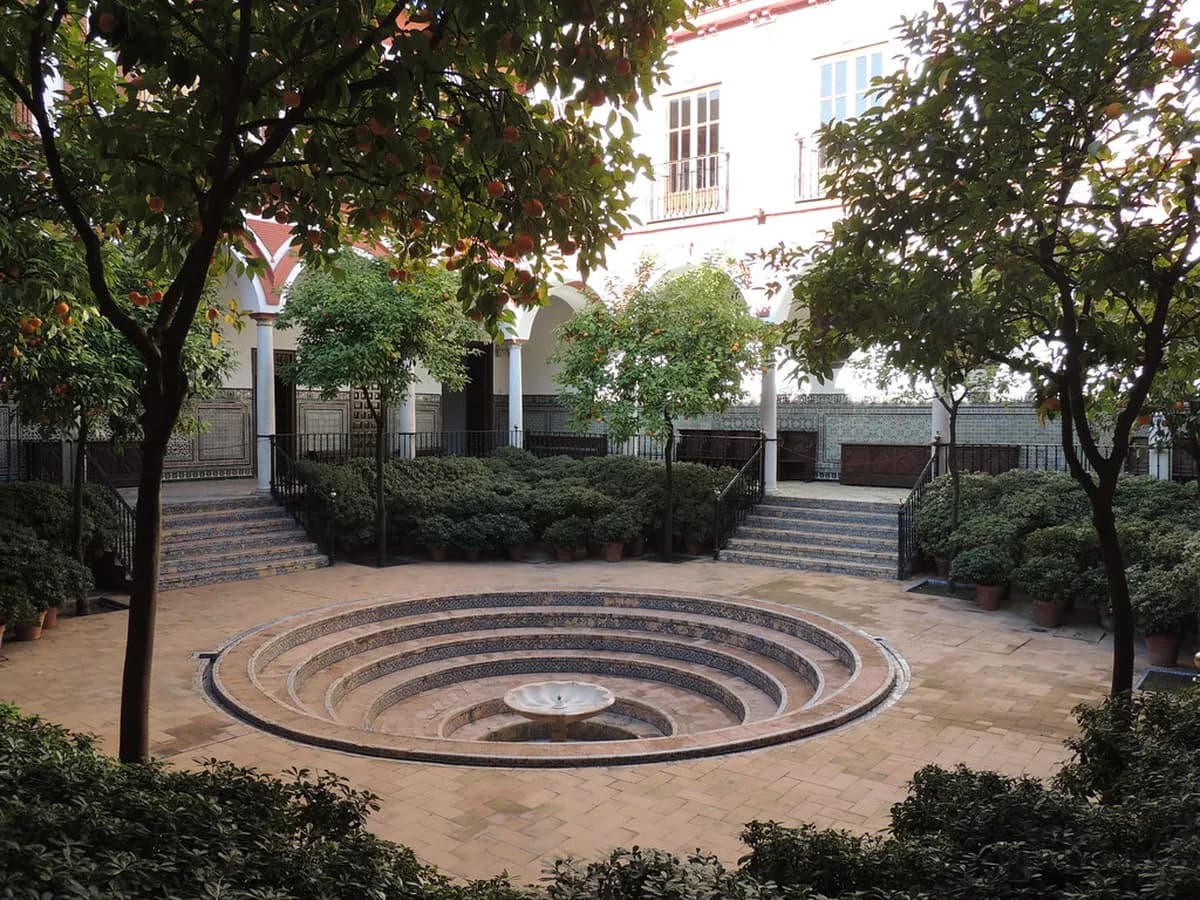
At its center sits a star-shaped tiled pond crowned by a 1900 bronze Bacchus by the sculptor Mariano Benlliure, with a Renaissance-style Eros nearby holding a bird. Orange trees, roses, and dense subtropical planting fill the beds around it, and the garden is at its most fragrant in spring when the citrus blossoms open.
Morning light works best here, it comes in low and warm through the surrounding arcades and picks out the tilework without the harsh midday glare that flattens the courtyard photos elsewhere in the palace. Few visitors linger past a quick photo, which makes it one of the easiest corners of Casa de Pilatos to have to yourself.
Zaquizami’s Corridor & The Golden Room: Architectural Wonders
Zaquizami's Corridor, the passage from the Main Patio into the Jardín Chico, takes its name from the Arabic sáqf fassamí, meaning "fragile roof" or "roof in the sky." Along the way, look for three Renaissance iron grilles and fragments of Roman plasterwork set directly into the walls, older material reused as decoration rather than removed.
The Golden Room sits at the far end of the Jardín Chico and was one of Fadrique's last projects before his death. Its walls are wrapped in brilliant yellow, and the gilded wooden ceiling gives the room its name; inside are Roman relief carvings from the Duke of Alcalá's collection, including two panels commemorating Augustus's naval victory at Actium.
Local legend holds that the third Duke of Alcalá brought Emperor Trajan's ashes back from Rome in an alabaster urn, only for a maid to accidentally spill them into the garden, the story goes that Trajan now rests among the orange trees just outside the Golden Room's door.
Together the corridor and room mark the shift from the palace's devotional Mudéjar core to its worldly, Italian-influenced wing, proof the same family that built a Via Crucis chapel also collected Roman antiquities.
The Flagellation Chapel & Pilates Cabinet: Religious Significance
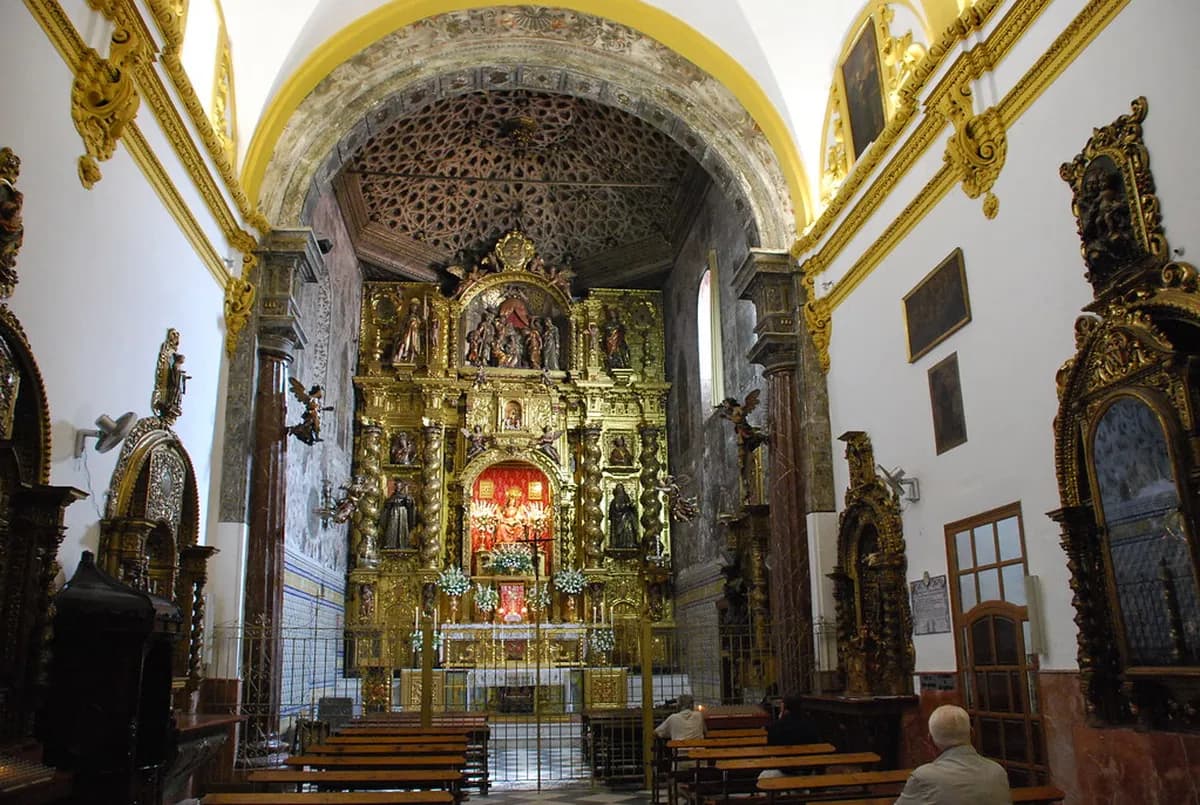
The Flagellation Chapel is the only room in the palace built in the Gothic style, a deliberate choice, since pointed arches and ribbed vaults read as unambiguously sacred against the mostly Mudéjar and Renaissance interiors elsewhere. A rose-jasper column at the center recalls the pillar to which Christ was bound during his flagellation, the detail that names the room.
Above the altar stands a 4th-century white marble Good Shepherd figure, a Christian adaptation of a classical Hermes sculpture and one of the oldest objects in the palace. The chapel also preserves cuerda seca tilework, an earlier, more labor-intensive technique than the cuenca tiles used elsewhere, introduced by Muslim artisans in the 13th century and refined by Mudéjar craftsmen through the 15th.
Exit north to the Pilates Cabinet, modeled on the qubba, a square Islamic reception chamber typically capped with a dome or coffered ceiling to symbolize the heavens. Its staggered wooden ceiling, installed before Catalina de Ribera's death in 1505, centers on a carved grotesque surrounded by ten-pointed stars on pineapple-shaped muqarnas clusters.
A small adjoining room displays a reproduction of "The Bearded Woman," José de Ribera's 1631 Baroque portrait of Magdalena Ventura, a woman with a hormonal condition that caused facial hair growth, shown nursing her infant with quiet dignity. The original is part of the Medinaceli collection, usually on loan to Madrid's Prado, so this copy is the only place to see it in the palace itself.
Beyond the Main Tour: Judges’ Resting Room, Stables & More
Behind the Athena de Medici statue sits the Judges' Resting Room, named for the 71 Sanhedrin members who, in the biblical account, judged Christ before the Passion, part of the palace-wide naming scheme tied to the Via Crucis. It originally served as the antechapel leading into the chapel through a segmental arch with lobed lattice windows, a finer stucco detail most visitors walk straight past.
The Mounting Block and Stables, near the service entrance, reflect how central horses were to a noble Sevillian household's status and daily logistics. The architecture here is plainer than the reception rooms by design, built for function rather than to impress guests.
The Hall of Columns, off the Main Patio, was originally an exhibition gallery for the Duke of Alcalá's collection of ancient marble columns, its bare walls exist to keep attention on the pillars themselves. From there, the Large Garden opens up: a former orchard turned "archaeological garden" in the late 1500s, with an L-shaped loggia of Roman-style arcades and a Mannerist grotto sheltering a 16th-century marble Sleeping Venus.
Set aside 15 extra minutes for this loop, it's the part of Casa de Pilatos most quick visits skip entirely, and where the palace's two personalities, devotional and classical, sit closest together.
Casa de Pilatos on Screen: Movies Filmed Here
Casa de Pilatos has stood in for palaces, headquarters, and courts across decades of film production, its layered Mudéjar-Renaissance architecture reads as convincingly Middle Eastern, Byzantine, or Italian depending on the lens angle.
Its best-known appearance is in 'Lawrence of Arabia' (1962), where the Main Patio served as General Allenby's Cairo headquarters. Ridley Scott's 'Kingdom of Heaven' (2005) used the palace's courtyards for interior scenes, and it also appears in '1492: Conquest of Paradise' (1992) and the Tom Cruise film 'Knight and Day' (2010).
Production crews are drawn to the same features that make the palace worth visiting: the Main Patio's mix of arches and statuary reads as generically "historic" on camera, while the Golden Room and Hall of Pretoria provide ready-made opulent backdrops without any set dressing.
If you enjoy spotting filming locations, the Main Patio and the staircase to the upper floor are the two spaces most recognizable on screen, worth a second look if you've seen these titles before your visit.
Is Casa de Pilatos Worth Visiting? Our Insider Verdict
Yes, for most visitors, and more so than its lower profile suggests. Casa de Pilatos gives you the same Mudéjar-Renaissance architectural vocabulary as Seville's bigger monuments, in courtyards you can often have almost to yourself, at roughly a third of the crowd density of the Real Alcázar.
- Genuine layering of Mudéjar, Gothic, and Renaissance styles in one building, with the only pure Gothic interior in the palace.
- Lighter crowds than the Alcázar or Cathedral, especially before 11:00 AM, easier to actually study the tilework and statuary.
- The Via Crucis backstory and family-residence status give it a narrative and lived-in feel museum-ified palaces lack.
- Gardens that reward slow visits, with comfortable, uncrowded photography.
The trade-offs: the upper floor is guided-tour-only on a fixed schedule, the interiors lean historical rather than lavishly decorative, and rooms will feel familiar if you've already toured two or three other Sevillian palaces.
It suits history buffs, architecture enthusiasts, and anyone who wants one unhurried visit rather than a rushed one. If your Seville time allows only one palace and you want spectacle, the Alcázar still wins, but for a second stop, Casa de Pilatos is the better value.
Casa de Pilatos vs. Other Seville Palaces: What Makes it Unique?
Seville has more than twenty historic private palaces, but three come up most often against Casa de Pilatos: the Real Alcázar, Palacio de las Dueñas, and, for those going deeper, smaller houses like Palacio de la Condesa de Lebrija or Casa de Salinas. Each answers a slightly different question about your time in the city.
The Real Alcázar is grander, still a working royal site, and requires timed-entry booking in peak season, plan two to three hours and real crowds even early in the day. Choose it first if you only have time for one palace; choose Casa de Pilatos alongside it if you want to actually linger in a courtyard rather than move with a tour group.
Palacio de las Dueñas, birthplace of poet Antonio Machado and long the home of the House of Alba, shares some of the same Mudéjar courtyard DNA but leans more floral and literary. Casa de Pilatos differentiates itself with its explicit Via Crucis narrative and a far larger classical sculpture collection, more Roman-era material than any comparable Sevillian palace.
Pick Casa de Pilatos for architecture and history, or Palacio de las Dueñas for literary Seville and garden design. Either way, expect a shorter visit and a smaller crowd than the Alcázar delivers.
Practical Tips for a Seamless Visit
The palace sits at Plaza de Pilatos, 1, in the San Bartolomé district, an easy walk from the Cathedral and Santa Cruz. By tram or metro Line 1 (L1), get off at Puerta de Jerez and walk roughly 15 minutes. TUSSAM buses 03, 20, 24, 32, M-111, and M-113 stop at Recaredo, about five minutes on foot, the closest option coming from outside the historic center.
The detail that trips up most first-timers: decide on the upper floor before you start touring, not after. Guided slots run roughly every 30 minutes between 10:00 AM and 5:30 PM, with two extra slots at 6:00 and 6:30 PM in summer, and you need the Complete House ticket before reaching the top of the staircase where the guide meets you. Visitors who tour the ground floor first and decide afterward often find the next slot 20-30 minutes away, or fully booked on busy days.
Wear shoes with grip, courtyard and garden paths are cobblestone and can be uneven or damp near the fountains. Ground floor and gardens are wheelchair accessible, but the upper floor is reached by stairs only, worth knowing before buying the Complete House ticket if mobility is a concern.
Photography without flash is allowed throughout the ground floor and gardens; upper-floor rules are set by each guide. An audio guide, included with the ground-floor ticket in multiple languages, adds context to rooms like the Praetor's Room that otherwise have minimal on-site signage.
Wear shoes with good grip; courtyard and garden paths are uneven cobblestone and can be slippery near fountains, especially early morning when moisture lingers.
Integrating Casa de Pilatos into Your Seville Itinerary
Casa de Pilatos works best as the opening act of a half-day loop through eastern Seville, start here right at 9:00 AM opening while it's quiet, then let the walk pull you toward the bigger sights. It is central enough that you never need a taxi to link it with the rest of the historic center.
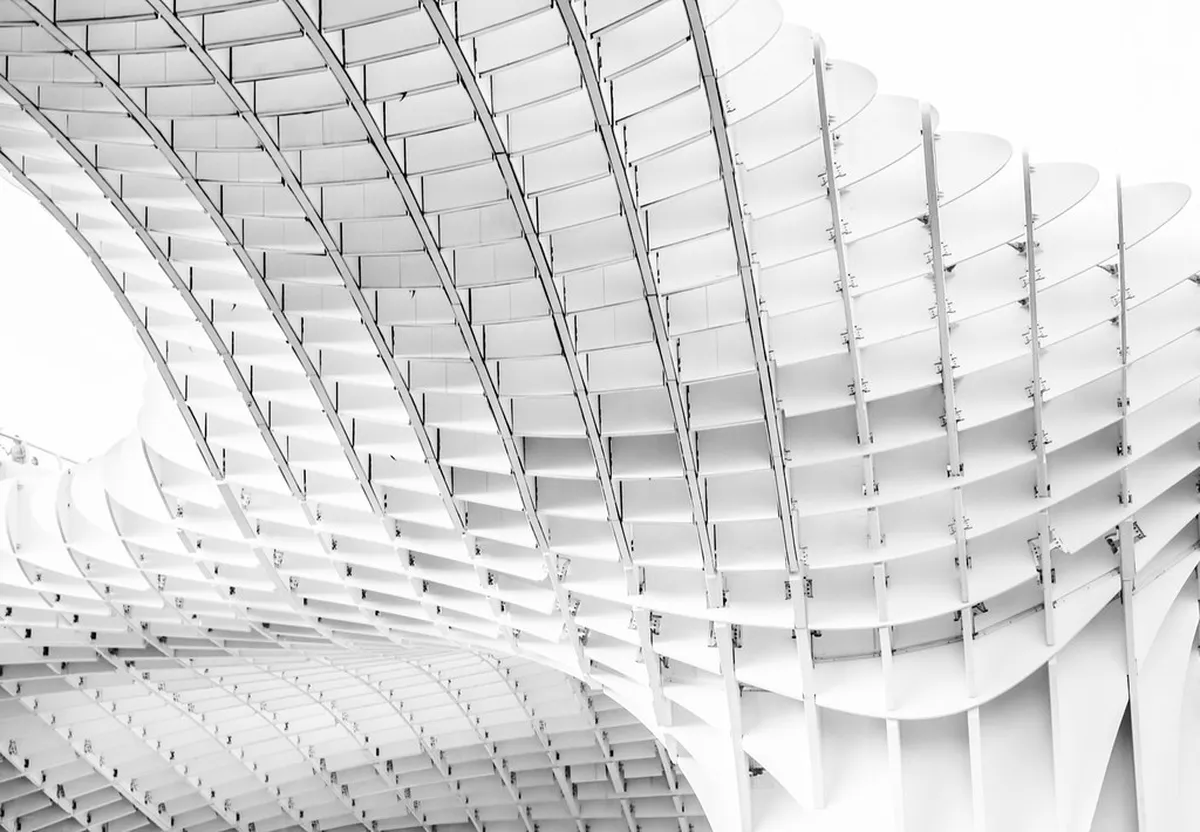
From the palace, it's a short walk to the Metropol Parasol for panoramic views, or south into the Santa Cruz Quarter toward the Cathedral and Real Alcázar. Both routes take 10-15 minutes on foot through some of Seville's most photogenic streets.
For lunch, the tapas bars around Alfalfa Square or Encarnación Square are a five-minute walk and stay busy with locals, a reasonable sign of quality. Casa Morales, one of Seville's oldest bodegas, is another solid option for a sit-down Andalusian meal.
For a longer Southern Spain itinerary, treat Casa de Pilatos as a fixed stop rather than an optional add-on, it pairs naturally with Palacio de las Dueñas and the Hospital de la Caridad on the same half-day loop, all three within a 15-minute walk of each other. See our Seville guide before you finalize your days.
Frequently Asked Questions
When was the Casa de Pilatos built?
The construction of Casa de Pilatos began in 1483 by Pedro Enríquez and Catalina de Rivera. Their son, Fadrique Enríquez de Rivera, significantly expanded and completed the palace after his pilgrimage to Jerusalem in 1519, incorporating Renaissance and Mudéjar styles.
Is Casa de Pilatos worth visiting for first-time visitors to Seville?
Yes, Casa de Pilatos is highly recommended for first-time visitors seeking a rich cultural experience. It offers a unique blend of architectural styles and a more intimate atmosphere than larger attractions. It provides a fascinating glimpse into Seville's history and art.
How much time should you plan for a Casa de Pilatos visitor guide experience?
Plan to spend approximately 1.5 to 2 hours for a comprehensive visit to Casa de Pilatos. This allows enough time to explore both the ground floor and take the guided tour of the upper floor. You can also enjoy the tranquil gardens at a relaxed pace.
What does Casa de Pilatos mean?
Casa de Pilatos translates to 'House of Pilate'. The palace was named by Fadrique Enríquez de Rivera, who believed its layout mirrored the Praetorium of Pontius Pilate in Jerusalem. This connection inspired its design and symbolic significance, linking it to the Stations of the Cross.
Are there any movies filmed at Casa de Pilatos?
Yes, Casa de Pilatos has been a popular filming location for several movies due to its unique architecture. Notable films include 'Lawrence of Arabia' (1962), where it served as General Allenby's headquarters, and scenes from 'Kingdom of Heaven' (2005).
Other Great Tiled Interiors in Iberia
The azulejo panels here run to some 150 designs, laid alongside Mudéjar plasterwork and Roman statuary the family shipped in. Lisbon's National Tile Museum traces five centuries of the same craft through to industrial production. Porto's Capela das Almas wraps a working parish church in roughly fifteen thousand blue-and-white tiles applied in 1929.
Casa de Pilatos rewards the kind of slow, attentive visit that busier Sevillian monuments rarely allow. From its 1483 origins through Fadrique Enríquez de Ribera's Jerusalem-inspired redesign to the Roman statuary the Duke of Alcalá later added, every room layers a different chapter of the same family's history.
Book the Complete House ticket before you start if you want the upper floor, arrive close to 9:00 AM opening for the quietest courtyards, and give yourself the full 1.5 to 2 hours rather than treating it as a quick stop between bigger sights. For most visitors planning a 2026 trip to Seville, that makes Casa de Pilatos one of the best-value hours in the entire city.
For authoritative information, refer to the Casa de Pilatos on Wikipedia.
Plan your Seville visit with our comprehensive things-to-do guide and 3-day itinerary.
Continue exploring
More guides you'll find useful