Castel dell'Ovo Naples: Free Entry, No Booking Needed
Castel dell'Ovo is free to enter with no booking required — explore Naples' oldest castle, its sea-view terrace, and the Santa Lucia waterfront.
On this page
Castel Dell Ovo Naples
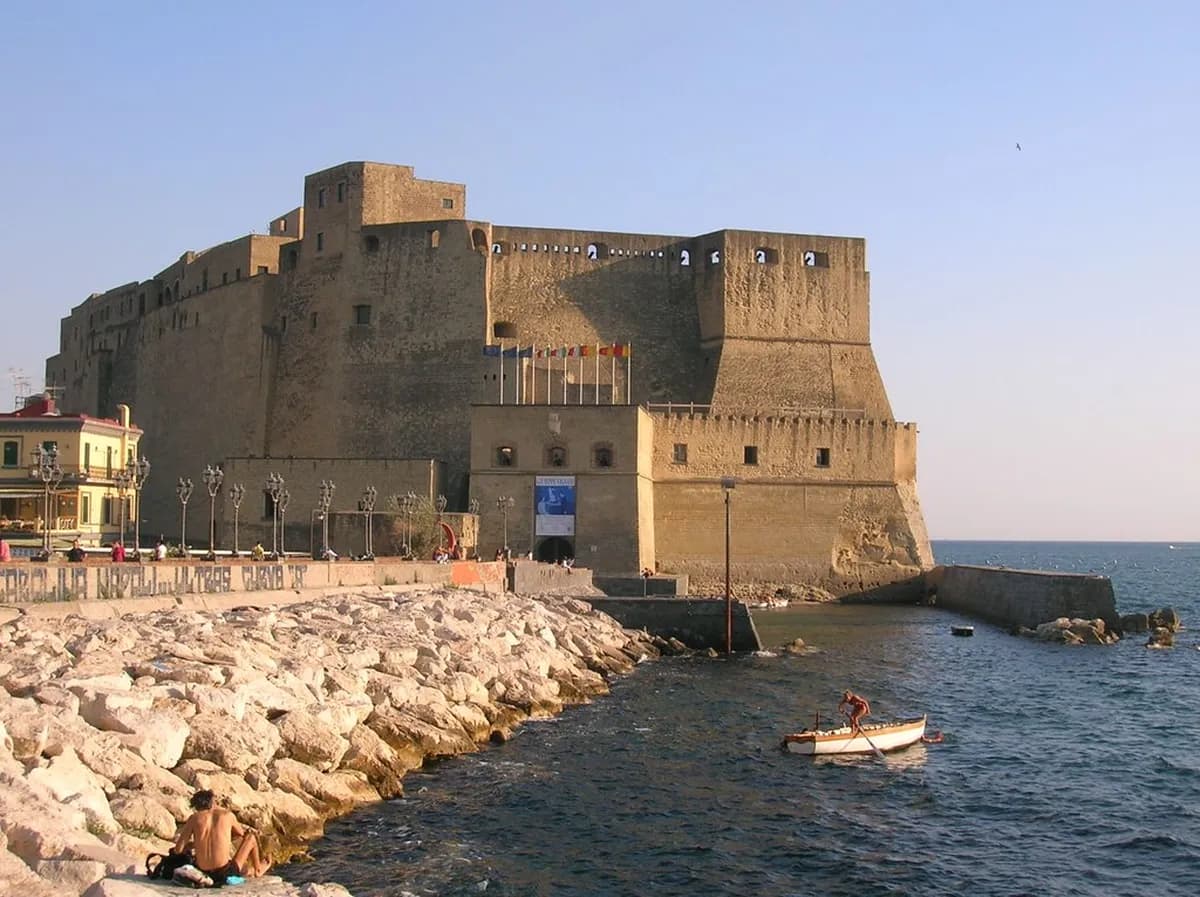
Castel dell'Ovo is the oldest castle in Naples, sitting on the ancient islet of Megaride in the Santa Lucia district. Its yellow tuff-stone walls rise directly from the sea, and the fortress gives its name to the entire Lungomare waterfront. No visit to Naples in 2026 is complete without at least walking across the bridge to its entrance.
The castle is free to enter and no advance booking is required for individual visitors. Inside, the highlights are the Terrace of the Cannons, the vaulted Sala Italia, and unobstructed views of Mount Vesuvius and the Bay of Naples. At its base, the fishing village of Borgo Marinari adds a slower pace that the rest of the city rarely offers.
This guide covers the essential highlights, the two legends that give the castle its name, exact opening hours, and the fastest ways to reach Via Eldorado, 3 from across the city.
Must-See Highlights Inside the Castle
The Terrace of the Cannons is the single best viewing point in the fortress. A row of antique artillery lines the parapet, and behind them the Bay of Naples stretches south toward Capri and Ischia. On clear mornings you can make out the cone of Vesuvius rising to the northeast. This terrace is one of the most photogenic vantage points in the city for photography, and it costs nothing to stand there.
The Sala Italia features a magnificent vaulted ceiling that dates to the Aragonese period. Look up before you look around — the stonework is the main event. The adjoining Church of the Savior contains frescoes and ancient carved capitals, though it is not always open to the public. Check with the guard at the entrance on the day you visit.
The castle's rooms are largely bare of furniture because they now serve as event and conference spaces. The architecture compensates: the yellow tuff stone walls, the narrow medieval corridors, and the contrast between cramped passages and sudden open terraces make the building genuinely engaging to walk through. Budget 90 minutes to see it properly.
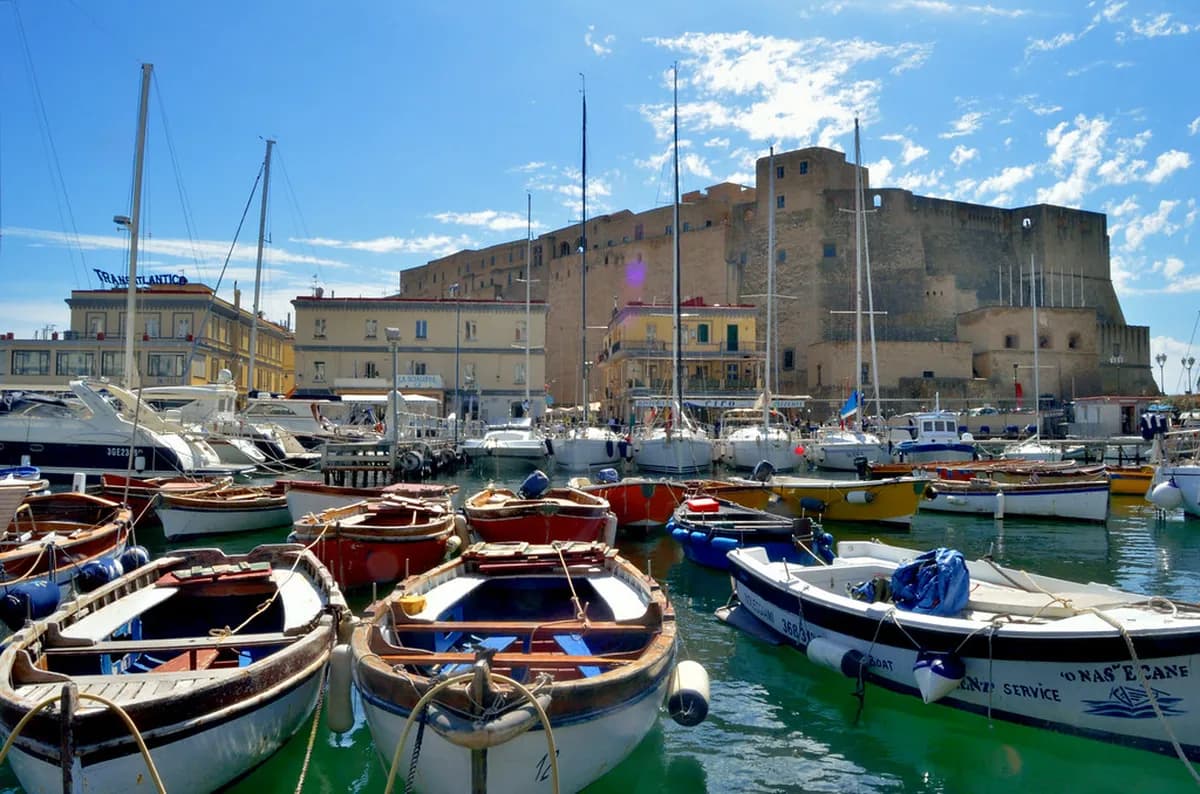
The Borgo Marinari marina wraps around the base of the castle walls. Fishing boats still moor here alongside boating clubs and old-school seafood restaurants. The low-season atmosphere — weekday mornings before 11:00 — is particularly quiet and makes for a very different experience from the summer weekend crowds.
The History of Castel dell'Ovo
The islet of Megaride is where the history of Naples itself begins. Greek colonists from Cumae founded the city of Partenope here in the 8th century BC, making this rocky outcrop the oldest continuously inhabited site in the Naples metropolitan area. The Roman general Lucius Licinius Lucullus later built a grand villa on the site — the Castrum Lucullanum — taking advantage of its commanding position over the gulf.
After the Roman period the site became a monastery, and the first version of the castle was built in 1140 by Ruggiero the Norman as a coastal fortification after his conquest of Naples. The Norman watchtower visible today dates to this phase. Subsequent rulers each left their mark: Frederick II of Swabia expanded the fortress in the 13th century, and Alfonso V of Aragon carried out the most significant reinforcement between 1400 and 1500, adding batteries and two drawbridges.
The Bourbons made further adjustments in the 18th century, and the castle has served at various points as a fortification against Saracen raids, a royal prison, and a royal palace. Today it is managed by the Municipality of Naples and is classified as a protected cultural heritage site.
The Legend of Virgil's Egg
The name "Egg Castle" comes from a medieval legend tied to the Roman poet Virgil, who was widely regarded as a powerful sorcerer in medieval Naples. According to the story, Virgil hid a magic egg inside a glass jar, which he locked in a metal cage deep in the castle dungeons. The egg's continued existence was said to protect both the fortress and the entire city of Naples from catastrophe. If it ever cracked, the castle would collapse and disaster would follow.
The story took on political weight during the 14th century reign of the Angevin queen Joan I of Naples. When a partial collapse of the castle terrified the city's population, Joan publicly announced that she had personally replaced the magical egg with a new one. The declaration worked: the panic subsided. It is one of the more remarkable examples of a ruler using local folklore as a tool of governance — the egg was never found, but the story did its job. This is one of the most quirky historical tales in the city for history enthusiasts, standing where that medieval crisis unfolded.
The name "Castel dell'Ovo" — Egg Castle — dates to this period. It is the only major landmark in the city named after a fictional object, and locals still invoke the legend when discussing the castle's resilience through earthquakes, eruptions, and centuries of occupation.
The Legend of the Siren Partenope
The Virgil story is the more famous legend, but an older myth predates it by nearly a thousand years. In ancient Greek tradition, the siren Partenope threw herself into the sea after she failed to enchant Odysseus with her song. Her body washed ashore on the rocks of Megaride, and the early Greek settlers who founded a city there named it Partenope in her honor — the first name of what would become Naples.
According to the tradition, Partenope is buried beneath the foundations of the castle and keeps eternal watch over the city from her resting place. This is why the siren appears on the official seal of Naples and remains a recurring symbol in Neapolitan art, street murals, and carnival imagery. When you cross the bridge to the castle, you are technically standing on the mythological grave of the city's founding figure.
The two legends — the siren and the egg — coexist comfortably in Neapolitan culture. One is Greek and cosmological; the other is medieval and political. Together they explain why this particular stretch of coastline has been considered sacred ground for nearly three millennia.
Opening Hours, Tickets, and Practical Info
Admission to Castel dell'Ovo is free for all visitors throughout 2026. No pre-booking is required for individuals or small groups; large groups should contact the municipality in advance. The phone number on file is +39 081 2400555.
Standard hours according to the most widely cited sources are Monday to Saturday, 9:00 to 18:30 and Sundays and public holidays, 9:00 to 18:00. However, at least one official regional source (Campania Artecard) lists the castle as closed on Saturdays with reduced weekday hours of 9:00 to 14:00. This discrepancy has persisted for several years and is worth flagging: if you plan to visit on a Saturday or outside the 9:00–14:00 window on a weekday, verify hours at the official municipality website before you go. Hours can also shift when the castle hosts a private event or temporary exhibition.
When a temporary exhibition is running, you may need to purchase a ticket to access the portion of the castle used for the show. The main terraces and exterior ramparts remain free even during exhibitions. Entry is typically cut off 30 minutes before the posted closing time.
The castle address is Via Eldorado, 3, Santa Lucia, Naples. There is no on-site parking for private vehicles.
Admission is free for all visitors throughout 2026 and no advance booking is required for individuals. Hours vary by source — Monday to Saturday 9:00–18:30, Sunday 9:00–18:00 is the most widely cited schedule, but verify at the official municipality website before a Saturday visit.
Getting to Castel dell'Ovo
The castle sits in a pedestrian-only zone, so you must arrive on foot from the nearest drop-off point. From the Municipio metro stop (Line 1), the walk takes about 20 minutes along the waterfront. This route passes Castel Nuovo and the port, giving you a preview of Naples's other major fortress on the way.
Bus route 151 to Piazza Vittoria puts you 10–15 minutes from the entrance along the scenic Via Partenope. If you are coming from the Mergellina area or the Chiaia neighborhood, take the Mergellina metro stop (Line 2) and then bus 140 to Santa Lucia. The Piazza Amedeo stop on Line 1 is also walkable, though the distance is slightly longer than from Municipio.
Taxis and ride-shares can drop you at the edge of the pedestrian zone near Borgo Marinari. Driving is strongly discouraged: parking in the Santa Lucia area is extremely limited, expensive, and often full. The Lungomare walk from wherever you arrive is part of the experience — flat, well-paved, and with open sea views the entire way.
The castle is within easy walking distance of several other major sights. Castel Nuovo (Maschio Angioino), the Royal Palace (Palazzo Reale), Teatro San Carlo, Piazza Plebiscito, and Galleria Umberto I are all reachable in under 20 minutes on foot. Combining these stops makes it possible to cover the full historic center on a single day. It is an essential stop on any curated Naples sightseeing plan.
Family-Friendly and Budget Considerations
Free entry and open outdoor spaces make Castel dell'Ovo the most accessible landmark in Naples for families traveling on a budget. Children are drawn to the old cannons on the Terrace of the Cannons and to the sheer physical scale of the walls. The stone ramps and corridors are navigable with older children, though a stroller is impractical on the uneven interior surfaces.
The surrounding area is largely car-free, which removes the main anxiety of sightseeing with young children in a Neapolitan street context. You can bring your own food and sit on the exterior terraces without any issue. The one cost to plan for is a meal or drink at Borgo Marinari — waterfront restaurants at the castle's base are pleasant but priced for tourists, so checking menus before sitting down is worthwhile.
For budget travelers, the combination of free entry and the free Lungomare promenade walk makes this a full half-day with zero mandatory spend. Save your budget for dinner at the highest-rated Naples eateries further into the city, where prices are more competitive than at the immediate waterfront. The top cost-free Naples activities all cluster within walking distance of the castle, so this area rewards a slow morning on foot.
Waterfront restaurants at the Borgo Marinari base are priced for tourists — check the menu outside before sitting down. For more competitive prices, walk 15 minutes toward the historic center where local trattorias serve the same food for considerably less.
How to Plan Your Visit
Arrive before 10:00 to beat tour groups, which typically arrive mid-morning after breakfast at their hotels. The light on the castle walls is also more photogenic in the first two hours of the day before it flattens. Wear comfortable shoes — the interior stone paths are uneven and the ramps to the upper terraces have no handrails on the outer edge.
Plan roughly 90 minutes for a thorough visit: 30 minutes for the exterior walk and Borgo Marinari, 30 minutes for the interior rooms and the Church of the Savior (if open), and 30 minutes on the Terrace of the Cannons. If a temporary exhibition is running, add another 20–30 minutes. The castle is compact enough that you will not need a map, but it is easy to miss the Sala Italia if you stick only to the most obvious paths — look for the signage near the main gate.
Check the weather forecast before going. High winds occasionally lead to temporary closures of the upper terraces. Bring a light jacket regardless of the season: the sea breeze on the ramparts is reliably cooler than the streets of the city center. If the terrace is closed on arrival, the interior rooms and the Borgo Marinari walk remain worthwhile on their own.
The castle pairs naturally with a Lungomare walk in either direction — east toward the ferry port and Castel Nuovo, or west toward Mergellina and the Chiaia neighborhood. Either direction takes you through one of the most pleasant pedestrian corridors in the south of Italy.
| Starting point | Route | Journey time |
|---|---|---|
| Municipio metro (Line 1) | Walk along Lungomare waterfront | ~20 min on foot |
| Piazza Vittoria (bus 151) | Walk along Via Partenope | 10–15 min on foot |
| Mergellina metro (Line 2) | Bus 140 to Santa Lucia | ~20 min combined |
| Naples Centrale (Garibaldi) | Metro Line 1 to Municipio then walk | ~35 min combined |
| Airport (Alibus) | Alibus to Municipio + Metro Line 1 | ~50 min combined |
Frequently Asked Questions
Which castel dell ovo naples options fit first-time visitors?
First-time visitors should focus on the upper ramparts for the best city views. Walking through the Borgo Marinari at the base is also essential for the atmosphere. These areas provide the most iconic experience of the fortress and its seaside setting.
How much time should you plan for castel dell ovo naples?
You should set aside approximately 90 minutes to two hours for a full visit. This allows enough time to walk the ramparts, visit any open exhibits, and take plenty of photos. It also leaves room for a short stroll around the marina.
What should travelers avoid when planning castel dell ovo naples?
Avoid visiting during the hottest part of the afternoon in summer as there is little shade. You should also skip driving to the site due to the lack of parking. Instead, enjoy a walk along the waterfront to reach the entrance.
Is castel dell ovo naples worth including on a short itinerary?
Yes, it is definitely worth including because it is free and centrally located. You can quickly see the highlights in under an hour if you are in a rush. It offers some of the best views of the city after dark from the nearby promenade.
Castel dell'Ovo earns its place at the top of every Naples itinerary because it costs nothing, teaches a great deal, and looks spectacular from every angle. The combination of Greek myth, medieval legend, and free panoramic views is hard to beat anywhere in southern Italy.
Whether you spend 45 minutes or a full morning here, the castle delivers. Pair it with the Lungomare walk and a meal in Borgo Marinari and you have one of the most satisfying half-days Naples offers in 2026.
Continue exploring
More guides you'll find useful