Wallenstein Garden Visitor Guide: 7 Essential Tips for Your Visit
Plan your visit to Prague's Wallenstein Garden with our guide to the Grotto Wall, Sala Terrena, and free concerts. Includes hours, history, and local tips.
On this page
Wallenstein Garden Visitor Guide: 7 Essential Tips for Your Visit
Tucked away in the historic Malá Strana district, this early Baroque masterpiece offers a peaceful escape from the busy city crowds. Thousands of visitors walk across Charles Bridge every day, turn into the Lesser Town, and pass the garden's high walls without ever realising it is there.
This wallenstein garden visitor guide covers the key features, practical logistics, and insider details you need to make the most of your time here. You will find specific advice on the Grotto, the Sala Terrena, the bronze statues, and the best approach for attending the free summer concerts.
The garden is managed by the Senate of the Czech Republic and remains free for all visitors throughout its April–October season. It is one of the most rewarding stops in Prague precisely because it costs nothing and rewards a slow look.
History and Significance of the Wallenstein Palace Gardens
Albrecht von Wallenstein, the imperial army general of Emperor Ferdinand II, built this palace complex between 1623 and 1630 as a deliberate act of personal ambition. To clear the land, he demolished 26 houses, 6 gardens, 2 brickyards, and a building plot — an act that required imperial favour and considerable force of will.
The result was a palace complex larger than Prague Castle itself. This was not accidental: Wallenstein intended his residence to rival the Habsburgs' royal seat and demonstrate that his military and financial power placed him on equal footing with the crown. He was assassinated on Emperor Ferdinand's orders in 1634, accused of treason, and never fully enjoyed what he had built.
The garden was the centrepiece of that ambition. Designed in the formal Italian style — strict geometry, long sightlines, controlled planting — it was the first palace garden of this scale ever built in Prague. The construction team included Giovanni Pieroni, Andrea Spezza, and Nicolo Sebregondi, working to a programme of theatrical grandeur.
A painful chapter in the garden's history came in 1648, when Swedish forces looted the most prized bronze statues during the Thirty Years' War. Those originals were taken to Drottningholm Palace near Stockholm, where they remain today. Understanding this loss puts the replicas that line the main path in a different light when you stand among them in Prague.
Essential Visitor Logistics: Hours, Admission, and Location
The garden is open from April through October only — it closes entirely from November to March for winter maintenance. This seasonal window is crucial information for anyone planning an off-season Prague trip, as the closure is firm and the garden offers no winter access.
In 2026, the standard opening hours are Monday to Friday 07:00–19:00, and Saturday, Sunday, and Czech public holidays 09:00–19:00. On Senate open days the hours can extend to 08:00–20:00. Entry is completely free — there are no tickets, no timed slots, and no booking required.
The main entrance sits on Letenská street, a two-minute walk from Malostranská metro station (Line A). Trams 12, 15, and 22 also stop at Malostranská. A third entrance near the metro exit was opened in 1997 specifically to make access easier from the underground. Dogs are not permitted inside. Photography is permitted for private, non-commercial use only — tripods and equipment setups are not allowed.
The adjacent Wallenstein Palace, now the seat of the Czech Senate, has separate and more restricted access. In 2026 it is open to visitors on Saturdays from 09:00 to 16:00 (last entry 15:30), free of charge, from the April season. Security checks are required for all palace visitors. Verify current dates on the official Senate website (senat.cz) before you visit.
- Getting there: Metro Line A to Malostranská, or trams 12, 15, 22
- Garden hours (Apr–Oct): Mon–Fri 07:00–19:00; Sat–Sun and public holidays 09:00–19:00
- Admission: Free, no ticket required
- Palace (Senate): Saturdays 09:00–16:00, last entry 15:30, free, Apr–Oct
- Restrictions: No dogs; photography for private use only, no equipment setups
- Winter: Closed November to March
The Grotto Wall and Dripstone Features
The dripstone grotto wall is the most unusual feature in the garden and consistently the one visitors remember longest. It runs along the southern boundary as a massive artificial stalactite surface, built from lime stucco with roof ridge-tiles used as the structural cores of the stalactites — a building technique entirely unique to this garden.
A plaque at the site describes the design intent: the wall was built to incorporate images of frogs, snakes, monsters, and grotesquely formed faces into the recesses of the artificial rock. Most visitors walk past quickly, but the wall rewards a slow circuit. Look for the tiger embedded in the surface, the owl perched in a recess, and the distorted human faces that appear to peer out of the stone. The effects change dramatically depending on light — overcast mornings deepen the textures and bring out details that disappear in direct sun.
Right beside the Grotto stands a large wired aviary housing eagle owls. These birds are a permanent feature, well cared for by the Senate's grounds staff. The adjacent small lounge has a fresco depicting the myth of the Argonauts and the golden fleece, a detail that most visitors overlook entirely.
For photographers, the grotto wall offers some of the most distinctive textures in Prague. The best light falls on the wall in the early morning, before 09:00, when low-angled sunlight picks out the relief in each stalactite. Return after a light rain for even sharper contrast across the stone.
The grotto wall reveals its finest detail in low, raking morning light before 09:00, when stalactites cast deep shadows. Overcast skies bring out textures that disappear in direct sun.
The Sala Terrena and Baroque Architecture
The sala terrena is the architectural heart of the garden — a monumental triple-arched loggia attached to the south face of the palace that was unprecedented in Prague when it was completed in 1629. Its high vaulted ceiling is decorated with frescoes and elaborate stucco by Baccio Bianco, depicting scenes from the Trojan War. The original paintings were damaged by repainting in 1853, then restored in 1911–1912 and again in 1965.
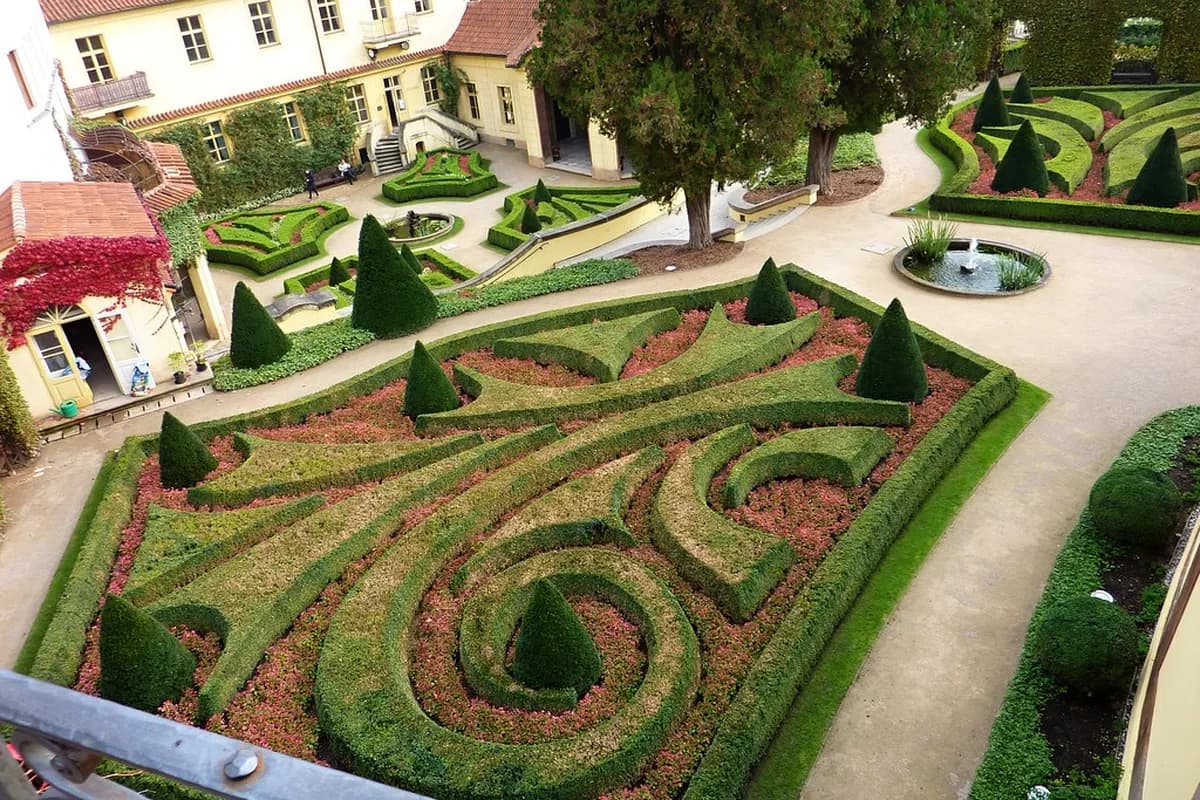
The loggia opens directly onto a formal flower parterre, creating a single axis from the palace façade to the ornamental pond at the far end of the garden. Walking this axis from the sala terrena toward the pond gives you the full effect of the design: controlled perspective, bilateral symmetry, and the pond's central fountain as the terminal focal point.
In summer the sala terrena becomes an open-air stage. The Prague Symphony Orchestra performs here as part of their seasonal programme, and the acoustics under the arches are genuinely impressive. For 2026, one confirmed date is 26 August at 17:00. Check Prague City Tourism for the full updated schedule, as additional dates are typically added in May.
Arrive at least 30 minutes early for a concert — seating is unassigned and fills quickly near the front. The light at that hour falls across the palace walls at a warm angle, and the combination of free Baroque music in an authentic 17th-century setting is one of the most distinctive evenings available in Prague without spending a single crown.
Statues of Adrian de Vries and the Hercules Fountain
The main path from the sala terrena to the pond is flanked by a series of bronze figures created between 1625 and 1626 by Dutch sculptor Adriaen de Vries. They depict figures from Greek mythology and were crafted in a style that bridges Mannerism and early Baroque — dynamic poses, taut musculature, and a theatricality designed to be read from a distance.
In 1648 Swedish troops took the originals to Sweden as war spoils. They still stand at Drottningholm Palace near Stockholm. The replicas currently in the garden were cast between 1914 and 1915 at the expense of Adolf Waldstein, a later descendant of the Wallenstein family. The pond island holds a copy of the Hercules and the Nayades marble fountain, also by de Vries.
A less-discussed element of the statuary programme is the Venus with Cupid and Dolphin fountain in front of the sala terrena. The original was a 1599 bronze by Nuremberg sculptor Benedikt Wurzelbauer — also seized by Swedish forces in 1648. Unlike the de Vries mythological figures, this one was returned to Bohemia in 1890. The original Wurzelbauer bronze is now held in the Prague Castle Picture Gallery, while the garden displays a replica. This makes it the only piece in the garden's entire sculptural programme where the authentic 17th-century work is both documented as having returned to Czech soil and is publicly viewable within Prague, if you know to look for it.
Walking among these bronzes in sequence — from the Venus fountain, along the de Vries figures, to the Hercules island — recreates the viewing experience Wallenstein intended: a procession of mythological power culminating in a commanding view of the palace loggia behind you.
Wildlife and Nature: Peacocks and Koi Ponds
Free-roaming peacocks are one of the garden's signature sights and a genuine surprise for first-time visitors. You are likely to encounter them near the ornamental pond and along the hedgerow paths toward the grotto wall. In early summer the males display their full plumage, and the contrast against the clipped green hedges and grey stone paths is striking. White peacocks appear occasionally and are a favourite subject for photographers.
The ornamental pond at the far end of the garden holds large koi carp that surface when visitors lean over the edge. The pond was historically used for boat rides and was the site of inventor Josef Božek's 1816 steamship experiment — the first steam-powered vessel tested in Bohemia ran on this modest pool. A small island in the centre carries the Hercules fountain. In early summer, yellow irises bloom along the pond margins.
The formal layout of clipped beech hedges and symmetrical paths gives the garden a different quality from Prague's more naturalistic parks. It is a designed landscape, not a wild one, and the wildlife sits unexpectedly within that geometry. Keep a respectful distance from the peacocks, particularly during mating season in spring — they are used to visitors but are not tame, and will defend their space if approached too closely.
Do not attempt to touch, feed, or corner peacocks, especially during spring breeding season. While accustomed to visitors, they will hiss, peck, and strike if they feel threatened.
Best Times to Visit and Seasonal Events
Weekday mornings — particularly between 07:30 and 09:30 — are the quietest period. Tour groups and school visits typically arrive after 10:00, and by midday in July and August the main path becomes crowded. The early morning slot is also when the grotto wall catches low, raking light that reveals its surface in the most detail. This is the best window for photography of both the sala terrena frescoes and the dripstone textures.
Late afternoon from around 16:00 onward brings a different quality: locals returning from work, softer light on the palace façade, and a noticeably calmer atmosphere. If a concert is scheduled, arriving at 16:30 for a 17:00 performance gives you time to find a good position and take in the setting before the music begins.
For visitors using the garden as a rest stop on a longer day, the ideal sequence is Malostranská metro → Wallenstein Garden (30–45 minutes) → Letenská street → Prague Castle. The garden sits directly on the natural pedestrian line between the metro and the castle hill. This route is less congested than the main tourist street and passes through one of Malá Strana's quietest residential pockets.
If you enjoy Baroque gardens, the Vrtba Garden is a short walk south and offers a contrasting style — terraced rather than flat, with city views across the rooftops. Together the two make a coherent half-day in the Lesser Town without significant backtracking. For wider context on the neighbourhood, the Speculum Alchemiae in the Old Town is another free or low-cost stop worth combining with a morning visit.
Frequently Asked Questions
Is Wallenstein Garden free to enter?
Yes, admission to the Wallenstein Garden is completely free for all visitors. It is one of the most popular free attractions in the Malá Strana district of Prague. The garden is managed by the Senate of the Czech Republic.
When are the concerts in Wallenstein Garden?
Free concerts usually take place in the Sala Terrena from May through September. These performances often feature the Prague Symphony Orchestra or local brass bands. You should check the official Senate cultural calendar for specific 2026 dates and times.
Are there real owls in the Wallenstein Garden grotto?
Yes, there is a large aviary located right next to the dripstone wall that houses several eagle owls. These birds are a permanent feature of the garden and are well-cared for by the staff. They add a unique atmosphere to the Grotto area.
How do you get to Wallenstein Garden from the Old Town?
The easiest way is to walk across the Charles Bridge and continue toward the Malostranská metro station. You can also take tram line 15 or 22 for a quicker journey. The main entrance is located just a few steps from the metro exit.
Is the Wallenstein Palace open to the public?
The palace itself serves as the seat of the Czech Senate and has limited public access. Guided tours are typically available only on weekends and public holidays. Entrance to the palace is also free, but security checks are required for all visitors.
Wallenstein Garden is one of those Prague sights that repays more attention than most visitors give it. Its blend of dramatic Baroque architecture, mysterious grotto art, free summer concerts, and roaming peacocks earns its place on any itinerary covering the Lesser Town.
The combination of free entry, a direct location on the route to Prague Castle, and a genuine density of historical and artistic detail makes it an easy choice. Plan for at least 45 minutes, arrive early for the light, and check the concert schedule before you go.
For official details, visit the Wallenstein Garden on Wikipedia.
Browse all Prague attractions in our Prague attractions hub.
Continue exploring
More guides you'll find useful