Botanical Gardens Rome Travel Guide
Plan botanical gardens rome with top picks, neighborhood context, timing tips, and practical booking advice for a smoother trip.
On this page
Botanical Gardens Rome
The Orto Botanico di Roma sits tucked between Via della Lungara and the Janiculum slopes, just minutes from the heart of Trastevere. Twelve hectares of cultivated wilderness hold over 3,500 plant species from every continent, yet the garden draws only a fraction of the crowds that queue at the Colosseum or Vatican. In 2026 it remains one of the most underused half-days in the city. This guide covers every section worth seeing, the practical details competitors skip, and how to time your visit to catch the garden at its best.
Must-See Botanical Gardens Rome Attractions
The Orto Botanico of Rome belongs to the Sapienza University of Rome and has occupied its current site at Villa Corsini alla Lungara since 1883. The villa's original fountains — the Fountain of the Eleven Spurts and the Fountain of the Tritons, both designed by Ferdinando Fuga — still stand near the entrance and give the lower garden an aristocratic character most visitors do not expect.

The Bamboo Collection is among the richest in Europe. The dense canopy of culms shuts out road noise almost completely, making it one of the few places in central Rome where you stop hearing traffic. Just beyond it, the Japanese Garden arranges cherry trees, camellias, and magnolias around two still ponds crossed by wooden bridges. The atmosphere is deliberately meditative and photographs well in almost any light.
The tropical greenhouse covers more than 2,000 square metres under climate-controlled glass and organises its contents by biome. Here you find roughly 400 orchid species, including the giant Vanda from South-East Asia, alongside the Serra Corsini glasshouse dating to the 1800s, which displays a large succulent collection. These indoor sections matter on rainy days when the rest of the garden becomes muddy.
Higher up the Janiculum slope, the Palm Collection includes specimens flagged on the IUCN red list of threatened species — a detail that lifts this beyond a pleasant stroll into something genuinely rare. Monumental plane trees, cork oaks, Himalayan cedars, and over 130 documented tree species shade the upper terraces. Allow time to climb; the paths are steep but the canopy up top is exceptional.
Parks, Gardens, and Outdoor Spots Worth Your Time
The Herb Garden runs along one of the lower terraces and traces the history of medicinal plant cultivation in Rome from Pope Leo X's first academic chair in 1514 right through to modern pharmacognosy. Every plant is labelled with its common name, Latin binomial, and historical use. It reads almost like a museum exhibit laid flat across the ground.
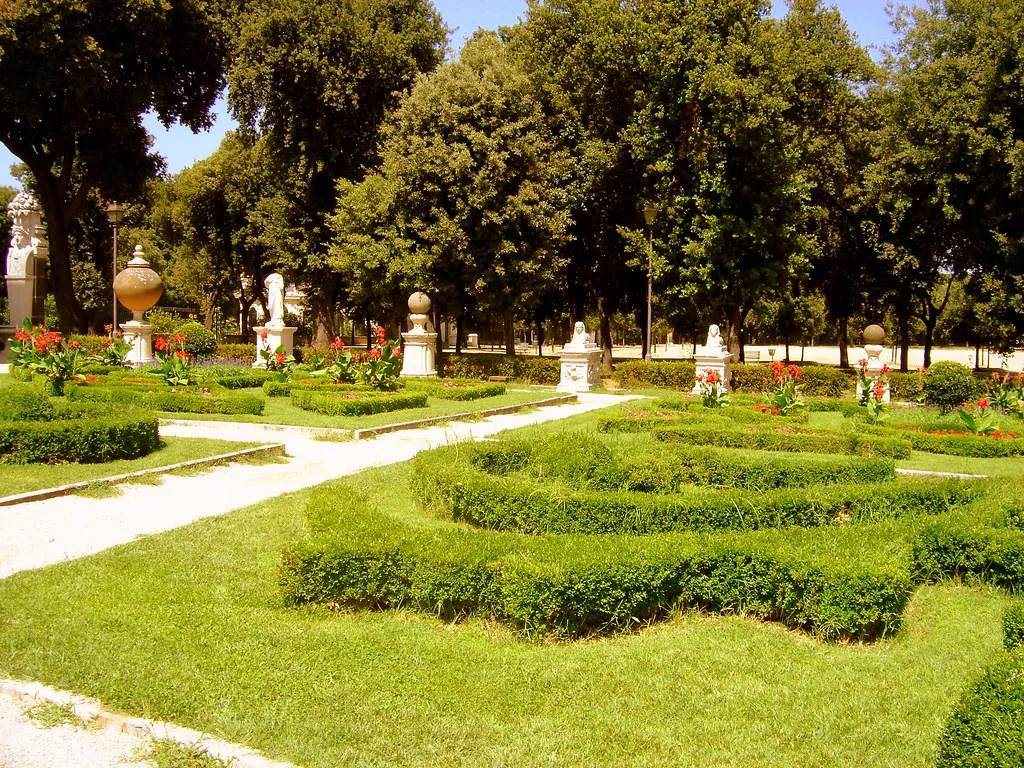
The Rose Garden is the sleeper hit of the site. It holds roughly 60 species chosen to illustrate 2,000 years of cultivated rose history, from ancient Roman varieties to modern hybrids. May is the peak flowering month and the best single reason to time your visit for late spring — the blooms are dense enough to be overwhelming in the best sense. While many tourists visit Villa Borghese Gardens for roses, the Orto Botanico collection is more historically curated and far less crowded.
The Valletta delle Felci is a shaded ravine planted with herbaceous ferns and flanked by a small stream, aquatic basins, and a lake. It occupies the lowest, coolest corner of the garden and provides real relief during July and August when the upper paths bake in direct sun. Autumn transforms this whole section when the maple species colour up from yellow through orange to deep red — the garden's own version of foliage season, usually peaking in late October.
The Mediterranean Garden reconstructs the maquis scrubland that historically covered the Gianicolo before the city expanded. Standing in it while hearing nothing but birds is an odd experience a short walk from the Tiber. The Gymnosperms section adds sequoias, larches, and multiple cedar species — plants that feel out of place in Rome until you realise the garden has been accumulating rare specimens for over 140 years.
Museums, Art, and Culture Near the Garden
The Villa Farnesina sits directly across Via della Lungara from the garden entrance. It holds Raphael's frescoes of the Galatea and the Loggia of Cupid and Psyche in rooms that are rarely mobbed. Tickets run around 6 EUR and the visit takes 45 minutes. Pairing it with the botanical garden makes a coherent morning: art indoors, nature outdoors, both covered before lunch.
A short walk up the Janiculum brings you to the Museum of the Roman Republic and Garibaldi Memorial, housed in the Villa Aurelia complex. The exhibits document the 1849 defence of the Roman Republic with maps, weapons, and personal effects of the volunteers who fought Napoleonic French forces on this exact hillside. It is a quiet institution that rewards history readers and receives almost no casual tourist traffic. The panoramic terrace above it has the best above-Trastevere views in Rome, particularly at dusk.
It is one of the more unusual things to do in Rome — combining a botanical garden, a Renaissance villa with Raphael frescoes, and a Risorgimento museum into a single afternoon that never touches the Forum or the Vatican circuit at all. The three sites are within 15 minutes on foot of each other and all sit in the same Trastevere-Gianicolo corridor.
Family-Friendly and Budget-Friendly Options
Adult admission to the Orto Botanico is 8 EUR as of 2026; reduced tickets for students and over-65s cost 4 EUR. Children under 6 enter free. No advance booking is required or available — you pay at the gate and walk in. This keeps it genuinely spontaneous in a city where most major sites now require timed-entry reservations booked days ahead.
| Visitor Type | Ticket Price | Opening Hours | Advance Booking |
|---|---|---|---|
| Adult | €8 | 09:00–19:00 (Apr–Sep) / 09:00–17:30 (Oct–Mar) | Not required |
| Student / Over-65 | €4 | 09:00–19:00 (Apr–Sep) / 09:00–17:30 (Oct–Mar) | Not required |
| Children under 6 | Free | 09:00–19:00 (Apr–Sep) / 09:00–17:30 (Oct–Mar) | Not required |
| Closed | — | Monday (all year) | — |
Families benefit from the wide, flat lower paths around the entrance fountain and aquatic garden. Educational labels throughout the site use clear Italian and English text, and many sections have tactile elements. The garden does not have a dedicated children's play area, but the open lawns around the Rose Garden and Japanese Garden give kids room to run. Bring snacks — there is no café inside the garden.
For budget travellers, the Orto Botanico is among the better value paid sites in Rome. It ranks alongside the places to visit in Rome for free in terms of value-to-crowd ratio: you pay less than a coffee and gelato combined for two hours of uncrowded parkland. The beautiful places in Rome list invariably includes Villa Borghese, but the Orto Botanico consistently outperforms it on tranquillity per euro spent.
How to Plan a Smooth Visit in 2026
The garden opens at 09:00 Tuesday through Sunday and is closed on Mondays — a detail both main competitor sites omit. Closing time is seasonal: 17:30 from October through March, and 19:00 from April through September. The last entry is 30 minutes before closing. Plan your departure time based on the season, not a single fixed hour.
Adult admission is 8 EUR; reduced tickets for students and over-65s are 4 EUR; children under 6 enter free. No advance booking is required — pay at the gate.
The best months to visit are April for cherry blossom in the Japanese Garden (the Hanami period, when the garden runs free guided tours and occasional Japanese cultural events), May for the Rose Garden in full bloom, and late October for autumn foliage on the maples and the aquatic garden. Mid-July and August are uncomfortable on the upper terraces but bearable in the fern ravine and the climate-controlled greenhouses.
To reach the garden, take bus 23 or 280 to the Lungotevere Farnesina stop — a five-minute walk to the Via della Lungara entrance. Tram 8 from Largo Argentina drops you in central Trastevere, from where it is a 10-minute walk uphill. The entrance is not signposted prominently from the street; look for a gate in the stone wall between the Corsini Palace and the Tiber embankment road.
- Address: Largo Cristina di Svezia 24, 00165 Rome
- Hours: 09:00–17:30 (Oct–Mar) / 09:00–19:00 (Apr–Sep), closed Monday
- Adult ticket: 8 EUR / reduced 4 EUR / under-6 free
- No advance booking needed — pay at the gate
- Bus: 23 or 280 to Lungotevere Farnesina (5-min walk)
- Allow 2–3 hours for a thorough visit
Wear shoes with grip. Many paths above the Rose Garden are loose gravel on a slope, and the upper terraces require a steady ascent. The descent back to the entrance is faster but can be slippery after rain. A light jacket is useful even in summer for the tropical greenhouse and the fern ravine, which are noticeably cooler than the open terraces.
Seasonal Highlights and Garden Events
The garden's seasonal rhythm is more varied than most visitor guides suggest. Spring is the headline season: Hanami in the Japanese Garden typically runs March through early April, with free guided tours offered on weekends during cherry blossom peak. The Rose Garden follows in May with 60-plus species in simultaneous bloom — this is the single strongest visual moment the garden offers across the whole year.
Summer shifts the best sections underground or into shade. The tropical greenhouse, the fern ravine, and the Garden of Aromas are the most rewarding in July and August. Late-summer rhododendron blooms along the upper paths extend interest into September. Autumn foliage on the multiple maple species and the plane tree avenue peaks in late October and can rival northern European parks for colour saturation, a fact almost no Rome travel guide mentions.
The garden also serves as a venue for occasional evening events tied to the Sapienza University programme — open lectures, guided night walks, and cultural partnerships. In recent years it hosted events connected to the gallery T293, including cross-disciplinary performances that blended music and botanical space. Beyond events, the botanical garden's history reveals active conservation projects spanning five continents — partnering with FAO and international gardens on endangered species preservation. Check the Sapienza Orto Botanico website for the current 2026 events calendar before your visit, as these are not reliably listed on general Rome tourism portals.
Paths above the Rose Garden are loose gravel on a slope and can be slippery after rain. Wear shoes with grip, and note that the upper terraces require a steady ascent with no shortcut back.
Accessibility at the Orto Botanico
The lower sections of the garden — the entrance fountain area, the aquatic garden, the Rose Garden, and the Garden of Aromas — are on relatively flat ground and navigable by wheelchair and pushchair. The Garden of Aromas (Giardino degli Aromi) is specifically designed as a multisensory experience: all plants are identified through touch and scent, and every bed has Braille labels. This is genuine inclusive design rather than a token gesture, and it predates most Italian museum accessibility retrofits by decades.
For visitors who cannot manage the steep Janiculum paths to the upper terraces and palm collection, the garden operates two battery-powered electric vehicles that carry mobility-impaired visitors to the hilltop sections on request. This is the detail neither competitor page mentions clearly: you do not have to skip the upper garden simply because you cannot walk the incline. Ask at the entrance gate when you arrive.
The accessible entrance is the main gate on Via della Lungara. There are toilet facilities near the entrance. Staff can provide route guidance in both Italian and English. The garden is one of the more thoroughly accessible green spaces in central Rome, and the electric vehicle service makes it meaningfully so rather than just technically compliant.
Frequently Asked Questions
Which botanical gardens rome options fit first-time visitors?
The Orto Botanico in Trastevere is the best choice for first-time visitors seeking a lush escape. It offers a diverse collection of plants and a central location near other major sites. You can easily combine it with a walk through the charming Trastevere neighborhood for a full day of exploration.
How much time should you plan for botanical gardens rome?
Plan to spend at least two to three hours exploring the various sections of the garden. This allows enough time to see the Bamboo Forest, the Japanese Garden, and the various greenhouses. If you enjoy photography or bird watching, you might want to stay even longer.
What should travelers avoid when planning botanical gardens rome?
Avoid visiting during the peak heat of the mid-afternoon, especially in the summer months of July and August. The greenhouses can become very humid and the uphill paths are tiring in the sun. It is better to arrive right when the gates open at 9:00 AM.
Is botanical gardens rome worth including on a short itinerary?
Yes, it is worth including if you need a break from the intense crowds at the Colosseum or Vatican. The garden provides a peaceful atmosphere that helps recharge your energy for more sightseeing. It is a refreshing change of pace from the city's stone monuments.
Which Must-See Botanical Attractions options fit first-time visitors?
The Japanese Garden and the Bamboo Forest are the top attractions for first-time visitors. These areas are visually stunning and provide the most unique photo opportunities in the park. They are also located on relatively flat ground near the main entrance for easy access.
Other Botanical Gardens Worth the Climb
The Orto Botanico climbs the Janiculum behind Trastevere and is run by the university, which is why it feels like a working collection. Ljubljana's Botanical Garden has the same academic origins and the same local-only feel. Bruges's Minnewater is the compact version. In Florence, the Bardini Garden pairs a wisteria tunnel with the best Duomo view in the city.
Rome offers much more than just ancient ruins and busy plazas for the modern traveler. The botanical gardens provide a necessary escape into the natural world and fresh air. Take time to breathe and enjoy the greenery during your next visit to Italy. Your trip will feel much more balanced with this peaceful and beautiful stop included.
For the broader picture, see our complete 18 Hidden Gems in Rome: The Ultimate Guide guide, or compare with the iconic Villa Borghese Gardens.
Continue exploring
More guides you'll find useful