10 Things to Know About a Venice Free Walking Tour
Plan venice free walking tour with top picks, neighborhood context, timing tips, and practical booking advice for a smoother trip.
On this page
10 Things to Know About a Venice Free Walking Tour
Exploring Venice on foot reveals a completely different city from the one most tourists see from a vaporetto window. The maze of narrow calli, hidden campielli, and centuries-old bridges only makes sense when a local guide is pointing out what to look for.
A Venice free walking tour runs on a simple model: you book a spot in advance, show up on time, and tip the guide at the end based on what you thought the experience was worth. No entry fees, no deposit, no commitment before you've experienced anything.
This guide covers how the model works, which neighborhoods the best tours cover in 2026, what the city's group regulations mean for your experience, and how to plan an entire free day around your walking tour.
How the Free Tour Model Works in Venice
Free walking tours in Venice operate on a pay-what-you-want basis. You reserve your spot online at no cost, attend the tour, and then decide how much to tip at the end. The guide's income depends entirely on how satisfied the group is, which creates a strong incentive for quality.
Most guides working under this model are independent local cooperatives or operate through vetted partner networks. SANDEMANs NEW Europe, for example, does not run its own Venice operation — it works through a trusted local partner that meets the same vetting standards. JM Walking Tour, another well-known option, is a registered non-profit whose volunteer guides raise funds for removing architectural barriers across the city.
The standard tip range in Venice is 10 to 20 EUR per person. Tipping at the lower end is fine for a standard experience. If the guide tailored the route, answered questions in depth, or adapted to your group's pace, the higher end is appropriate. Larger families on a tight budget can adjust accordingly — the model is designed to be accessible.
Booking in advance is not optional. Free tours in Venice have group caps (typically 15 to 20 people), and walk-up spots are rarely available at popular meeting times. Book at least 24 to 48 hours ahead, especially during spring and summer 2026 when demand is high.
The standard tip for a Venice free walking tour is 10 to 20 EUR per person. Guides depend entirely on tips for their income, so tipping at the higher end is appropriate when the guide tailored the route or answered questions in depth.
Which Neighborhoods Free Tours Actually Cover
Most free walking tours in Venice deliberately avoid St. Mark's Square. This is not an oversight — it is a sustainability decision. The area around Piazza San Marco handles roughly 30 million visitors per year, and responsible tour operators actively redirect foot traffic to neighborhoods that can absorb it. You will still learn the history of the square and the Basilica; you just won't be standing in the middle of the crowd while you do it.
Venice's historic center is divided into six sestieri, and most free tours focus on one or two of them rather than racing across the whole city. The two most common route types are northern Venice and Dorsoduro. The northern route moves through Cannaregio, Venice's most populous sestiere, where locals actually shop, eat, and live. Guides point out the former Jewish Ghetto — the world's first, established in 1516 — along with lesser-known churches and quiet canal-side streets that rarely appear in standard tourist itineraries. This route suits anyone who wants to understand how a functional city operates inside a UNESCO World Heritage Site.
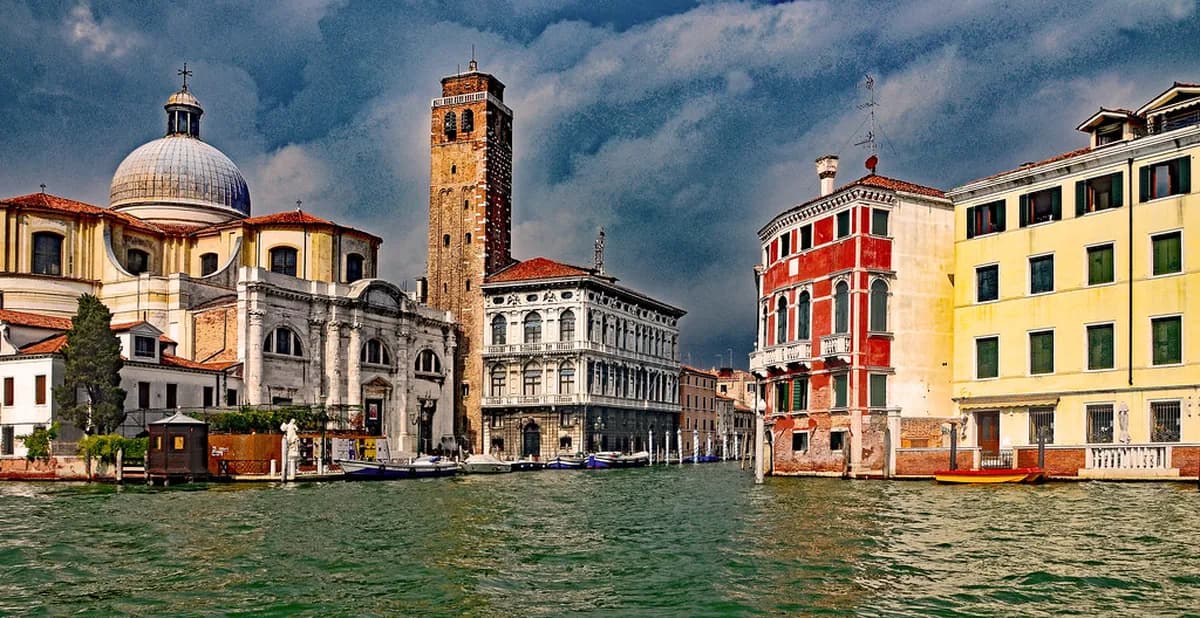
The Dorsoduro route covers the artistic southern district, including the Basilica della Salute and panoramic Grand Canal viewpoints. It is visually dramatic and historically rich, but it involves more bridges. Travelers with limited mobility should note that Dorsoduro's bridge density makes it the more physically demanding option — an accessible alternative route is available through some operators on request.
For a deeper dive into the neighborhoods themselves, the off-the-beaten-path Venice locals guide covers what to look for after the tour ends.
Venice Group Regulations and the Earphone Rule
Venice enforces strict noise regulations for guided groups in residential neighborhoods. Any group larger than six people must use earphone systems — the guide speaks into a transmitter and participants listen through small receivers. This rule exists to protect residents from the constant background noise of tour narration echoing through narrow alleys, and is part of the broader municipal regulation on guided groups that also caps tour parties at 25 people and bans portable loudspeakers.

For small groups of two to six people, no earphones are required. This changes the experience significantly. Smaller groups can hear the guide without amplification, ask questions more naturally, and move through tight spaces without the logistical delay of distributing equipment. Solo travelers and couples often find that smaller tour slots — sometimes listed as "intimate tours" — offer a more conversational experience than a full group booking.
If you are booking as a family of four or a couple, check whether the tour operator allows you to join a smaller-slot session. Some operators, including JM Walking Tour, cap their tours at 20 participants but group arrivals separately to manage the earphone threshold. Arriving early and flagging your group size helps the guide plan the equipment logistics.
Operators typically provide earphone sets at the start of the tour for a small deposit or include them in the recommended tip range. Confirm this when you book — it affects what to bring.
Venice requires earphone systems for any guided group larger than six people. Loudspeakers are banned and tour parties are capped at 25. Failing to comply can result in fines for the operator and disruption to your tour.
Choosing Between Tour Providers in 2026
Three types of operators run free walking tours in Venice: global partner networks, independent local cooperatives, and individual guide listings on platforms like GuruWalk. Each has trade-offs worth understanding before you book.
Global partner networks such as SANDEMANs select local operators through a vetting process. The advantage is consistency — guides meet a defined standard before they are listed. The disadvantage is that you are booking through an intermediary, and the local operator's style may vary. SANDEMANs currently offers two routes in Venice: a morning highlights tour focusing on Dorsoduro and an afternoon hidden Venice tour covering the northern neighborhoods.
Independent cooperatives like JM Walking Tour and Venice Free Walking Tour are run by guides who grew up in or have deep ties to Venice. These operators tend to offer more specific local knowledge — neighborhood gossip, current events, restaurant recommendations that are not on any list yet. Venice Free Walking Tour's daily "Venice Through the Centuries" route runs 2.5 hours and is widely cited as the best introductory option for first-timers. They also run Legends and Curiosities and Stunning Views tours on rotating days of the week.
GuruWalk-listed tours are individual guide offerings, often more niche. The "Venice Only the Locals Know" northern route listed there covers some of the same Cannaregio territory as the cooperative tours but with a single guide's personal narrative. Read recent reviews carefully — quality varies more on these listings than with established cooperatives.
When reading reviews, prioritize mentions of crowd management and guide personality over generic praise. A guide who adapts the route when a piazza is too crowded, or slows down for a participant who needs more time on the bridges, is worth tipping at the higher end.
| Provider Type | Example | Group Cap | Route Focus | Best For |
|---|---|---|---|---|
| Global partner network | SANDEMANs | ~20 | Dorsoduro + northern Venice | Consistency, vetted guides |
| Independent cooperative | JM Walking Tour | 20 | Cannaregio / custom | Local knowledge, charity mission |
| Independent cooperative | Venice Free Walking Tour | ~20 | Venice Through the Centuries (2.5 hrs) | Best intro for first-timers |
| GuruWalk individual | "Venice Only the Locals Know" | Varies | Northern Cannaregio | Niche narrative, smaller group |
Free Tours vs. Paid Tours: What You Actually Get
The core difference between a free walking tour and a paid tour in Venice is not quality — it is access. Free tours cover public outdoor spaces: streets, bridges, campi, and canal-side promenades. Paid tours can include skip-the-line entry to ticketed attractions like Doge's Palace or St. Mark's Basilica.

Doge's Palace entry costs around 30 EUR per person in 2026. The Alone in St. Mark's and Doge's Palace tour from Take Walks offers after-hours access at a significant premium — worth it if the palace is the centerpiece of your visit, but not necessary for a broader orientation. A free walking tour followed by a self-purchased entry to Doge's Palace the next morning is a practical and budget-conscious sequence.
Food-focused paid tours (from 89 EUR) run through the Rialto Market and neighborhood bacari. These are a different category entirely — they are eating experiences as much as history lessons. If your budget allows one paid upgrade in Venice, a food tour is where you will feel the value most clearly. The best cicchetti in Venice guide covers the self-guided version of this experience at a fraction of the cost.
For travelers focused on staying within a strict budget, the free walking tour is the correct orientation tool. It gives you enough context to navigate independently for the rest of your stay without paying for repeated guided visits.
How to Plan a Full Free Day Around Your Walking Tour
The smartest sequence in Venice is to take the free walking tour first — ideally on your first full day — and then use the orientation to plan the rest of your stay independently. JM Walking Tour specifically recommends attending at the start of your trip for exactly this reason. The guide's local tips about food spots, quieter hours, and transport shortcuts compound in value across the following days.
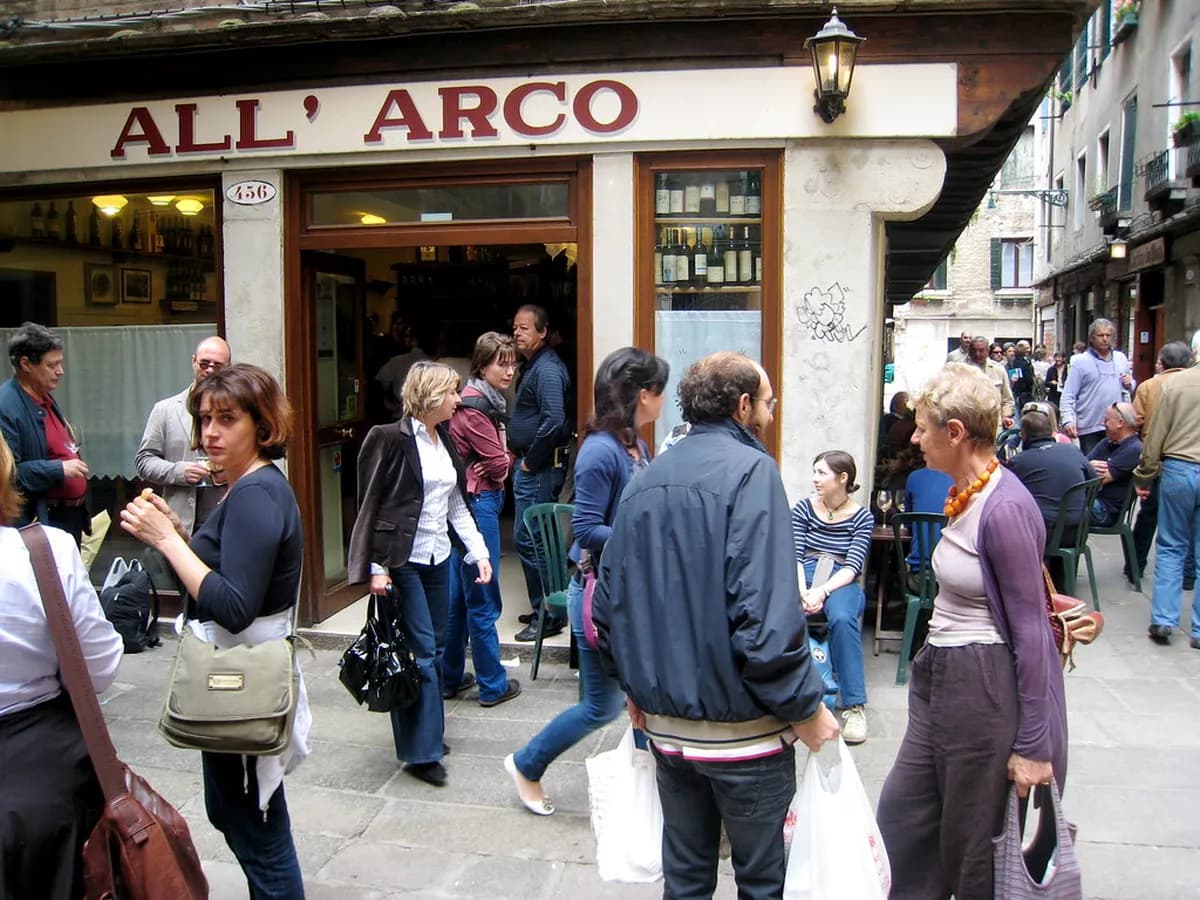
A morning free tour (typically starting around 10:00 or 11:00) ends by early afternoon, leaving you with enough energy to explore on your own. After the tour, the natural follow-on is a self-guided bacari crawl. Bacari are Venice's small wine bars, and cicchetti — the finger food served at the counter — costs 1 to 2 EUR per piece. Walking from bar to bar in Cannaregio or near the Rialto between 17:00 and 19:00 is entirely free until you order, and a round of cicchetti and a glass of house wine rarely exceeds 8 EUR per person. The bacari Venice guide maps the best bars by neighborhood for this exact purpose.
This combination — a 2.5-hour morning history tour followed by a self-guided evening food walk — is the most complete free-day itinerary available in Venice. No competitor tour operator mentions it because each is selling their own product. But it is what a local would actually recommend to a friend visiting on a budget.
For more ideas on structuring a day without spending heavily, the free things to do in Venice guide covers the full range of cost-free options across the city.
Logistics: What to Bring and Where to Meet
Venice's streets are not stroller- or wheelchair-friendly in most historic neighborhoods. The city has over 400 bridges, and the majority have steps on both sides. The JM Walking Tour explicitly flags its standard route as not suitable for people with reduced mobility, though it offers a separate accessible itinerary. If mobility is a concern for anyone in your group, contact the operator before booking to confirm which route applies.
Wear flat, non-slip shoes. Calli (the narrow Venetian streets) are made of smooth stone that becomes slick when wet. Venice's weather in spring and autumn shifts quickly — bring a light rain layer regardless of the forecast. A reusable water bottle is useful; public water fountains (nasoni) are scattered across the city and provide free drinking water.
Most operators send the meeting point by email after you complete your booking — it is typically a specific campo or bridge, not a vaporetto stop. Download an offline map of Venice before your tour. Mobile data is unreliable in the densest parts of the historic center, and getting lost on the way to the meeting point is a common first-timer problem. Arriving 15 minutes early is standard practice; guides will not hold the group for latecomers once the tour has started.
The tour typically lasts two to 2.5 hours and ends at a different location from the meeting point. Your guide will give you directions back, but knowing your vaporetto line in advance removes any stress from the end of the tour.
Must-See Venice Attractions Covered on Foot
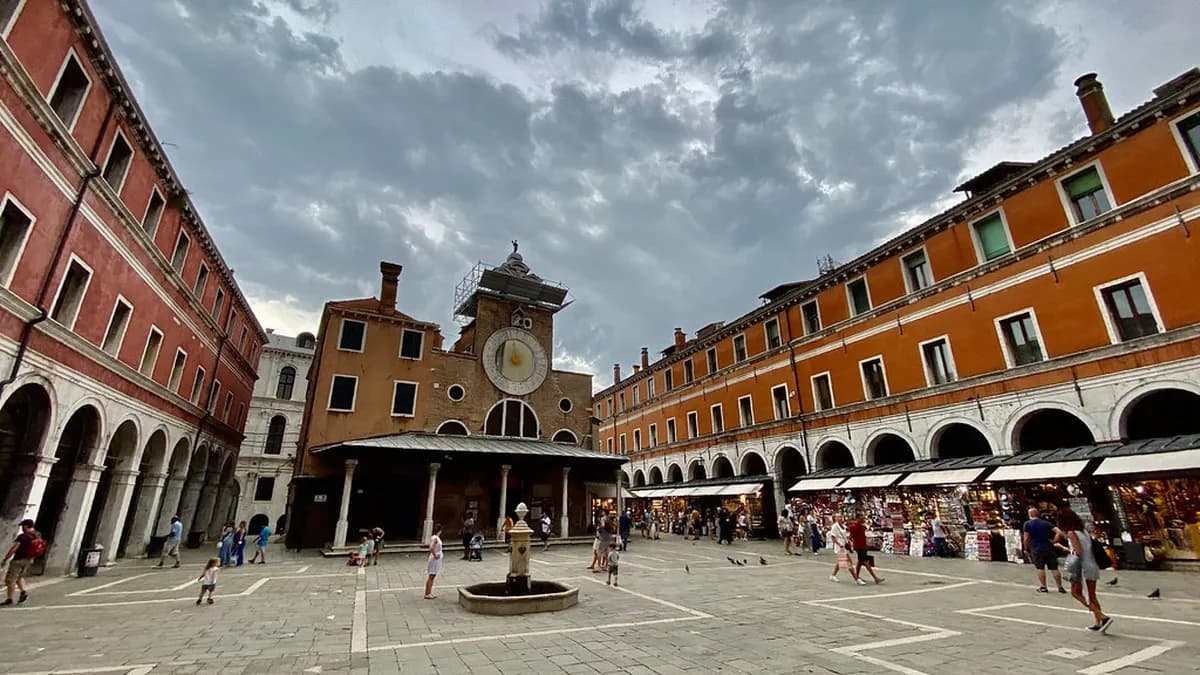
A free walking tour typically includes the Rialto Bridge and its market — one of the oldest and busiest commercial points in Venice, where the fish and produce market still opens at dawn. Guides use the bridge as a starting point to explain how Venice's trade networks shaped the entire Mediterranean economy for three centuries.
Depending on the route, you may pass Campo Santa Margherita in Dorsoduro, one of the few large open squares in Venice where locals actually gather for aperitivo. The Jewish Ghetto in Cannaregio is another common stop — five synagogues in a small area, each built in a different style because the community was not permitted to build upward and had to stack prayer halls above living spaces instead. These are the kinds of architectural details that are impossible to notice without a guide pointing them out.
Many tours include stops near hidden churches in Venice that contain Renaissance paintings visible for free, without the queues attached to the major museum entries. The guide usually flags two or three worth returning to independently after the tour.
For a broader map of what sits beyond the tour route, the hidden gems in Venice guide covers the city's less-visited landmarks in detail.
Frequently Asked Questions
How does a Venice free walking tour work?
These tours operate on a 'pay what you want' basis. You book a spot online for free and then tip the guide at the end based on your satisfaction. It is a great way to see the city without high upfront costs.
How much should I tip for a free tour in Venice?
A standard tip is usually between 10 and 20 EUR per person. This amount supports the guides who often work as independent contractors. Larger groups or families might adjust this based on their total budget.
Are earphones mandatory for Venice walking tours?
Yes, city regulations require groups of more than six people to use earphones. This rule reduces noise pollution in residential areas. Most guides will provide these at the start of the tour for a small fee or tip.
A free walking tour is the most efficient orientation tool available in Venice — two to three hours with a knowledgeable local guide yields more practical insight than a day of independent wandering. Book early, tip fairly, and use what you learn to spend the rest of your trip navigating like a local.
Wear comfortable shoes, arrive 15 minutes early, and download an offline map before you leave your accommodation. The city rewards preparation.
Continue exploring
More guides you'll find useful