8 Essential Insights for the Best Cicchetti in Venice
Master the art of the Venetian bacaro crawl with our guide to the 8 best cicchetti bars, ordering etiquette, and the historic Rialto market scene.
On this page
8 Essential Insights for the Best Cicchetti in Venice
Venetian food culture centers on social eating and drinking local wine in traditional bars called bacari. Finding the best cicchetti in Venice requires understanding not just where to go, but how and when to show up. These small bars offer an authentic glimpse into daily life across the historic floating city. Travelers who skip the tourist restaurants and head to a bacaro instead get the most honest version of Venice on a plate.
A bacaro crawl, known locally as a giro d'ombra, is the perfect way to explore different neighborhoods while tasting the city's freshest seafood and market produce. Locals gather before and after work to share stories and small plates, following rhythms that have barely changed in centuries. This guide covers the cicchetti varieties worth knowing, where to find them, when to arrive, and how to order like a regular. Read our Bacari Venice guide alongside this one — that article focuses on the bars themselves, while here the spotlight stays on the food.
What are Venetian Cicchetti?
Cicchetti (pronounced chi-KEH-tee) are small snacks served in traditional Venetian wine bars known as bacari throughout the city. These bites range from simple crostini with creamy salt cod to fried meatballs and marinated sardines. You will find them displayed in large glass cases at the front of the bar, made fresh each morning and replenished at the evening session. The emphasis is always on hyper-local ingredients sourced from the lagoon and nearby islands.
Most bacari price cicchetti per piece, typically between €1 and €3 depending on the topping. You can easily construct a full meal by picking four or five pieces across a couple of bars. This flexibility is part of why the format has remained popular for centuries — you control both your budget and your variety. Cicchetti are found nowhere else in Italy in quite this form, which makes them a uniquely Venetian experience.
Budget €15–25 per person for a full bacaro crawl of four to six stops — two ombre and two cicchetti per bar. This is significantly cheaper than a single sit-down dinner in the same neighbourhoods. Pay at the end of your visit unless the bar is very crowded, in which case pay as you go.
Types of Cicchetti You'll Actually Find
Knowing the main categories before you walk up to a counter makes ordering much faster. Crostini are the most common: thin slices of toasted bread or polenta topped with anything from baccalà mantecato (whipped salt cod) to anchovies, gorgonzola, or sun-dried tomatoes. Baccalà mantecato appears on almost every bar's counter and is the single item most closely associated with Venetian food identity.
Polpette are fried balls made from fish, meat, tuna, or potato — closer to a croquette than a Spanish meatball and noticeably lighter in texture. Tramezzini are crustless white-bread sandwiches folded around a filling, common at bars in Castello and Dorsoduro. Sarde in saor — marinated sardines with sweet onions and pine nuts — is a preparation unique to Venice and worth ordering even if you think you don't like sardines. At better bars the sardines are lagoon-fresh and nothing like the tinned variety.
Seasonal specials are what separate a good bacaro from a great one. The saor technique itself dates back to 1300 AD, born from Venetian sailors needing to preserve fish for long sea crossings. In spring (roughly March to May), look for moeche: soft-shell crabs from the lagoon that are battered and fried whole. In winter, schie (tiny grey lagoon shrimp) appear served cold on a mound of white polenta. These items do not appear on menus year-round, so ask at the counter what is fresh that day.
The One Timing Mistake Most Visitors Make
Bacari keep shorter hours than any other category of food venue in Venice. Most open around 10:00 and serve cicchetti through a morning session until roughly 13:30–14:00, then close entirely until the evening session begins around 17:30 or 18:00. The evening window closes early too — many bars are clearing their counters by 20:00 or 20:30, well before the dinner hour that visitors from outside Italy expect.
Showing up at 15:00 or 16:00 almost guarantees you will find shuttered doors and empty cases. This catches a surprising number of first-time visitors, who plan a "late afternoon snack" and find nothing open. The best strategy is to treat cicchetti as a late-morning or pre-dinner activity, not an afternoon option. Plan your sightseeing around the windows: markets and churches in the morning, then a cicchetti stop before 13:30; canal walks in the afternoon, then another round from 18:00 onward.
Most bacari close entirely from roughly 14:00–17:30 and again by 20:30. Arriving at 15:00 or 16:00 will almost always mean shuttered doors and empty cases. Plan cicchetti stops for late morning (before 13:30) or the early evening session (18:00–20:00).
Some bars in the Rialto area open as early as 09:30 to serve market workers and early shoppers. Al Mercà, on the square between the Rialto Bridge and the fish market, often has its counter running by 10:00. Arriving early means a less crowded counter and the widest selection before the most popular pieces sell out.
How to Order Cicchetti Like a Local
Ordering in a busy Venetian bar is simpler than it looks. Walk directly to the counter, scan the glass display case, and point at what you want while holding up fingers for the quantity. Pointing is not rude here — it is the expected method, even for Italians who do not speak Venetian dialect. The counter staff will place your pieces on a small plate or a square of paper.
Standing at the bar is the traditional and cheapest way to eat. Many bacari charge a coperto (table service fee) of €1–2 if you sit down, and a few outdoor tables carry a further premium. Locals almost universally stand, often stepping outside to the canalside or a nearby campo with their plates. Daryl and Mindi Hirsch, who have documented five bars across Venice in detail, specifically flag one useful rule: if a bar displays photos of food on a menu board rather than a glass case of real items, walk on.
Payment usually comes at the end of your visit unless the bar is very crowded, in which case you may be asked to pay as you go. Cash is still preferred at many traditional bacari — a €20 note covers a generous session at most spots. Tipping is optional and not expected, though leaving small change is appreciated.
Un Giro d'Ombra: The Wine Culture
The phrase un giro d'ombra means a round of shadows in Venetian dialect and refers to this traditional bacaro tour, moving from bar to bar for small glasses of wine. The name traces back to medieval wine merchants who followed the shadow of the Campanile di San Marco across the piazza to keep their barrels cool through the day. Today it describes the Venetian approach to social drinking: a few stops, a glass at each, never sitting still for too long.
An ombra is a small pour of house wine — typically 0.75–1 dl — that costs €1–2 at most bars. You specify rosso (red) or bianco (white); the bartender pours from whichever open bottle is doing duty that day. Prosecco is a popular alternative, especially with seafood crostini. Aperol Spritz or the more traditional Select Spritz (made with Select amaro rather than Aperol) are also acceptable at any hour — Venetians do not observe the same cocktail-hour restrictions as visitors expect.
The ritual is about pace and company more than the volume of wine consumed. You might drink two small glasses across three bars over 90 minutes, talking between bites, before heading home for dinner. That cadence is the point. It keeps the atmosphere welcoming at each bar without anyone getting in the way.
San Polo vs Cannaregio: Choosing Your Crawl Neighborhood
The two neighborhoods with the highest concentration of good bacari sit on opposite sides of the city and suit different types of visitor. San Polo — especially the tight alleys between the Rialto Bridge and Campo San Polo — is the historic epicenter of cicchetti culture. The bars here are older, denser, and operating in the same footprint they have occupied for generations. Trade-offs: it is busier, prices at a few spots near the bridge have crept upward, and you will share the narrow streets with other tourists during peak season.
Cannaregio, Venice's most residential sestiere, offers a quieter version of the same experience. Bars like Vino Vero on Fondamenta della Misericordia draw a mostly local crowd and specialize in natural wines with rotating seasonal crostini. The canal-side setting here is less postcard-perfect than the Rialto but genuinely calmer. Prices are often 20–30 cents lower per piece. Cannaregio works best if you are staying in the neighborhood — it is covered in detail in our Cannaregio Venice neighborhood guide. If you have only one session, San Polo delivers more bars per block; if you have two nights, split them.
Dorsoduro is worth a mention for those staying near the Accademia. Cantina del Vino già Schiavi (known locally as Schiavi) on Fondamenta Nani has one of the best selections of house-made crostini in the city and a loyal local following. It is slightly off the main tourist circuit, which keeps the quality high and the counter from feeling overwhelming. Our Dorsoduro hotels guide covers the area if you want to base yourself close by.
Top Recommended Bacari in Venice
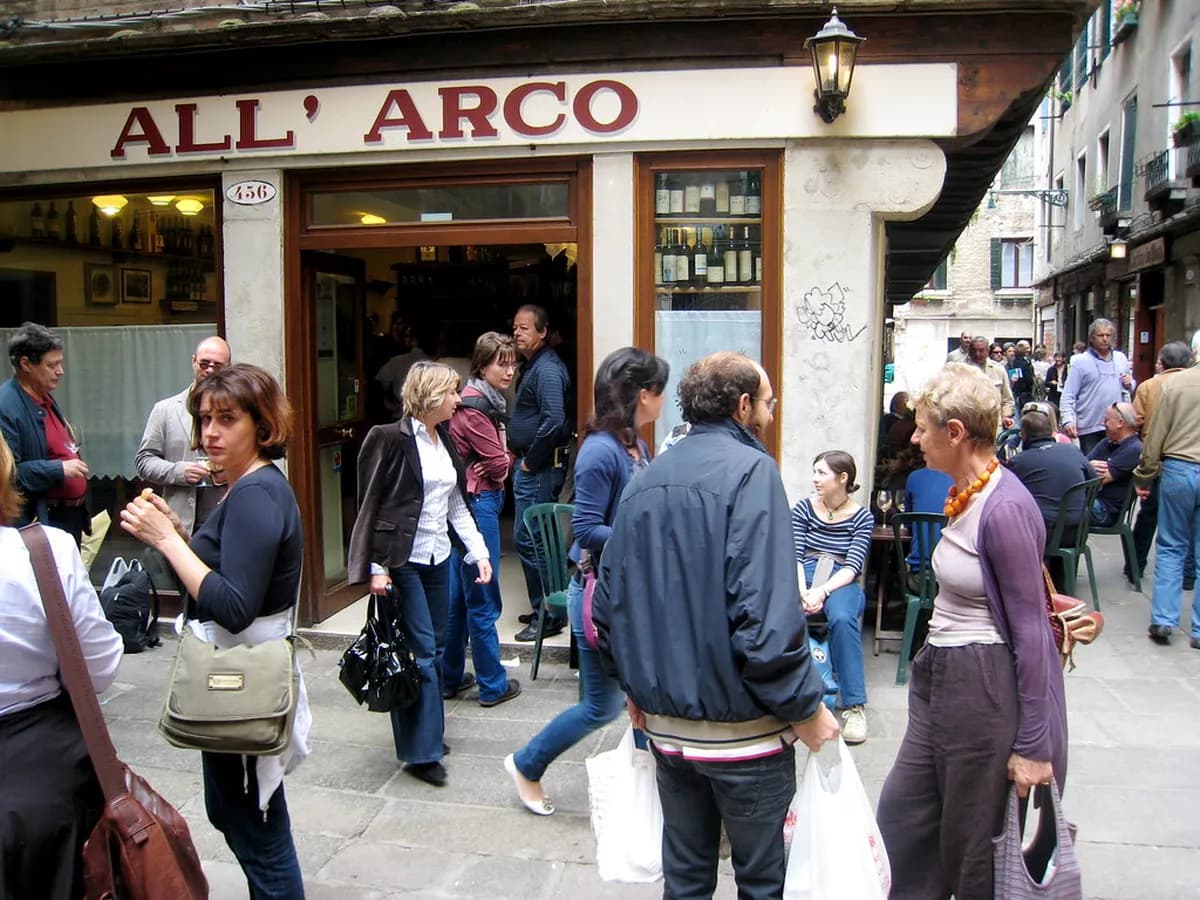
Osteria all'Arco at Calle Arco 436, San Polo is the most referenced cicchetti bar in serious food writing on Venice. It is family-run, tiny, and specialises in crostini with baccalà mantecato, anchovies, and porchetta sourced from the Rialto Market. Arrive before 12:00 for the widest selection. Note that the Google Maps address (Campo San Polo 436) is often wrong — search for Calle Arco 436 instead.

Cantina do Spade at Calle do Spade 859, San Polo is said to be the second-oldest bar in Venice and reportedly a favorite of Casanova. The signature item is polpette on a stick — spicy sausage and smoky scamorza cheese fried until crisp. They also do strong fried calamari and stuffed squid. The bar fills quickly after the Rialto market closes, so 11:00–12:30 is the best window.
Al Mercà at Campo Bella Vienna 213, San Polo is the smallest of the main spots: a counter no bigger than a wardrobe opening onto a small square. Their panini filled with truffle paste, Italian cured meats, and local cheese are the draw. It opens around 10:00 and the square outside gives you room to stand and people-watch while you eat.
Vino Vero at Fondamenta della Misericordia 2497, Cannaregio is the go-to for natural wine. The blackboard lists reds, whites, rosés, and sparkling by the glass. Cicchetti here lean toward burrata and baccalà crostini. It sits on one of Venice's most scenic residential canals and is best visited at the 18:00–20:00 evening window. For a broader look at what is worth seeing while you are in the area, our hidden gems in Venice guide covers several spots nearby.
The Rialto Market and Its Role in the Cicchetti Scene
The Rialto Fish Market (Pescheria) and the adjacent Erberia vegetable market sit a two-minute walk from the Rialto Bridge and open from around 07:30 Tuesday to Saturday, closing by 13:00. The market area has served as Venice's commercial heart since 1097, with the current neogothic loggia built in 1907. Every serious bacaro owner shops here in the morning. The daily catch determines which seafood items appear in the glass cases that afternoon — if the fishermen had a good haul of spider crabs, you will see granseola crostini at lunchtime; if the lagoon shrimp were plentiful, schie on polenta will be on offer.
| Cicchetti Type | Main Ingredients | Price Range | Best Season |
|---|---|---|---|
| Baccalà mantecato | Whipped salt cod on toast | €1.50–3 | Year-round |
| Sarde in saor | Sardines, onion, vinegar, pine nuts | €2–3 | Year-round |
| Polpette | Fried fish, meat, tuna, or potato balls | €1.50–3 | Year-round |
| Tramezzini | Crustless sandwiches: ham, artichoke, shrimp | €2–4 | Year-round |
| Moeche (soft-shell crab) | Lagoon crab, battered and fried | €4–6 | Spring (Apr–May) |
| Schie on polenta | Tiny grey lagoon shrimp, white polenta | €3–5 | Winter |
| Carciofi fritti | Fried violet artichokes from Sant'Erasmo | €2–4 | Spring (Mar–May) |
Walking through the market before your cicchetti session gives you a genuine read on what is fresh that day. This is one of the most rewarding non-touristy things to do in Venice because locals are there for actual shopping, not spectacle. The vegetable section carries produce from the island of Sant'Erasmo, Venice's market garden in the lagoon — varieties of artichoke and radicchio that do not appear on mainland Italian menus. When you see a bacaro serving carciofi fritti (fried artichokes), the artichokes almost certainly came from Sant'Erasmo that same morning.
Seasonality at the market directly shapes what you should order. Spring brings moeche (soft-shell crab, April–May) and violet artichokes. Autumn sees the return of lagoon fish like branzino and rombo. Winter is for schie and baccalà. Summer is the leanest season for hyper-local produce, though the fish market remains active year-round.
Why Cicchetti Are Not Tapas
The comparison to Spanish tapas is understandable — both are small plates eaten socially at a bar — but Venetians bristle at the label. Cicchetti as a tradition predate the modern tapas culture by centuries and evolved from the maritime trade economy of the Republic of Venice, not from Iberian hospitality customs. The ingredients are strictly northern Adriatic: lagoon seafood, Po Valley meats, and mountain dairy from the Veneto hinterland. None of these appear in a Madrid tapas bar.
The eating mechanics differ too. Tapas in many Spanish regions arrive free with a drink, or come as shared plates at a table. Venetian cicchetti are priced individually, eaten standing, and consumed in a few bites — you are not sharing a bowl across a group. The social element is about the movement between bars, not the time spent at one table. Prices here also do not disappear into a drinks bill: every piece has a transparent cost, which is part of why the format works as a budget strategy. For more context on doing Venice affordably, see our free things to do in Venice guide.
Finishing the Meal: Espresso and Grappa
A traditional cicchetti session often closes with a short espresso at the bar. Coffee in Venice is taken standing at the counter, same as the wine, and Venetians are particular about their roast — the city has its own tradition of slightly darker blends compared to northern Italy. Del Doge Café on Calle dei Cinque is one of the most respected roasters in the centro storico and worth the short walk from the Rialto area.
Grappa is the digestive of choice for those who want a stronger close. It is distilled from the pressed grape skins and seeds left after winemaking — a high-proof spirit (40–50% ABV, sometimes higher) with an intensely grape-forward character. Nardini grappa, produced in Bassano del Grappa about 70 km northwest of Venice, is widely considered the regional benchmark and appears behind many bacaro counters. A caffe corretto — espresso with a small measure of grappa poured in — is the working-class Venetian version, ordered briskly and consumed in one stand.
Grappa di Prosecco, made from the lees of Glera grape production, is the most aromatic local variety and a logical choice after a session that included Prosecco wine. Expect to pay €2–4 per measure at a traditional bacaro; café settings charge more. The warmth of the spirit is especially welcome during Venice's cold, damp winters, when the city is at its quietest and the cicchetti bars feel most genuinely local.
Frequently Asked Questions
What are Venetian cicchetti?
Cicchetti are traditional small snacks served in Venetian bars called bacari. They include items like crostini with salt cod, fried meatballs, and marinated seafood. These bites are meant to be enjoyed socially with a small glass of wine. You can find many affordable options in this free things to do in Venice guide.
How do you order cicchetti in Venice?
To order, walk to the bar counter and point at the items in the glass display case. Tell the server how many of each you would like to eat. It is best to stand at the counter to avoid extra service charges for seating. Most people pay for their food and drinks at the end of their visit.
What is an 'ombra' in Venice?
An ombra is a small glass of local house wine typically served in a simple glass. The name comes from the Italian word for shadow because ancient wine merchants followed the shade of the bell tower. It is a central part of the social drinking culture in the city. You can choose between red or white varieties.
Where are the best cicchetti bars near Rialto?
Some of the best bars near Rialto include Osteria all'Arco and Cantina do Spade. These spots are famous for using fresh ingredients from the nearby fish market. They can get very crowded during the lunch hour so try to arrive early. Many locals visit these bars for a quick snack before heading home.
Is cicchetti cheaper than a regular meal in Venice?
Yes, eating cicchetti is generally much cheaper than a full sit-down meal in a restaurant. Each snack usually costs between one and three euros depending on the ingredients used. You can control your budget by choosing a few items at different bars across the city. This allows for a diverse and affordable dining experience.
Exploring the best cicchetti in Venice is one of the most rewarding food experiences in Italy in 2026 — affordable, social, and deeply tied to the city's daily rhythms. By learning the types, respecting the timing windows, and choosing your neighborhood deliberately, you can eat better than most visitors who spend three times as much at tourist restaurants. The combination of fresh lagoon seafood and local wine creates a meal that no other city in Italy replicates.
Start at the Rialto Market before 10:00, work through the San Polo bars at their busiest mid-morning window, and return to Cannaregio or Dorsoduro for the evening session. Use our off the beaten path Venice locals guide to find the calmer alleys where the best bacari hide from the main tourist flow. Every piece you eat will have come from a market stall or a lagoon boat that same day.
Continue exploring
More guides you'll find useful