Musée Gustave Moreau, Paris: Spiral Staircase, Essential Tips
Step inside Gustave Moreau's own townhouse in the 9th Arrondissement, famous for its double spiral staircase and the artist's preserved apartment upstairs.
On this page
8 Essential Tips for Visiting the Musée Gustave Moreau: A Paris Visitor Guide
The Musée Gustave Moreau is a hidden treasure located in the heart of the 9th Arrondissement. This former family home offers a rare glimpse into the private world of a master Symbolist painter. Our musee gustave moreau visitor guide helps you navigate this unique townhouse museum with ease. You will find thousands of sketches and massive oil paintings within these historic walls.
Stepping inside feels like entering a time capsule from the late 19th century. The building combines intimate living quarters with grand, light-filled studios designed for artistic creation. Many travelers miss this site in favor of larger galleries, but its charm is unmatched. This guide covers everything from the iconic spiral staircase to essential ticket tips for your Paris adventure.
Essential Visitor Information: Hours, Tickets, and Location
The museum sits at 14 Rue de la Rochefoucauld in the quiet Saint-Georges area of the 9th Arrondissement. The nearest Métro station is Saint-Georges on Line 12, a five-minute walk away. The Trinité – d'Estienne d'Orves stop (also Line 12) is equally convenient. Several bus routes serve the area, making the museum easy to reach from anywhere in the city.
Opening hours are 10:00 to 18:00 every day except Tuesday, with last admission at 17:30. The museum is closed on 1 January, 1 May, and 25 December. In 2026, check the Musée Gustave Moreau official website before visiting for any seasonal closures or special exhibition updates. Arriving right at opening on a weekday gives you the quietest galleries and the spiral staircase largely to yourself.
Adult admission is €8; the reduced rate is €6 for eligible visitors including EU/EEA residents under 26, who enter free. Entry to the permanent collection is also free on the first Sunday of every month. Note that free-Sunday visits are busy — book a timed slot online even when the ticket is free. Your Musée Gustave Moreau ticket grants free entry to the Musée Jean-Jacques Henner within seven days of your visit, and the same applies in reverse: it is the only two-museum combo deal of its kind in Paris.
Entry to the permanent collection is free on the first Sunday of every month. Book a timed slot online in advance, as the museum reaches capacity quickly on free-entry days.
| Visitor Type | Price | Notes |
|---|---|---|
| Adult | €8 | Full-price admission |
| Reduced | €6 | EU/EEA residents under 26 |
| Free | €0 | 1st Sunday of each month (book timed slot) or EU/EEA under 26 |
| Combo ticket | Included | Free entry to Musée Jean-Jacques Henner within 7 days |
Your ticket grants free entry to the nearby Musée Jean-Jacques Henner within seven days of your visit, and vice versa — the only two-museum combo deal of its kind in Paris.
The Paris Museum Pass covers this museum as part of the national museums network. At €8 for a stand-alone visit, the museum is modest in cost on its own — but if you plan three or more national museum visits in two days, the pass pays for itself quickly. Unlike the Louvre or Musée d'Orsay, there are no queues here even on weekends, so the pass's skip-the-line benefit matters less; its real value at this address is the cost saving on a multi-site day.
- Address: 14 Rue de La Rochefoucauld, 75009 Paris
- Métro: Saint-Georges (Line 12) or Trinité – d'Estienne d'Orves (Line 12)
- Hours: 10:00–18:00, closed Tuesday; last admission 17:30
- Adult ticket: €8 full / €6 reduced; free for EU/EEA under-26 and on the 1st Sunday of each month
- Combo deal: ticket valid for free entry to Musée Jean-Jacques Henner within 7 days
Who Was Gustave Moreau? The Man Behind the Symbolism
Gustave Moreau was born in Paris in 1826 into a cultivated upper-middle-class family. His father was an architect for the City of Paris and his mother an accomplished musician, so art, classical literature, and architecture were woven into his childhood. He entered the École des Beaux-Arts at 18 and rose to fame at the 1864 Salon with his painting Oedipus and the Sphinx. By the time he died in 1898, he had produced over 8,000 paintings, watercolors, and drawings.
His work sits at the heart of the French Symbolist movement. Unlike the Impressionists, who chased light and surface, Moreau chased internal emotion, spiritual ideas, and the mythology of ancient civilizations. His canvases are dense with biblical heroes, Greek gods, chimeras, and jewel-toned palettes that give them an almost hallucinatory quality. He saw painting not as description but as a language of the soul.
Beyond his own canvases, Moreau was a formative teacher at the École des Beaux-Arts. He mentored Henri Matisse and Georges Rouault, encouraging students to develop their own voice rather than replicate his style. This philosophy of artistic freedom was radical for the period. Visitors who explore his apartment often note how his personal book collection, ranging from Vitruvius to Flaxman's illustrated works, shaped the eclectic visual language of his paintings.
Moreau's recurring symbols — chimeras, sphinxes, Salome, Orpheus, Hercules — carry consistent psychological weight across his career. Understanding this shorthand transforms a visit from a passive viewing experience into something closer to reading a long, layered novel. Pick any two paintings in the studio and you will find the same mythological vocabulary connecting them.
A Museum Born from a Vision: The History of the Townhouse
Moreau's parents bought the townhouse at 14 Rue de La Rochefoucauld in 1852. He lived and worked here for the rest of his life, eventually transforming the modest family residence into one of the most unusual museums in Europe. In 1895, he commissioned Belle Époque architect Albert Lafon to carry out the conversion, adding two massive studio floors above the original living quarters to house his largest canvases.
The new upper floors were built with high ceilings, large north-facing windows, and custom display systems: pivoting panels, pull-out wooden drawers, and cupboards that open to reveal more art behind. Moreau designed these himself, determined that future visitors would be able to study not just his finished masterpieces but thousands of preparatory drawings and watercolors. The result was a hybrid space — part private home, part carefully engineered archive.
Moreau bequeathed the house and its entire contents to the French state on his death in 1898. The Musée national Gustave Moreau opened to the public in 1903. It remains one of the oldest house-museums in Paris and one of the few where the artist's own organizational logic — the order he arranged the paintings in — has been preserved almost entirely intact, restored in 2003 on the museum's centenary.
Walking through the rooms today, you are following the exact sequence Moreau intended. He wanted the ground floor Cabinet de Réception to introduce his breadth, the first-floor apartment to reveal his personal life, and the upper studios to overwhelm with scale. The building itself is an argument about how art should be experienced.
Ground Floor: The Cabinet de Réception
Most visitors head straight upstairs, but the ground floor rewards a careful look first. The six rooms that make up the Cabinet de Réception function as a cabinet of curiosities on a grand scale. Rather than shelves of rare objects, the walls are stacked with over 400 paintings spanning Moreau's entire career — from early academic pieces like Lady Macbeth, inspired by Shakespeare, to late experimental works in watercolor.
The display system is extraordinary. Hidden cupboards open to reveal additional canvases. Doorways swing aside to expose more paintings inside. Pivoting display panels fold out from the walls like pages in a giant illustrated book. Moreau designed all of this himself, and it means the ground floor holds far more art than its footprint suggests. Visitors who spend ten minutes here often end up staying forty.
One room functions as the study and reception space, housing a glass case with brass doors that contains ancient ceramics and two kraters from an Apulian princess's tomb — part of a collection originally assembled by Moreau's architect father. Nearby bookshelves hold 16th- and 17th-century architectural treatises from the father's library, including a beautifully illustrated 1836 edition of John Flaxman's work that directly influenced Moreau's style. This room is where the man's intellectual formation becomes visible in three dimensions.
Exploring the First Floor: The Sentimental Museum Apartment
The first floor is known as the Sentimental Museum — Moreau's own term for the private living quarters he shared with his parents. The contrast with the studios above is stark. These rooms are small, densely decorated, and charged with personal memory rather than professional ambition. The intimate scale forces you to slow down.
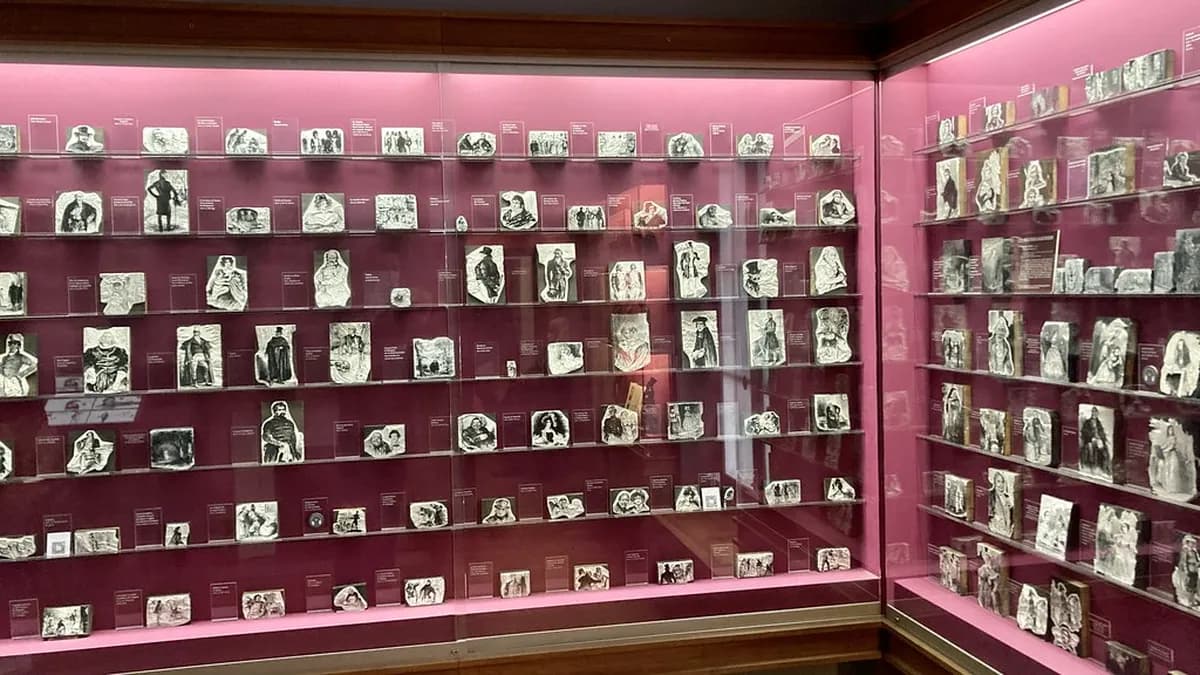
The sea-green dining room is immediately distinctive, its walls hung with photographs of paintings Moreau sold and engravings by other artists. The Louis XVI chairs match the green paneling purchased in 1852. On the credenza you can find rare ceramics: a Moustier water fountain, a 16th-century Faenza plate, and decorative pieces by Bernard Palissy — a collection the father built during the Restoration and Second Empire period.
The bedroom holds the most personal items. Family portraits, drawings, and photographs cover the walls. There is a famous portrait of Gustave Moreau painted by Edgar Degas in 1860, made after the two artists returned together from a trip to Italy. Moreau placed his mother's writing desk alongside his own in this room, a deliberate blending of generations. The boudoir next door, small and furnished with an armchair and delicate writing table, was once his mother Adèle's sitting room.
Comparing this floor to the grand studios above captures the two sides of Moreau's life. The apartment is about roots and continuity; the studios are about legacy and scale. If you rush through the apartment to reach the famous paintings, you lose the emotional logic of the building. Budget at least fifteen minutes here before climbing.
The Second and Third Floor Studios: Masterpieces and the Spiral Staircase
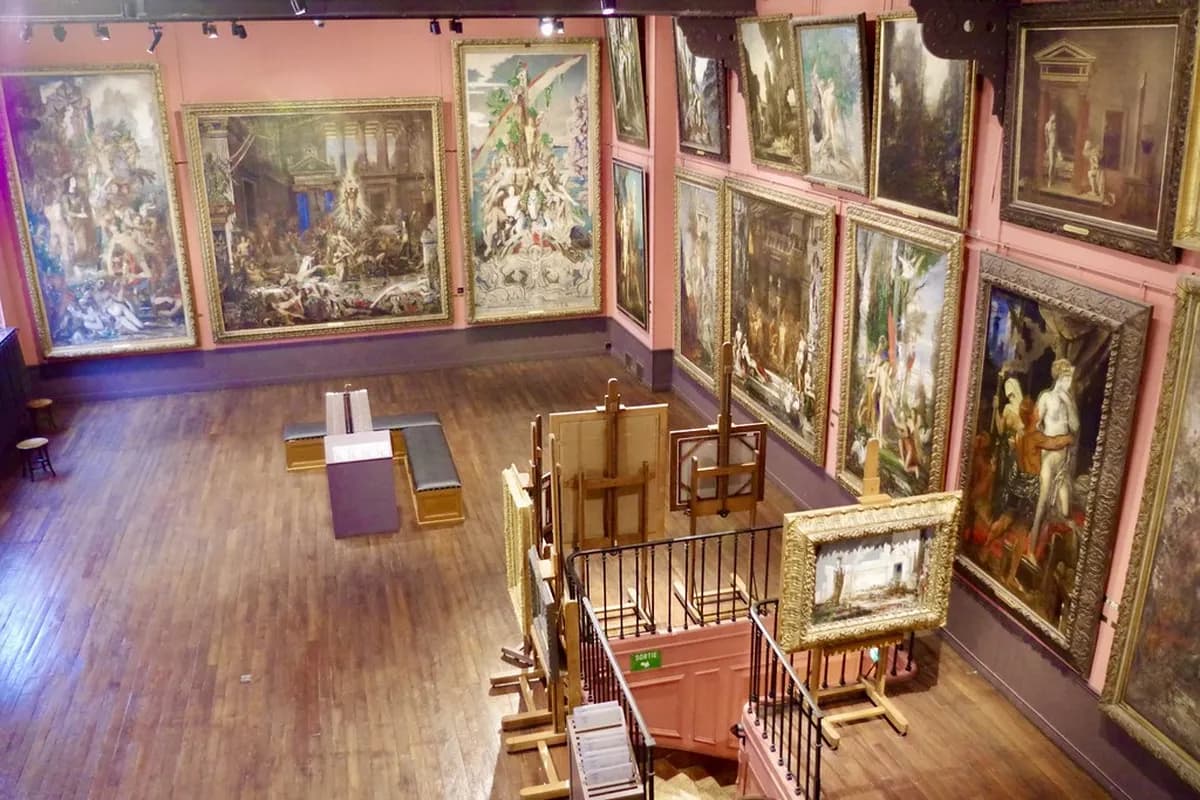
The upper floors are where the scale of Moreau's ambition hits you. Architect Albert Lafon built these two purpose-designed studios in 1895 specifically to display canvases that could not fit in any domestic room. The walls run from floor to ceiling with paintings: Jupiter and Semele, The Apparition, The Unicorns, The Chimeras, Hercules Among the Daughters of Thespius, and dozens more. The density is intentional — Moreau wanted the collection to be experienced as a total environment, not a curated selection.
The spiral staircase connecting the two studio floors was designed by Moreau and executed by Lafon. It is a wrought-iron structure that sweeps upward in a single graceful curve. To photograph it well, stand at its base and angle upward to capture the symmetry of the handrail against the curved ceiling. Late morning light from the studio windows catches the ironwork at its best. The staircase is the most photographed feature in the museum and worth the extra minute to compose the shot properly.
Each studio also contains a system of wooden pull-out drawers and swinging frames that house thousands of watercolors and drawings. You can open these yourself and flip through them like pages in a giant sketchbook. This is Moreau's working process made tactile: you see the same mythological figure rendered ten or twenty times as he worked through a composition. No other museum in Paris offers this kind of direct access to an artist's preparatory archive.
Key works to find: Jupiter and Semele (third floor, painted 1895) for its vertical composition and symbolic density; The Life of Humanity, a nine-panel polyptych tracking the arc from Adam through Orpheus to Cain; and The Unicorns (second floor), which collector Émile Straus called "one of the most beautiful things I've ever seen" when he first viewed it in 1887.
The Ultimate Self-Guided Tour of the Musée Gustave Moreau
A well-planned route ensures you see every floor without backtracking. Start on the ground floor and spend time in the Cabinet de Réception. The pivoting panels and hidden cupboards reward slow exploration. This floor also sets the thematic vocabulary — Moreau's chimeras, sphinxes, and mythological heroes — that you will encounter on every level above.
From the ground floor, climb to the first-floor apartment. Move through the study, the sea-green dining room, the bedroom, and the boudoir in sequence. Read the labels on the Degas portrait and the father's ceramics. This floor takes roughly fifteen minutes at a steady pace but deserves longer. The contrast between the intimate furnishings here and the studio scale above is the emotional heart of the visit.
Head next to the second-floor studio and immediately open several of the pull-out drawers. Moreau's preparatory sketches are raw and fast in a way his finished canvases are not. Then step back and spend time with the large mythological canvases. Use the spiral staircase to reach the third floor, pausing at mid-height for the best architectural photograph. The third-floor studio holds Jupiter and Semele as its centerpiece.
Finish your visit by stopping at the small gift shop near the entrance. It stocks quality prints and books on Symbolism that are hard to find elsewhere. If you have more time, the nearby Musée de la Vie Romantique offers a similar house-museum atmosphere just a short walk away in the same quarter.
Best Time to Visit and Accessibility Notes
Weekday mornings between Tuesday-exclusion opening and 12:00 are the quietest slots. The museum is small enough that even a moderate mid-afternoon crowd makes the narrow hallways feel congested. Spring (April–June) and autumn (September–October) offer mild walking weather for the neighborhood and lighter tourist pressure than the summer peak. Avoid free-entry Sundays unless you book a timed slot online in advance — the museum reaches capacity quickly and the staircase becomes difficult to photograph.
A practical point that most guides skip: the Musée Gustave Moreau is a historic townhouse with original staircases throughout. Step-free access is very limited. If you or a companion require level access, check the museum's official accessibility page on musee-moreau.fr before your visit — the ground-floor Cabinet de Réception is partially accessible, but the apartment and studios above involve staircases with no lift alternative. This is not a limitation of the museum's welcome; it is a constraint of a 19th-century residential building that was never designed as a public institution.
The 9th Arrondissement extends naturally toward Montmartre to the northwest and the Opéra Garnier district to the southeast. After the museum, the local cafes on Rue Notre-Dame-de-Lorette or around Place Saint-Georges are good for a coffee break without tourist pricing. For more art history, a short walk south reaches the grands boulevards, while a longer walk north brings you to Musée de Montmartre. Check the Paris Convention and Visitors Bureau listing for seasonal evening openings and special lectures, which are held a few times per year and draw smaller crowds than standard daytime hours.
Frequently Asked Questions
Is the Musée Gustave Moreau included in the Paris Museum Pass?
Yes, the museum is fully included in the Paris Museum Pass. Using the pass is a great way to save money if you plan to visit multiple sites. It also allows you to bypass the main ticket queue for faster entry. Check the pass website for the latest participating locations in Paris.
Can you take photos inside the Gustave Moreau Museum?
Photography is generally permitted for personal use without a flash. The spiral staircase is a popular subject for visitors looking for unique architectural shots. Be respectful of other guests and avoid using large tripods in the narrow hallways. Always check for updated signage regarding specific temporary exhibitions.
How much time should I spend at the museum?
Most visitors find that 90 minutes to two hours is sufficient for a thorough visit. This allows enough time to see the private apartments and explore the large studios. If you enjoy looking at sketches and drawings, you may want to stay longer. The museum is small enough that it never feels exhausting.
More Studio-Museums Designed by the Artist
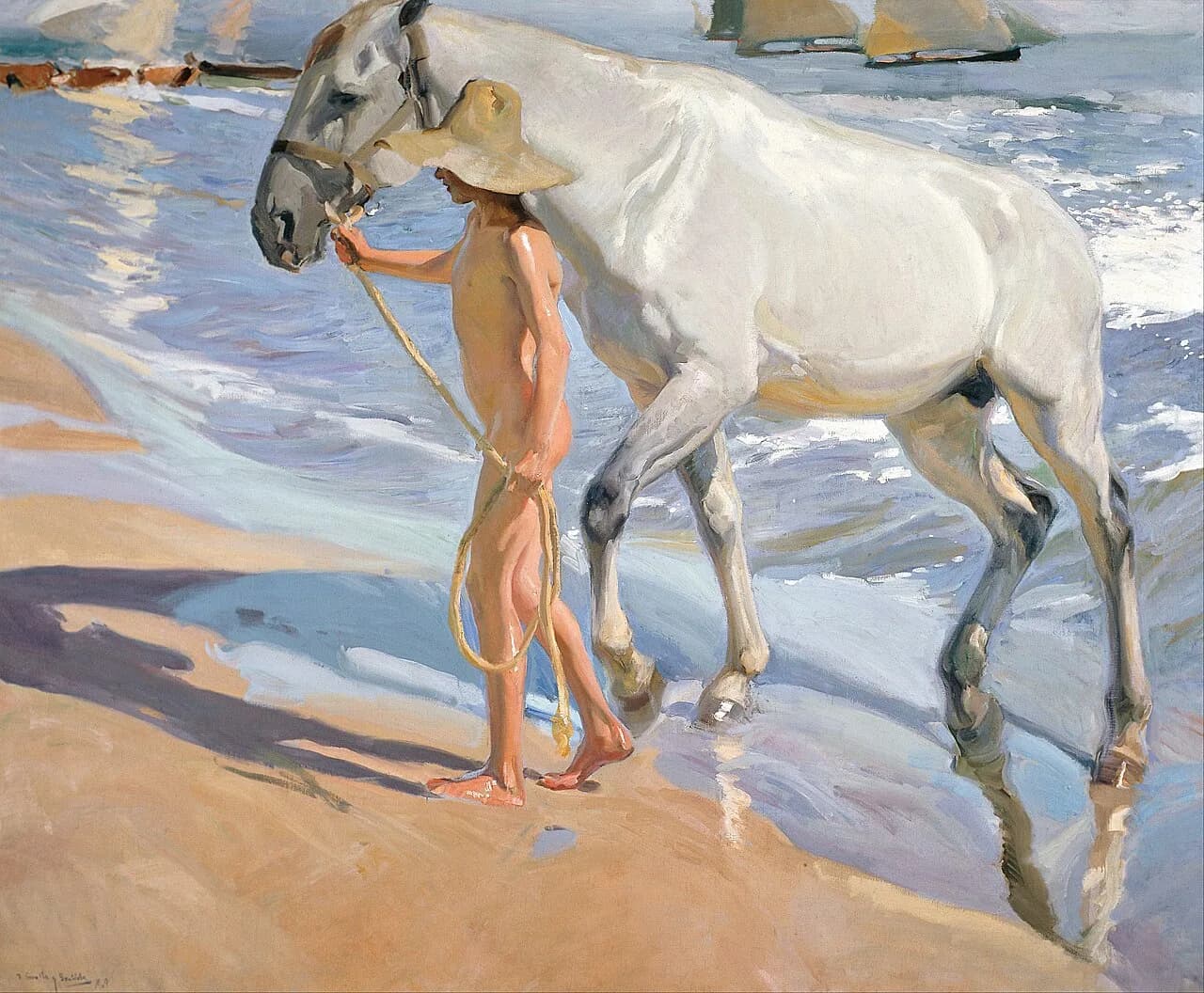
Moreau spent his last years converting his house into the museum you now walk through, which puts it in rare company. Madrid's Museo Sorolla is the painter's house and Andalusian-style garden, kept as the family left it. In Berlin, the Georg Kolbe Museum occupies the sculptor's purpose-built studio in Charlottenburg, with the casting hall and garden still in use.
The Musée Gustave Moreau remains one of the most enchanting cultural stops in all of France. Its combination of personal history and grand artistic vision offers something for every traveler. Following our musee gustave moreau visitor guide ensures you don't miss the hidden details of this townhouse. You will leave with a deeper appreciation for the Symbolist movement and 19th-century life.
Whether you are an art historian or a casual tourist, the spiral staircase and massive canvases will impress you. This museum proves that the smaller, quieter sites in the city often hold the most magic. Plan your visit today to experience this unique blend of home and gallery. It is a journey into the mind of a master that you will not soon forget.
For the latest official information, see the Musée Gustave Moreau on Wikipedia.
Continue exploring
More guides you'll find useful