Maison de Balzac Visitor Guide: 10 Things to Know Before You Go
Plan your visit to the Maison de Balzac with our expert guide. Discover Balzac's secret study, the Rose Bakery, and practical tips for tickets and timing.
On this page
Maison de Balzac Visitor Guide: 10 Things to Know Before You Go
Visiting the Maison de Balzac offers a quiet glimpse into the life of one of France's greatest novelists. This hidden gem sits tucked away in the residential Passy district of the 16th arrondissement. You will find a peaceful escape from the busy streets of central Paris here. The house remains a sanctuary for literature lovers seeking a deeper connection to the 19th century.
Honoré de Balzac lived in this modest house to escape the pressures of his many creditors. Today, the museum preserves his workspace and personal artifacts with remarkable care. It provides an intimate look at the environment that fueled his massive literary output. Our guide covers everything you need to know for a perfect visit in 2026.
Essential Visitor Information (Hours, Rates, and Access)
The museum is located at 47 Rue Raynouard, 75016, in the 16th arrondissement. The nearest Métro station is Passy (Line 6), about a five-minute walk through a quiet residential street. You can also arrive by RER C at Avenue du Président Kennedy, which is slightly closer. The entrance has been through a modern glass visitor centre since the 2019 renovation — look for it roughly 30 metres along the street from the old gate.
Entry to the permanent collections is free for all visitors throughout the year. Temporary exhibitions usually require a paid ticket of around €7 for an adult, which you can buy at the front desk. The Official Museum Website provides the most current pricing for special shows. Check the site before your trip to confirm any holiday closures or upcoming exhibitions.
The museum is open Tuesday to Sunday from 10:00 to 18:00. Last admission is at 17:30, so do not arrive later than that if you want to see all the rooms. The entire site is closed every Monday and on certain public holidays. Audioguides are available in English and French, and the Paris Museum Pass is accepted for paid temporary exhibitions.
- Hours: Tuesday–Sunday 10:00–18:00 (last admission 17:30)
- Closed: Mondays and public holidays
- Address: 47 Rue Raynouard, 75016 Paris
- Métro: Passy (Line 6) or RER C: Avenue du Président Kennedy
- Permanent collection: Free entry
- Temporary exhibitions: Around €7 adult
- Audioguides: English and French
- Paris Museum Pass: Accepted for paid exhibitions
Entry to the permanent collection is free for all visitors throughout the year. Temporary exhibitions require a paid ticket of around €7 for adults.
History of the Maison de Balzac: A Writer's Sanctuary
Honoré de Balzac lived in this house from 1840 to 1847 during one of his most productive periods. He was constantly hiding from debt collectors who sought to seize his assets. The author used the pseudonym Monsieur de Breugnol — after his housekeeper Louise Breugniot — to rent the property and stay hidden. This house provided the isolation he needed to edit and complete large parts of La Comédie humaine.
The most famous feature of the house is the secret exit on Rue Berton. Balzac could slip out through the back door down the hillside if creditors knocked at the front gate on Rue Raynouard. This narrow, winding street still feels like a step back into the old village of Passy. The writer Gérard de Nerval, a close friend, once described the property as "an upside-down house" — an apt phrase for a building that faces two different streets at two different levels.
After Balzac's death in 1850 at the age of 51, the house passed through several owners and narrowly escaped demolition. The City of Paris took possession in 1949 and opened it to the public as a museum in 1960. In 2019 a major renovation added a new glass-and-steel visitor centre at street level, an elevator to bring visitors down to the garden level, and a new café building. It remains the only one of Balzac's many Parisian residences still standing today.
The house features a famous secret exit on Rue Berton, where Balzac could slip out through a back door if his creditors came knocking at the front gate on Rue Raynouard.
Navigating the 2019 Redesign: What First-Timers Need to Know
Many visitors arrive at the old iron gate on Rue Raynouard and find it no longer serves as the entrance. Since the 2019 renovation the correct entrance is a squat, flat-roofed glass building about 30 metres further along the street. From inside the visitor centre, you take either an elevator or an outdoor staircase down to the garden level where the historic house sits. The topography is disorienting at first — the house occupies a terrace between Rue Raynouard above and Rue Berton below.
The Rose Bakery occupies the ground floor of the new visitor centre building immediately at the base of the stairs. The actual historic rooms are tucked in a corner to the side, which can make the house feel smaller than visitors expect. The route through the permanent collection is straightforward once you are inside: ground-floor rooms, then the study. Allow a few minutes to orient yourself in the garden before heading to the house entrance.
Visitors with reduced mobility should note that the 2019 elevator makes the main level accessible from street level for the first time. Some upper areas of the historic house remain harder to reach due to the sloped terrain. Contact the museum via maisondebalzac.paris.fr before your visit if you need specific access information. The garden paths are mostly flat once you reach the lower level.
Balzac Museum – A Testament to 19th-Century France
The museum serves as a physical representation of the world depicted in La Comédie humaine. Balzac's project aimed to capture every level of French society — over 91 novels and stories featuring more than 2,000 recurring characters. Walking through the rooms allows you to visualize the settings of his novels and the milieu that produced them. It provides a unique historical context that you will not find in larger national museums.
Choosing between the Maison de Balzac and the Maison de Victor Hugo depends on your interests. Balzac's home offers a modest and intimate look at a writer in hiding, with a strong focus on manuscripts and the creative process. Victor Hugo's apartment on the Place des Vosges feels much grander and more theatrical, with elaborate décor Hugo designed himself. Both sites are worthwhile stops for anyone exploring the literary heart of Paris alongside places like the Musée de la Vie Romantique.
- Maison de Balzac: Quiet Passy setting, intimate rooms, free permanent collection, strong focus on manuscripts and the writing process
- Maison Victor Hugo: Grand Place des Vosges location, elaborate period interiors, paid temporary exhibitions, theatrical atmosphere
- Key artifact at Balzac: Original writing desk + turquoise-studded cane
- Key artifact at Hugo: Ornate furniture Hugo designed himself
Must-See Collections and Literary Exhibits
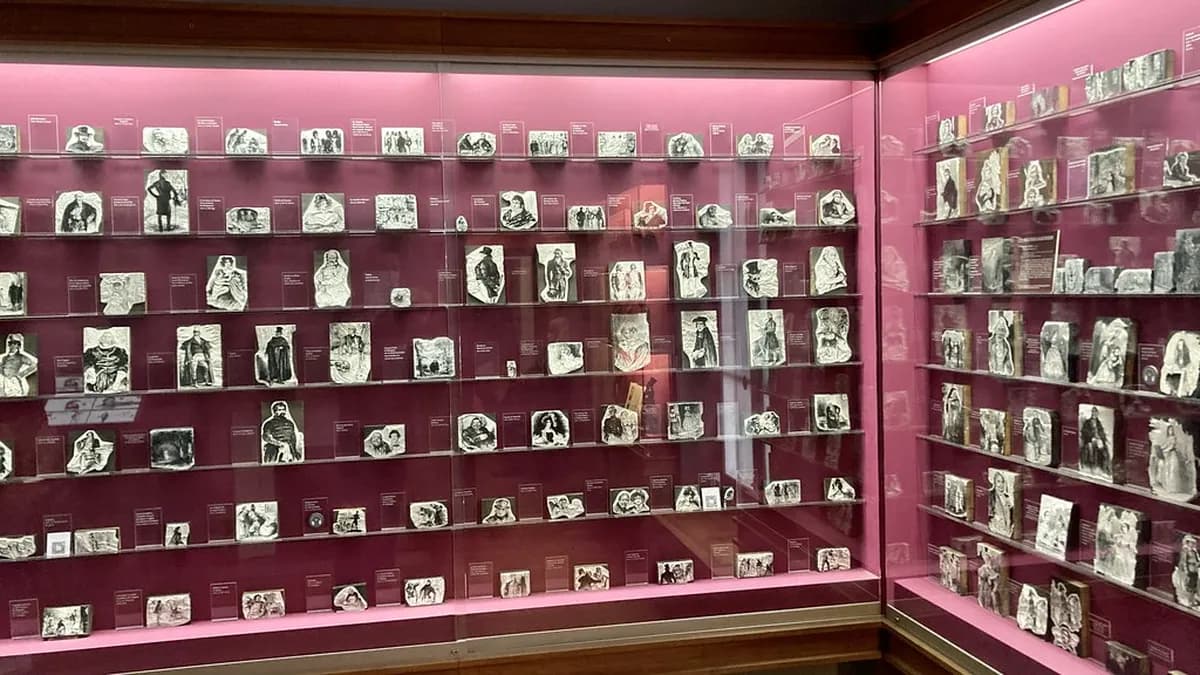
The museum houses an impressive collection of original manuscripts, corrected proofs, and personal letters. You can see the author's handwriting and the many edits he made to his drafts, which shows the grueling process behind his vast literary output. Portraits of Balzac and his contemporaries line the walls, alongside illustrations of characters from La Comédie humaine. Many of these items are rotated to ensure their long-term preservation.
One highlight easy to overlook is Balzac's turquoise-studded cane. Its gold handle inlaid with turquoise florets made such a splash on the Parisian social scene that it inspired the writer Delphine de Girardin to publish a novella — La Canne de M. de Balzac — in which the cane grants its young borrower magical invisibility. No other Parisian literary museum has an object quite like it: a personal accessory that became a cultural sensation in its own right.
The museum also holds a specialist library of over 15,000 documents, including works annotated in Balzac's own hand and newspaper clippings from his era. Researchers can access the library by appointment, though casual visitors can see a selection of documents on display. Check the Official Museum Website to see if the current temporary exhibition theme interests you before deciding whether to pay the extra fee. Casual visitors typically find the free permanent collection sufficient for a first visit.
Balzac's Study: The Heart of The Human Comedy
The study is the most significant room in the house for any literary visitor. This is where Balzac spent countless nights writing by candlelight, often composing up to twenty pages a day before the rest of Paris had woken up. The original writing desk and chair are still positioned exactly where he used them. It feels as though the author has only just stepped away for a moment.
On display beside the desk is the porcelain cafetière given to Balzac by his close friend Zulma Carraud. Balzac was famous for drinking his coffee black and unfiltered, and he described its effect in combustive terms — in a short essay on stimulants he compared ground coffee beans to gunpowder. Some accounts put his daily intake at 50 cups, a habit he believed unlocked his imagination and allowed him to write through the night. The cafetière is a small object that carries an outsized amount of the room's atmosphere.
The room is described in the museum's own wall text as a "modest study" and "a small room in a banal apartment in a village on the outskirts of Paris." That contrast — between the plainness of the space and the monumental ambition of the work produced in it — is what makes standing here so affecting. Balzac also wrote lengthy letters to his Polish mistress Evelina Hańska from this desk; he later married her just months before his death in 1850.
Rodin's Balzac: A Controversial Masterpiece
The museum features several studies and versions of Auguste Rodin's famous representation of Balzac. The monumental commission was placed by the Société des Gens de Lettres in 1891, and Rodin spent seven years researching the author's life and physique before producing the final version. The result was a bold departure from traditional commemorative statues — Balzac depicted wrapped in his dressing gown, raw and imposing, rather than in formal dress.
When the statue was first revealed in 1898 it caused a public scandal. Critics called it a "sack of coal" and the society rejected the commission entirely. The controversy was sharp enough that the sculptor Hanz Lerche produced a satirical statuette depicting Balzac as a seal, playing on the critics' complaints about the work's rounded form. Today Rodin's version is considered one of the most important works of modern sculpture. You can find a bronze cast on Boulevard Raspail at the crossroads with Boulevard du Montparnasse, and another at the Musée Jacquemart-André area.
The studies displayed at the Maison de Balzac include the Monumental Head, a gleaming bust that captures the writer's raw intellectual presence. Together with the caricatures and portraits elsewhere in the house, they give you a remarkably full picture of how contemporaries saw Balzac — as someone simultaneously larger than life and slightly absurd. Rodin's work captures both qualities at once.
The Garden and Secret Eiffel Tower Views
The garden covers around 650 square metres on the hillside between Rue Raynouard and Rue Berton. It is terraced into several levels with benches tucked under the trees for quiet reflection. Small pale-green signs at ground level read "Pelouse au repos" — the lawn is resting — a typically Parisian instruction to stay on the paths and let the grass recover. The garden occasionally hosts poetry readings and cultural events in the warmer months.
The garden offers a surprisingly private view of the Eiffel Tower through the surrounding trees. Unlike the crowded platforms of Trocadéro a few minutes away, this perspective feels entirely your own. You can sit on a bench and enjoy the iron monument in near-total silence. It remains one of the quietest Eiffel Tower viewpoints in the whole city, and one of the least photographed.
Be aware that the garden may close during heavy rain, high winds, or private events. Check the weather forecast before your visit if you specifically want to spend time outdoors. The garden is at its most beautiful in late spring when the plants are in full leaf, and in autumn when the light turns golden and the neighbourhood feels especially literary.
The Rose Bakery and On-Site Amenities
The Rose Bakery occupies the ground floor of the 2019 visitor centre building at the base of the entrance staircase. It serves fresh teas, cakes, salads, and light lunch options using high-quality ingredients. The bakery uses the same plate-glass and black-steel aesthetic as the new building it inhabits, giving it a modern feel that contrasts with the historic house a few metres away. It is the obvious place to sit and decompress after your tour.
You can enjoy your food and drink on the terrace overlooking the garden. The outdoor seating is particularly pleasant in spring and summer, with the garden in view and the Eiffel Tower visible through the trees. It offers a similar tranquil atmosphere to the café at the Musée de Montmartre, though the setting here is more tucked-away. Both spots provide a rare sense of stillness in a busy capital.
The museum also provides restrooms and a small gift shop near the entrance. You can find editions of Balzac's novels and literary souvenirs to take home. Most staff members speak English and are happy to answer questions about the collection or help you navigate the building. The audioguide, available in English and French, is free to borrow and covers the main rooms in around 45 minutes.
Planning Your Visit: Month-by-Month Calendar
January and February are the quietest months to visit the museum. You will likely have the rooms almost to yourself during these cold winter days. It is an ideal time for researchers who want to spend hours with the library collection or the manuscript displays. The atmosphere inside feels especially fitting for Balzac's nocturnal, reclusive persona when it is grey and chilly outside.
May and June offer the best garden experience with blooming plants and mild weather. The Eiffel Tower views through the green canopy are at their most picturesque in late spring. This is also the peak tourist season, so expect slightly more visitors — though the museum never gets truly crowded. Consider pairing your visit with the Musée Jean-Jacques Henner a short distance away for a full afternoon of intimate Parisian house museums.
Autumn provides a moody and literary vibe that perfectly suits the spirit of Balzac's work. October is a particularly beautiful time to walk through the surrounding Passy neighbourhood, with changing leaves adding atmosphere to the historic streets. The garden in autumn has a contemplative quality that feels completely in keeping with the house. It is a wonderful season for slow travelers who want to linger rather than rush.
Frequently Asked Questions
Is the Maison de Balzac free to visit?
Entry to the permanent collection is free for everyone throughout the year. However, temporary exhibitions usually require a paid ticket. You can check the current prices and book tickets for special shows at the Musée Cognacq-Jay or other city-run museums.
How long does a visit to the museum take?
Most visitors spend between one and two hours exploring the house and gardens. If you plan to enjoy tea at the Rose Bakery, allow for an extra hour. Researchers using the library resources will likely need a full afternoon to complete their work.
Can you see the Eiffel Tower from the garden?
Yes, the garden offers a beautiful and relatively secret view of the Eiffel Tower. It is much quieter than the typical tourist spots like Trocadéro or the Champ de Mars. The view is partially framed by trees, creating a very picturesque and private atmosphere.
Other Writers' and Artists' Houses in Europe
Balzac's Passy house survives because he rented it under a false name to avoid creditors, and that kind of biographical accident is what makes writers' houses worth visiting. In Rome, Casa di Goethe occupies the Via del Corso apartment where Goethe lodged during his Italian journey. Florence's Casa Buonarroti was built by Michelangelo's descendants around the works he left the family. Amsterdam's Rembrandt House Museum rebuilds the studio and print room from the inventory taken when Rembrandt went bankrupt.
The Maison de Balzac is a must-visit for anyone interested in French literature and history. It provides a rare and intimate look at the life of a creative genius in hiding. The combination of the historic study, the peaceful garden, and the Rose Bakery is hard to match elsewhere in the city. Plan your trip for a Tuesday-through-Sunday slot, arrive before 17:30, and allow at least an hour to do the house justice.
Remember to check the official website for last-minute updates or new temporary exhibitions before you head out. Explore the surrounding Passy district to see a different, quieter side of the French capital. You might also consider a visit to the Musée de la Chasse et de la Nature for more unique Parisian history. Each small museum in Paris tells a story that adds to the city's rich cultural tapestry.
For authoritative information, refer to the Maison de Balzac on Wikipedia.
Continue exploring
More guides you'll find useful