Teufelsberg Visitor Guide Travel Guide
Plan teufelsberg visitor guide with top picks, neighborhood context, timing tips, and practical booking advice for a smoother trip.
On this page
Teufelsberg Visitor Guide
Teufelsberg sits at the western edge of Berlin's Grunewald forest: an abandoned Cold War listening station perched on a man-made hill of WWII rubble, its radar domes now encrusted with some of Europe's most striking street art. It is one of the few places in the city where espionage history, ruin photography, and open-air art coexist on a single hill. In 2026 it remains open as a paid visitor site, run by a private operator who has made it accessible without stripping away its atmosphere.
This guide covers what Teufelsberg is, how to reach it, what to expect inside, the entry prices, and which nearby attractions reward the extra travel time from the city centre.
What Is Teufelsberg?
Teufelsberg — German for "Devil's Mountain" — is a man-made hill 120 metres above sea level in the Grunewald forest, making it one of the highest points in Berlin. The hill was built from roughly 75 million cubic metres of wartime rubble, piled over two decades using 800 trucks. Buried beneath it is the unfinished Wehrtechnische Fakultät, a Nazi military college that the Allies could not demolish because the reinforced concrete proved indestructible.
From 1963, the US National Security Agency built Field Station Berlin on the summit. The station's white geodesic radomes housed antenna equipment pointed east, intercepting East German and Soviet military communications around the clock throughout the Cold War. The ECHELON intelligence network — a signals intelligence alliance between the US, UK, Australia, New Zealand, and Canada — is believed to have been coordinated in part from here.
After the Berlin Wall fell in 1989, the Americans packed up and left within months. The site changed private hands repeatedly, a luxury residential development was proposed and abandoned, and the empty walls attracted street artists from across Europe. What began as trespass-graffiti evolved into sanctioned muralism: the current operator requires visiting artists to register, and names from global street art have painted here. The result is one of the largest open-air graffiti collections on the continent.
Entry Tickets and Opening Hours in 2026
Teufelsberg is open daily from 11:00 to sunset, weather permitting. Last admission is one hour before closing, so the practical cutoff in summer is around 20:30, in October around 18:00, and in November–December around 15:30. The site can close on a handful of dates each year; check the official site at teufelsberg-berlin.de before you travel.
Self-guided entry costs €12 for adults (18 and over), €10 reduced for students, apprentices, visitors 65 and over, and disabled visitors, and €5 for anyone under 18. Children under 7 are free. Guided tours run in addition to self-guided entry and cost extra; the standard public tour, the Street Art Tour, and the winter Flashlight Tour each have their own pricing. Tickets can be bought online in advance or at the entrance on the day. Both cash and card are accepted.
If you are unsure whether a guided tour is worth it, the short answer is: the self-guided ticket gets you into every building and to the top dome. A guide adds the Cold War operational detail — unit rotations, listening equipment, the ECHELON network — which is genuinely interesting but not strictly necessary for a satisfying visit.
How to Get to Teufelsberg
The site sits at Teufelsseechaussee 10, 14193 Berlin. It is outside the S-Bahn ring, so allow more travel time than most central Berlin attractions. The most straightforward public transport route is the S7 to Grunewald station, then a 25–35 minute walk northwest through the forest. From the platform, follow Neuer Schildhornweg northwest, pass through a small residential street, cross Teufelsseechaussee, and take the forest trails uphill. The trails are a mix of compacted dirt and asphalt and appear on Google Maps; as long as you head uphill, you will reach the fence perimeter and then the entrance.
Alternatively, take the S5 or S7 to Heerstraße, then bus M49 towards Grunewald. By car, Teufelsberg appears directly on Google Maps; a small car park at the entrance charges €5. Uber and taxis can drop you to the entrance.
One important detail for walkers: wild boars roam the Grunewald forest, especially at dusk. They are generally not aggressive but do not approach them or leave food accessible. Mountain bikers also share the forest trails, so stay on the path. Sturdy shoes rather than trainers are worth it, as the slope is steep in places.
Inside Teufelsberg: What to Expect
The entrance brings you through a gate into a compound of crumbling station buildings. Every horizontal and vertical surface is covered in layers of graffiti, some of it large-scale commissioned muralism, some of it accumulated over decades. The lower levels feel like an industrial ruin; staircases and corridors are dark, unheated, and structurally sound but rough. Bring a torch if you want to read the art in the darker corridors.
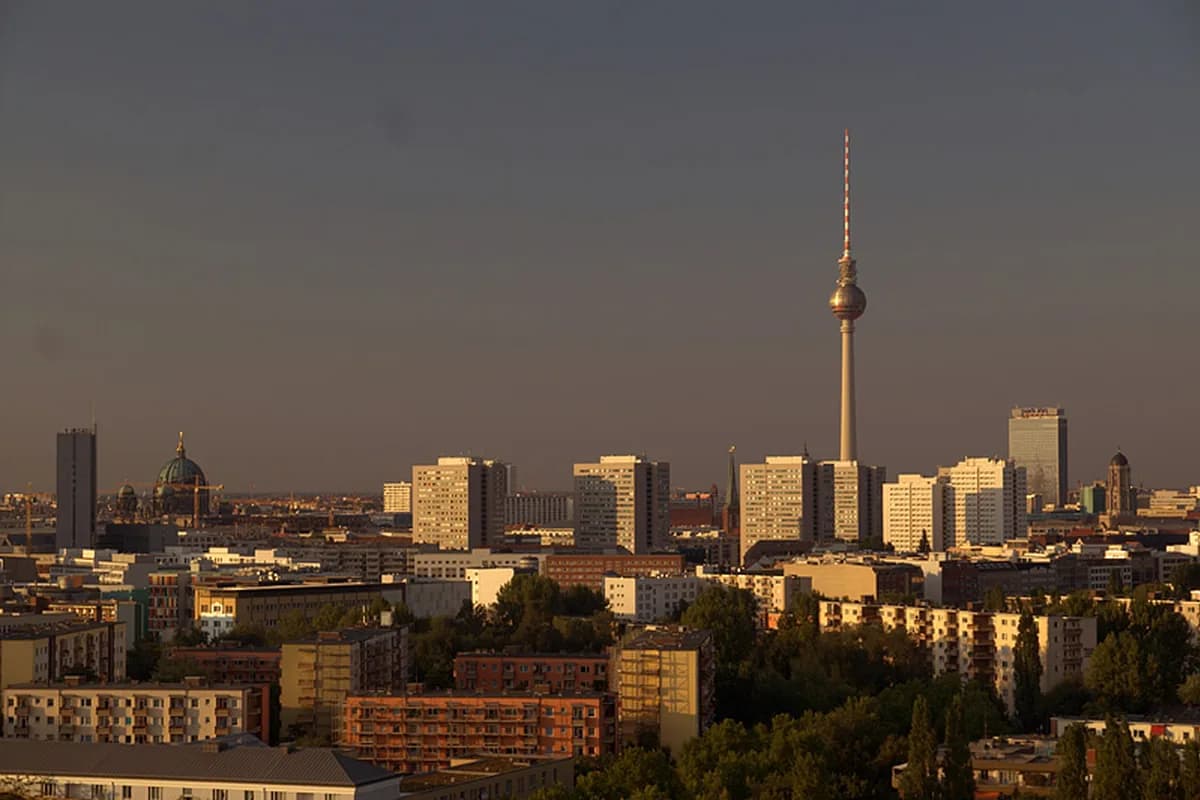
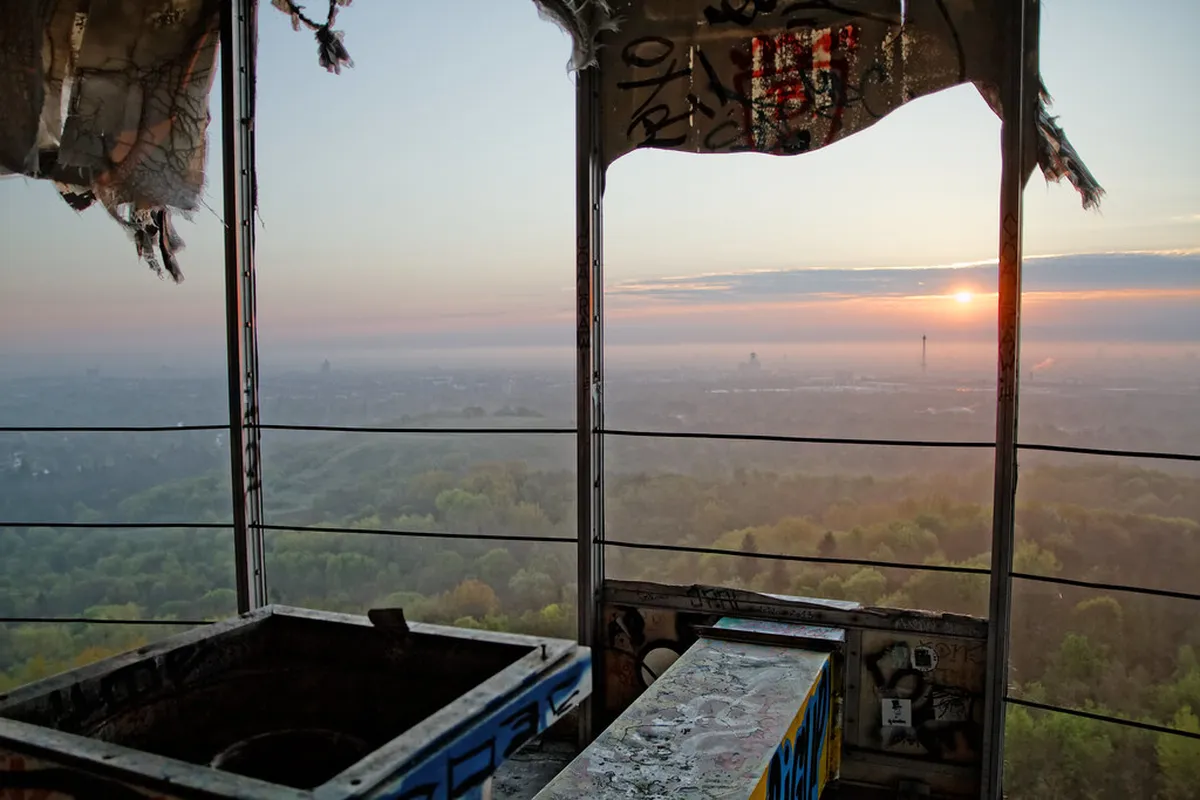
The top dome is the highlight. Reaching it involves climbing several flights of stairs in near-darkness, which some visitors find unsettling. At the summit, the large geodesic dome is intact and houses a circular 360-degree viewing platform. The acoustics inside are extraordinary: any sound — a whisper, a handclap — produces a long, spiralling echo that fills the dome. This is an experience unique to Teufelsberg; no other attraction in Berlin replicates it. From the viewing platform you can see the Berlin skyline and the full canopy of the Grunewald stretching west.
The acoustics inside the geodesic dome are extraordinary: any sound produces a long, spiralling echo that fills the entire space. This unique acoustic experience is found nowhere else in Berlin.
Most visitors spend 45 minutes to two hours on site, depending on how thoroughly they explore each building and how much time they spend with the street art. A self-guided visit on a quiet weekday morning allows the most peaceful experience of the domes. Weekends bring more visitors and the atmosphere becomes livelier but less contemplative.
The Street Art Collection
The street art at Teufelsberg is not a backdrop — it is the primary attraction for many visitors. The site has hosted major international artists since at least 2015, when Berlin Rising brought 70 artists together in a single season. Subsequent events have layered new work over old, so the collection shifts year by year. Some sections preserve large-format murals with clear artistic intention; others are denser accumulations of tags and smaller pieces from artists who have visited over the years.
Artists who want to paint here in 2026 must register through the official site rather than arrive with spray cans unsanctioned. This has raised the overall quality of new additions without closing the site to spontaneous creativity. The combination of Cold War ruin aesthetics and vivid contemporary colour is visually striking in a way that photographs do not fully capture.
If street art is your main interest, the Street Art Tour offered by the operator adds context about individual pieces and their creators. A standalone street art walking tour of Berlin's Friedrichshain and Kreuzberg murals makes a natural pairing on the same day if you want deeper immersion in the city's urban art scene.
Nearby Attractions Worth Combining
The walk from Grunewald S-Bahn station to Teufelsberg passes directly beside Gleis 17, a Holocaust memorial on the station's old freight platform. Between 1941 and 1945, tens of thousands of Berlin's Jewish residents were deported from this platform to extermination camps. The memorial is marked by cast-iron plates recording each transport date, destination, and number of deportees. It is sombre and brief — ten minutes — but the proximity to a Cold War spy station on the same walk creates a genuinely affecting pairing that few visitor itineraries in Berlin replicate.
Olympiastadion, the stadium built for the 1936 Olympics and still in active use, is accessible on foot north of Teufelsberg down the forest trails. Entry costs €11 and the interior is more impressive in person than photographs suggest. An S-Bahn and a U-Bahn station sit adjacent, making it easy to continue into the city centre.
For Cold War history in the city centre, the Stasi Museum documents the East German secret police and their surveillance apparatus. The contrast with Teufelsberg — American signals intelligence on one side of the Wall, Stasi human intelligence on the other — gives both sites additional context when visited on the same trip.
Practical Tips for Visiting Teufelsberg
Dress in layers. The hilltop is exposed and windy even in summer, and the interior buildings are unheated throughout the year. The stairwells are dark — a phone torch is sufficient but a small head torch is more convenient if you want both hands free for photography.
Visit on a weekday morning if possible. A Thursday visit typically means a handful of other visitors rather than the weekend groups that can reach 50 people per guided tour. Morning light also falls better on the eastern-facing murals. The site opens at 11:00, so you can be among the first in and have the top dome to yourself for the first hour.
Weekends bring guided tour groups that can reach 50 people per tour, making the experience crowded. A weekday visit, especially Thursday morning, typically means only a handful of other visitors, allowing for a much more contemplative experience.
Photography is encouraged and the standard entry ticket does not restrict it. However, drone use requires prior permission from the operator. If you are a serious photographer, the Flashlight Tour in winter provides a completely different atmosphere: the darkened buildings lit by torch create a much starker environment than the sun-drenched summer version.
There are no food vendors on site and no café. Bring water, especially in summer, and a snack if you plan to spend more than an hour exploring. The forest trails around the hill are pleasant for a post-visit walk before returning to the S-Bahn.
Is Teufelsberg Worth Visiting?
Teufelsberg is not for everyone. Those who value a well-signposted, polished museum experience may find the ruined, unrestored setting underwhelming. The travel time from central Berlin — 45 minutes by S-Bahn plus the forest walk — is real, and the site requires slightly more physical effort than most Berlin attractions.
For visitors drawn to Cold War history, street art, or urban exploration, it is one of the most memorable stops in the city. The combination of a buried Nazi college, a US spy station, two decades of international muralism, and panoramic forest views is genuinely unusual. The dome acoustics alone justify the climb for many visitors. Earthtrekkers rates it a must-do for anyone who finds the strangeness appealing; those who prefer conventional sightseeing are better served by Museum Island or the Stasi Museum.
Budget two to three hours for the full experience including the Grunewald walk. Go on a clear day for the views. Check the official site for closures before you travel, and book a guided tour in advance if you want one — public tours sell out on weekends.
Frequently Asked Questions
What is Teufelsberg?
Teufelsberg is a man-made hill in Berlin, constructed from post-WWII rubble. It is famous for being a former US listening station during the Cold War. Today, it serves as an open-air art gallery and historical site. Visitors can explore abandoned radar domes and admire extensive street art.
How did Teufelsberg evolve into a graffiti park?
After the Cold War, the abandoned listening station became a magnet for artists. Its remote location and decaying structures offered a unique canvas. Graffiti and street art flourished, transforming the site into a dynamic outdoor gallery. This artistic takeover has made it a renowned spot for urban art lovers.
Which teufelsberg visitor guide options fit first-time visitors?
First-time visitors should consider a guided tour to understand the site's history. These tours offer context to the abandoned buildings and Cold War operations. Alternatively, self-guided exploration allows for flexibility to focus on the street art. Combine with a walk in the surrounding Grunewald forest.
How much time should you plan for teufelsberg visitor guide?
Plan at least 2-3 hours for your Teufelsberg visit, including travel to and from the nearest public transport. This allows ample time to explore the radar domes and street art. Add more time if you plan to enjoy a picnic or extended walk in the Grunewald forest. Always check current opening hours.
More Cold War Ruins and Underground Sites in Europe
Teufelsberg belongs to a small category of sites where recent history is best read from infrastructure rather than exhibits. Naples has two of the strongest: the Galleria Borbonica, a 19th-century royal escape tunnel that became an air-raid shelter and later a vehicle dump, and Napoli Sotterranea, the Greek-Roman aqueduct system running forty metres below the old centre. For the Cold War specifically, Budapest's Hospital in the Rock ends in a nuclear bunker kept in operational condition.
Teufelsberg rewards the extra effort needed to reach it. The buried college, the ruined spy station, the dome acoustics, the street art, and the forest views form a combination that no other attraction in Berlin offers. Allow a full half-day, dress warmly, and check the official website for any closures before you go.
Pairing Teufelsberg with the Gleis 17 memorial on the walk in, and the Stasi Museum later in the day, turns a single quirky stop into a coherent day structured around Berlin's layered Cold War history. Few itineraries make as much use of a single afternoon.
For more ideas in the city, explore the full range of Berlin attractions and plan a trip that matches your interests across history, art, and architecture.
For official details, visit the Teufelsberg on Wikipedia.
Continue exploring
More guides you'll find useful