Hospital in the Rock Nuclear Bunker Museum: Visitor Guide
Plan your visit to Budapest's Hospital in the Rock. Discover ticket prices, tour times, Cold War history, and essential tips for exploring this underground nuclear bunker.
On this page
Hospital in the Rock Nuclear Bunker Museum Visitor Guide
Deep beneath the cobblestone streets of Buda Castle lies one of Europe's most chilling historical sites. The Hospital in the Rock, or Sziklakórház, served as a secret medical facility during the darkest days of World War II. Today, this labyrinth of caves offers a haunting look into Hungary's wartime past and its Cold War preparations. This hospital in the rock nuclear bunker museum visitor guide provides everything you need to navigate this underground marvel.
Visitors often find the atmosphere inside both somber and deeply immersive due to the preserved medical equipment. Walking through the narrow tunnels reveals how doctors worked under impossible conditions during the Siege of Budapest. The site later evolved into a top-secret nuclear shelter designed to survive a chemical or atomic attack. Understanding these layers of history is essential for anyone exploring the complex heritage of Budapest today.
The History of Sziklakórház: From WWII Hospital to Nuclear Bunker
The facility began its life in the late 1930s as a preparation for the inevitable conflict of World War II. Engineers connected existing natural caves under the castle to create a reinforced emergency surgical hospital. During the 1944–45 Siege of Budapest, the hospital meant for 60 people often held over 600 wounded patients. The staff included Jewish prisoners forced into labour service alongside volunteer nurses and civilian doctors working under the Red Cross.
Conditions were dire, with medical staff performing surgeries by candlelight while the city above crumbled. Following the war, the site played a brief but vital role during the 1956 Hungarian Revolution against Soviet rule. It provided a safe haven for injured civilians and freedom fighters when city hospitals were overwhelmed. This period solidified the location's reputation as a sanctuary during times of extreme civil unrest.
By the 1960s, the Hungarian government secretly expanded the site into a sophisticated nuclear fallout shelter. New air filtration systems and massive steel blast doors were installed to protect against modern weaponry. The facility remained a state secret until its eventual declassification and opening as a museum in 2008. Today it stands as a preserved time capsule of 20th-century survival and engineering — one of the few Cold War bunkers in Central Europe still largely intact.
What to Expect: Key Highlights and Exhibitions
The museum uses over 200 realistic wax figures to recreate scenes from the hospital's active years. These life-sized models depict doctors, nurses, and patients in startlingly vivid detail, with some surgical scenes graphic enough to unsettle sensitive visitors. The tour moves chronologically: you enter through the WWII hospital wards, pass through a section dedicated to the 1956 Revolution, and then descend into the Cold War bunker. This logical flow helps you absorb each era without the history blurring together.
Authentic medical tools from the 1940s and 1950s line the shelves of the various wards. You can see original sterilization equipment, iron lungs, and vintage stretchers that were actually used on-site. Many of these items remained untouched for decades while the bunker was still a classified military zone. Exploring these artifacts offers a rare look at the evolution of emergency medicine in Hungary.
The nuclear bunker section showcases the machinery required to keep a population alive underground. Massive diesel generators and complex air-scrubbing units highlight the technical side of Cold War paranoia. Walking through the decontamination showers provides a stark reminder of the atomic threats of that era. One quirky detail that genuinely surprises visitors: the entrance area features an artistic, elaborately decorated restroom that stands in absurd contrast to the otherwise grim atmosphere — a talking point that has spread widely on travel forums.
The wax figures depict surgical scenes that are graphic by design. Visitors with sensitivity to medical trauma imagery should be aware of the intense and realistic nature of the exhibits.
Essential Visitor Information: Tickets, Tours, and Hours
The museum is open daily from 10:00 to 19:00. The ticket office closes at 18:00 and the last guided tour departs at 18:00. The museum is closed on 1 January, 1 November, 24–25 December, and 31 December. Access is strictly regulated and only possible through a scheduled guided tour lasting approximately 60 minutes. Consult the Official Hospital in the Rock Website for the most current tour schedule.
As of 2026, adult tickets cost HUF 9,500 (approximately €30). Seniors aged 65 and over and students holding a valid ISIC card pay HUF 7,000 (approximately €22). Children aged 6–18 pay HUF 4,800 (approximately €15). EU citizens aged 70 and over, EU teachers, and disabled visitors with one companion pay a symbolic HUF 1.27 (€0.01). Children under 6 are not permitted due to the disturbing nature of the exhibition content. The museum is cashless — payment by credit or debit card, or SZÉP card only.
Every admission includes a free audio guide available in nine languages: English, German, French, Italian, Spanish, Russian, Chinese, Japanese, and Hungarian. You do not need to arrange this separately. Groups of 15 or more must register in advance. Booking tickets online ahead of time is strongly recommended during summer months and holiday weekends, when individual tour slots fill up quickly.
| Visitor Type | Price (HUF) | Price (EUR) |
|---|---|---|
| Adult | 9,500 | €30 |
| Senior (65+) | 7,000 | €22 |
| Child (6–18) | 4,800 | €15 |
| EU 70+ / EU Teachers / Disabled + 1 | 1.27 | €0.01 |
How to Get There: Finding the Entrance Under Buda Castle
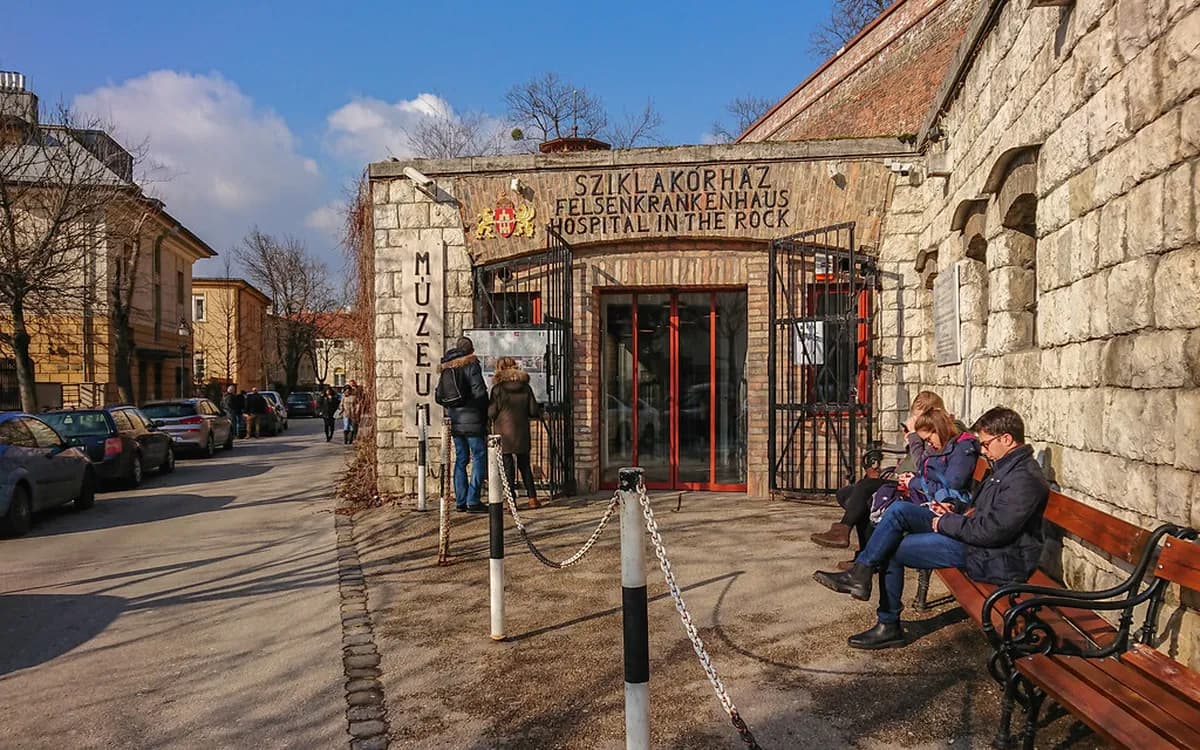
The museum is located on the western side of Castle Hill at Lovas út 4/c, in Budapest's 1st district. It sits directly beneath the residential area of the castle district, away from the main tourist squares. Finding the entrance can be tricky, so look for the historical signage along the stone walls. You can use Google Maps Location: Lovas út 4/c to pinpoint the exact doorway.
Public transport is the most efficient way to reach the site from the Pest side of the city. The number 16 or 16A bus will take you from Deák Ferenc tér directly to the Castle District. Get off at the Dísz tér stop and enjoy a short five-minute walk toward the museum entrance. Check the Budapest Transport (BKK) for route planning to see real-time bus arrivals.
Walking from the Matthias Church is a scenic option if you are already exploring the castle area. Follow the paths along the ramparts before descending to the entrance. The path involves some stairs and uneven surfaces, so wear comfortable walking shoes. A staircase and elevator connect the cave entrance to street level, but the cave passages themselves are not wheelchair-accessible — contact the museum in advance if you have specific mobility needs.
Hospital in the Rock vs. House of Terror: Which Should You Visit?
Budapest has two internationally known trauma-history museums, and first-time visitors regularly ask how they compare. The House of Terror on Andrássy út focuses on the political and human-rights atrocities of Hungary's Nazi and Soviet occupations. It is a slicker, more designed exhibition experience — powerful, but curated for emotional impact through text, video, and architecture rather than physical artifacts.
The Hospital in the Rock offers something different: a physical place where history actually happened. The original equipment, the confined underground space, and the wax-figure recreations create an immersive environment that feels less like an exhibition and more like a site. Many travellers who have visited both describe the Hospital as more visceral and the House of Terror as more politically illuminating. If you have time for only one, the Hospital wins on sheer uniqueness; if you are deeply interested in communist-era political repression, add the House of Terror to your itinerary the same day since it is easy to reach by metro from Pest.
Is It Worth It? What Visitors Actually Say
The museum consistently earns strong ratings across travel platforms, with the immersive atmosphere and knowledgeable guides praised most often. Visitors who connect with 20th-century European history report it as one of the most memorable stops in Budapest. The combination of WWII medicine, Cold War technology, and the actual physical cave system is hard to replicate anywhere else in the region.
The most common criticism is that the tour pace can feel rushed. Guides move the group at a fixed tempo to stay on schedule, which leaves some visitors wishing for more time to read labels or study the equipment. To get the most out of this, listen carefully to the guide during the walk and ask questions — guides are generally willing to elaborate on details during natural pauses. Arriving early in the morning on a weekday means smaller tour groups and a slightly more relaxed pace than peak afternoon slots.
The experience is not recommended for children under 6 (officially prohibited) or for visitors with a genuine sensitivity to medical trauma imagery. The wax figures are realistic, and some surgical scenes are graphic by design. Travelers with claustrophobia should know that the transition tunnels between wards are narrow, though the main wards themselves are spacious enough that most people manage fine.
Insider Tips for a Smooth Visit
The temperature inside the bunker remains a constant 15–18°C (60°F) throughout the entire year. While this feels refreshing in summer, it can be a shock after arriving from 30-degree heat. Bring a light jacket or sweater even if the outdoor temperature is sweltering — being cold for an hour-long tour significantly distracts from the guide's commentary.
Photography is strictly prohibited inside all exhibition areas of the museum, with no photo tickets available to purchase. You may take photos in the reception area and the gift shop only. Guides enforce this consistently. Put your phone away before the tour starts and focus on the audio guide and live narration instead.
Arrive at least 15 minutes before your tour slot to check in and collect your audio guide headset. The museum cannot hold your place if you arrive late, and tour groups leave on time. If you plan to visit Matthias Church or Fisherman's Bastion on the same day, do the Hospital in the Rock first — the somber tone is easier to transition from than into.
The underground temperature stays constant at 15–18°C (60°F) year-round. Bring a light jacket or sweater, even on scorching summer days, to stay comfortable during your hour-long tour.
Nearby Attractions in the Castle District
After your tour, consider visiting the House of Houdini located just a short walk away. This museum celebrates the life of the famous escape artist who was born in Budapest. It offers a more magical and upbeat experience compared to the heavy history of the bunker. Combining these two sites makes for a diverse afternoon on Castle Hill.
For those interested in more niche history, the Budapest Pinball Museum is another underground gem. While it is located across the river in Pest, it shares a similar subterranean charm. If you prefer to stay in Buda, the Roman ruins at Aquincum are a short train ride north. Each of these locations highlights a different era of Hungary's long and varied history.
Fisherman's Bastion and Matthias Church are the most famous landmarks within walking distance of the hospital. The panoramic views of the Parliament building from the bastion are perfect for sunset photography. Many visitors choose to eat at the cafes near the church before heading down to the bunker. This area is the heart of the city's tourism and provides endless photo opportunities.
Frequently Asked Questions
Is the Hospital in the Rock suitable for children?
The museum is generally suitable for children over the age of 6, but parents should be cautious. The wax figures are very realistic and some depict medical trauma. It may be frightening for very young or sensitive children. There is also a lot of walking involved during the hour-long tour.
Do I need to book tickets for the Hospital in the Rock in advance?
Yes, booking in advance is highly recommended, especially during the summer and holiday weekends. Group sizes are limited for safety, and tours often sell out early in the day. You can book directly through the official website to secure your preferred time slot. Walk-ins are possible but not guaranteed.
How long does the guided tour of the Hospital in the Rock take?
A standard guided tour takes approximately 60 minutes from start to finish. This includes the walk through the WWII wards, the 1956 section, and the nuclear bunker. You should arrive at least 15 minutes before your scheduled start time to check in. The pace is steady but manageable for most visitors.
Is the Hospital in the Rock accessible for people with disabilities?
The museum has made efforts toward accessibility, but the underground nature presents challenges. There are some stairs and narrow sections that may be difficult for wheelchairs. It is best to contact the museum staff in advance to discuss specific needs. They can provide guidance on the most accessible routes within the tunnels.
Can you take photos inside the Hospital in the Rock?
No, photography and video recording are strictly prohibited inside the exhibition areas of the museum. This policy helps maintain the somber atmosphere and keeps the tour groups moving efficiently. You are welcome to take photos in the reception area and the museum shop. For more photography-friendly sites, consider visiting the Miksa Roth Museum instead.
The Hospital in the Rock is more than just a museum; it is a testament to human resilience. Visiting this site allows you to connect with Budapest's history on a visceral, emotional level. Whether you are a history buff or a casual traveler, the experience is likely to stay with you. Make sure to add this unique underground journey to your next Hungarian itinerary.
Remember to dress warmly and book your tour ahead of time to ensure a smooth visit. The stories of the doctors and soldiers who lived here provide a perspective you won't find in textbooks. Exploring the depths of Buda Castle offers a rare glimpse into a world once shrouded in total secrecy. It remains one of the most impactful attractions in Budapest for modern travelers.
To verify current details, consult the Hospital in the Rock Nuclear Bunker Museum on Wikipedia.
For more Budapest planning, see our Budapest Hidden Gems, non-touristy things to do in Budapest, and Secret Budapest guides.
Continue exploring
More guides you'll find useful