Fiumei Road Cemetery Visitor Guide: 7 Essential Tips
Plan your visit to Budapest's Fiumei Road Cemetery with our guide to the top mausoleums, Art Nouveau arcades, the Apponyi carriage, and practical travel tips.
On this page
Fiumei Road Cemetery Visitor Guide: 7 Essential Tips
Fiumei Road Cemetery stands as the most prestigious burial ground in Hungary and serves as a national pantheon. Often called the "Père Lachaise of Budapest," this 56-hectare site offers a profound journey through the nation's turbulent history. Visitors will find grand mausoleums, intricate sculptures, and peaceful parkland just a short distance from the city center.
Established on 1 April 1849, the cemetery grew into Hungary's national pantheon by the turn of the century. It is also officially known as Kerepesi Cemetery — that older name still appears on many maps, so knowing both helps you navigate. Exploring these grounds is one of the most rewarding things to do in Budapest for history enthusiasts.
This fiumei road cemetery visitor guide provides all the practical details needed for a respectful and enlightening visit. From the massive Kossuth Mausoleum to the delicate Art Nouveau arcades, every corner tells a unique story. Use this resource to navigate the vast grounds and discover why this open-air museum is a must-see landmark.
Fiumei Road Cemetery — a treasure of Hungarian heritage
The site is officially managed by the National Heritage Institute (Nemzeti Örökség Intézete, or NÖRI) as a National Memorial. It functions as far more than a graveyard — it is a preserved archive of Hungarian identity and struggle spanning nearly 175 years. NÖRI oversees conservation of the monuments, organizes guided programs, and maintains the arboretum-grade green space.
Walking through the main gates on Fiumei út feels like stepping into a peaceful sanctuary away from the urban bustle of the city of Budapest. The cemetery gained its national pantheon status in the late 19th century when the city's political and cultural elite began commissioning grand monuments here. It now holds the graves of poets, scientists, revolutionaries, and Nobel laureates who shaped modern Hungary.
Since the cemetery functioned as a public burial ground for a long time, the composition of those resting here is extremely mixed, both nationally and religiously. That diversity makes every pathway a surprise — a Baroque family vault sits beside a modernist sculptor's tomb, and a 19th-century revolutionary lies a few rows from a 21st-century Nobel laureate. Many international travelers find the artistic scale rivals the most celebrated cemeteries in Europe.
Must-See Fiumei Attractions: The Great Mausoleums
The three massive mausoleums dedicated to Lajos Kossuth, Ferenc Deák, and Lajos Batthyány form the historical core of the cemetery. These structures honor the leaders of the 1848–49 War of Independence and the political compromise that followed. Each monument features a distinct architectural style and symbolic sculpture program that rewards a slow, close inspection.
Kossuth Mausoleum (1902–1909)
Designed by architect Kálmán Gerster and sculptor Alajos Stróbl, the Kossuth Mausoleum is the largest funerary building in Hungary. Its upper structure evokes the Parthenon in Athens, and a bronze statue group above the entrance represents the revolution and the War of Independence. The centrepiece inside is a sarcophagus carved from green onyx, surrounded by interior walls covered in Murano glass mosaics gilded with 23.5-carat gold leaf. Family members of Lajos Kossuth rest in the side chambers.
Deák Mausoleum (1887)
The Deák Mausoleum was also designed by Kálmán Gerster, giving the two most prominent monuments a visual family resemblance. The 26-metre-high Neo-Renaissance dome is covered with ornamental tiles from the famous Zsolnay porcelain factory and topped by a 6-metre-high bronze angel. Inside, frescoes depicting the four main virtues — rendered in glass mosaic — line the walls. The symbolic sarcophagus of Ferenc Deák visible today is a post-war replacement; the original was destroyed during World War II.
Batthyány Mausoleum (1872–1874)
Designed by Albert Schickedanz, the Batthyány Mausoleum honors the first Prime Minister of Hungary, who was executed following the revolution. Stone lions flank the staircase, and wall reliefs carry the family coat of arms alongside the Hungarian national coat of arms. This is the only large mausoleum in the cemetery where free-standing coffins are visible to visitors, making it unusually intimate despite its imposing exterior.
Other notable monuments
The Ábrahám Ganz Mausoleum (1868), designed by renowned architect Miklós Ybl, is among the oldest surviving funerary structures on the grounds. The tomb of József Antall — Hungary's first democratically elected Prime Minister after 1989 — features dramatic shrouded horseman figures by sculptor Miklós Melocco. Writer Imre Kertész, who won the Nobel Prize for Literature in 2002 for "Fatelessness," is also buried here; his 2019 tombstone, a bronze column with an open door, bears the inscription "love redeems."
Museums, Art, and Culture in Fiumei: Art Nouveau and Sculptures
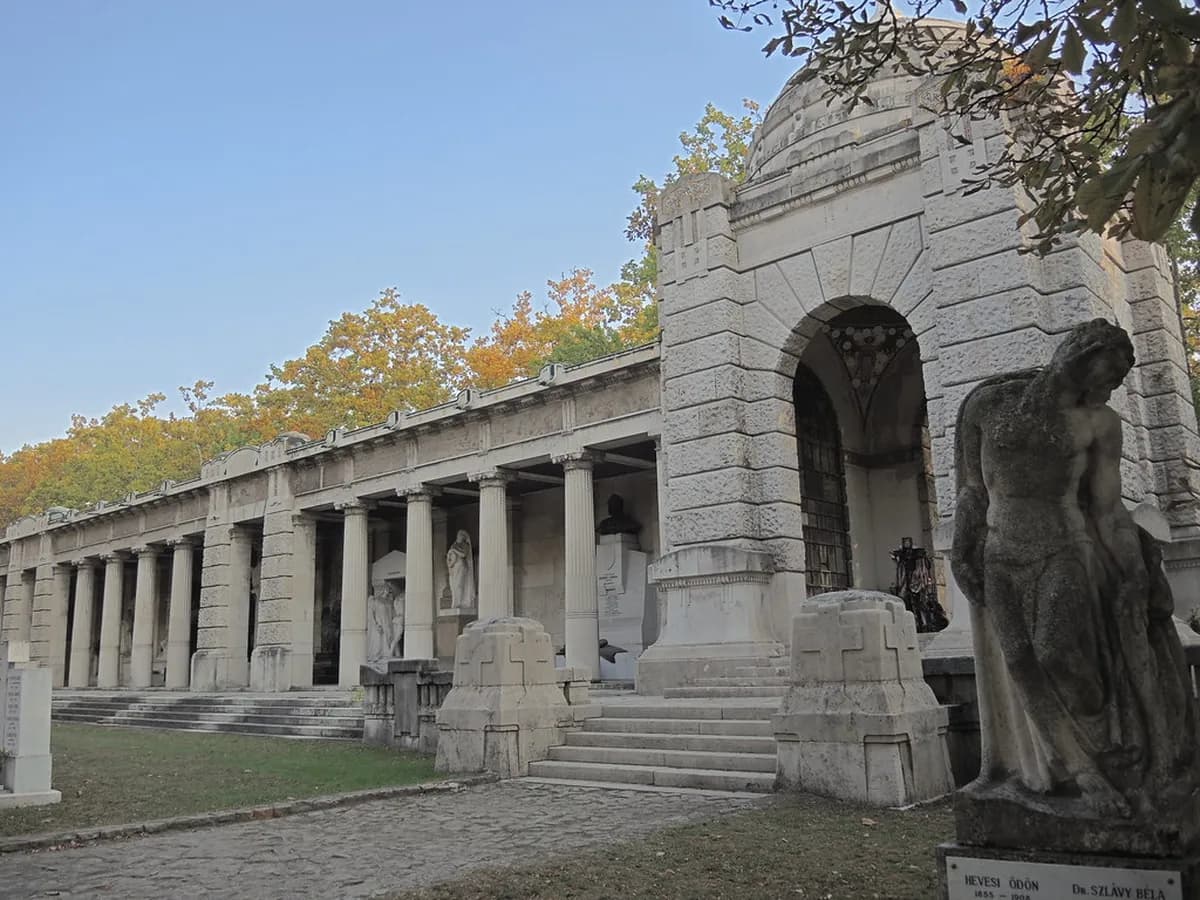
Beyond the major mausoleums, the Art Nouveau arcade buildings offer some of the most stunning visual experiences in the cemetery. These covered walkways, modelled on Italian examples and built in the early 20th century, are lined with family vaults decorated with intricate mosaics. The domes above the arcade bays are decorated with mosaics covered in 23.5-carat gold leaf — the same gilding technique used inside the Kossuth Mausoleum — creating a warm, amber glow in afternoon light.
A highlight for many visitors is the display housing the Apponyi mourning carriage near the entrance. This nearly four-metre-high, five-and-a-half-metre-long black vehicle was manufactured in Budapest between 1928 and 1932, and was used only four times for the state funerals of major national figures. It ranks among the largest surviving mourning carriages in the world and is displayed in a dedicated glass-walled pavilion.
The cemetery also functions as an open-air sculpture gallery with works by Hungary's most celebrated artists. Alajos Stróbl and János Fadrusz are among the masters whose bronze figures and marble reliefs adorn tombs across the grounds. The earlier, simpler wall tombs from 1849 provide a fascinating contrast — these were the original "most prestigious" burial spots before the arcades were built, and their restrained stonework reflects a different era of mourning culture.
The Pantheon of the Working Movement
One of the most architecturally distinctive areas within Fiumei Road Cemetery is the Pantheon of the Working Movement, also called the Labour Movement Mausoleum, built in 1958. This large Soviet-era complex holds the remains of Hungarian Communist-era leaders and workers' movement figures. Its stark, monumental design contrasts sharply with the ornate 19th-century mausoleums nearby — the visual difference alone tells a complete story of how Hungary's political culture shifted across a single century.
For visitors interested in Cold War history, the Pantheon is one of the most sobering stops in Budapest. It stands as a historical relic of the post-war period that has neither been demolished nor repurposed, which makes it unusual by European standards. Walking through this section alongside the revolutionary-era memorials creates an unfiltered timeline of Hungarian political memory that no single museum can replicate.
Travelers exploring this period of history may also find the Memento Park a useful complement — it houses statues removed from public spaces after 1989, offering a different angle on the same era. At Fiumei, the Pantheon remains in context, surrounded by the full sweep of the nation's history.
Parks, Gardens, and Outdoor Spots in Fiumei: The Arboretum
The cemetery is officially recognized as an arboretum due to its remarkable variety of plant and animal life. Over 110 bird species have been recorded within the 56-hectare grounds, making it a hidden gem for birdwatchers who can combine a history walk with casual birding. The dense canopy of ancient trees provides cooling shade during Budapest's warm summer months.
You will encounter at least 10 species of rare trees as you wander the winding footpaths — plane trees, ginkgos, and holm oaks are among the most striking. This green space serves as a vital ecological lung for the city and a quiet retreat for locals and tourists alike. The balance between man-made monuments and natural growth creates a unique, hauntingly beautiful atmosphere that intensifies with the seasons.
The Fiumei arboretum provides a much softer, more contemplative environment than most city parks. It is a place where nature and history have grown together over nearly two centuries, and where the boundary between the two has become genuinely blurred.
Family-Friendly and Budget-Friendly Options in Fiumei
Entry to the main grounds is completely free for all visitors, every day of the year. No ticket, reservation, or advance booking is required to walk the grounds — you simply enter through the main gate on Fiumei út 16-18. This makes the cemetery one of the most accessible cultural experiences in Budapest for budget-conscious travelers.
Students and school groups frequently visit to learn about Hungarian history in a tangible, three-dimensional way. The site brings textbook figures to life through their monuments in a manner that resonates particularly well with older children and teenagers. Families can spend a slow-paced afternoon exploring the art without the crowds found at more central paid attractions.
The wide main avenues are easy to navigate with strollers, though some side paths are uneven gravel. The NÖRI website at fiumeiutisirkert.nori.gov.hu publishes updates on any special exhibitions that may carry a small fee. Budget travelers who visit here can save their spending for paid experiences like the Budapest Flipper Museum or an evening river cruise.
Best Time to Visit: Seasonal Hours and Crowd Patterns
The cemetery is open every day of the year, but the closing time changes significantly by season. From May through July the gates stay open until 20:00, giving visitors a rare opportunity to walk the grounds in long evening light — the golden hour illumination on the gold-leaf mosaics of the arcades is particularly striking. In January and February the site closes at 17:00, which means winter visitors should arrive by early afternoon.
- January–February: 07:30–17:00
- March: 07:00–17:30
- April: 07:00–19:00
- May–July: 07:00–20:00
- August: 07:00–19:00
- September: 07:00–18:00
- October: 07:00–17:00
- November–December: 07:30–17:00
Spring (late April through May) is the ideal window for a first visit: the trees are leafing out, bird activity is at its peak, and the summer tourist crowds have not yet arrived. Autumn brings rich foliage that frames the stone monuments dramatically. Midweek mornings are consistently quietest; weekends around national holidays — particularly 15 March (Hungarian Revolution Day) — draw larger crowds for memorial walks.
An early morning visit on any weekday is the most peaceful option. The cemetery opens before 07:30 in most months, and the first hour or so before mid-morning coffee crowds a genuinely contemplative space.
From May through July, the gates stay open until 20:00, offering rare evening light when the gold-leaf mosaics of the arcades glow amber in the golden hour.
How to Plan a Smooth Fiumei Attractions Day
Reaching the cemetery is straightforward via Budapest's efficient public transport system. The main entrance at Fiumei út 16-18 (VIII district, Józsefváros) is a 10-minute walk from Keleti Railway Station, which is served by Metro lines M2 (red) and M4 (green). You can also take Trams 23, 24, or 28, which stop directly in front of the gates.
Respectful behavior is essential — this remains a functioning cemetery and a sacred national site. Keep noise levels low and avoid climbing on monuments or gravestones to preserve the dignity of the area. Most visitors find that two to three hours is sufficient to see the main highlights without feeling rushed; those joining a guided tour should allow up to three hours.
Keep noise levels low and avoid climbing on monuments or gravestones to preserve the dignity of this functioning cemetery and sacred national site.
For a deeper look into Budapest's diverse heritage, the Salgótarjáni Street Jewish Cemetery is located immediately next door, separated only by a stone wall. It offers a striking, intentionally overgrown contrast to the manicured lawns of Fiumei. Combining both sites in a single afternoon provides a comprehensive and moving view of the diverse cultures that shaped the Hungarian capital.
Guided Tours and Thematic Walks for 2026
NÖRI organizes several thematic walks each year that cater to specific interests including botany, fine arts, military history, and architecture. These guided tours often provide access to areas — and mausoleum interiors — that are normally closed to the general public. The 1848–49 memorial walk held every 15 March is the most popular, drawing visitors for historical recitations and patriotic ceremonies at the relevant monuments.
Special events like the "Night of Museums" (Múzeumok Éjszakája) and "Cultural Heritage Days" (Kulturális Örökség Napjai) feature evening tours and occasional musical performances in the grounds. These programs transform the cemetery into a vibrant cultural hub for a few nights each year and offer a rare chance to see the monuments illuminated after dark. Check the NÖRI schedule for 2026 dates before you travel, as exact dates vary annually.
Groups of more than 10 people can arrange a guided tour in advance by contacting NÖRI at regisztracio@nori.gov.hu. During the annual Week of Discovering European Cemeteries, the gates of historically closed mausoleums — including the Kossuth and Deák interiors — are opened for special guided access. For general inquiries, NÖRI can be reached at +36 1 795 2700 or nori@nori.gov.hu.
Frequently Asked Questions
Is Fiumei Road Cemetery free to visit?
Yes, entry to the main grounds of the Fiumei Road Cemetery is free for all visitors. Some specialized guided tours or indoor museum exhibits managed by the National Heritage Institute may require a small fee. It remains one of the best budget-friendly cultural sites in Budapest.
How do I get to Fiumei Road Cemetery from central Budapest?
The cemetery is easily accessible by taking the M2 or M4 metro lines to Keleti Railway Station. From there, it is a five-minute walk or a short ride on Trams 23, 24, or 28. Public transport is the most convenient way to reach the gates.
Who are the most famous people buried in Fiumei Road Cemetery?
The cemetery houses many national heroes, including Lajos Kossuth, Ferenc Deák, and Lajos Batthyány. You will also find the graves of famous writers like Endre Ady and architects like Ignác Alpár. It serves as the final resting place for Hungary's most influential figures.
How much time should you spend at Fiumei Road Cemetery?
Most visitors should plan to spend between two and three hours exploring the 56-hectare site. This allows enough time to see the major mausoleums, the Art Nouveau arcades, and the Apponyi carriage. If you join a Budapest guided tour, it may take longer.
Other Monumental Cemeteries Worth the Walk
Fiumei Road is a national pantheon where mausolea were commissioned as competitively as town houses. Milan's Cimitero Monumentale is the closest match anywhere, an open-air gallery of Italian funerary sculpture. Rome's Capuchin Crypt represents the older tradition, where the remains themselves are the decoration.
Fiumei Road Cemetery is a captivating destination that offers deep insights into the soul of Hungary. Its combination of grand architecture, significant history, and natural beauty makes it a standout attraction in Budapest. Whether you are a history buff or a casual traveler, the site provides a peaceful and educational experience.
By following this fiumei road cemetery visitor guide, you can ensure a smooth and respectful visit to this national treasure. Remember to check the official schedules for thematic walks to enhance your understanding of the monuments. This "open-air history book" is waiting to be discovered on your next trip to the Hungarian capital.
For the latest official information, see the Fiumei Road Cemetery on Wikipedia.
For more Budapest planning, see our non-touristy things to do in Budapest guide.
Continue exploring
More guides you'll find useful