Palacio De Las Dueñas Visitor Guide Travel Guide
Plan palacio de las dueñas visitor guide with top picks, neighborhood context, timing tips, and practical booking advice for a smoother trip.
On this page
Palacio De Las Dueñas Visitor Guide
Discover the Palacio de las Dueñas, a true gem tucked into a quiet corner of Seville's Santa Catalina neighborhood. This 15th-century noble palace offers a captivating glimpse into Andalusian nobility and culture, without the crowds that fill the city's headline sights.
Our 2026 palacio de las dueñas visitor guide covers must-see attractions and practical advice drawn from the palace's own visitor rules and current opening hours.
Explore stunning patios, lush gardens, and richly decorated rooms filled with art and history — a serene escape from the bustling streets around the Cathedral and Real Alcázar.
Must-See Palacio Attractions
Palacio de las Dueñas follows a single walking route, so there's no risk of missing a room. The visit begins at the entrance courtyard, where bougainvillea climbs the main house and a 17th-century tile above the arch shows the coat of arms of the House of Alba.
To the right sit the palace's old stables, among the oldest structures on the site. They were originally Arab-era baths, which is why the floor drops about two meters below the surrounding courtyard.
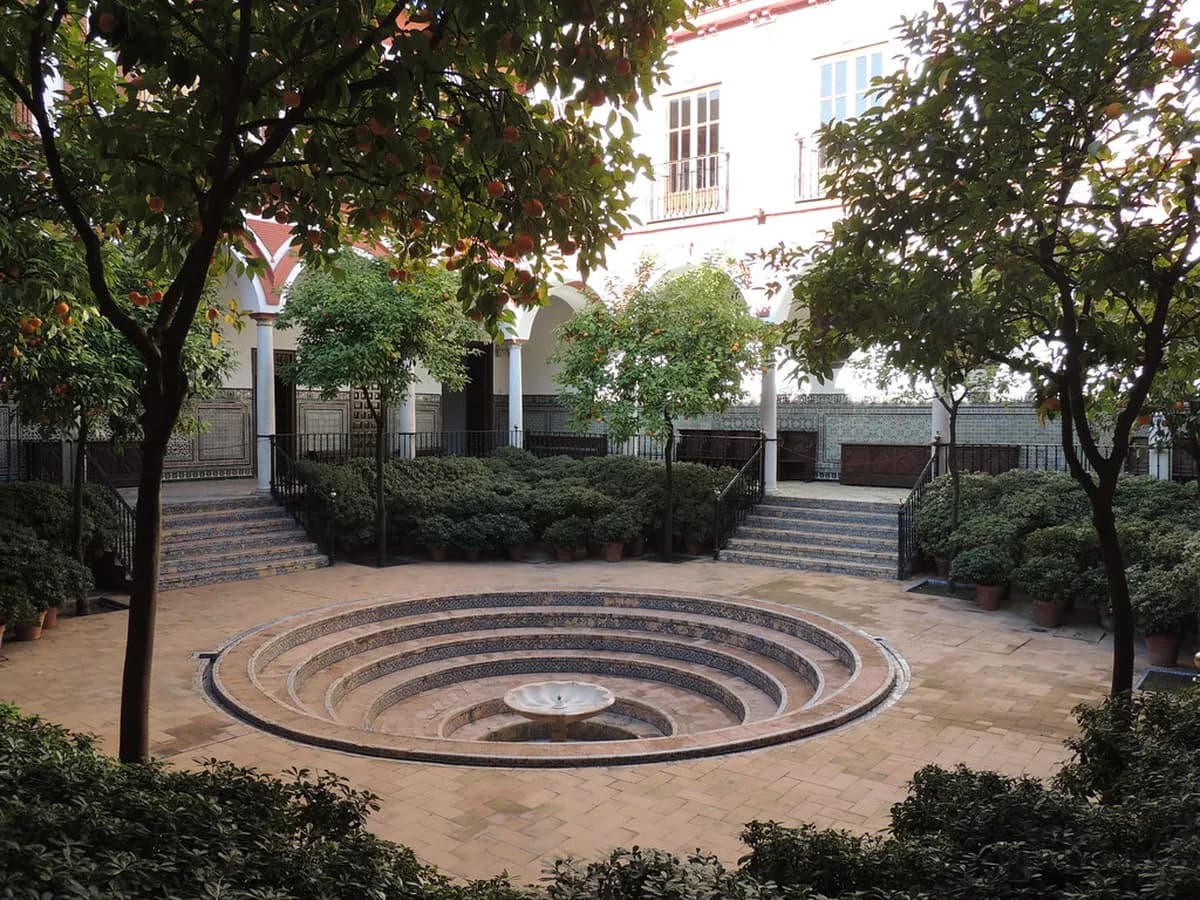
From there the route passes the Jardín de los Limoneros, a lemon-tree garden centered on a small tiled fountain, then the main courtyard, ringed by Mudejar-style arches and carved wooden ceilings, before finishing through the furnished interior rooms and the palm-shaded Jardín de Santa Justa.
- Entrance courtyard, for the 17th-century Alba coat of arms and bougainvillea-covered walls
- Old stables, a sunken former bathhouse showing the site's earlier Islamic-era use
- Jardín de los Limoneros, a quiet lemon garden with a tiled fountain
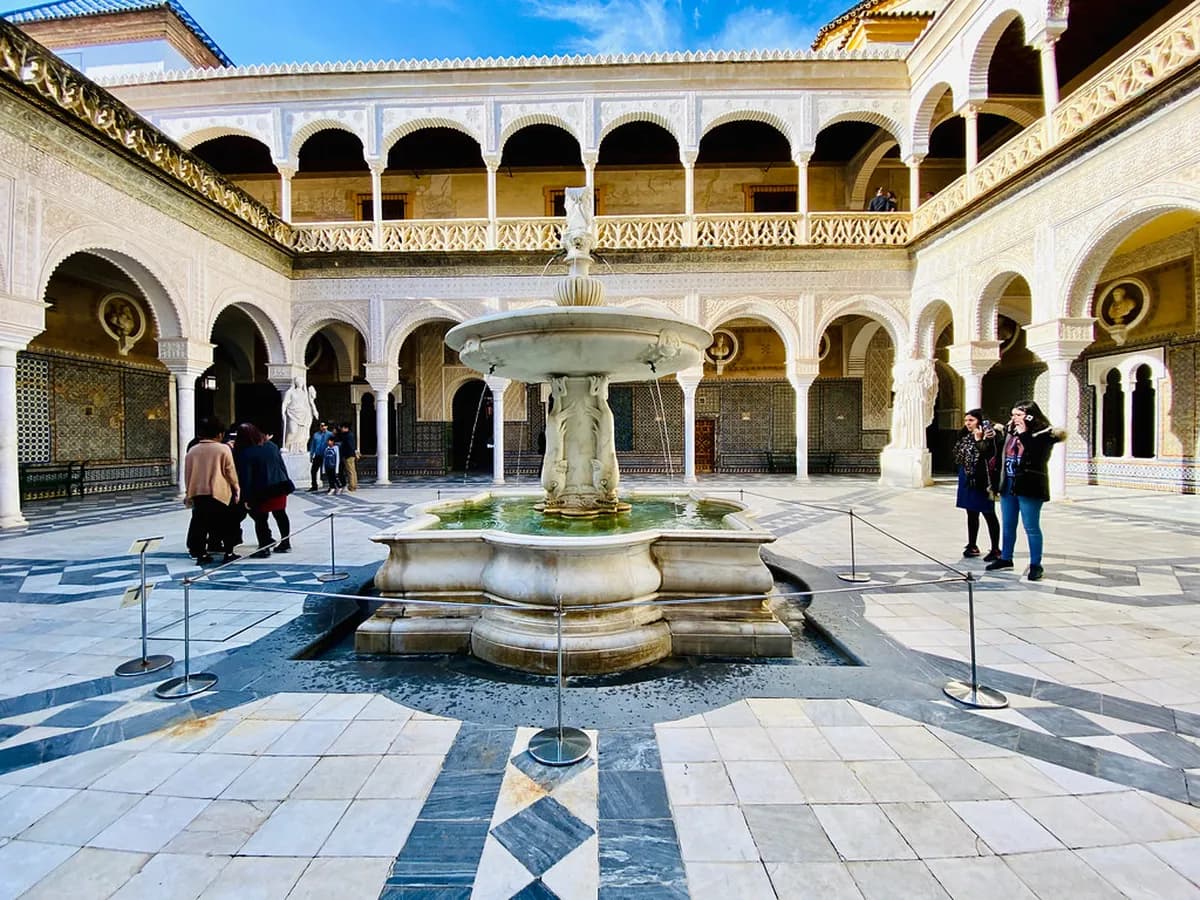
- Main courtyard, the most photographed space, with Mudejar arches and wooden ceilings
- Interior salons, furnished as a lived-in family home rather than a formal museum
- Jardín de Santa Justa, a shaded closing garden good for a last quiet moment
Museums, Art, and Culture in Palacio
Palacio de las Dueñas functions as a living museum rather than a curated gallery. Its rooms hold more than a thousand historic objects, protected under Andalusian heritage law, collected by the House of Alba over four centuries of residence.
Visitors move through hallways lined with 16th- and 17th-century Italian and Spanish paintings, Flemish tapestries, and antique furniture passed down through the family. Little is roped off the way it would be in a national museum, which is part of what makes the visit feel personal rather than staged.
The architectural mix reinforces the same layered history: Mudejar, Gothic, and Renaissance elements sit side by side, echoing the nearby Real Alcázar. For a more formal survey of Sevillian painting, the Museo de Bellas Artes de Sevilla is a short taxi ride away.
Parks, Gardens, and Outdoor Spots in Palacio
The outdoor spaces at Palacio de las Dueñas are as memorable as the interiors, and for many visitors they're the main reason to come. Century-old ficus trees and tall cypresses give the gardens a sense of scale you won't find at the palace's smaller sister sites.
The Jardín de los Limoneros offers a picturesque, quiet setting near the start of the route. It was historically the section of garden open to tenants who rented apartments within the palace grounds, which explains its more modest layout compared with the main courtyard.
The Jardín de Santa Justa closes the visit with denser shade and fewer people lingering. Use the palace's own interactive garden map to identify individual plant species, since nothing on-site is labeled in English.
Shade matters more here than at most Seville attractions, given how few covered spots exist between the entrance and the exit.
Family-Friendly and Budget-Friendly Options in Palacio
Palacio de las Dueñas can work well for families and budget-conscious travelers, but it rewards a little planning. The open courtyards give children room to explore, while the furnished rooms are closer to "look, don't touch," so it suits curious kids better than toddlers.
Children under 6 enter free with no ticket needed. Visitors aged 6-25, over-65s, the unemployed, and people with disabilities qualify for reduced tickets, though staff may ask for ID or documentation.
The single best budget move is the free-entry window on non-holiday Monday afternoons, 16:00 until one hour before closing (a small ~€1 booking fee may still apply, and slots are limited, so reserve early).
The coat-of-arms tile, the sunken stables, and the garden fountains give kids specific things to spot.
Children under 6 enter free. Weekday mornings right at opening are consistently the quietest window to explore without crowds.
Tickets and Opening Hours
General self-guided admission with an audio guide costs €15 for adults, with reduced tickets at €11-13 for the categories listed above. A guided tour with an official guide runs €35, and a themed night tour costs €25 — worth knowing before you decide which option fits your trip.
From April to September the palace is open daily 10:00-20:00, with last entry at 19:15. From October to March it switches to 10:00-18:00, last entry 17:15. It closes on January 1, January 6, and December 25, so double-check the calendar if your 2026 trip lands near a Spanish public holiday.
- Self-guided with audio guide suits most first-timers: cheapest, flexible, roughly 60-90 minutes
- The guided tour costs more than double but adds a live narrative and Q&A, worth it for history-focused travelers
- The night tour trades daylight for atmosphere at a mid-range price, better suited to a repeat visit than a first one
- In recent summers the gardens have hosted evening performances of Bizet's opera Carmen, roughly 75 minutes, ticketed separately from standard entry
| Ticket Type | Price (Adults) | Price (Reduced) | Duration/Best For |
|---|---|---|---|
| Self-guided with audio guide | €15 | €11–13 | 60–90 minutes; first-timers |
| Guided tour | €35 | — | Full narrative & Q&A; history enthusiasts |
| Night tour | €25 | — | ~75 minutes; atmosphere & return visits |
How to Plan a Smooth Palacio Attractions Day
Book online during spring and autumn, Seville's busiest shoulder seasons, to secure your time slot rather than queuing at the door. Weekday mornings right at opening are consistently the quietest window; afternoons and weekends draw the largest crowds.
Allow 60-90 minutes for a relaxed self-guided visit, closer to two hours with the audio guide through every room. The palace sits in Santa Catalina, walkable in about 10-15 minutes from Plaza Nueva or the Cathedral, and the C5/C6 circular buses that loop the historic center both stop nearby.
If you only have one full day in central Seville, weigh Dueñas against the two other palace-style sights nearby rather than trying to fit all three in.
- Real Alcázar demands the most time and money (tickets from roughly €21, often 2+ hours with queues) but delivers the city's most spectacular interior — prioritize it if you're seeing Seville once
- Casa de Pilatos sits a short walk from Dueñas, costs less than the Alcázar, and takes about an hour — a natural pairing since both are quieter
- Palacio de las Dueñas is the shortest and cheapest of the three at self-guided rates, best for gardens and a lived-in family-home feel over a formal state visit
You can also plan other activities in Seville around your palace visit, especially if combining it with Casa de Pilatos.
Visit Palacio de las Dueñas in Seville
The Palacio de las Dueñas stands at Calle Dueñas, 5, in Santa Catalina, a residential pocket just north of the tourist-heavy Santa Cruz quarter. Its central location makes it an accessible, rewarding stop whether it's your first or fifth visit to the city.
The palace is reachable on foot from many central areas, including the Alameda de Hércules a few minutes away, and public buses also serve the surrounding streets. It shares an architectural lineage with the Real Alcázar but feels far less crowded, which is its main draw for repeat visitors.
An audio guide, available in several languages, is included in the standard ticket and gives context for each room, though it leans heavily on names and dates rather than stories. First-time visitors generally get more out of it than travelers who've already toured several Seville palaces.
The experience offers a blend of architectural beauty, historical narrative, and artistic treasures, and gives a genuinely different insight into a noble Spanish household than the more formal, state-run Real Alcázar next door.
Hotels close to the Palacio de las Dueñas
Staying near the Palacio de las Dueñas puts you within walking distance of both Santa Cruz and Alfalfa, two of the best base points for exploring central Seville on foot. Several hotel tiers sit a short stroll from the palace gates.
Luxury options like CoolRooms Palacio Villapanés occupy converted historic buildings and typically run upward of €200 a night in peak season, often with rooftop pools. Mid-range hotels in the Vincci and Posada del Lucero style usually land in the €130-180 range, with 2026 rates fluctuating by month.
Budget guesthouses and apartments in Santa Catalina and Alfalfa give a more local experience, often with kitchen facilities, and can come in well under €130 a night outside peak weeks. Weekday stays are consistently cheaper than weekend rates across all three tiers.
Proximity matters most if you want an early-morning visit before the tour groups arrive, or a quiet evening stroll through Santa Catalina after the day's heat breaks.
The beautiful palace is also known as 'Casa de Alba'
Palacio de las Dueñas takes its name from the old Monastery of Santa María de las Dueñas, which once stood on the grounds and is long gone but preserved in the title. It was built between the late 15th and 16th centuries by the Pineda family, who were later forced to sell it to pay a ransom after a family tragedy.
In 1612, the palace passed to the House of Alba and has remained in their hands since. The Duchess Cayetana Fitz-James Stuart, one of Spain's most recognized aristocratic figures, spent much of her life here and married her third husband, Alfonso Díez, at the palace on October 5, 2011.
The palace opened to the public in 2016, decades after it had already become a gathering place for royals, writers, and artists through the 20th century. Poet Antonio Machado was born within its walls in July 1875 and spent part of his early childhood there.
The current Duke of Alba, Fernando Fitz-James Stuart, still uses parts of the palace as a private residence, which is why only a portion of the grounds is open to visitors. Understanding its role as the 'Casa de Alba' adds context to the family portraits and personal effects you'll encounter on the walk.
Tips for visiting the Palacio de las Dueñas
Wear comfortable shoes, since the visit crosses courtyards, gardens, and rooms over uneven historic flooring, and Seville's cobblestone streets demand sturdy footwear too. Photography is generally allowed throughout, but respect any signage restricting flash near textiles and paintings.
The ground floor and both gardens are step-free and manageable for wheelchairs and strollers, but the old stables sit about two meters below the main courtyard and are reached only by a short flight of stone steps with no ramp. Visitors with mobility limitations can simply skip that one room without missing the rest of the route — a detail that isn't obvious from a generic "wheelchair accessible" listing.
The palace is a short walk from Casa de Pilatos, making it easy to visit both back-to-back.
Avoid the midday summer heat, which regularly tops 38°C in July and August; the gardens offer more shade than most Seville attractions, but the interior rooms aren't air-conditioned. Check for temporary exhibitions or the seasonal Carmen opera performances before you go.
Interior rooms are not air-conditioned, and midday summer heat regularly tops 38°C in July and August. Plan your visit for early morning, evening, or during cooler months.
Find Accommodation Nearby
Finding the right accommodation near Palacio de las Dueñas depends on your priorities and budget. Prioritize the old city center — Santa Catalina, Santa Cruz, or Alfalfa — for easy walking access to the palace and other major attractions.
If you plan to explore beyond the historic core, look for hotels near a C5/C6 bus stop or the T1 tram line for flexibility. Read recent guest reviews for cleanliness and noise levels, since many buildings are centuries-old conversions with thin walls.
Book ahead for spring and autumn, when rates rise and the best rooms sell out first. Amenities like breakfast, Wi-Fi, or a rooftop pool matter more in Seville's summer heat than elsewhere in Europe — details that shape your overall experience in Seville.
Frequently Asked Questions
What is the Palacio de las Dueñas / Casa de Alba?
The Palacio de las Dueñas is a historic Sevillian palace and the primary residence of the House of Alba. It showcases a rich blend of Gothic, Mudejar, and Renaissance architectural styles. Visitors can explore its beautiful courtyards, gardens, and art-filled rooms, offering a glimpse into Spanish aristocratic life.
Where is Palacio de las Dueñas in Seville?
Palacio de las Dueñas is centrally located in Seville, Spain, at Calle Dueñas, 5. It is easily accessible by foot from many parts of the city center. The palace is situated in a vibrant neighborhood, close to other cultural attractions and dining options.
How much time should you plan for a Palacio de las Dueñas visit?
Most visitors find 1.5 to 2 hours sufficient to explore the Palacio de las Dueñas thoroughly. This allows time to enjoy the gardens, courtyards, and interior rooms at a leisurely pace. Add extra time if you wish to linger or revisit favorite spots.
Is Palacio de las Dueñas worth including on a short itinerary?
Yes, Palacio de las Dueñas is highly recommended even on a short Seville itinerary. Its manageable size and central location make it easy to fit into a busy schedule. It offers a unique cultural and historical experience distinct from other major attractions.
What should travelers avoid when planning a Palacio de las Dueñas visit?
Avoid visiting without checking current opening hours and ticket availability, especially during holidays or peak season. Do not forget to wear comfortable shoes for walking. Also, try to avoid midday summer heat by visiting earlier or later in the day.
Other Palaces the Family Still Uses
The Alba dukes still live here, which is why the courtyards feel arranged for use rather than display. Rome's Palazzo Colonna opens its Great Hall for a few hours a week and remains in the same family after eight centuries. Milan's Museo Bagatti Valsecchi was lived in by the brothers who furnished it and is still shown as a home.
The Palacio de las Dueñas offers a captivating journey into Seville's aristocratic past. This 2026 visitor guide covers everything from precise ticket prices to which room to skip if mobility is a concern.
From its stunning architecture to its serene gardens and centuries-old art, every corner tells a story. The palace stands out precisely because it feels smaller and more personal than its grander neighbors.
Plan your trip using these insights, and pair it with Casa de Pilatos if you have the afternoon free — you'll leave with a deeper appreciation for Spanish heritage in the heart of Andalusia.
For the latest official information, see the Palacio de las Dueñas official site and Palacio de las Dueñas on Wikipedia.
For more on planning your Seville visit, explore our guides on things to do in Seville, a 3-day Seville itinerary, and hidden gems in Seville.
Continue exploring
More guides you'll find useful