Stockholm Subway Art: Tunnelbana Guide & Best Stations
Explore Stockholm subway art tunnelbana: the world's longest art gallery. See the best Blue, Red, and Green Line stations, 2026 ticket prices, and routes.
On this page
Stockholm Subway Art Tunnelbana: The Complete Station Guide
Last updated July 2026: Stockholm subway art tunnelbana routes turn an ordinary Tunnelbana ride into a tour through the world's longest art gallery, where roughly 90 of the network's 100 stations are decorated with murals, mosaics, and raw bedrock caves. This guide breaks the Blue, Red, and Green lines into a self-guided route, with 2026 ticket prices, timing windows, and photography etiquette so a single ticket or day pass covers the highlights efficiently. Expect station-by-station detail, a cost breakdown, and route options built for both a quick stop and a full afternoon loop.
Stockholm Subway Art Tunnelbana: Inside the World's Longest Art Gallery
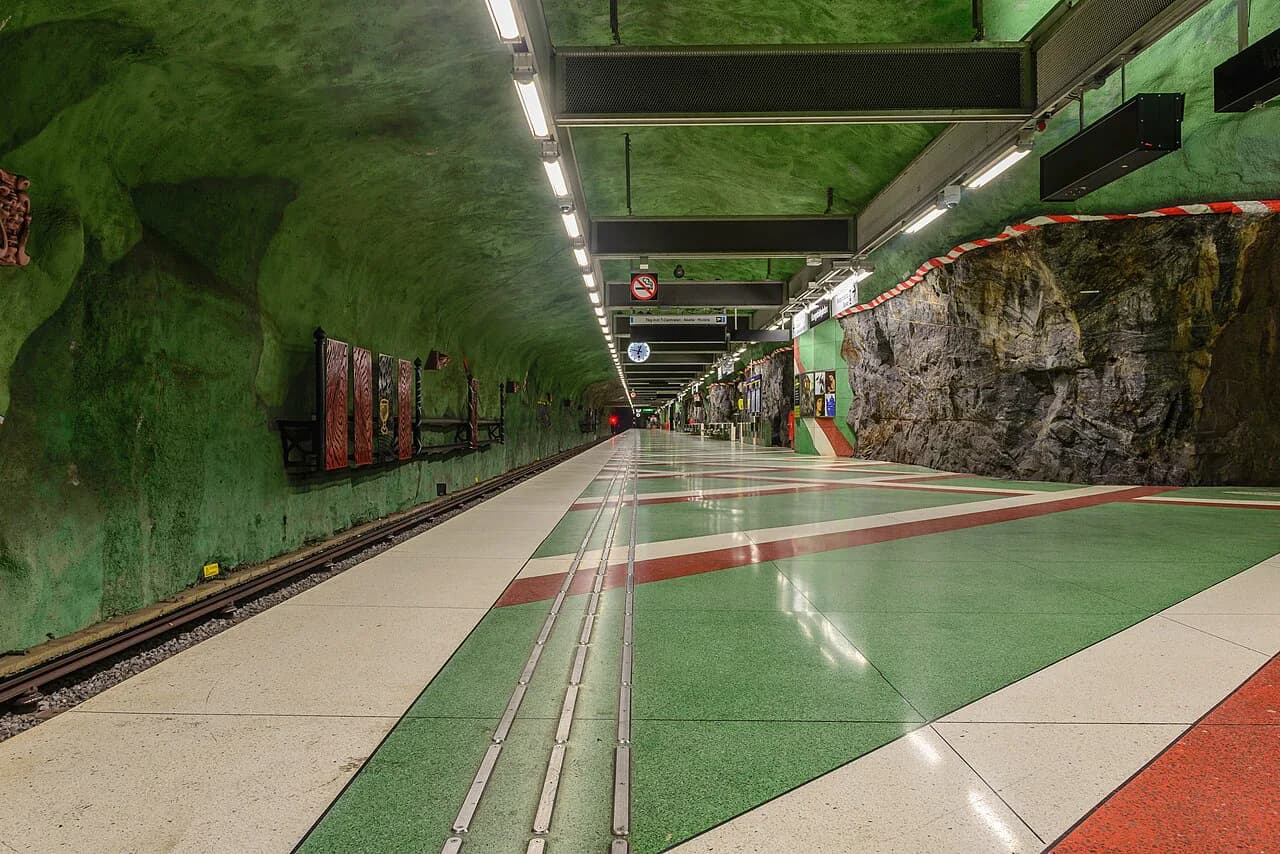
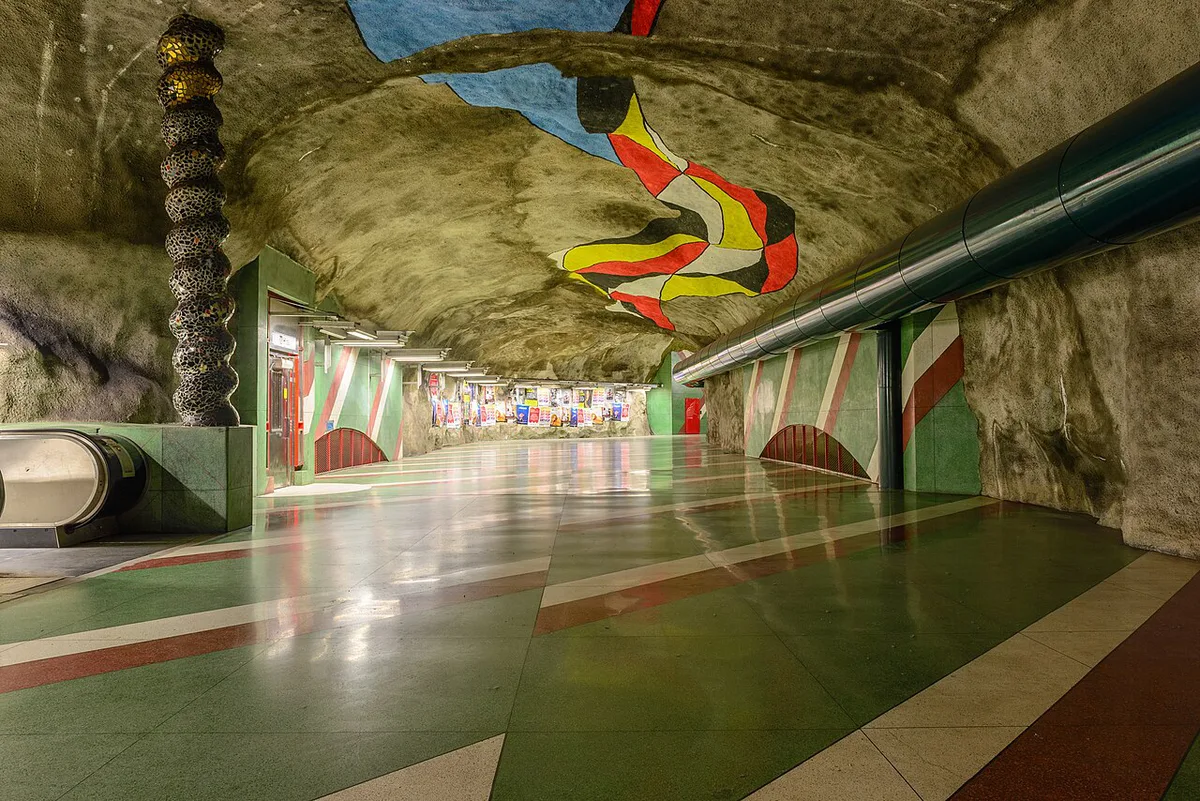
Stockholm subway art tunnelbana lines cover roughly 110 kilometers of track across three color-coded lines, and the transit operator SL (Storstockholms Lokaltrafik) has commissioned artists to decorate stations since 1957. Of the network's approximately 100 stations, more than 90 feature permanent art — mosaics, sculptures, neon installations, and, most distinctively, platforms carved directly into exposed granite bedrock instead of finished with standard tiling. That bedrock treatment is what separates Stockholm's system from most metro art programs elsewhere: rather than covering the rock, several stations leave it rough and painted, turning the tunnel itself into the artwork. For travelers who prioritize distinctive Stockholm experiences over standard museum visits, the Tunnelbana delivers a free-form gallery that rewards slow exploration, and it pairs naturally with a day spent tracking down lesser-known Stockholm corners above ground.
Tunnelbana Tickets, Timing, and the SL App
Getting the most out of a Stockholm subway art tunnelbana visit starts with the right ticket. A single-use ticket covers 75 minutes of travel, including transfers, which works for a short loop but is tight for the full multi-line route. Recent SL.se pricing lists a single ticket at 42 SEK and a 24-hour pass at 175 SEK; because fares are adjusted periodically, confirm the current 2026 rate on sl.se before heading underground. Tunnelbana stations generally run from around 05:00 to 00:30, with 24-hour service on weekends, so both an early start and a late-night visit work for uncrowded photography. Pay with a contactless bank card or phone directly at the fare gates, or buy tickets in advance through the SL app — both skip the ticket-machine queue that trips up first-time visitors. Physical SL Access cards are still sold at station counters for travelers who prefer a dedicated transit card. For timing, aim for the 10:00–14:00 window on a weekday: it sits after the 07:30–09:00 commuter rush and before the platforms fill up again, giving the clearest shots. Build the rest of the day around avoiding Stockholm's peak crowds generally, and remember that once inside the gates the art itself costs nothing extra — it rides along with budget-friendly Stockholm outings that already use the transit system to get around.
| Ticket Type | Price | Best For |
|---|---|---|
| Single ticket (75 minutes) | 42 SEK | A quick, one-directional 'Express Route' of Blue Line highlights |
| 24-hour pass | 175 SEK | The full multi-line loop plus other sightseeing on the same pass |
The Blue Line: Stockholm's Dramatic Cave Stations
The Blue Line carries Stockholm's reputation for dramatic subway art, since most of its stations were carved straight into the bedrock rather than built with conventional tunneling and tiling. Expect raw rock, deep color washes, and cave-like ceilings — a moodier, more theatrical feel than the Tunnelbana's other two lines. Because a single Tunnelbana fare covers the whole network, the Blue Line stops leave room to continue elsewhere on the same ticket. Competitor-tested pairings include a stop in Södermalm's cafe scene or one of the ferries near Djurgården's ferry piers once the platform art is done.
- T-Centralen: The Blue Line platform is painted almost entirely in vivid blue, with artist Per Olof Ultvedt's cave-motif vines and worker silhouettes running along the rock ceiling. The Red and Green line platforms one level up date to 1957 and use a more traditional geometric-tile design.
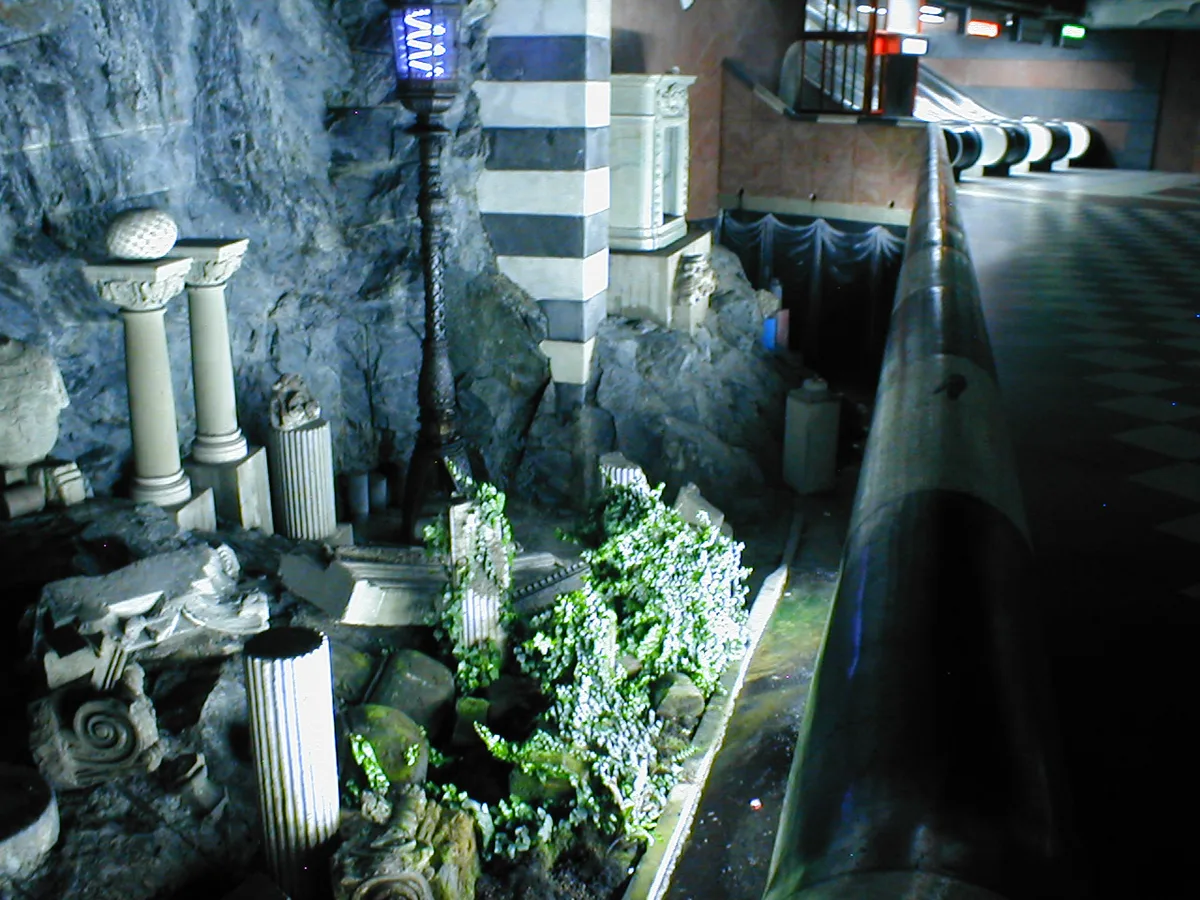
- Kungsträdgården: Designed by Ulrik Samuelson, this station recreates an excavated baroque garden underground, with fragments of ruined columns, statue casts, and rock-embedded sculptures set against damp, exposed bedrock walls.
- Solna Centrum: The platform ceiling is painted a dramatic red evoking a forest fire sky, fading into green forest tones toward the platform ends.
- Radhuset: Named for the City Hall above it, Radhuset keeps its bedrock walls in earthy, pinkish tones with minimal added ornamentation, making it one of the rawer 'cave' stations on the line.
The Red Line: Science, Nature, and Human Rights Themes
Where the Blue Line goes for drama, the Red Line's art leans social and scientific — stations designed to reflect the institutions above them. Heading north from T-Centralen, confirm the train's listed terminus before boarding: the Red Line splits into two northern branches, and only the branch continuing past Stadion reaches Tekniska Högskolan and Universitetet.
The Red Line splits past Stadion into two northern branches—confirm your train's destination before boarding. Its institutional-themed stations contrast with the Blue Line's dramatic cave bedrock and Green Line's retro graphics, creating thematic variety across the three-line system.
- Stadion: Opened in 1973 as one of the first bedrock 'cave' stations, Stadion was given a rainbow theme by artists Åke Pallarp and Enno Hallek specifically to counter fears that exposed rock would feel bleak underground.
- Tekniska Högskolan: Serving the Royal Institute of Technology, the station's centerpiece is a large glass polyhedron installation surrounded by science- and invention-themed artwork.
- Universitetet: Below Stockholm University, tile panels trace the travels of Carl Linnaeus, the Swedish botanist known as the father of modern taxonomy, alongside artwork referencing the UN Declaration of Human Rights.
The Green Line: Retro History and Graphic Art
The Green Line's art skips theatrics for a more historical and graphic sensibility, tracing the Tunnelbana's own design history from the 1950s to today. Each of these three lines can be ridden independently or combined into a single loop, which the itinerary section below lays out as ready-made routes.
- Hötorget: One of the original 1950s stations, Hötorget kept its plain tile walls and retro signage until artist Gun Gordillo added a neon ceiling installation in 1998 — a deliberate contrast between mid-century restraint and modern light art.
- Thorildsplan: Renovated with an 8-bit theme, Thorildsplan's tiled walls reference early video game graphics, giving the platform a pixel-art look unlike anywhere else on the network.
- Odenplan: The newer platform features a 'Line of Life' neon installation designed to echo a heartbeat pulse along the ceiling.
Self-Guided Tunnelbana Art Itineraries
Match the plan to the ticket in hand, since the Blue, Red, and Green line highlights don't all fit inside a single 75-minute window. The art trail also fits naturally into a broader day across Stockholm's diverse neighborhoods. The same 24-hour pass stretches toward Vasastan's residential streets, Kungsholmen's waterfront paths, or Östermalm's grand boulevards near the Östermalmstorg art station, without needing a second fare. For a slower finish, the same ticket also reaches the Monteliusvägen skyline walk and the Skogskyrkogården cemetery grounds, plus a stop for Stockholm's local food scene — all worked into the same fare used for the station art.
The Hidden Gems route—Hallonbergen and Tensta—pairs perfectly with a 24-hour pass and 10:00–14:00 weekday timing: outer stations attract fewer photographers crowding the frame, while mid-morning hours avoid both the commuter surge and the repeated train traffic at central platforms.
- Express Route (75 minutes, single ticket): Start on the Blue Line at T-Centralen for the vivid blue cave platform, then ride one stop to Kungsträdgården for the excavated-garden installation. This stays inside one 75-minute ticket since it doesn't backtrack across lines.
- Full Loop (24-hour pass, around two hours of station time): Cover all three lines — the Blue Line caves (T-Centralen, Kungsträdgården, Radhuset, Solna Centrum), the Red Line's science and rights themes (Stadion, Tekniska Högskolan, Universitetet), and the Green Line's history and graphics (Hötorget, Thorildsplan, Odenplan) — using the pass's unlimited rides to backtrack through T-Centralen between lines.
- Hidden Gems Route: For travelers chasing far-flung suburban stations, Hallonbergen and Tensta sit further from the center but carry their own recognized installations, and both appear alongside the city-center stalwarts on official lists of the Tunnelbana's most photogenic platforms — a solid pick for anyone after under-the-radar Stockholm spots.
Photography Tips and Commuter Etiquette Underground
Most cave stations run darker than a typical smartphone camera expects, often with an orange tint from sodium-style lighting, so images can come out grainier or warmer than reality. A longer exposure — even braced against a bench or wall rather than shot handheld — captures the bedrock texture far better than a quick snapshot. Shooting from the middle of the platform generally gives the most symmetrical view of a station's ceiling art, since most installations are designed to be seen from that central sightline. Commuter friction is the main hazard for photographers: locals use these stations to get to work, not to pose for visitors, so keep gear compact, avoid blocking escalators or fare gates, and expect the platforms to feel busier and faster-paced outside the recommended 10:00–14:00 window.
- Bring a compact tripod, or brace the camera against a fixed surface for longer exposures in low light.
- Shoot from the platform's center line for the most symmetrical framing of ceiling art.
- Expect a handful of trains to pass while composing a shot — platforms stay in live service, so plan around it rather than around a closure.
- Stay back from the platform edge and the yellow safety line during busier periods so a shot doesn't block boarding passengers.
Mistakes to Avoid on Your Tunnelbana Art Tour
A handful of planning slip-ups turn an efficient subway art tour into a frustrating one.
- Underestimating the 75-minute ticket window: a single ticket covers one continuous 75-minute journey, not a full multi-line loop with long stops at each station — budget a 24-hour pass for the Full Loop route instead.
- Visiting during rush hour: 07:30–09:00 and 16:30–18:00 bring the heaviest commuter traffic, cramped platforms, and the least patience for tripods or slow photographers.
- Boarding the wrong branch: several lines split outside the city center — the Red Line, for example, forks toward two different northern termini — so confirm the destination shown on the train before boarding.
- Skipping the upper concourses: art often continues past the platform into escalator halls and ticket areas, so it's worth walking the full length of a station rather than just the platform.
Less-Crowded Outer Stations Worth the Extra Ride
If the central platforms feel too busy, extend the tour beyond the usual T-Centralen, Stadion, and Solna Centrum circuit. On the Blue Line toward Akalla, Hallonbergen is one of the easiest quieter additions: its walls are covered with deliberately childlike drawings by Elis Eriksson and Gösta Wallmark, giving the station a softer, more playful mood than the dramatic cave stops closer to the center.
Continue farther on the same branch to Tensta for a more community-focused station, with large-scale artwork linked to migration, solidarity, and everyday life in the surrounding suburb. These outer stations take longer to reach, so they fit better with a 24-hour pass than a strict 75-minute ticket. They are especially useful for photographers who want cleaner platform views without waiting through repeated train arrivals at the most famous stops.
Frequently Asked Questions
What is Stockholm subway art (Tunnelbana art) and why is it called the world's longest art gallery?
Stockholm subway art tunnelbana refers to the Tunnelbana's decades-long program of commissioning artists to design its stations — more than 90 of the roughly 100 stations carry permanent murals, mosaics, sculptures, or bedrock carving across a network spanning around 110 kilometers, which is why it's commonly described as the world's longest art gallery.
How much does it cost to see the Stockholm subway art?
Seeing the art costs whatever a standard Tunnelbana ticket costs, since no separate admission applies. Recent SL.se pricing lists a single 75-minute ticket at 42 SEK and a 24-hour pass at 175 SEK; check sl.se directly for the current 2026 fare before traveling, since prices are adjusted periodically.
Can the subway art tour be done on a single 75-minute ticket?
A short Blue Line loop, such as T-Centralen to Kungsträdgården, fits comfortably within one 75-minute ticket. Covering all three lines and the full station route takes closer to two hours of station time, which is easier to manage with a 24-hour pass that allows unlimited re-entry.
What's the best time to visit for photos without crowds?
Weekday mid-mornings to early afternoons, roughly 10:00 to 14:00, offer the clearest platforms, since that window falls after the 07:30–09:00 commuter rush and before the 16:30–18:00 evening rush. Weeknight visits also work, since stations stay open until around 00:30.
Do you need a special ticket for the subway art tour, or is it included with a regular transit ticket?
No special ticket exists — a standard single ticket or day pass covers entry to every station, so the art is effectively free once inside the fare gates, making it one of the more accessible free things to do in Stockholm for budget travelers.
Continue exploring
More guides you'll find useful