Monestir De Pedralbes Visitor Guide: Plan Your Trip to Barcelona's Royal Monastery
Plan your visit to Monestir de Pedralbes with our comprehensive guide. Discover history, attractions, practical tips, and unique tours for a memorable Barcelona experience.
On this page
Monestir De Pedralbes Visitor Guide
Tucked into the quiet upper reaches of Barcelona's Les Corts district, the Monestir de Pedralbes is one of the city's most rewarding half-days out. Most first-time visitors never make it this far from the Eixample — which is precisely why it is worth the trip.
Founded in 1326 by Queen Elisenda de Montcada, the monastery is one of the finest surviving examples of Catalan Gothic architecture. Its three-storey cloister, 14th-century frescoes, and carefully preserved daily life spaces offer a depth that Barcelona's more famous monuments rarely match.
This guide covers everything you need for 2026: exact admission prices, opening hours, transport options, the best guided tours, and the exhibits most visitors walk past without realising what they are missing.
History and Significance of Monestir de Pedralbes
The monastery takes its name from the Latin petras albas — white stones — a reference to the pale local limestone used in its construction. Queen Elisenda de Montcada, fourth wife of King Jaume II of Aragon, founded it in 1326. She secured papal permission for the community to follow the rule of the Poor Clares, a Franciscan order, and remained unusually hands-on as a patron: after her husband's death she moved into an adjoining palace and spent her final years beside the women she had installed there.
The monastery's first decades coincided with some of Catalonia's most turbulent years. Barcelona in the early 14th century was both wealthy and politically volatile, and the Black Death reached Catalonia within two decades of the foundation. Yet the cloister and surrounding buildings survived largely intact — a remarkable fact that makes Pedralbes one of the best-preserved Gothic monastic complexes in Spain.
Unlike many urban monasteries that lost their communities during 19th-century anti-clerical upheavals, the Poor Clares of Pedralbes held on through repeated expulsions and threats of dissolution. The last nuns left the main complex in 1983, though a small community continues to live nearby today. What you are visiting is therefore not a ruin or a reconstruction but a lived space, preserved by seven centuries of continuous habitation.
Today the Museu Reial Monestir de Santa Maria de Pedralbes is a cornerstone of Barcelona's cultural heritage, open for public visits Tuesday through Sunday year-round.
What to See: Key Attractions and Highlights
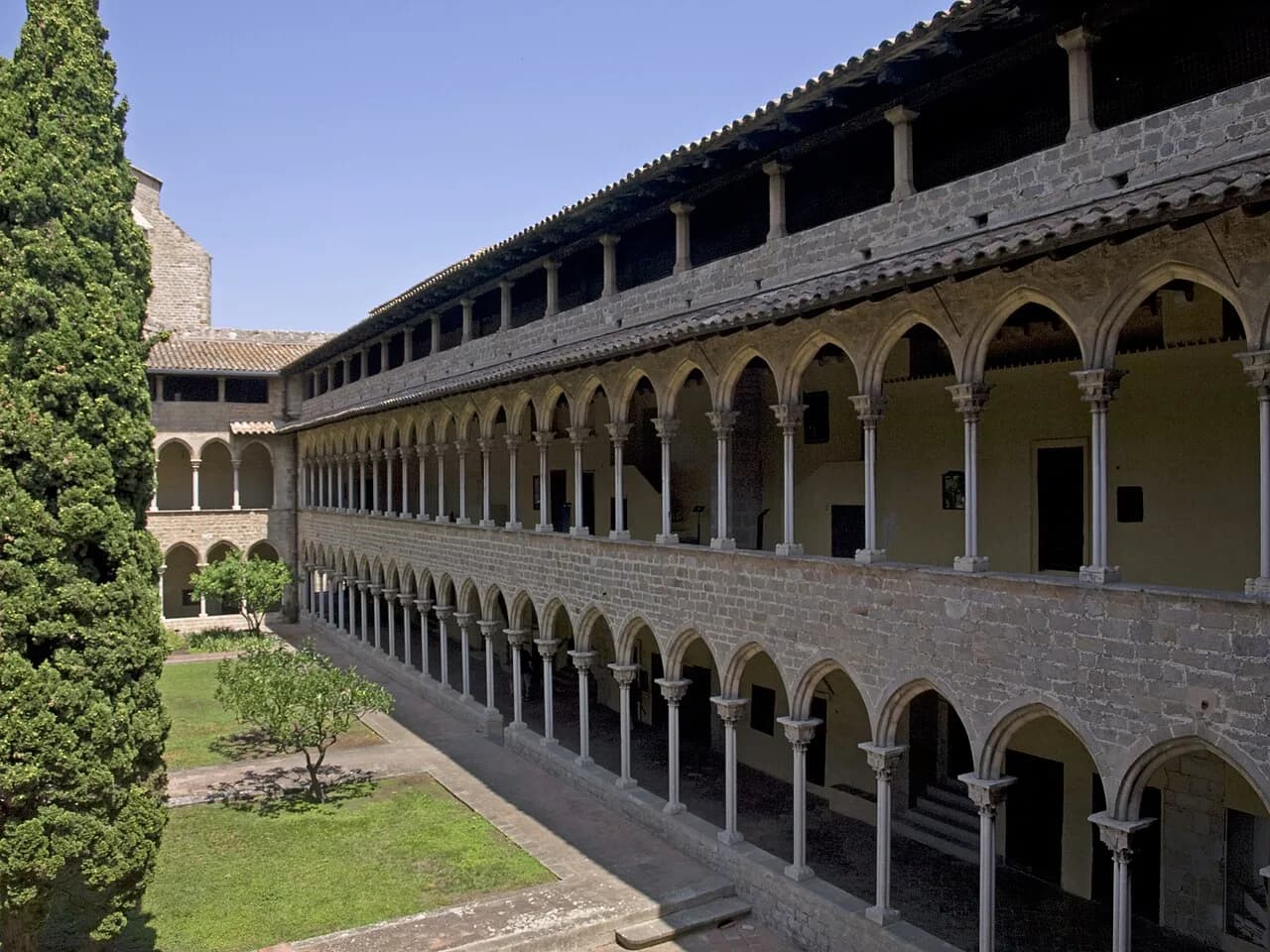
The centrepiece is the three-storey Gothic cloister, measuring roughly 40 metres per side — one of the largest in Europe. Its slender columns, pointed arches, and central garden create a spaciousness that feels extraordinary in a city as dense as Barcelona. Walking the ground floor arcade, you can look up through all three levels to open sky.
St Michael's Chapel (Capella de Sant Miquel) is the monastery's artistic highlight. Its walls carry 14th-century frescoes by Ferrer Bassa, painted in the 1340s and showing the Passion of Christ on one wall and the Joys of the Virgin on another. Art historians often compare Bassa's style to Giotto's: the same intimacy, the same quiet intensity. The chapel recently completed an extensive restoration and is in excellent condition for 2026 visits.
In the church, the Sepulchre of Queen Elisenda is a double-sided monument unique in Barcelona. One face shows her dressed as a sovereign, looking into the church; the other shows her as a widow and penitent, looking into the cloister. The church also holds 14th-century stained glass windows and three sets of choir stalls — upper choir, lower choir, and friar's choir — that are easy to overlook if you move through quickly.
The museum floors above the cloister walk deserve more time than most visitors give them. The nuns' cells, partially recreated behind glass, show wooden beds, simple shelves, and personal objects whose ordinary scale makes the past feel tangible. On the upper floor, objects missing from the collection are marked not with labels but with shaped mirrors in their place — a quietly poignant acknowledgement of what seven centuries of turmoil cost this community.
Exploring the Cloister and Gardens
The cloister is the heart of the complex and one of the great Gothic spaces in Spain. Three storeys of arcades rise around a central garden planted with orange trees, palms, and medicinal herbs — the same varieties the Poor Clares grew for the community's daily and medical needs. The combination of stone, greenery, and filtered light changes noticeably through the day.
Take time with the stonework. The tracery on the upper arches varies subtly bay by bay; the wear on the flagstones accumulates centuries of daily procession routes. Early morning — arrive at 10:00 when it opens — gives the best light conditions and often twenty minutes of near-solitude before the first tour groups arrive.
One practical note that most guides skip: the visit route is not immediately obvious from the entrance. Many visitors turn the wrong way around the cloister and end up at St Michael's Chapel as an afterthought rather than a destination. Follow the posted route signs from the ticket desk and you will reach the chapel while your energy is high. The correct route also takes you through the stone-walled kitchen and laundry courtyard — small, plainly furnished spaces that bring the rhythms of daily monastic life into sharper focus than any altarpiece.
The gardens are most fragrant from April through June, when the orange trees and medicinal plantings are in bloom. Spring mornings before 11:00 offer the best combination of light, scent, and thin crowds.
For the best experience, visit on a weekday morning between 10:00 and 11:00. This timing combines optimal light in the cloister, fragrant gardens during bloom season (April–June), and minimal crowds before tour groups arrive.
Guided Tours and Visitor Experiences
The standard self-guided visit with posted information panels is included in admission. An audio guide is available for hire at the entrance and earns its cost in the church and chapel sections, where the iconography is dense and the posted panels are brief.
The most distinctive guided option is the Guia'm tour. This Saturday-morning programme pairs visitors with a guide who has Asperger's syndrome, as part of an employment and social inclusion project run in collaboration with the Fundació Friends. The guides bring careful, precise observation to the monastery's details — the sort of attentiveness that a conventional tour rarely achieves. Tours run every Saturday from 11:30 to 12:30, except on public holidays, during Easter Week, and throughout August. The fee is €3, separate from general admission. Places are strictly limited; book by calling 93 256 34 27 or emailing reservesmonestirpedralbes@bcn.cat. Full scheduling details are on the official Guia'm booking page.
Group visits and school programmes can be arranged directly through the museum. Themed family workshops occasionally run on weekends and tend to fill quickly — check the monastery's events calendar before you visit if you are bringing children, as these programmes offer a far more interactive experience than the self-guided route alone.
Planning Your Visit: Tickets, Hours, and Practical Tips
The monastery is at Baixada del Monestir, 9, 08034 Barcelona, in the Les Corts district. Always confirm current hours and prices on the official website before you travel, as seasonal changes apply.
Opening hours for 2026:
- 1 April – 30 September: Tue–Fri 10:00–17:00, Sat 10:00–19:00, Sun 10:00–20:00
- 1 October – 31 March: Tue–Fri 10:00–14:00, Sat–Sun 10:00–17:00
- Closed every Monday and on 1 January, 1 May, 24 June, and 25 December
Admission in 2026: General admission is €5. Reduced admission (€3.50) applies to students under 30, over-65s, the unemployed, and groups of 10 or more. Children under 16, Barcelona Card holders, and ICOM members enter free. Admission is free for everyone on the first Sunday of each month and every Sunday from 15:00 onwards — a little-known window that makes Sunday afternoon one of the smartest times to visit.
| Ticket | Price |
|---|---|
| General | €5 |
| Reduced | €3.50 |
| Children under 16 | Free |
Admission is free on the first Sunday of every month and every Sunday from 15:00 onwards. The monastery is closed every Monday year-round.
The fastest public transport option is the FGC commuter rail L6 line: alight at Reina Elisenda station and walk uphill for about 10 minutes. Bus routes 22, 64, and 75 also stop nearby. For door-to-door directions use the Barcelona public transport planner. Weekday mornings are the quietest overall. The first Sunday of the month draws a crowd for free admission, but the complex is large enough to absorb it comfortably. Allow 2–3 hours for a full visit; the Guia'm tour adds one hour if you take it on a Saturday. The site has partial wheelchair access — contact the museum directly for details on specific sections, as some older areas have uneven surfaces.
Family-Friendly and Budget-Friendly Tips
The free admission windows make Pedralbes one of Barcelona's best-value museum visits. The first Sunday of each month and every Sunday afternoon from 15:00 onwards are both free with no registration required. A Sunday afternoon combines free entry with late-afternoon light in the gardens and a quieter second half of the cloister — one of the most pleasant conditions for a relaxed visit.
For families with children, the nuns' cells behind glass tend to engage younger visitors more than large altarpieces. The ordinary scale of the wooden beds, shelves, and personal objects makes the past feel concrete rather than abstract. The double-sided tomb of Queen Elisenda — sovereign on one face, humble widow on the other — is worth pausing to explain; it is the kind of detail children remember after everything else has blurred.
There are no picnic areas inside the monastery. The immediate neighbourhood has small cafes and a bakery within a few minutes' walk of the exit. For something more atmospheric, Petanca Pedralbes — a short walk downhill from the monastery — is an open-air café beside a pétanque court with shaded tables and cold drinks. It suits the unhurried mood of the visit well and is a far better option than tourist cafes in the centre of Les Corts.
Family workshops run periodically on weekends; check the monastery's events calendar before booking travel, as these programmes sell out quickly and add genuine depth to what the monastery can offer younger visitors.
Nearby Attractions and Things to Do
The Pedralbes neighbourhood rewards a slow walk after your visit. The streets around the monastery are quiet and largely residential, lined with early 20th-century villas and garden walls. It is one of the few parts of Barcelona where the pace genuinely slows and the tourists are thin.
CosmoCaixa, Barcelona's science museum, is a 15-minute walk north and is an excellent addition for families visiting in the morning. It offers several hours of hands-on exhibits and is large enough to occupy children who have run out of patience for Gothic cloisters.
For contemporary art, the Fundació Joan Miró is reachable by bus or metro — allow at least two hours there. For a sharp architectural contrast, Gaudí's first house, Casa Vicens, is accessible by a short FGC hop: vivid ceramic tiles, Moorish-influenced ornament, and a building that looks like nothing else in the city.
Park Güell is technically reachable from Pedralbes but involves a long walk or an indirect transit journey. If you want to combine both sites in a single day, do the monastery first and allow at least four hours total. They share an unhurried character — neither rewards rushing — which makes the pairing work if you pace it correctly.
Frequently Asked Questions
Which monestir de pedralbes visitor guide options fit first-time visitors?
First-time visitors will benefit from a self-guided tour with the audio guide for flexibility. Alternatively, a general guided tour provides a comprehensive overview of the monastery's history and key areas. Both options ensure you cover the essential highlights effectively.
How much time should you plan for monestir de pedralbes visitor guide?
Plan to spend approximately 2 to 3 hours for a thorough visit to the Monestir de Pedralbes. This allows ample time to explore the cloister, St Michael's Chapel, museum exhibits, and gardens at a relaxed pace. Guided tours typically last 60-90 minutes, so factor that in.
Is monestir de pedralbes visitor guide worth including on a short itinerary?
Yes, Monestir de Pedralbes is worth including even on a short Barcelona itinerary if you seek tranquility and history. It offers a unique contrast to the city's more bustling sites like Palau de la Música Catalana. Its relatively compact size means you can experience its main attractions efficiently within a few hours.
What is the history of Monestir de Pedralbes?
Queen Elisenda de Montcada founded the Monestir de Pedralbes in 1326 for the Poor Clare nuns. It served as a royal retreat and her eventual burial site. Over centuries, it functioned as a religious center, fortress, and now a museum. Its rich history reflects medieval Catalan society and royal patronage.
Are there guided tours available at Monestir de Pedralbes?
Yes, the Monestir de Pedralbes offers various guided tours. These include general historical tours and special programs like the 'Guia'm al Monestir de Pedralbes' tour. Check the official website for schedules and booking information. Booking in advance is often recommended, especially for specific tours.
Other Gothic Cloisters Still Standing Quiet
Three storeys of cloister, a chapter house and the day cells where the nuns worked, founded by Queen Elisenda in 1327 and never sacked. Madrid's Descalzas Reales is the Habsburg equivalent, still enclosed and still holding its tapestries. Florence's Museum of San Marco has Fra Angelico's frescoes in the cells themselves, painted for the friars rather than for visitors.
The Monestir de Pedralbes rewards anyone willing to make the trip uphill to Les Corts. Its medieval cloister, intimate chapel frescoes, and preserved daily life spaces offer a quality of experience that is rare in a city better known for Modernista showpieces.
This guide gives you what you need to plan the visit properly: exact 2026 hours, correct admission prices, Guia'm tour logistics, and the exhibits most visitors miss. The free Sunday afternoon window makes it accessible on almost any budget.
Come on a weekday morning if you can, follow the route signs from the entrance, and save time for the museum floors above the cloister. The nuns' cells and the shaped-mirror display are worth the extra twenty minutes.
To verify current details, consult the Monestir de Pedralbes on Wikipedia.
For more Barcelona planning, see our Hidden Gems in Barcelona guide.
For more Barcelona planning, see our Unique Things to Do in Barcelona guide.
Continue exploring
More guides you'll find useful