St Dunstan-in-the-East Visitor Guide: Free Church Garden & History
Plan a visit to St Dunstan-in-the-East, the free ruined-church garden in the City of London. Includes opening hours, history, getting there, best photo times, and etiquette.
On this page
St Dunstan-in-the-East Visitor Guide
St Dunstan-in-the-East is one of the most atmospheric free attractions in the City of London: the ruined shell of a medieval church, rebuilt after the Great Fire with a soaring steeple by Sir Christopher Wren, gutted in the Blitz, and now kept as a tranquil public garden where climbing plants pour through the empty window arches. Maintained by the City of London Corporation, it costs nothing to enter and sits only a short walk from the Tower of London and the Monument. This st dunstan in the east visitor guide covers the practical details you need in 2026: opening hours, getting there, the best times for photographs, accessibility, and the etiquette that keeps this quiet space special.
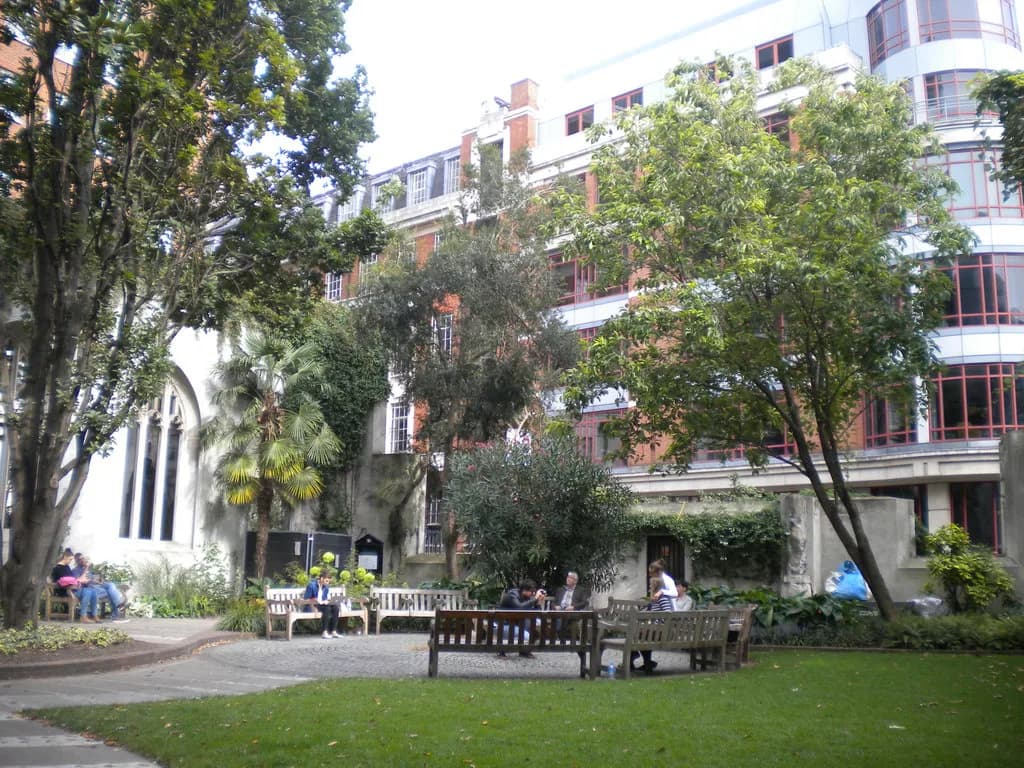
Unlike the ticketed heritage sites nearby, St Dunstan-in-the-East is not a museum with a front desk. It is a working public garden built inside a Grade I listed ruin, and that dual character is exactly why it has become one of the best-loved secret photography spots in London. Ivy and creepers frame the Gothic tracery, benches line the old nave, and a low fountain plays where the congregation once sat, making it feel far removed from the office towers pressing in on every side.
The garden suits anyone drawn to history, architecture, quiet green corners, or the layered story of how London rebuilds itself after disaster. It rewards a slow wander rather than a rushed tick-box visit, and it pairs neatly with the wider cluster of London attractions around the eastern City. Read on for everything you need to plan a smooth, respectful, and photogenic visit.
The History of St Dunstan-in-the-East
A church has stood on this site since around 1100, taking its name from Saint Dunstan, the tenth-century Archbishop of Canterbury. For centuries St Dunstan-in-the-East served the merchants, mariners, and residents of the eastern City, close to the wharves and warehouses that lined the medieval Thames. Its position between the river and the trading heart of London made it one of the busier parish churches of the old walled city.
The Great Fire of London in 1666 severely damaged the medieval building, but rather than demolishing it entirely the parish opted for extensive repairs between 1668 and 1671. The most famous addition came a little later: a steeple designed by Sir Christopher Wren and added around 1695 to 1701. Wren's needle-thin spire, supported on flying buttresses that spring from the tower corners, became a celebrated feature of the City skyline and is the element most visitors still admire today.
By the early nineteenth century the main body of the church had deteriorated, and it was rebuilt in a Gothic style by David Laing between 1817 and 1821, while Wren's tower and steeple were retained. This gave the church the layered character that its ruins still show: a Wren steeple crowning a Georgian-Gothic body, all raised on much older foundations. Understanding these three phases helps explain why the surviving fabric feels so varied as you walk around it.
For decades the rebuilt church continued as an ordinary City parish, its bells and services woven into the working rhythm of the surrounding streets. That long, uneventful chapter came to an abrupt end during the Second World War, when the building was caught in the bombing that reshaped so much of the City of London.
From Bombed Church to Public Garden
St Dunstan-in-the-East was severely damaged during the Blitz in 1941, when incendiary raids devastated large areas of the City. The main body of the church was gutted, but remarkably Wren's tower and steeple survived the bombing largely intact. That contrast between the ruined nave and the standing spire is the defining image of the site and the reason it feels so poignant to visit.
After the war, as the Anglican Church reorganised its many bomb-damaged City parishes, the decision was taken not to rebuild St Dunstan's. Instead, in 1967 the City of London Corporation resolved to turn the surviving ruins into a public garden. The scheme planted lawns, shrubs, trees, and climbing plants within the roofless walls, and set a low fountain in the middle of the old nave. The garden opened to the public in 1970 and has been cared for by the Corporation ever since.
This act of adaptive reuse is what makes St Dunstan-in-the-East so unusual. Rather than clearing the site or reconstructing the lost church, the City chose to preserve the ruin as a living memorial, softened by greenery and open to everyone free of charge. The tower itself has found a continued purpose too, and the ruins carry Grade I listed protection that safeguards their historic fabric.
For visitors in 2026, the result is a rare kind of London space: a place that is at once a war memorial, a piece of Wren's architectural legacy, and an ordinary neighbourhood garden where City workers eat lunch. Reading the ruins with this history in mind turns a quick photo stop into a genuinely moving experience.
What You'll See: Ruins, Steeple, and Climbing Plants
The first thing most visitors notice is the way nature has been allowed to reclaim the architecture. Virginia creeper, ivy, and other climbing plants scramble up the old walls and hang through the empty Gothic windows, so that the stone tracery is framed in green in spring and summer and turns fiery red in autumn. This interplay of ruin and planting is the single most photographed feature of the garden.
Rising above the roofless nave is Wren's tower and its distinctive steeple, the survivor of both the Great Fire and the Blitz. From within the garden you can look up through the open shell toward the spire, a composition that captures the whole story of the site in one frame. The tower is not generally open to the public as a viewing platform, so it is best appreciated from below and from the surrounding streets.
At ground level the garden is arranged around the footprint of the former church. Key features to look for include:
- The surviving Wren steeple and tower, seen through the open nave.
- The Gothic window arches draped with climbing plants.
- A low fountain set in the centre of the old nave.
- Benches and lawn areas among the ruined walls.
- Mature trees that shade the space in summer.
Because the site is compact, most visitors spend somewhere between fifteen and forty-five minutes here. It works best as a contemplative pause on a wider City walk rather than a half-day destination, and it changes character noticeably with the seasons, so it rewards return visits at different times of year.
Visitor Information: Opening Hours, Free Entry, and Etiquette
Entry to St Dunstan-in-the-East is completely free, and there are no tickets, no booking, and no ticket office. Because it is a public garden rather than a paid attraction, planning revolves around opening hours, timing, and behaviour rather than admission prices. The City of London Corporation publishes the garden as open daily, typically from 08:00 to 19:00 or dusk, whichever comes first, with closures on Christmas Day, Boxing Day, and New Year's Day.
In practice the earlier closing time of dusk applies through the darker winter months, so in December and January the garden may shut well before 19:00. It is always worth confirming current hours on the City of London website before a special trip, particularly if you are planning to arrive late in the day for evening light. Occasional church services and events are still held in the ruins, which can also affect access on specific dates.
Since there is nothing to buy and nothing to queue for, the most useful planning is simply choosing the right time of day and treating the space with care. The table below summarises the essential visit information at a glance.
| Detail | Information | Notes |
|---|---|---|
| Entry | Free | No tickets or booking required |
| Opening hours | Daily 08:00–19:00 or dusk | Whichever is earlier; dusk in winter |
| Closed | 25–26 Dec, 1 Jan | Christmas Day, Boxing Day, New Year's Day |
| Managed by | City of London Corporation | Grade I listed public garden |
| Nearest stations | Monument, Tower Hill | Both under 10 minutes' walk |
There is no admission fee and no ticket desk at St Dunstan-in-the-East. Plan around the daily 08:00–19:00 (or dusk) opening hours instead, and check the City of London website in winter when the garden closes earlier at dusk.
Best Times to Visit and Photography Tips
St Dunstan-in-the-East has become genuinely popular with photographers, so timing matters if you want the ruins to yourself. Early morning, shortly after the 08:00 opening, is by far the quietest window, especially on weekdays before the surrounding offices fill up. Weekday lunchtimes are the busiest period, when City workers and photographers arrive together, so serious photography is easiest either side of the midday rush.
The garden also changes dramatically with the seasons. Late spring and summer bring the fullest, greenest curtains of climbing foliage through the window arches, while autumn turns the creeper deep red and gold. Winter strips the walls back to bare stone and exposes the architecture more clearly, which some visitors actually prefer for its stark, atmospheric mood. Overcast days suit photography well, as soft light avoids the harsh shadows cast by the high walls in bright sun.
A few practical pointers help you get the most from a visit:
- Arrive early or mid-afternoon on a weekday to avoid the lunchtime crowds.
- Shoot toward the steeple through the open nave for the signature composition.
- Visit in different seasons, as the foliage transforms the ruins completely.
- Bring a wide lens to capture the full height of the walls and spire.
- Be patient and considerate with other visitors who are also framing shots.
If you are building a wider photo itinerary of the capital, this garden pairs naturally with other atmospheric locations covered in our roundup of the best hidden corners across the eastern City and beyond.
Location and Directions: Getting to St Dunstan's Hill
The garden sits on St Dunstan's Hill, a short, sloping lane in the City of London with the postcode EC3R 5DD. It lies just north of the river between the Tower of London and the Monument, tucked among office buildings so that many first-time visitors walk straight past the entrance. Watch for the narrow gateway and the surviving tower, which are the clearest landmarks from the street.
Public transport is the easiest way to arrive. Monument station, served by the District, Circle, and Northern lines, is roughly a five-minute walk uphill from the river, while Tower Hill station on the District and Circle lines is a similar distance to the east. Fenchurch Street and London Bridge mainline stations are both within a comfortable walk, and numerous bus routes stop nearby along Lower Thames Street and Eastcheap.
There is no visitor car park at the garden, and driving into the City is discouraged by the Congestion Charge and very limited parking, so trains, the Underground, walking, or cycling are all preferable. The area is well suited to combining several sights on foot, and a natural route runs from the Tower of London, up to St Dunstan-in-the-East, then on to the Monument and the riverside walkways.
Accessibility, Facilities, and What to Expect
As a historic ruin converted into a garden, St Dunstan-in-the-East offers a fairly basic level of facilities. There is no café, no shop, no toilet, and no staffed reception on site, so plan to use amenities elsewhere in the City before or after your visit. Benches provide places to sit, and the surrounding streets have plenty of cafés and eateries catering to office workers.
The garden's approach involves sloping ground, as St Dunstan's Hill descends toward the river, and there are some steps and uneven historic surfaces within the ruins. Step-free access is possible to parts of the garden, but wheelchair users and visitors with limited mobility should be prepared for the incline and for older paving. Because layouts and access can vary, anyone with specific requirements may wish to check current details on the City of London website.
Set your expectations accordingly and the visit is a delight: this is a small, quiet, atmospheric space rather than a full-scale attraction. It rewards a gentle, unhurried wander, a few minutes on a bench, and time to appreciate the interplay of ruin and greenery. Visitors who arrive expecting a museum-style experience with facilities may be surprised, while those seeking a peaceful pause find it one of the loveliest spots in the City.
Nearby Attractions Near the Tower of London
St Dunstan-in-the-East is superbly placed for combining with other sights in the eastern City and just across the river. The Tower of London, Tower Bridge, and the Monument are all within an easy walk, and the riverside Thames Path makes it simple to string several stops into a single afternoon. This is prime territory for pairing a free garden visit with a ticketed attraction or two.
Just across the river in Southwark you will find the Old Operating Theatre Museum, a wonderfully preserved Georgian surgical theatre hidden in a church garret, which shares St Dunstan's sense of stepping into an unexpected historic space. A little further east, the atmospheric Wiltons Music Hall offers the same layered, time-worn character in performance-venue form.
For more of London's quieter heritage corners, the tranquil almshouse complex of The Charterhouse in Clerkenwell rewards those who enjoy hidden histories, while the engineering story of the Brunel Museum in Rotherhithe makes another rewarding riverside pairing. Together these sites make an excellent themed day out around London's lesser-known landmarks.
Is St Dunstan-in-the-East Worth Visiting?
For a site that costs nothing to enter, St Dunstan-in-the-East delivers an outsized sense of place. The combination of Wren's surviving steeple, the roofless nave draped in greenery, and the quiet fountain at its heart makes it one of the most photogenic and moving corners of the City. Visitors consistently describe it as a hidden oasis, a peaceful refuge amid the office towers where history and nature meet.
The main thing to understand before going is that this is a small, contemplative garden rather than a large attraction with facilities and displays. Travellers who arrive expecting a museum may find it modest, while those seeking a beautiful, atmospheric pause almost always leave charmed. Because it is free and central, it slots easily into a wider itinerary without demanding much time or budget.
St Dunstan-in-the-East is a war-damaged church and a place of quiet remembrance, as well as a lunchtime retreat for local workers. Keep voices low, take care not to trample planting or block benches while photographing, and avoid tripods or drawn-out photo shoots during the busy midday period out of consideration for others.
In short, this ruined church garden is well worth the short detour for anyone exploring the eastern City in 2026. Visit early or mid-afternoon, take time to read the ruins with their layered history in mind, treat the space gently, and pair it with the Tower of London or a Thames-side walk for a memorable and inexpensive half-day.
Frequently Asked Questions
Is St Dunstan-in-the-East free to visit?
Yes. St Dunstan-in-the-East is a free public garden maintained by the City of London Corporation. There are no tickets, no admission charge, and no booking required to enter.
What are the opening hours of St Dunstan-in-the-East garden?
The garden is generally open daily from 08:00 to 19:00, or until dusk if that comes earlier, which it does through the winter months. It is closed on Christmas Day, Boxing Day, and New Year's Day. Confirm current hours on the City of London website before a special trip.
How do I get to St Dunstan-in-the-East?
The garden is on St Dunstan's Hill, EC3R 5DD, in the City of London. Monument station is about a five-minute walk and Tower Hill station a similar distance, and it sits between the Tower of London and the Monument.
Why is St Dunstan-in-the-East a ruin?
The medieval church was repaired after the Great Fire of 1666 and given a steeple by Sir Christopher Wren, then rebuilt in the early 1800s. It was severely damaged in the Blitz in 1941, and instead of rebuilding it the City of London turned the surviving ruins into a public garden, which opened in 1970.
When is the best time to visit for photography?
Early morning shortly after opening is the quietest time, while weekday lunchtimes are busiest with City workers and photographers. Summer brings the greenest foliage through the window arches and autumn turns it red and gold, so the garden is worth visiting in different seasons.
Are there toilets or a café at St Dunstan-in-the-East?
No. This is a small ruined-church garden with benches but no on-site café, shop, or toilets. Use the many cafés and facilities in the surrounding City streets before or after your visit.
Other Ruins the City Decided to Keep
Wren's tower survived the Blitz and the City planted a garden inside the shell rather than rebuilding, which is now the best free half-hour near the Tower. Lisbon's Carmo Convent made the same decision after 1755 and left the Gothic arches open to the sky. Berlin's Teufelsberg is the Cold War version of a ruin the city could not decide what to do with.
St Dunstan-in-the-East is proof that some of London's finest experiences cost nothing at all. Within the roofless walls of a bombed City church, Wren's steeple still rises over a garden of climbing plants and quiet fountains, telling a story that runs from the Great Fire through the Blitz to a peaceful reinvention in 1970. It is a memorial, a piece of architectural history, and a working neighbourhood garden all at once.
For the smoothest visit in 2026, aim for early morning or mid-afternoon to avoid the lunchtime crowds, check the seasonal dusk closing time in winter, and treat the space with the respect a place of remembrance deserves. Combine it with the Tower of London, the Monument, or a riverside walk, and this small ruined garden becomes one of the most memorable stops on any City of London itinerary.
Continue exploring
More guides you'll find useful