14 Secret Photography Spots in London (2024 Guide)
Discover the best secret photography spots in London. From hidden mews to ruined churches, plan your shoot with tripod rules, timing tips, and local insights.
On this page
14 Secret Photography Spots and Planning Tips for London
After a decade of living in London and carrying my camera through every borough, I have learned a vital lesson. The most famous sights are rarely the most rewarding to shoot when you want a unique portfolio. London's visual landscape is shifting constantly, with new street art and seasonal blooms changing the city's face every month.
This guide was last updated in 2026 to reflect current opening times and access rules for photographers. I have vetted each location to ensure they offer something beyond the typical postcard views found in every gift shop. Travel across the United Kingdom for more photography inspiration once you have mastered the capital.
Instagrammable Mews and Colorful Streets
West London's residential back streets are the most reliably photogenic corners of the city. St Luke's Mews in Notting Hill anchors any colorful London shoot with its candy-pink corner house on the left side of the lane. Visiting is free at all hours, though mid-morning light from the south-east eliminates the heavy shadows that ruin afternoon shots. Notice the small £1 charity donation box near the door — drop something in; residents have kept the house immaculate specifically for visitors.
Hillgate Place, at the corner with Farm Place, offers an entire row of pastel façades rather than a single showstopper house. Arrive just after noon when the sun is high enough to illuminate both sides of the street equally. For more aesthetic inspiration, Siobhan Ferguson's Pretty City London: Volume 2 maps dozens of photogenic streets you can walk in a single afternoon. The Churchill Arms on Kensington Church Street rounds out the area — completely covered in hanging baskets and lit with dozens of trees in December, it is one of the most reliably lush façades in the capital.
Neal's Yard in Seven Dials is a compact courtyard of bright painted walls and artisan shop signs hidden behind a narrow entrance off Short's Gardens. It is free, central, and most vibrant on sunny weekday mornings before the lunch crowd fills the narrow space. Explore more hidden gems in London near Seven Dials after your shoot, as the surrounding streets hold several unmarked alleyways worth your lens.
St Luke's Mews in Notting Hill is best photographed between 09:00 and 11:00 when south-east light eliminates heavy shadows. A small £1 charity donation box near the door helps residents maintain the house for visitors.
Parks, Gardens, and Outdoor Secret Spots
The Pergola and Hill Garden in Hampstead Heath is the single most underrated outdoor photography location in London. This Edwardian raised terrace was built for 1920s high-society garden parties; the overgrown ionic columns and crumbling stonework now create a dreamlike backdrop that no other city park replicates. Entry is free, and the garden opens daily at 08:30, closing at dusk. On a weekday you will almost certainly have the whole structure to yourself apart from a dog walker or two.
Visit in late April or early May to capture the mauve wisteria cascading across the stonework — this is the moment every photographer chases here and competitors rarely pin down the exact timing. Autumn brings deep red Virginia creeper over the columns, which is equally striking if you have missed the spring window. Nearest Tube is Hampstead on the Northern line; allow ten minutes on foot through the Heath to reach the Garden entrance.
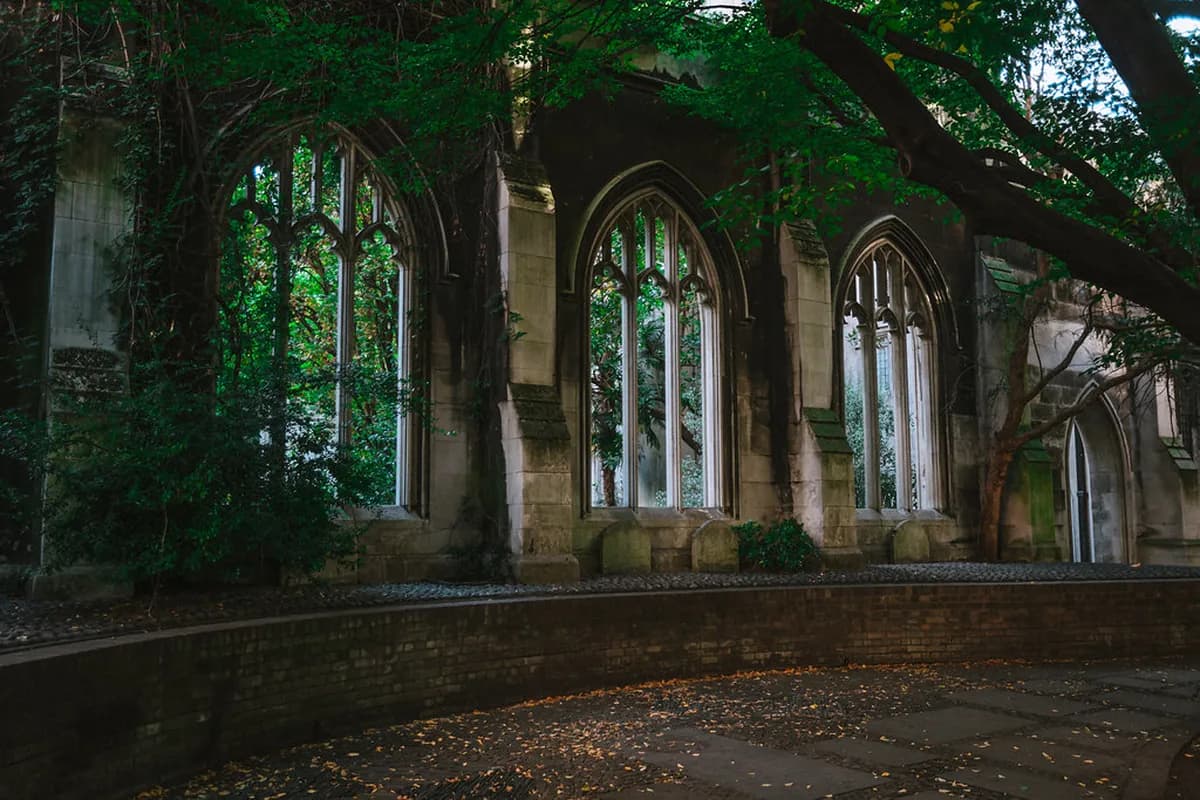
Severndroog Castle in Shooters Hill sits inside the oldest surviving ancient woodland in Greater London, giving it a fairy-tale context no Thames-side spot can match. Entry costs around £4 and the castle opens on Sundays (check the official website for volunteer-dependent seasonal dates). Climb the 87-step spiral staircase for a full 360-degree panorama taking in seven counties; on a clear winter day Windsor Castle is visible to the west. St Dunstan in the East is the urban counterpart — a bombed-out medieval tower with Christopher Wren's surviving steeple now wrapped in ivy, set inside a free public park that opens 08:00–19:00. Arrive before 09:00 on a weekday; by lunchtime, City workers fill every bench.
Museums, Art, and Cultural Hidden Corners
The Tate Modern Viewing Platform sits at the top of the Blavatnik Building and gives an unobstructed panorama of St Paul's Cathedral across the Thames. Access is free but requires a timed ticket booked on the Tate website; go on a Friday or Saturday when the museum stays open until 21:30 to capture the city at dusk. No tripods are permitted on the platform — the museum strictly enforces this rule — so rest a compact tabletop tripod on the corner railing with your camera strap looped around your neck. The specific "chimney" framing angle from the Level 4 terrace uses the Bankside chimney as a foreground element against the city's skyline for a powerful geometric composition that Level 10 visitors miss.
Leake Street Arches under Waterloo Station is London's only legal graffiti tunnel and it changes almost monthly, making every visit unique. The tunnel is free and open 24 hours, though daytime gives you enough natural light spilling from both entrances to avoid flash. Check our London street art guide for additional walls across the city that are replaced on a rolling schedule. For architecture and texture, Coal Drops Yard in King's Cross pairs Victorian brick railway vaults with contemporary curved roofing — a single wide-angle frame captures 150 years of London industry in contrast.
Goodwin's Court near Covent Garden is a 17th-century passage running between St Martin's Lane and Bedfordbury with perfectly preserved bow-fronted windows and three original working gas lamps. Harry Potter walking tours pass through here because the production designers cited it as one of the inspirations for Diagon Alley — come during the day when the tours have moved on, or after 21:00 when the lamps are at full glow and the passage empties. Artillery Passage in Spitalfields is the grittier East London equivalent: crooked timber facades, cobblestones, and a 17th-century shopfront that has barely changed since the Huguenot weavers settled here.
Thames Riverbank and Bridges: The Quiet Angles
The Millennium Bridge offers London's most photogenic leading lines, drawing the eye from the silver suspension cables directly to the dome of St Paul's Cathedral. The bridge is a public right of way and tripods are permitted. Arrive before sunrise — the cathedral faces roughly east, so early morning light falls directly on the stone, and the pedestrian numbers at 06:30 in winter are close to zero. A perfectly symmetrical composition is possible only from the very centre of the bridge, so scout it before dark to claim your spot.
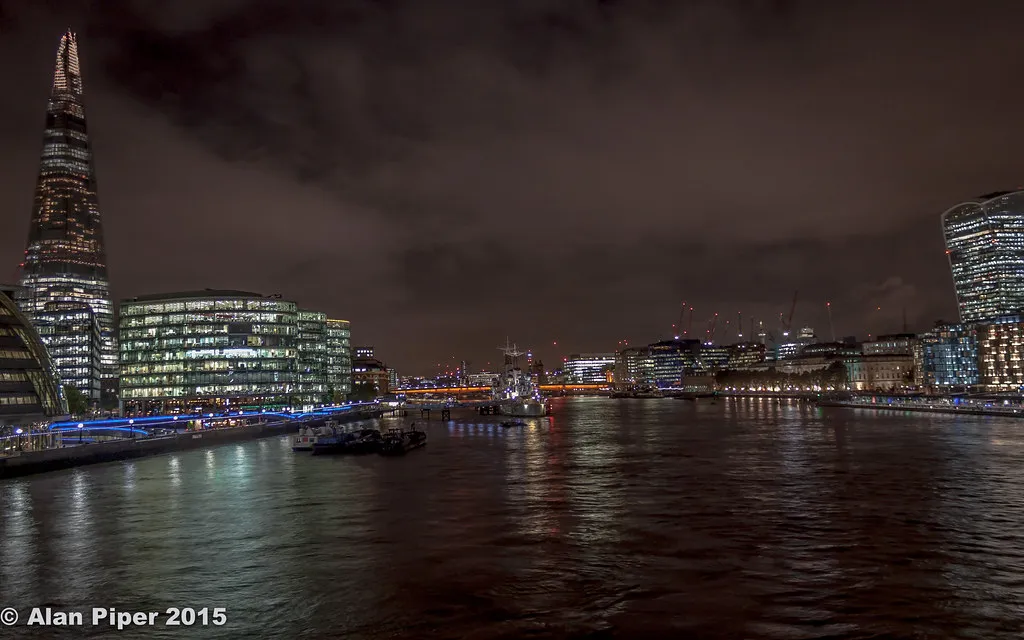
Tower Bridge photographed from St Katherine Docks gives you an angle that puts the Shard directly behind the north tower — a composition most visitors never find because it requires walking east past the marina. The docks area is free, ungated in the evening, and tripod-friendly. Time your visit for blue hour (roughly 20 minutes after sunset) when the bridge's white and blue lighting contrasts with the darkening sky and the masts of docked boats add vertical lines to the foreground. London Eye from Westminster Bridge is the classic long exposure target; winter pre-sunrise visits around 07:00 solve both the crowd problem and the lighting challenge.
For a lesser-known Thames perspective, the Golden Jubilee Bridge (Hungerford Bridge pedestrian walkway) frames the Houses of Parliament and the Eye in a single west-facing shot that never becomes as crowded as Westminster Bridge. Tripods are permitted and the poles of the bridge structure actually help frame the composition rather than hinder it. Walk from Embankment station on the Circle and District lines and position yourself on the south-western walkway after dark.
Seasonal Guide: When Each Spot Peaks
Spring (March–May) is the clear winner for garden and mews photography. Late April and early May deliver the wisteria at Pergola and Hill Garden, and the hanging baskets at the Churchill Arms reach full bloom by mid-May. Neal's Yard and Hillgate Place read best in bright spring sunshine, when the painted walls saturate more cleanly on camera without the flat winter light washing them out.
Autumn (October–November) transforms Hampstead Heath and the vine-covered walls around St Dunstan in the East. Virginia creeper turns crimson in October; bare trees in November open the tree canopy along the South Bank, revealing more of the skyline behind the streetlamps — a trick Trevor Sherwin has noted adds significant depth to South Bank compositions. Severndroog Castle's surrounding ancient woodland peaks in the first two weeks of October when the canopy is golden rather than bare.
Winter (December–January) is the night-photography season. The Shard runs a multicoloured light show throughout December, and the Churchill Arms wraps its facade in dozens of lit Christmas trees, doubling its photogenic value. Sunrise in January sits around 08:00, so you can reach any Thames bridge for a pre-sunrise shoot without a 04:00 alarm. Leake Street Arches is best year-round but winter gives you longer darkness windows for long-exposure work from both tunnel entrances.
Quick Reference: Tripod Rules, Tube, and Crowd Ratings
No competitor guide lists all practical logistics in one place, so here is a consolidated reference for all 14 spots. Crowd rating runs 1 (almost always empty) to 5 (expect to wait for a clear shot). Best light window uses 24-hour time to remove ambiguity.
- St Luke's Mews, Notting Hill — Tripod: yes. Best light: 09:00–11:00. Tube: Notting Hill Gate (Central/Circle/District). Crowd: 3 at weekends, 1 on weekday mornings.
- Pergola and Hill Garden — Tripod: yes. Best light: 10:00–13:00 (open from 08:30). Tube: Hampstead (Northern). Crowd: 1 on weekdays.
- St Dunstan in the East — Tripod: technically yes, but security discourages professional setups at peak lunch hours. Best light: 08:00–10:00. Tube: Monument (Circle/District). Crowd: 4 at lunch, 1 before 09:00.
- Severndroog Castle — Tripod: yes. Best light: any clear midday. Tube: none; take Overground to Woolwich then bus 89. Crowd: 1.
- Goodwin's Court — Tripod: yes (narrow passage, fold legs tight). Best light: 21:00–23:00 for gas lamp glow. Tube: Leicester Square (Northern/Piccadilly). Crowd: 2 evenings, 4 on tour-group afternoons.
- Artillery Passage — Tripod: yes. Best light: 09:00–11:00 (east-facing). Tube: Liverpool Street (Central/Circle/District/Hammersmith & City). Crowd: 1.
- Tate Modern Platform — Tripod: no (strictly enforced). Best light: dusk (Friday/Saturday open until 21:30). Tube: Blackfriars or Southwark. Crowd: 3.
- Millennium Bridge — Tripod: yes. Best light: pre-sunrise (06:00–07:30 in winter). Tube: St Paul's (Central) or Blackfriars. Crowd: 1 at dawn, 5 at midday.
- Tower Bridge from St Katherine Docks — Tripod: yes. Best light: blue hour (20 min post-sunset). Tube: Tower Hill (Circle/District). Crowd: 1.
- Hillgate Place — Tripod: yes. Best light: 12:00–14:00. Tube: Notting Hill Gate. Crowd: 1.
- The Churchill Arms — Tripod: yes (exterior). Best light: 11:00–13:00 (south-facing). Tube: High Street Kensington or Notting Hill Gate. Crowd: 2.
- Leake Street Arches — Tripod: yes. Best light: any daytime for ambient-lit art; after dark for moody tunnel shots. Tube: Waterloo (Jubilee/Northern/Bakerloo). Crowd: 2.
- London Eye from Westminster Bridge — Tripod: yes. Best light: pre-sunrise winter (07:00). Tube: Westminster (Jubilee/Circle/District). Crowd: 5 evenings, 1 at pre-sunrise.
- Neal's Yard — Tripod: yes (tight space). Best light: 10:00–13:00 on sunny days. Tube: Covent Garden (Piccadilly). Crowd: 4 at lunch, 2 before 10:00.
| Location | Tripod Allowed | Best Light Window | Nearest Tube | Crowd Rating (1–5) |
|---|---|---|---|---|
| St Luke's Mews | Yes | 09:00–11:00 | Notting Hill Gate | 3 weekends / 1 weekdays |
| Pergola & Hill Garden | Yes | 10:00–13:00 | Hampstead (Northern) | 1 |
| St Dunstan in the East | Yes (restricted at peak) | 08:00–10:00 | Monument | 4 lunch / 1 before 09:00 |
| Severndroog Castle | Yes | Clear midday | Overground to Woolwich | 1 |
| Goodwin's Court | Yes (fold legs tight) | 21:00–23:00 | Leicester Square | 2 evenings |
| Millennium Bridge | Yes | 06:00–07:30 (winter) | St Paul's / Blackfriars | 1 dawn / 5 midday |
| Tate Modern Platform | No (strictly enforced) | Dusk Fri/Sat | Blackfriars / Southwark | 3 |
| Tower Bridge (St Katherine Docks) | Yes | Blue hour post-sunset | Tower Hill | 1 |
How to Plan a Smooth Secret Photography Day
Planning a shoot across London requires a solid understanding of the city's vast public transport network. The Tube is efficient, but many of these spots are best reached by using the secret London walks that connect them. Walking between locations often reveals unexpected details like small plaques or unique architectural flourishes that the train misses.
Timing is everything when you want to avoid the crowds at popular spots like Neal's Yard or St Luke's Mews. Start your day at sunrise in the West — Hillgate Place and St Luke's Mews on the same morning walk — then move east toward St Dunstan and Artillery Passage as the light strengthens. Discover off the beaten path London locations by staying out late when the commuters have gone home and Goodwin's Court is empty.
Equipment rules vary significantly between public parks and privately managed estates. Most of the spots in this guide are tripod-friendly, but the Tate Modern platform is a firm no, and the South Bank between the London Eye and Blackfriars technically prohibits tripods (though enforcement is inconsistent further from the Eye). Always carry a spare battery and a lens cloth: Thames-side mist smudges glass fast after dark, and you will not want to miss the blue-hour window cleaning up.
No tripods are permitted on the Tate Modern Viewing Platform — the rule is strictly enforced. Use a compact tabletop tripod rested on the corner railing with your camera strap looped around your neck for stability.
Budget: every location on this list except Severndroog Castle (£4 entry) and the Tate Modern (free but requires a booked timed slot) is completely free and open without booking. A single Oyster card day travel card (around £15 in 2026 for Zones 1–3) covers all but Severndroog, which sits in Zone 4 and costs a small fare supplement.
Is London Photography Better at Night?
As the sun sets, the city transforms into a playground for long exposure enthusiasts and fans of urban light. The Thames acts as a giant mirror, reflecting the neon signs and golden streetlamps of the Southbank. Visit London rooftop bars for high-altitude shots of the city lights stretching toward the horizon.
Night photography requires a steady hand or a small travel tripod that won't attract too much attention from security. The area around Tower Bridge is particularly stunning after dark when the blue and white lights illuminate the stone towers. Wait for a passing bus to capture light trails that add a sense of motion to your stationary cityscape shots.
Rainy nights in London are a secret blessing for photographers because they create vibrant reflections on the pavement. Look for puddles in the cobblestone alleys of Spitalfields to capture upside-down views of the historic architecture. The contrast between the dark sky and the glowing shop windows creates a cinematic mood that is hard to beat.
Frequently Asked Questions
Can I use a tripod at London's secret photography spots?
Most public streets and parks allow tripods, but private estates like the Southbank may require a permit. Arrive early at spots like St Dunstan in the East to avoid bothering other visitors with your gear.
When is the best time to photograph London's hidden mews?
Mid-morning is ideal for mews photography as the sun is high enough to light the facades without creating deep shadows. Avoid weekends when residents are more likely to be coming and going from their homes.
Are these photography spots free to visit?
Almost all the locations on this list are free, though some mews houses appreciate a small charity donation. Sites like Severndroog Castle charge a small entry fee of around £4 to support their preservation.
Finding the best secret photography spots in London requires a mix of careful planning and spontaneous exploration. By focusing on these 14 locations across parks, mews, riverside bridges, and cultural hidden corners, you will build a portfolio that captures the true, multifaceted soul of the city. Use the quick-reference table above to route your day efficiently and arrive at each spot during its best light window.
London is a city that rewards those who look beyond the obvious landmarks and venture into the quiet side streets. I hope this guide helps you see the capital through a new lens on your next creative journey. Safe travels and happy shooting as you discover the visual magic hidden within the Great Smoke.
Continue exploring
More guides you'll find useful