12 Secret Viewpoints in Barcelona (2026)
12 secret viewpoints in Barcelona — escape Bunkers del Carmel crowds with local-only spots, hidden gardens, water towers, and urban forests.
On this page
12 Secret Viewpoints in Barcelona
After living in Barcelona for five years, I've learned that the best views aren't always at the top of the Sagrada Família. My first sunset at the Búnkers was magical, but the growing crowds eventually pushed me to find quieter alternatives. Updated January 2026 after my latest winter hike, this guide focuses on the spots where locals actually go to breathe.
Barcelona's overtourism problem is visible at ground level — Las Ramblas in August, the queue for Park Güell, the Saturday afternoon scramble at the Búnkers. The city's elevated perimeter is the antidote. Many of these locations remain absent from standard guidebooks despite offering superior photographic opportunities and genuinely peaceful atmospheres. Finding these 12 Best Hidden Gems in Barcelona requires a bus ride or a short uphill walk. The reward is a Mediterranean skyline without a selfie stick in sight.
Búnkers del Carmel: The Famous Baseline
The Búnkers del Carmel — officially the Turó de la Rovira — is still the best single viewpoint in Barcelona for raw panoramic quality. At 262 metres with a true 360-degree sweep, you get the Sagrada Família aligned precisely with the sea horizon, the Eixample grid below, and the Collserola ridge behind. No other point in the city matches that specific combination.
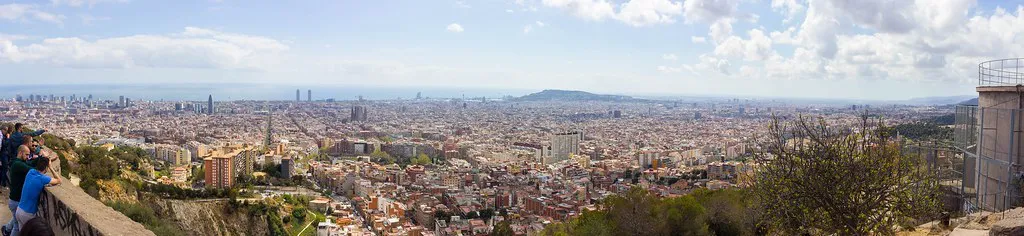
The issue is access. Since 2023 the city regulates entry: gates open at 09:00 and close at 19:30 from May to October, at 17:30 from November to April. Weekend afternoons between 16:00 and closing are the most congested window. For the quietest experience, arrive on a weekday morning before 11:00 — security patrols are lighter and the sunrise light hits the city from the east in a way the sunset crowds never see. The interior museum opens Saturdays and Sundays 10:00–15:00.
Take the V17 bus from Carrer de Muntaner or Metro L4 to Guinardó | Hospital de Sant Pau followed by a 15-minute uphill walk. Entry is free. Read the full access and history breakdown in our dedicated Búnkers del Carmel guide before visiting.
Pont de Mühlberg: The Búnkers View Without the Crowd
The Pont de Mühlberg is a 70-metre iron footbridge in the Can Baró neighbourhood, 150 metres in a straight line from the Búnkers del Carmel. It was built in 1991 to connect Carrer de Mühlberg with the upper section of the Parc del Guinardó at 261 metres altitude. The panorama from the bridge and the surrounding paths is practically identical to the Búnkers: Sagrada Família aligned with the sea, the Eixample grid, the full seafront horizon.
The difference is entirely about density. On a summer weekend afternoon the Búnkers holds hundreds of people under security management. The Pont de Mühlberg rarely has more than ten visitors at any given time. There are no closing times, no entry control, and no fencing. Access is free and open 24 hours.
The Parc del Guinardó surrounding the bridge has additional panoramic terraces in its upper section, particularly on the paths facing both north and toward the sea simultaneously. Combine the bridge with a slow walk through the park for a full hour of views that most Barcelona guides never mention. Metro L5, stop Guinardó | Hospital de Sant Pau, then 15–20 minutes on foot uphill via Carrer del Guinardó.
Pont de Mühlberg sits 150 metres from the Búnkers del Carmel and offers virtually the same panorama with no closing times, no entry control, and rarely more than ten visitors at any one time — a practical alternative when the Búnkers gates are shut.
Turó del Putxet: 360° Urban Forest, Zero Tourists
Turó del Putxet sits in the Sarrià-Sant Gervasi district and is the most underrated easily-accessible viewpoint in the city. The park has genuine ecological diversity — Himalayan cedars, holm oaks, laurels — that creates a Mediterranean forest feel without leaving the urban grid. It functions as a neighbourhood park rather than a tourist attraction: on weekdays the probability of finding almost nobody at the summit is high.
The ascent from the main entrance is steep but short, under 20 minutes base to summit. From the top you get a full 360-degree panorama: coastline from Badalona to the south, the Collserola ridge to the north, and the Sagrada Família clearly visible in the centre of the skyline. There are picnic areas and pétanque courts at the base. No entry fee, no closing time restrictions.
Take Metro L3 to Lesseps or Fontana and walk 15 minutes, or the FGC to Gràcia station. Combining this with a descent into Gràcia for lunch makes an efficient half-day that covers both an elevated panorama and one of the city's most interesting residential neighbourhoods.
Carretera de les Aigües: The Local's Skyline Trail
Carretera de les Aigües is a nine-kilometre gravel path that runs along the lower slopes of the Collserola range at roughly 300 metres altitude. It is the most consistently used running and cycling route for Barcelona residents and provides an unobstructed panorama of the entire city and the Mediterranean for almost its full length. On a clear winter morning the Balearic Islands are occasionally visible on the horizon.
The path is flat — genuinely flat, which is rare at this elevation — making it accessible to walkers and cyclists who would struggle with the steeper ascents to the Búnkers or Tibidabo. Access is free and open at all hours. The Funicular de Vallvidrera (part of the FGC network, included in the T-Casual transport card) drops you directly at the midpoint without a steep climb.
Bring water. There are no shops or fountains along the main stretch. The best entry points are near the Carretera de les Aigües trailhead above Peu del Funicular station, or from the Sant Medir area further along the ridge. Weekends see local families, cyclists, and joggers; weekday mornings are quiet enough to feel genuinely private.
Montjuïc: Three Viewpoints Most Guides Collapse Into One
Montjuïc is not one viewpoint — it is at least three distinct perspectives depending on where you stand on the hill. Most guides send visitors only to the castle terrace and stop there. Two other spots on the same hill give views the castle cannot.
The MNAC steps at Plaça de Carles Buïgas sit at the top of Avinguda de Maria Cristina, directly above the Magic Fountain basin. Standing here at dusk — free, no ticket required, no hike — frames the entire Plaça d'Espanya axis with the city grid stretching toward the sea behind it. It is the only elevated point in Barcelona that puts grand Catalan architecture and the urban street plan in the same shot. The Magic Fountain shows run Thursday through Sunday from 21:30 in summer, and this terrace is the best free vantage point for watching them from above.
The Jardins de Mossèn Costa i Llobrera are a specialized cactus garden on the eastern cliff face of Montjuïc, open daily from roughly 10:00 until sunset. Free entry. The gardens house hundreds of succulent and cactus species from desert regions worldwide, with harbour views through the planting as a constant backdrop. They provide significant wind shelter on cooler days and are often completely empty.
The Mirador del Migdia sits on the south face of the hill behind the castle — the side everyone ignores. From 170 metres you look toward the port of Barcelona, El Prat airport, and the open southern Mediterranean, not back toward the city. The scale of the container port from this height is genuinely striking. La Caseta del Migdia, a bar integrated into the viewpoint, opens Wednesday through Sunday in summer (approximately April to October). Walk 15–20 minutes on foot from the castle along a marked forest track, or arrive by car or motorbike via the Carretera del Migdia. The Montjuïc funicular reaches the base of the hill; from there, climb on foot or continue via the castle cable car.
Park Güell: The Free Perimeter Terrace Most Visitors Pay to Skip
The paid Monumental Zone of Park Güell — the mosaic terrace, the dragon staircase, the hypostyle hall — costs €10 and requires advance booking. On summer weekends it runs at near-capacity. What most visitors don't realise is that roughly 80 percent of the park's area is freely accessible without any ticket at all. The perimeter paths and the upper vantage points along the ridge deliver views of the city that are as good as or better than the paid zone terrace.
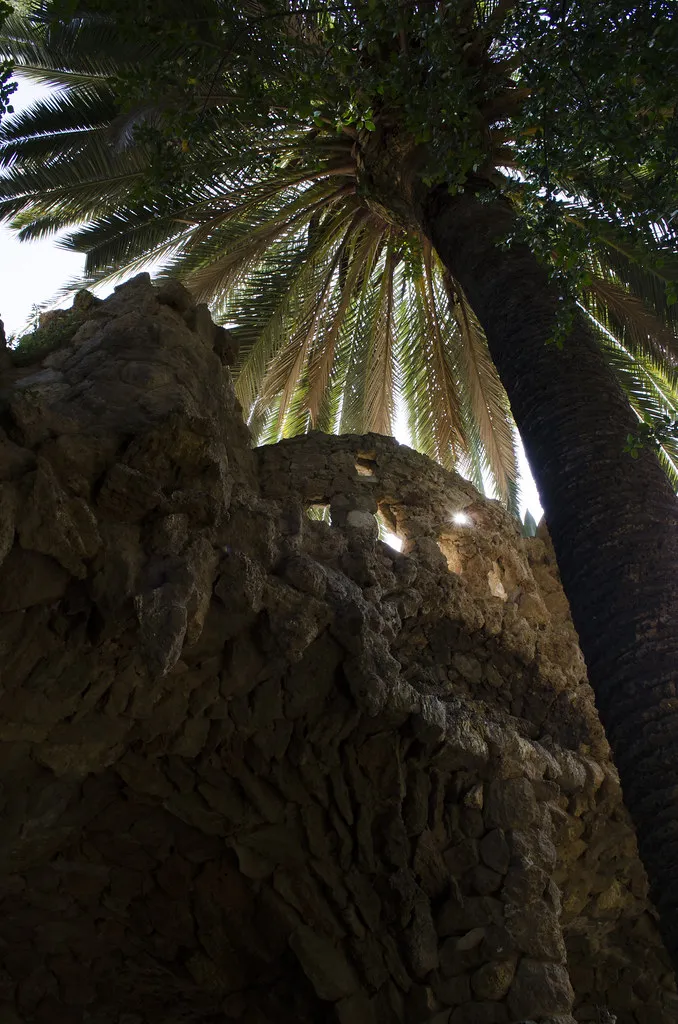
The highest free viewpoint in the park sits near the Calvary (Turó de les Tres Creus) at the top of the northeast ridge. This stone tower at 180 metres provides a 360-degree view that includes the Sagrada Família, the sea, the Collserola, and the entire Gràcia roofscape below. The climb is steep — roughly 200 steps from the main path — but takes under 10 minutes. No ticket, no queue, no timed-entry slot.
The free zone also includes the Via del Coll footpath along the park's western edge, which provides framed city views through the pine trees throughout the day. For a full visit without paying, enter from the Carmel side via the less-visited north entrance near the Carrer de Mühlberg. Metro L3 to Lesseps or Vallcarca, then 10 minutes on foot following the escalators up the hillside.
Tibidabo and Collserola: The Height Advantage
The Tibidabo summit sits at 512 metres — more than twice the height of the Búnkers del Carmel. On a clear day the view extends to Mallorca, roughly 200 kilometres offshore. The standard tourist approach involves the amusement park and the Funicular del Tibidabo, both of which can feel crowded and commercial. The better option for viewpoint hunters is the Observatori Fabra, at 415 metres on the Tibidabo ridge above the main tourist area.
The Observatori Fabra has been operating since 1904 with a working telescope that is still used for active research. The observatory organises guided night visits with astronomical observation and, in summer (June through September), outdoor dinners with a night panorama of the city from the ridge. These dinners require reservation weeks in advance and sell out quickly. Walk-in access is not available — always book ahead via the Observatori Fabra website. The experience of seeing Barcelona illuminated at night from 415 metres, surrounded by functioning 1904-era scientific equipment, is unlike anything in the standard tourist circuit.
For a free daytime alternative at similar elevation, the Carretera de les Aigües trail (covered above) runs along the Collserola base at around 300 metres and requires no reservation or ticket. The FGC Vallvidrera train line connects directly from Plaça Catalunya in about 25 minutes.
Castell de Torre Baró: The Besòs Face Nobody Shows You
Most Barcelona viewpoints face south or west — toward the sea, the port, and the Eixample grid. The Castell de Torre Baró in upper Nou Barris faces northeast, over the Besòs river valley, Santa Coloma de Gramenet, Sant Adrià, Badalona, and the beginning of the northern coastline. It is a completely different picture of the city, and it appears in almost no tourist content.
The building itself looks medieval but isn't. It was a failed hotel project from the early 20th century, abandoned incomplete and listed as heritage in 1989. The historic name refers to the Torre del Barón de Pinós, destroyed during the War of Spanish Succession in 1714. Free guided visits run on weekends covering this architectural and historical background. On weekdays the site is practically deserted.
Access: Metro L11, stop Torre Baró, then a 15–20 minute steep uphill walk along a marked path. Bus lines 73 and 119 also serve the area. The neighbourhood — deeply residential Nou Barris — is off every tourist circuit, which is precisely why the viewpoint stays quiet.
Turó de la Peira: The Only Double Horizon in the City
The Turó de la Peira in Nou Barris has one characteristic that exists at no other elevated point in Barcelona: from the upper section of the park you can see the Mediterranean to the south and the Collserola ridge to the north simultaneously. Two completely distinct horizons — water and mountain — visible without turning your head. No other hill in the city achieves this particular geometry due to the Eixample grid blocking the southern sightline from most northern viewpoints.
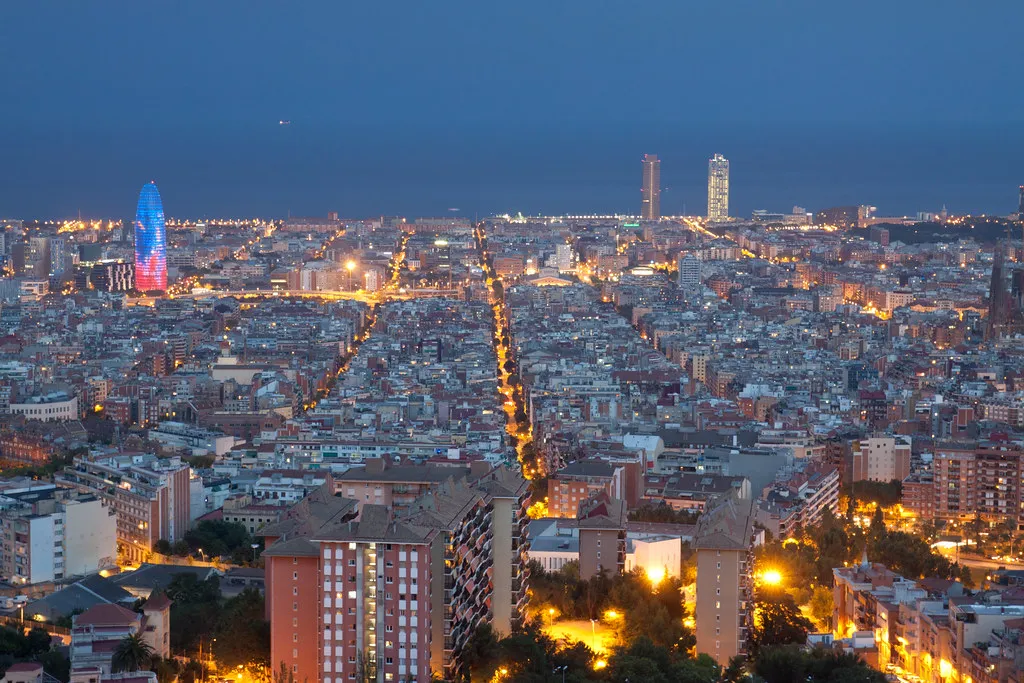
The park is free, always open, and fully integrated into the residential fabric of Nou Barris — a neighbourhood that appears on no tourist circuit. The density of outside visitors on any given weekday is effectively zero. Local families use it for weekend picnics; on weekday mornings it functions as a private urban escape. Metro L5 to Vilapicina or Virrei Amat — the park is signposted from both stops.
Torre de les Aigües del Besòs: 311 Steps of Industrial History
In Poblenou there is a 130-year-old water tower you can climb. The Torre de les Aigües del Besòs stands 63 metres tall on the Rambla del Poblenou with 311 steps to the upper terrace. The staircase is narrow and vertical — not suitable for people with vertigo or significant mobility limitations, but manageable for most walkers in reasonable fitness.
The view from the top is specifically the maritime and industrial face of Poblenou: the Mediterranean horizon to the east, the converted chimneys of the 22@ innovation district, the 19th-century fishing village street grid still visible below. It is a view of industrial and maritime Barcelona that exists from no other point in the city — you are looking at the texture of a neighbourhood from directly above it.
Access is guided visits only on Saturdays. There is no free access on any other day. Check exact dates and booking details at the Barcelona city council website before visiting — arriving on a Sunday or a Tuesday means finding a closed gate. Entry costs approximately €5. Our Poblenou neighbourhood guide covers the surrounding streets and the Rambla del Poblenou context in detail.
The Torre de les Aigües del Besòs is accessible only on guided visits on Saturdays — arriving any other day means a closed gate. Book via the Barcelona city council website before visiting; entry costs approximately €5.
Three More Spots Worth Knowing
The Mirador dels Xiprers in Sarrià is a small neighbourhood balcony between gardens and cypress trees that Sarrià residents know and visitors never search for. No tourist infrastructure, no information panels. Views point south toward the Hotel Arts and Hotel W as visual anchors, with the Mediterranean in the background. FGC to Sarrià station, then 10–15 minutes uphill along Carrer de Sarrià. Free, always accessible.
The Parc del Laberint d'Horta on the northern edge of the city dates to the 18th century and contains a famous cypress hedge labyrinth alongside neoclassical garden terraces with views toward the Collserola. General admission costs approximately €2.50, though the park is free for city residents on Wednesdays and Sundays. Metro L3 to Mundet, then a short signposted walk. Arrive before 10:00 to avoid school groups.
The Hotel 1898 on La Rambla offers a rooftop pool and terrace with a day pass — roughly €25–30 depending on season — that puts you directly above the pedestrian artery at roof level with a clear sightline to the port. It is the most practical elevated option for anyone staying near the Gothic Quarter who wants a view without a hike. The rooftop is adults-only, open from June through September, and fills quickly on summer weekends so booking ahead is advisable.
How to Plan Your Viewpoint Day in Barcelona
Most viewpoints in this list are free and reachable by public transport using a standard T-Casual card (10 journeys, approximately €12 in 2026). The TMB (Transports Metropolitans de Barcelona) network covers nearly every spot via metro or bus — the V17 bus is the key line for the Carmel cluster, the FGC handles the Tibidabo and Vallvidrera ridge. Wear proper walking shoes: the ascents to Torre Baró, Turó del Putxet, and the Calvary in Park Güell involve uneven ground.
The Torre de les Aigües del Besòs and Observatori Fabra both require advance booking and specific-day visits — plan those first, then fill the rest of the itinerary around them. For everything else, the only timing rule that matters is avoiding the Búnkers between 16:00 and closing on weekends. All other viewpoints in this list have no meaningful peak-hour problem in 2026.
Two practical notes for residential areas: keep noise down when walking through El Carmel after dark, and don't play music from speakers at the Búnkers — the city has increased enforcement following complaints from local residents in 2024 and 2025. Checking the 11 Key Insights on the Best Time to Visit Barcelona will help you time the wider trip around lower-density windows, not just the viewpoints.
| Viewpoint | Altitude | Entry cost | Hours | Crowd level |
|---|---|---|---|---|
| Búnkers del Carmel | 262 m | Free | 09:00–19:30 (summer) | High (weekends) |
| Pont de Mühlberg | 261 m | Free | 24 hours | Very low |
| Turó del Putxet | ~180 m | Free | No restrictions | Very low |
| Torre de les Aigües | 63 m tower | ~€5 | Saturday guided only | Low |
| Tibidabo summit | 512 m | Free (church) | Funicular hours | Medium |
| Carretera de les Aigües | ~300 m | Free | All hours | Low–medium |
Frequently Asked Questions
What is the best free viewpoint in Barcelona?
The Bunkers del Carmel remains the most famous, but Turó del Putxet offers a quieter, free alternative with 360-degree views. Both spots are easily accessible via public transport and require no entry fee or advance booking for budget-conscious travelers.
Are Barcelona viewpoints safe at night?
Most elevated parks are safe, but it is best to leave shortly after sunset when the crowds disperse. Stick to well-lit paths and be mindful of your belongings, especially in popular spots like the Bunkers where pickpockets occasionally operate.
Which viewpoint is best for the Sagrada Família?
The Bunkers del Carmel and Pont de Mühlberg provide the most direct, elevated views of Gaudí's masterpiece. From these northern hills, you can see how the basilica dominates the surrounding Eixample district grid from a perfect diagonal perspective.
Barcelona's skyline is best enjoyed from the quiet corners where the city's energy feels distant and calm. Whether you choose the industrial height of the Besòs tower, the port-facing silence of the Migdia, or the free ridge path above the city that most visitors never find, these views offer a deeper connection to the landscape than any ground-level attraction. The viewpoints are still there — it's just that most guides send everyone to the same two spots.
Continue exploring
More guides you'll find useful