Poblenou Barcelona: The Ultimate Neighborhood Guide
Poblenou, Barcelona's industrial-chic district — best restaurants, Can Framis museum, Bogatell beach, and local tips for visiting 22@.
On this page
Discovering the Industrial Charm of Poblenou Barcelona
Poblenou Barcelona sits northeast of the city center, far from the Gothic Quarter crowds, and close enough to the sea that you can hear seagulls on quiet mornings. It was once called the Mediterranean Manchester for its dense concentration of nineteenth-century textile factories. Today those same brick warehouses host tech startups, Michelin-starred chefs, and some of the city's sharpest street murals. Planning a trip to Spain should include at least a half-day here — most visitors who visit once come back.
The neighborhood sits between the Diagonal Mar towers to the north, the Olympic Village to the south, and Bogatell Beach to the east. It is compact enough to walk end-to-end in forty minutes, but dense enough in good cafes, galleries, and wine bars that you will not manage it without stopping constantly. That combination — urban grit plus coastal ease — is the core of what makes Poblenou different from everywhere else in Barcelona.
Must-See Poblenou Barcelona Attractions
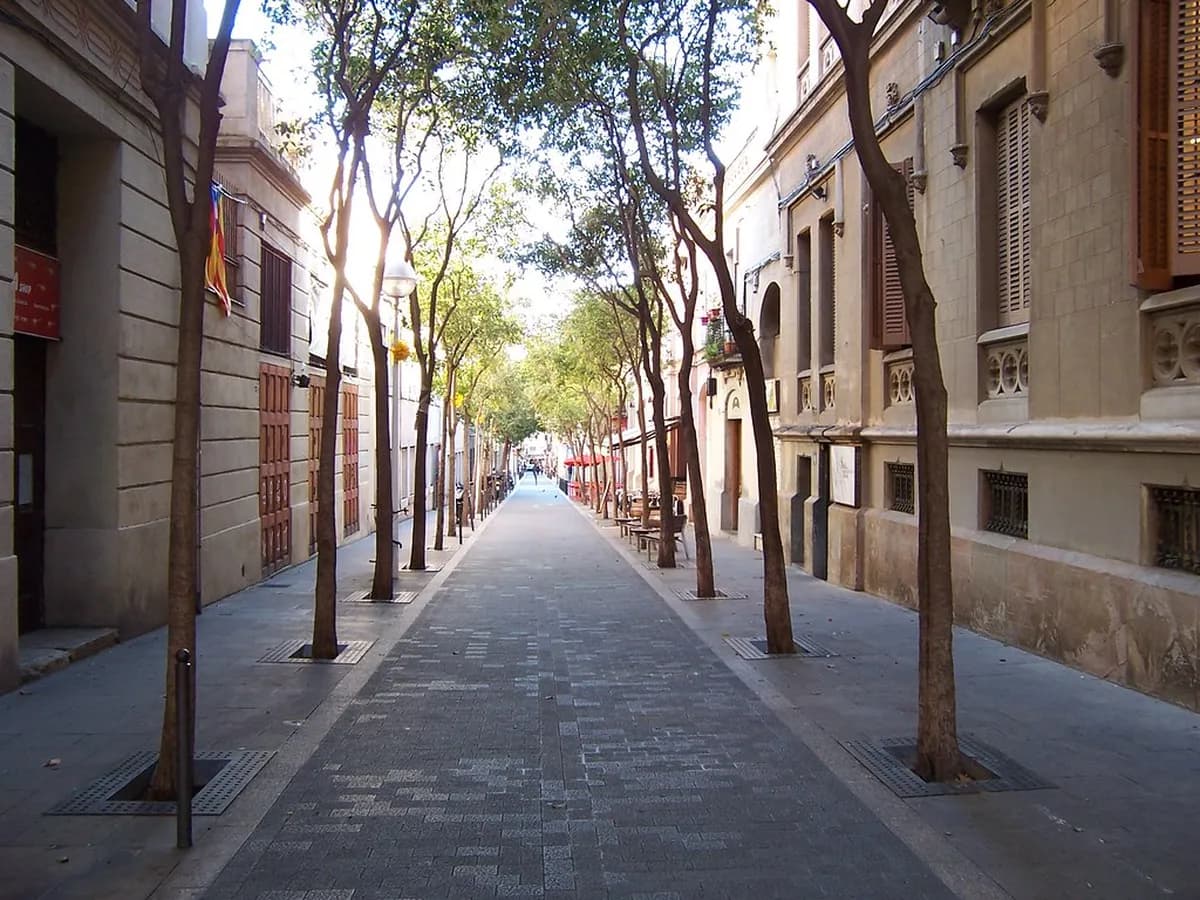
The Rambla del Poblenou is the neighborhood's spine. It runs from Avinguda Diagonal down to Bogatell Beach, lined with terraces where locals eat lunch at 14:00 and drink vermouth at 13:00 on Sundays. Unlike Las Ramblas in the city center, this boulevard has almost no souvenir stalls and very few tourists — it is simply where people in the neighborhood live their lives. Els Tres Porquets at Rambla del Poblenou 165 is the benchmark tapas bar, with a seasonal chalkboard menu that changes daily and staff who actually enjoy explaining the dishes.
Bogatell Beach offers a notably calmer experience than Barceloneta. The sand is wider, the bars are less aggressive, and the crowd skews local. It sits a ten-minute walk from the Rambla and connects directly to the Poblenou coastal path. The local beaches here are among the places to visit for free that are genuinely worth the walk even in shoulder season.
The Poblenou Cemetery at Carrer de Sancho de Avila deserves more attention than it gets. Founded in 1775, it holds the famous Kiss of Death sculpture on the tomb of a textile manufacturer — a white marble figure of a young man being kissed by a winged skeleton. The tomb of El Santet, a local boy believed to grant miracles, remains an active pilgrimage site. Admission is free and the funerary sculpture is genuinely among the best in Europe.
Palo Alto Market runs on the first weekend of every month inside a factory courtyard at Carrer dels Pellaires 30–38. Entry is €4 and covers live music, food trucks, and around 200 curated designer and ceramics stalls — Saturday 10:00–21:00, Sunday 10:00–20:00.
Casino de l'Alianca at Rambla del Poblenou 42 is a working-class cultural club founded in 1869 that still hosts concerts, ballroom evenings, and community events. It is not a tourist attraction — it is an active neighborhood institution. Check their program for whatever is on during your visit; attending an event there is a sharply different experience from anything in the city center.
Museums, Art, and Culture in Poblenou
The Can Framis Museum at Carrer de Roc Boronat 116 is worth visiting for its building as much as its collection. The structure is an eighteenth-century factory restored by architect Jordi Badia, who inserted two concrete volumes inside the original stone walls rather than demolishing them. The result is a building that holds both its industrial past and a contemporary Catalan painting collection — works spanning from the 1960s to the present — without either element overwhelming the other. Admission is €6, open Tuesday to Saturday 11:00–19:00 and Sunday 11:00–14:00. The neighborhood is full of hidden gems that rivals find it hard to replicate.
Street art is woven throughout Poblenou in a way that few neighborhoods in Europe match outside of Berlin or Lisbon. The densest concentration runs along Carrer de Pere IV — check the walls around numbers 345 and 412, where the artists' collective La Escocesa is based. The blocks bounded by Carrer del Treball, Pallars, Agricultura, and Venezuela contain a city-council-sanctioned mural zone where artists work at scale. For a curated walk, start at Fluvià 89, then head to the corner of Lope de Vega and Pujades, where a large castellers mural covers an entire building end. The whole route takes about ninety minutes on foot.
Can Saladrigas on Carrer del Pallars is an old textile factory saved from demolition by a neighborhood campaign in 1998 and converted into the local library. The original industrial masonry is intact, the factory chimney still stands outside, and the ground floor hosts a permanent display of traditional Catalan parade figures. It is free to enter and gives a clear picture of why residents here fought hard to preserve the industrial fabric rather than erase it.
Parks, Gardens, and Outdoor Spots in Poblenou
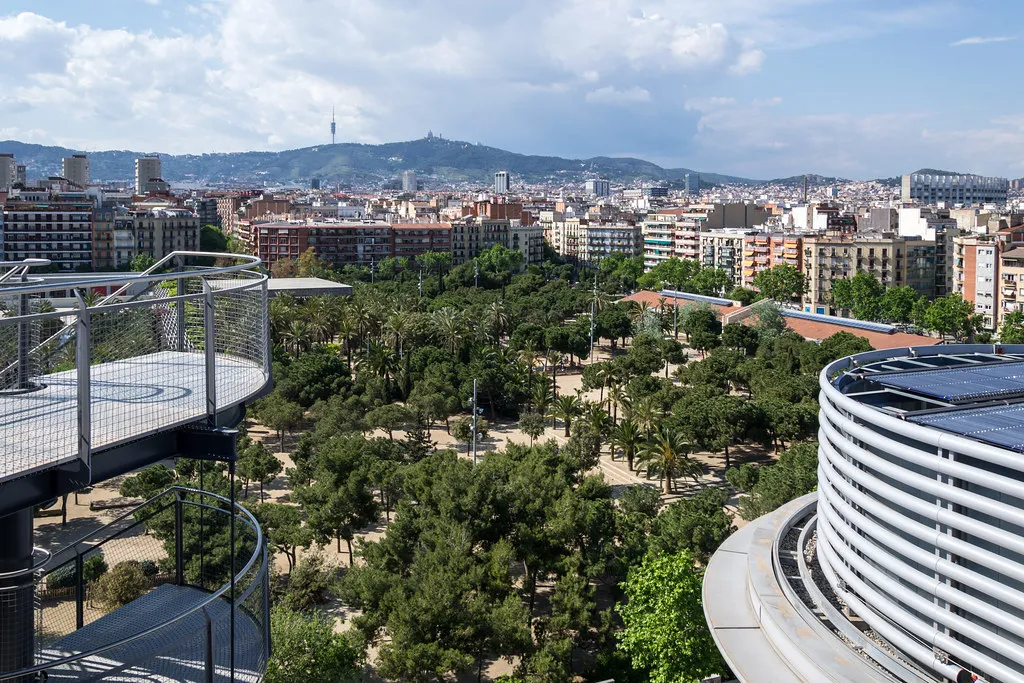
Parc del Centre del Poblenou was designed by Jean Nouvel and opened in 2008. It is unusual for a Barcelona park — the plantings are dry-climate Mediterranean species rather than the tropical density you find in Ciutadella, and the metallic pergola structures create layered shade without blocking sky. It is a genuinely good place to sit in the morning before the day heats up. The park sits one block from Carrer de Pallars and is used heavily by local families and remote workers with laptops.
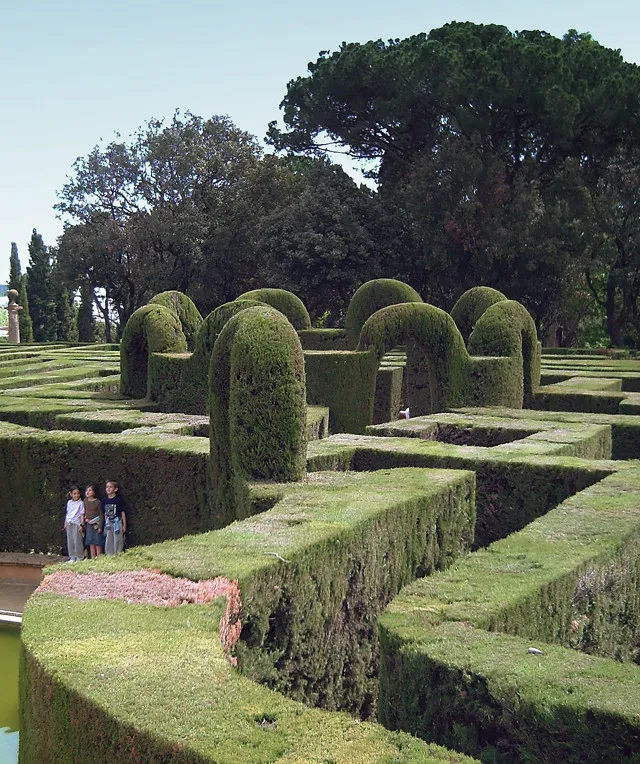
Diagonal Mar Park at the northern end of the neighborhood is larger and more formal, with water channels, large-scale sculptures, and views toward the sea. The park connects the Diagonal Mar shopping center to the beach and serves as a buffer between the 22@ office towers and the residential blocks. Morning joggers and dog walkers use it before 09:00; by midday it is mostly parents with children and older residents.
The coastal path between Bogatell and Mar Bella beaches is worth noting for anyone visiting in 2026. The stretch between the Rambla del Poblenou access point and the Garage Poblenou beach bar at Passeig de Calvell 45 is about fifteen minutes on foot and entirely flat. Garage Poblenou has twenty craft beer taps and a large open-air terrace directly on the sand — a useful end-point for a coastal walk.
The 22@ District: Tech Hub and Neighborhood Tension
The 22@ urban plan, launched by Barcelona City Council in 2000, rezoned 200 hectares of old industrial land for technology, media, and design businesses. The idea was to replace polluting factories with knowledge-economy jobs and restore the neighborhood's economic role. The plan worked, in purely economic terms. Poblenou now holds more than 1,500 companies, several university campuses, and office addresses for the Barcelona Supercomputing Center and numerous international tech firms.
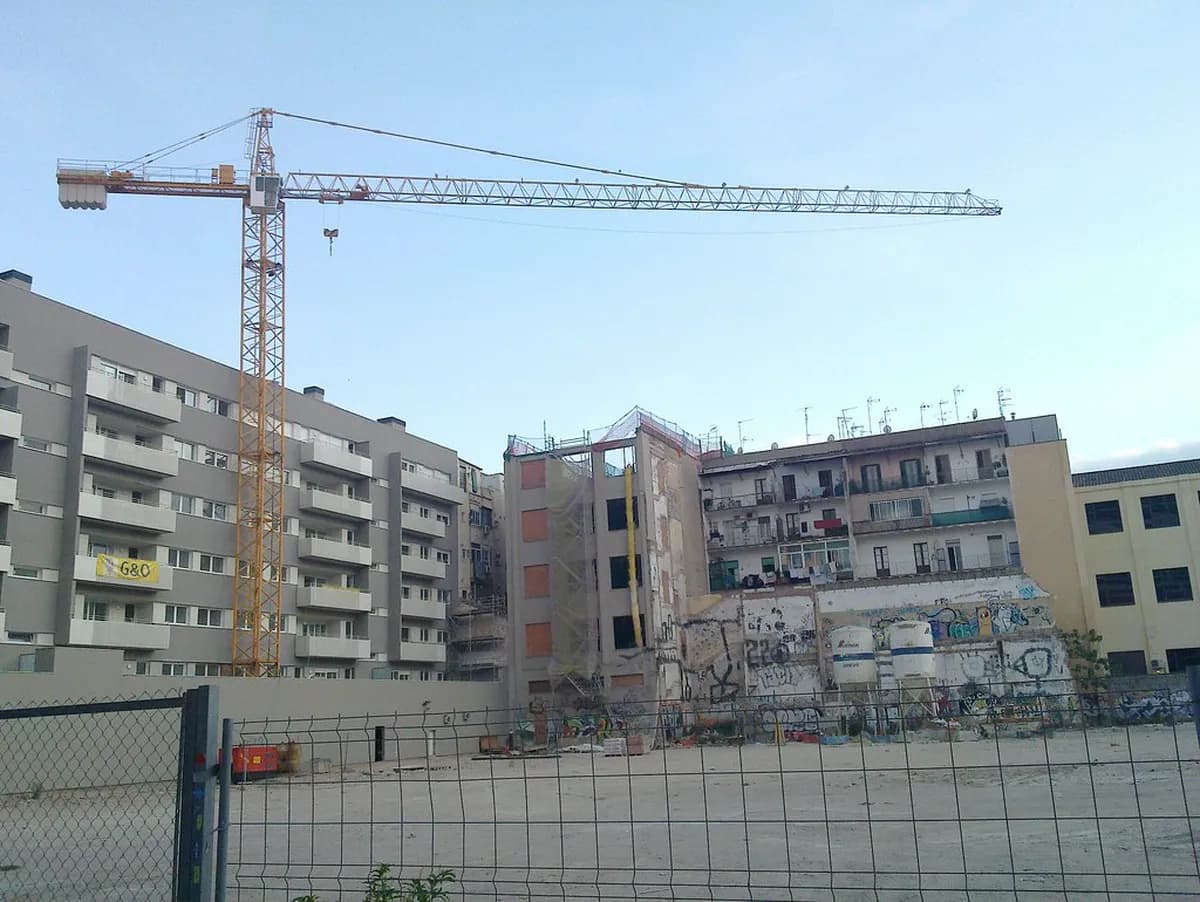
What the plan underestimated was cultural displacement. The cheap warehouse rents that made Poblenou attractive to artists, craftspeople, and small food producers in the 1990s and 2000s — the very people who gave the neighborhood its current creative identity — were compressed by office conversion. A residents' movement, active since the mid-2010s and still vocal in 2026, has pushed back against further rezoning and pushed for affordable workspace quotas in new developments. Their argument is straightforward: if you remove the people who made the neighborhood interesting, you will eventually remove the reason to go there.
For visitors, this tension is visible in small ways — the mix of independent bars and chain coffee shops on the Rambla, the remaining empty lots adjacent to finished glass towers, the occasional protest banner on a building. It is also part of why the neighborhood still feels authentic rather than curated. The outcome of this friction is not settled, and that unresolved quality is one of the more honest things about Poblenou right now compared to neighborhoods that were gentrified and homogenized a decade ago.
Poblenou Dining Guide: Where to Eat and Drink
Masa Vins at Carrer de Pallars 154 is the area's standout natural wine bar. It fills up fast after 19:00 and stays loud until late. The wine list runs to multiple pages and the selection by the glass is genuinely adventurous — staff will steer you toward growers you have never heard of. No kitchen, but the bar snacks are good. This is the right place if you want to drink something interesting with people who care about what they are drinking.
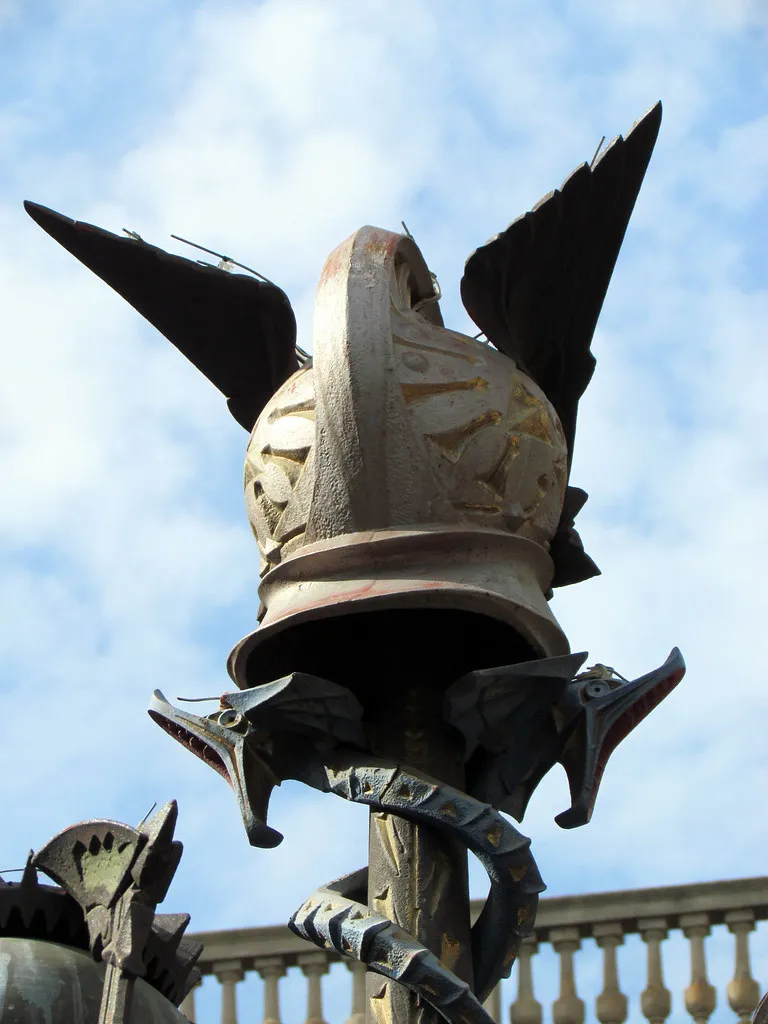
Enoteca Paco Perez at Carrer de la Marina 19–21 is a two-Michelin-starred restaurant inside the Hotel Arts. Chef Paco Perez works primarily with seafood and changes the menu frequently. Sunday's El Arroz de Paco — a six-course rice tasting with optional wine pairing — is a more affordable entry point than the full tasting menu on weekdays. Booking several weeks in advance is essential in 2026. The contrast with Masa Vins is complete: where Masa is casual and communal, Enoteca is formal and precise.
Henry's Bar at Carrer de la Llacuna 92 occupies a space between wine bar and dive bar — craft cocktails, good comfort food, and the owner's dog Henrietta on the premises. It opens early and welcomes everyone. Dreamboat Bar & Deli at Carrer de la Llacuna 136 is the more theatrical version of the same idea, with second-hand decor, guest DJs, and well-constructed cocktails. Both are on the same street and represent the low-key, local-facing nightlife that defines this part of the neighborhood.
For craft beer, Garage Poblenou now runs two locations — the original near the Rambla and the beach terrace at Passeig de Calvell 45 with twenty taps and an outdoor terrace. The brewery organizes regular events; check their Instagram for the schedule. For something quieter, The Miners Coffee on the Rambla is one of the best specialty coffee spots in the neighborhood, with knowledgeable staff and beans sourced from their own roastery. You can find more of the best local restaurants across the city when planning a longer stay.
For food that is not a sit-down meal: Frutas Selectas at Carrer de Pujades 95 is a deli run jointly with Nomad Coffee roasters. You can pick up seasonal Catalan produce, artisan cheese, natural wines, and a Nomad espresso in the same visit — it is the most efficient single stop in the neighborhood for putting together a beach picnic. Cloudstreet Bakery at Carrer de Fluvià 113 is the reliable morning option for pastries and good coffee, and Can Recasens at Rambla del Poblenou 102 is the classic cheese-focused restaurant that requires a reservation but rewards it with one of the more charming dining rooms in the neighborhood.
| Venue | Type | Price range | Reservation needed |
|---|---|---|---|
| Masa Vins | Natural wine bar | Bar snacks only | No (fills fast after 19:00) |
| Enoteca Paco Perez | 2-Michelin-star | High (tasting menu) | Yes, weeks ahead |
| Els Tres Porquets | Tapas | Mid-range | Early arrival or reservation |
| Can Recasens | Cheese restaurant | Mid-range | Yes |
| Garage Poblenou | Craft beer & terrace | Low–mid | No |
Nightlife and Markets: Razzmatazz and Palo Alto
Razzmatazz at Carrer dels Almogavers 122 is one of Europe's genuinely important clubs. It runs five rooms simultaneously across a converted industrial space, covering electronic music, indie, and hip-hop on the same night. International headliners book here regularly alongside local artists. The venue opens late — doors are typically at midnight, and the crowd arrives closer to 01:00. Tickets range from €15 to €30 depending on the lineup; check the official site for 2026 programming. It operates Thursday through Saturday.
Palo Alto Market takes place on the first weekend of every month inside a factory courtyard at Carrer dels Pellaires 30–38. Entry costs €4 and covers live music, food trucks, and roughly 200 stalls selling work by independent designers, ceramicists, jewelers, and food producers. It runs Saturday 10:00–21:00 and Sunday 10:00–20:00. The quality of the market has stayed high because the organizers curate the vendor list carefully rather than accepting everyone who applies. It is a reliable way to spend a weekend morning without walking far from the beach.
For a more local weekly rhythm, Els Encants Vells — the city's major second-hand market — sits just outside the neighborhood at Avinguda Meridiana 69, covered by a mirrored steel canopy. It runs Monday, Wednesday, Friday, and Saturday from 09:00 to 20:00. The market sells genuine used goods rather than antiques, which keeps prices low. It is a ten-minute walk from the Llacuna metro stop and worth combining with a morning in Poblenou.
Razzmatazz opens at midnight and the crowd typically arrives closer to 01:00 — doors on Thursday through Saturday only. Tickets range from €15 to €30 and the lineup varies weekly; check the official site for 2026 programming before heading out.
Family-Friendly and Budget-Friendly Options in Poblenou
Bogatell Beach is the practical choice for families over Barceloneta. The sand is wider, the water-sports rental stalls are less predatory, and there are functioning public showers and changing rooms. A morning at the beach followed by lunch at Sopa — a canteen-style vegetarian restaurant at Carrer de Roc Boronat 114 where a starter and main costs under €10 — covers a full half-day without spending much. The Rambla del Poblenou has multiple playgrounds integrated into it, which makes the boulevard usable for children without requiring a specific destination.
Can Framis Museum charges €6 for adults and is free for under-18s. The building engages children more than most contemporary art spaces because the factory structure is physically interesting — exposed roof beams, raw concrete, courtyards. Parc del Centre del Poblenou is directly adjacent and free, so the combination works well as a morning itinerary. For families who want a market day, Palo Alto on the first weekend of the month has enough food stalls and live music to hold a child's attention for a couple of hours.
Dates & Avocados Atelier at Carrer de Pere IV 240 is worth knowing for families with dietary restrictions. The plant-based pastry shop uses no gluten and no refined sugar across its entire menu. Morgentau at Carrer de la Llacuna 114 is a vegan brunch spot with a corner play area for small children and a terrace facing a park. Both are considerably quieter than their equivalents in the Eixample or Gràcia.
How to Plan a Day in Poblenou
The L4 yellow metro line stops at Poblenou (for the Rambla and Can Framis) and at Llacuna (for the 22@ tech zone and street art walks). Both stations put you within a five-minute walk of the main points of interest. The neighborhood is entirely flat and well-lit, which makes it comfortable on foot or by bike. Most of the good cafes, bars, and restaurants are concentrated in the blocks between Carrer de Pujades, Carrer de Pallars, and the Rambla del Poblenou itself.
A practical day sequence: arrive by 10:00 and visit Can Framis Museum before it gets warm. Walk the street art route along Carrer de Pere IV toward La Escocesa. Stop for coffee at The Miners or Frutas Selectas. Lunch at Els Tres Porquets or Can Recasens — both require either a reservation or an early arrival. Spend the afternoon at Bogatell Beach. End the evening at Masa Vins or Garage Poblenou depending on whether you want wine or beer. For a first visit to 27 Unique Things to Do in Barcelona: Hidden Gems & Local Secrets, this sequence covers the neighborhood's range without feeling rushed.
In 2026, opening hours at Can Framis have shifted slightly — confirm via the Fundacio Vila Casas website before visiting. Palo Alto Market dates are published on their website at the start of each year. Razzmatazz programming varies week to week; the club's official site lists confirmed lineups about two weeks in advance. If you are staying in Poblenou rather than passing through, note that the neighborhood is significantly quieter than the center on weekday mornings, which makes it a practical base for anyone working remotely.
Characteristics of the Poblenou Neighbourhood
Poblenou is the most legible example in Barcelona of what happens when industrial land meets cultural investment and then commercial pressure. The sequence ran: factories close (1960s–1980s), artists and small businesses occupy cheap space (1990s–2000s), the city formalizes this with the 22@ tech district plan (2000 onward), office values rise, original tenants struggle to stay. The neighborhood you visit in 2026 is mid-sequence — interesting precisely because the outcome is still contested.
The visual result is a district where a nineteenth-century brick chimney stands next to a glass co-working tower, and both are considered normal. The streets are wide by Barcelona standards because they were designed for carts, not pedestrians. The ground floors have a higher proportion of independent businesses than most comparable neighborhoods in Europe because the commercial rents, while rising, have not yet reached the level that forces full homogenization. That may change — but for now, the mix is intact enough that exploring Poblenou feels different from exploring a neighborhood that has already been fully processed.
Long-term residents are a mix of families who have been here for two or three generations and newer arrivals drawn by the tech sector. The community remains active — there are annual street festivals, a neighborhood newspaper, and organized campaigns around planning decisions. It is this ongoing civic engagement that keeps the Rambla feeling like a place where people actually live rather than a backdrop for tourism. The area also represents a genuinely off the beaten path corner of the city that rewards curiosity over planning.
Frequently Asked Questions
Is Poblenou Barcelona safe?
Poblenou is generally considered a very safe neighborhood for both families and solo travelers. The residential atmosphere and wide streets contribute to a secure environment throughout the day and night. Standard safety precautions should still be followed as they would in any other major European city.
What is Poblenou known for?
This district is famous for its industrial heritage and its modern transformation into a technology and design hub. It is also known for the beautiful Bogatell Beach and the lively Rambla del Poblenou boulevard. Many visitors enjoy the unique mix of old factories and contemporary architecture.
How far is Poblenou from Barcelona city center?
Poblenou is located just a few kilometers northeast of the historic city center. The yellow L4 metro line connects the neighborhood directly to the center in about fifteen minutes. You can also enjoy a scenic thirty-minute walk along the coastline to reach the Barceloneta area.
Is Poblenou a good place to stay in Barcelona?
Poblenou is an excellent choice for travelers who prefer a local atmosphere away from the main tourist crowds. The area offers modern accommodations and easy access to the beach and public transport. Check the best time to visit to ensure a peaceful stay.
Poblenou offers a refreshing and authentic perspective on life in Barcelona beyond the typical tourist sites. The combination of industrial history, modern innovation, and coastal beauty creates a truly unique urban experience. You will leave with a deeper appreciation for the creative energy that defines this evolving Mediterranean neighborhood.
Continue exploring
More guides you'll find useful