Gracia Barcelona Travel Guide
Plan gracia barcelona with top picks, neighborhood context, timing tips, and practical booking advice for a smoother trip.
On this page
Gracia Barcelona: The Ultimate Local Neighborhood Guide
Gràcia is the one neighborhood in Barcelona where you feel like you have stepped out of the tourist machine and into a real city. The streets are quieter, the squares are shaded and unhurried, and the residents clearly live here — they are not just working in a hotel or running a souvenir stall. For many repeat visitors to Spain, it is the only part of Barcelona worth staying in.
The district sits north of Eixample, bounded roughly by Carrer de Còrsega to the south and the Collserola hills to the north. It rises noticeably as you walk uphill, and the steep side streets give you constant framed views back over the city and down to the sea. Getting your bearings takes about twenty minutes of wandering. After that, the grid logic clicks into place.
This guide covers the essentials: the neighborhood's character and history, its main plazas and sights, where to eat and drink, the Festa Major festival in August, where to stay, and how to get around. Prices are in euros and reflect 2026 levels.
A Village That Got Swallowed by a City
Gràcia was an independent municipality until 1897, when Barcelona annexed it. The locals never fully accepted the merger. The neighborhood still flies its own flag (a distinctive red-and-gold design separate from the Catalan flag), elects a neighborhood council that fights development decisions aggressively, and maintains a calendar of community events that pre-dates Barcelona's tourism economy by a century.
That history explains why the vibe is so different. You are not walking through a former fishing village or an aristocratic boulevard. You are walking through a place that fought to stay itself. The streets are almost entirely car-free, the plazas are interconnected by narrow lanes, and the ground floors are overwhelmingly independent: bakeries, hardware shops, print studios, a Palestinian takeaway, a shop selling only bulk legumes.
Barcelona's 2024 overtourism protests were concentrated in the Gothic Quarter, Barceloneta, and La Barceloneta beach — not here. Residents in Gràcia still largely welcome considerate visitors because the neighborhood has not yet tipped into mass-tourism saturation. That balance is fragile in 2026. Behaving like a temporary resident — keeping noise down after 22:00, buying from local shops, not bringing a rolling suitcase up staircases at 06:00 — matters more here than in neighborhoods already written off as tourist zones.
Peaceful Streets and a Real Sense of Community
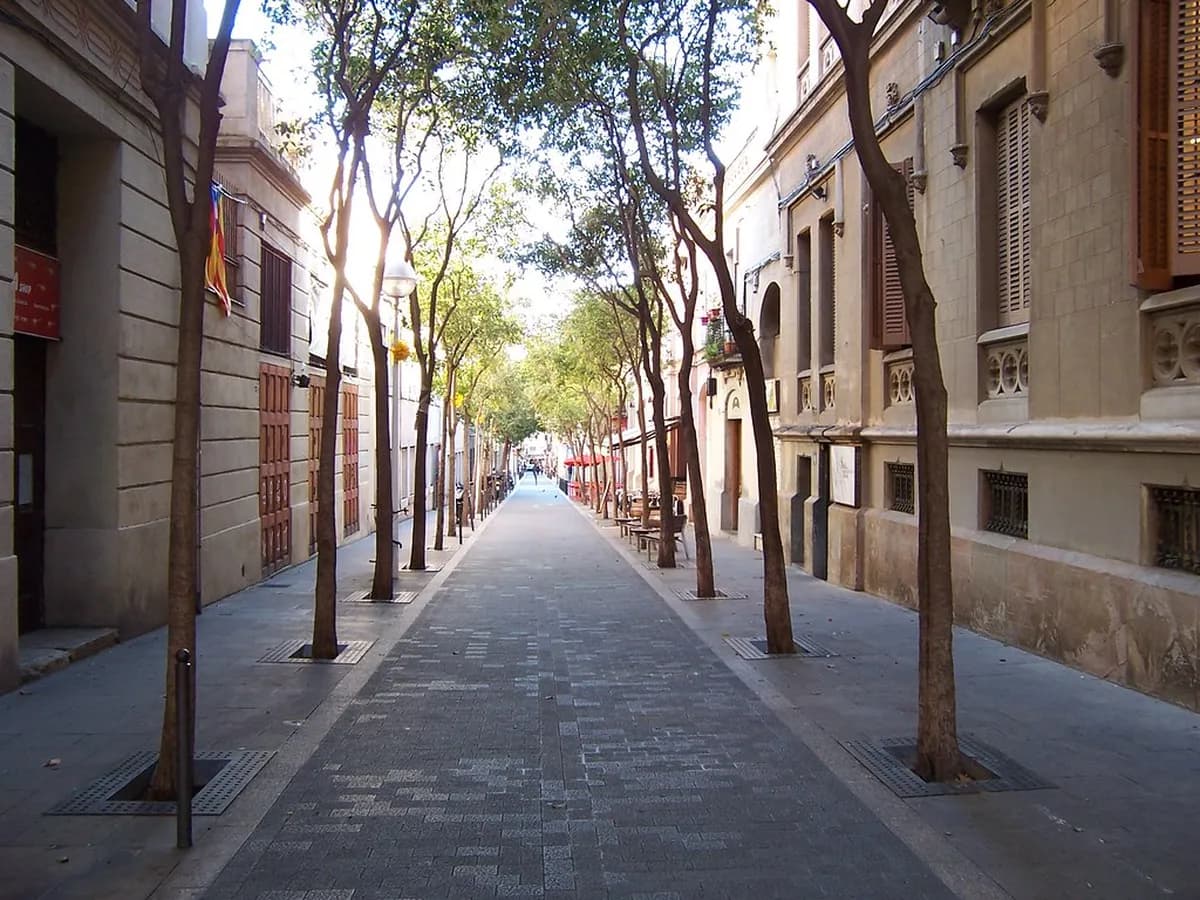
The most striking thing about Gràcia on arrival is the quiet. Barcelona's central neighborhoods — Raval, the Gothic Quarter, even Eixample — push a constant low roar of traffic, tourist groups, and amplified terraces. In Gràcia, the main sound is conversation. The streets are narrow enough that traffic is largely banned, and the squares function as outdoor living rooms rather than transit nodes.
The community feel is visible in small details. Neighbors prop their apartment doors open. Parents walk children home from school on foot, unhurried. The local residents' association has been taping handwritten notices about zoning hearings to lampposts for decades. This is not a performance of local life for visitors; it is local life, with visitors allowed to watch.
For travelers who have been battered by the Gothic Quarter's pickpocket density and Las Ramblas' relentless hustle, Gràcia operates at a different frequency. You can walk slowly, sit for an hour without anyone pressuring you to order something, and leave a bag on a café chair without the anxiety spike that follows in more central areas.
Must-See Attractions in Gràcia
The architectural landmark most visitors come for is Casa Vicens, Gaudí's first major commission, completed in 1888 on Carrer de les Carolines. It is genuinely worth the 18–22 EUR entry. The building predates everything Gaudí is famous for — no flowing stone, no mosaics — and shows him working out his ideas in ceramic tile, Moorish geometry, and iron. It is far less crowded than Sagrada Família or Casa Batlló and takes about 90 minutes to see properly. Book tickets online in advance; the timed-entry system means you rarely queue more than five minutes.
Book Casa Vicens tickets online before your visit — the timed-entry system means queues are rarely more than five minutes, a stark contrast to the 45-minute waits common at Casa Batlló or Sagrada Família.
Park Güell sits on the northern edge of Gràcia. The paid Monumental Zone — the dragon staircase, the hypostyle hall, the famous ceramic terrace — costs 10 EUR and requires advance booking. Timed slots sell out weeks ahead in summer. The surrounding parkland and gardens are free and often less satisfying than the paid zone, but they do offer good city views. A private guided option worth considering is the Private Gaudi Barcelona tour, which covers both Casa Vicens and Park Güell with a local architect explaining the design decisions.
Turó de la Rovira — locally called the Bunkers — is the viewpoint that most visitors miss. A set of anti-aircraft gun emplacements from the Spanish Civil War sits on a hill above Gràcia at 262 metres. The 360-degree view from the top takes in the entire city, the Collserola ridge, and the Mediterranean in one sweep. There is no entry fee. Vendors sell cold drinks in the evening. It is a forty-minute walk from Plaça del Sol or a short taxi ride, and it is the single best place in Barcelona to watch the sunset without paying for a rooftop bar.
The Plazas: Plaça del Sol, Plaça de la Vila, and Beyond
Gràcia is a neighborhood of squares. They are strung together by pedestrian lanes and each has a distinct personality. Learning their names and character is the fastest way to orient yourself in the district.
Plaça del Sol is the most energetic. Bar and restaurant terraces ring the perimeter, and the square fills from about 17:00 onward with the full Gràcia social mix: students, elderly couples, young parents, office workers finishing early. It is the right place for a pre-dinner vermouth. Expect to pay around 3.50–4.50 EUR for a copa de vermut at the terraces closest to the center.
Plaça de la Vila de Gràcia (also called Plaça de la Vila) is the formal civic center, anchored by a clock tower built in 1862 that is the neighborhood's unofficial symbol. It is quieter than Plaça del Sol and feels more residential. The Saturday morning market here sells seasonal produce and a small selection of local crafts. Plaça de la Virreina, a short walk away, is shaded by plane trees and backed by the Església de Sant Joan church — the most photogenic of the squares, particularly in the late afternoon.
If you have time for only one unscheduled hour in Gràcia, spend it sitting in one of these three squares with a coffee or a local beer. The informal people-watching is more instructive about Barcelona's actual character than any museum visit.
Festa Major de Gràcia: The August Street Festival
The Festa Major de Gràcia takes place every year in the week around 15 August (the Feast of the Assumption). In 2026 that means roughly 15–21 August. This is when the neighborhood transforms completely. Residents spend months building elaborate themed decorations — full ceiling installations, cascading flowers, giant sculptures — and each street competes for the best-decorated title. The judging is taken seriously; some streets have been winning for decades.
The street parade on 15 August is the centerpiece. Giants (gegants), fire-runners (correfoc), and brass bands move through the decorated streets from early evening. The correfoc in particular — participants dressed as devils running with lit fireworks on long poles — is genuinely chaotic and spectacular. Wear old clothes you do not mind getting singed and stand back unless you know what you are doing.
Practical notes: the neighborhood becomes very crowded during Festa Major, accommodation prices spike, and the noise goes past midnight every night of the festival week. Book rooms three to four months ahead if you plan to be there. The festival is officially free to attend. Live concerts in the plazas are free. Some food stalls charge; others are run by neighborhood associations at near-cost prices. It is the best single week to visit Gràcia if you can handle the crowds — and the worst if you cannot.
During Festa Major de Gràcia (around 15–21 August), accommodation prices spike and noise continues past midnight every night — book rooms three to four months in advance if visiting during festival week.
Where to Eat and Drink in Gràcia
The food scene in Gràcia is one of the most coherent in Barcelona. The restaurants are mostly small and owner-run, the menus change with the market, and the prices are noticeably lower than Eixample or El Born for equivalent quality. The neighborhood is also extremely vegetarian and vegan-friendly — a Gràcia trait that long pre-dates the broader trend.
For Catalan food, Tasta Gràcia on Carrer de Verdi is the reliable recommendation: arroz negro meloso, first-rate jamón, unhurried service. It is not cheap by Gràcia standards (mains 16–22 EUR) but delivers on quality. Bar Bodega Quimet, a hundred-year-old vermouth bar on Carrer de Vic, is the right call for a late-morning aperitif: house vermouth, conservas, anchovies — Quimet does this better than anywhere nearby. KILTRO Restobar handles South American-inflected food — ceviche, tacos, the Salted Paloma cocktail — and is reliably good for an informal dinner.
Carrer de Verdi is the main restaurant corridor; walk its full length before deciding. Mercat de la Llibertat on Plaça de la Llibertat is the neighborhood covered market, built in the 1870s, and worth a morning visit for coffee and a pastry before the tourist coaches from other districts arrive. Several stalls serve menú del día lunches for 12–14 EUR — three courses, bread, and a drink. For coffee specifically, look for Origo Bakery near the market or The Madness Coffee on Carrer Gran de Gràcia, which sources beans from small producers and charges Barcelona-normal prices (2.50–3.50 EUR).
Evenings skew toward the squares. Nola Cocktail Bar near Plaça del Sol does well-executed mixed drinks without the cocktail-bar markup premium. The AMBici crowd and the after-work crowd overlap here from 19:00 onward.
Built-In Exercise: Gràcia's Hills and What They Reward
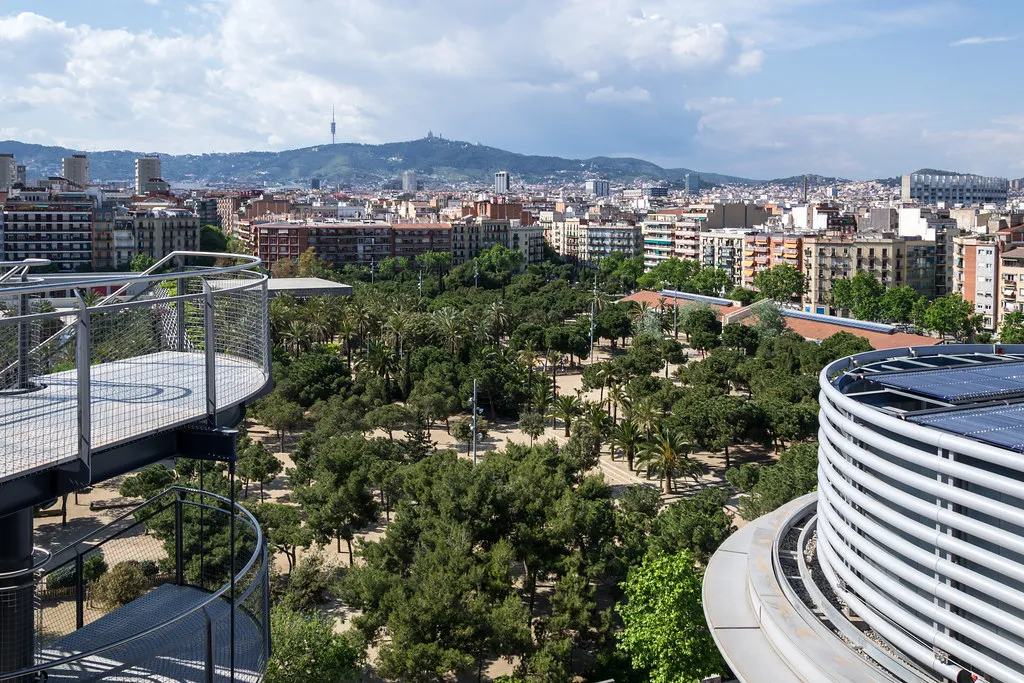
Gràcia climbs steeply as you move north toward Park Güell and the Bunkers. The streets near Fontana metro are broadly flat. By the time you reach Carrer de Larrard below the park entrance, you have gained significant elevation and your legs will know it. This is worth flagging clearly for visitors with mobility constraints: the upper half of Gràcia is not wheelchair-accessible in any practical sense, and anyone with knee or hip issues should plan their routes around the flatter southern streets.
For everyone else, the incline pays dividends. Even mid-block streets in upper Gràcia frame views over the city that would cost 25 EUR at a rooftop bar elsewhere. The hilly terrain also keeps tour groups below — guided walking tours rarely venture above Plaça del Sol, so the streets near the park are disproportionately local even in high season.
The practical tip is to walk uphill in the morning when it is cooler and you have more energy, and to drift downhill through the afternoon. Start at the Bunkers for sunrise if you are an early riser, descend through Park Güell's free zone, cut through upper Gràcia's residential streets, and arrive at Plaça del Sol around noon — you will have covered the neighborhood's best vertical range in a single morning.
Gràcia Is Cheaper Than Eixample and the Gothic Quarter
Accommodation in Gràcia runs 15–30% cheaper than equivalent quality in Eixample or El Born. A well-reviewed three-star hotel near Fontana metro sits in the 80–110 EUR range in low season and 120–160 EUR in August. The same category in Eixample typically opens at 130 EUR low season. Sol de Gracia is the benchmark local option: centrally placed in the district, walking distance from the main squares, and consistently well-reviewed for cleanliness and staff attitude.
| Neighborhood | 3-Star Hotel (Low Season) | 3-Star Hotel (August) | Cortado Price | Menú del Día |
|---|---|---|---|---|
| Gràcia | €80–110 | €120–160 | €1.50–1.80 | €12–14 |
| Eixample | €130+ | €180+ | €2.50–3.00 | €18–25 |
| El Born | €120+ | €170+ | €2.50–3.50 | €18–25 |
| Las Ramblas area | €150+ | €220+ | €5–6 | €25–35 |
Daily costs follow a similar pattern. A cortado at a neighborhood bar costs 1.50–1.80 EUR. A copa de vermut is 3.50 EUR. A menú del día lunch is 12–14 EUR. Compare that to 2.50 EUR for an espresso on Las Ramblas and the savings over a week are meaningful. Grocery shopping at Mercat de la Llibertat or the local Caprabo is cheaper than the supermarkets inside the tourist belt.
The discount also applies to atmosphere. The 12 Best Hidden Gems in Barcelona that require no entry fee — the squares, the street art, the covered market, the Bunkers at sunset — are either in Gràcia or within easy walking distance. You are not paying a premium location surcharge to be near attractions you could reach in fifteen minutes by metro from anywhere.
Shopping and Independent Businesses
Gràcia is one of the last urban districts in Barcelona where independent retail genuinely dominates. There are no H&M stores on the main shopping streets, no international souvenir chains. What you find instead are small fashion labels, bulk food shops, art supply stores, bookshops with hand-written staff picks, and ceramics studios that sell directly.
Carrer d'Astúries is the best single street for browsing: bio grocery, cosmetics, natural remedies, a second-hand clothing shop, and several cafés with outdoor tables. Carrer de Verdi runs parallel and mixes restaurants with creative fashion boutiques. Gran de Gràcia connects the neighborhood to Passeig de Gràcia and has a slightly more commercial feel, but still carries a higher proportion of local brands than the Eixample grid streets below it.
Sense Shop, a well-edited zero-waste and natural cosmetics store near Plaça del Sol, is worth visiting for gifts. Prices are not cheap, but the products are locally sourced and the shop does not stock anything you would find in an airport. Matcha Crew also operates a small retail space alongside its café on Carrer de Còrsega — Matcha Crew sells ceremonial-grade matcha and tea accessories for a reasonable price by European standards.
Getting To and Around Gràcia
The two most useful metro stations are Fontana (L3 green line) and Joanic (L4 yellow line). Both place you within five minutes of the main plazas. Diagonal station (L3/L5) on the southern edge of the district is useful if you are arriving from the airport or from Sants station. A standard metro ticket costs 2.40 EUR in 2026; a T-Casual card with ten trips costs around 12 EUR and covers metro, bus, and some suburban trains — worth buying if you are staying more than two days.
The AMBici electric bike-share scheme covers Gràcia well. The annual membership costs 40 EUR; single-day access is available via the AMBici app for about 2 EUR per 30 minutes. Bikes work well on the flat southern streets of the district. The northern streets are too steep to cycle comfortably, and there is nowhere to lock up a bike at the Bunkers in any case.
Walking from the Gothic Quarter takes about 25–30 minutes along Passeig de Gràcia, which doubles as an architecture tour — you pass Casa Batlló, Casa Amatller, and several other modernist buildings on the way. Walking from Barceloneta beach takes around 50 minutes. Both routes are flat enough to be comfortable. An e-Bike Gaudí Highlights Tour is a practical option if you want to cover Casa Vicens, Park Güell, and Sagrada Família in a single morning without worrying about uphill segments.
For families or anyone staying more than a week, the neighborhood is extremely walkable day-to-day. The pedestrianised squares and traffic-calmed streets mean young children can move around without constant hand-holding on kerbs. The main practical constraint is that the hills make stroller navigation complicated above Plaça del Sol — the flatter streets around Fontana metro are the best base for families with prams.
Frequently Asked Questions
Is Gracia a good place to stay in Barcelona?
Yes, Gracia is excellent for travelers seeking a local and authentic atmosphere. It is safer and quieter than central hubs like the Gothic Quarter. You will find many 27 Unique Things to Do in Barcelona: Hidden Gems & Local Secrets right at your doorstep in this charming district.
How do I get to Gracia from the city center?
The easiest way is taking the L3 metro line to Fontana or the L4 to Joanic. Both stations put you within a five-minute walk of the main plazas. Walking from Passeig de Gràcia takes about twenty minutes and features beautiful architecture along the way.
What is the Festa Major de Gràcia?
This is a massive street festival held every August where residents decorate their streets with elaborate themes. It features live music, traditional parades, and communal dinners. Visitors are welcome, but the area becomes extremely crowded during this week-long celebration.
Gràcia Barcelona stands as a vibrant reminder of the city's rich history and creative future. Whether you are exploring Gaudí's early works or enjoying a quiet coffee in a plaza, the neighborhood enchants every visitor. It offers a rare balance of tourist appeal and genuine local life.
Taking the time to wander without a strict itinerary often leads to the best discoveries here. From hidden artisan shops to world-class dining, the district rewards those who explore its narrow streets. Make sure to include this area in your next Catalan adventure for a truly authentic experience.
As the city evolves, this neighborhood continues to protect its unique identity and community spirit. Supporting local businesses and respecting the residential nature of the area ensures it remains special for years to come. Enjoy the slow pace and artistic energy of this remarkable Barcelona district.
Continue exploring
More guides you'll find useful