Casa Vicens Barcelona: Gaudí's First Masterpiece Visitor Guide
Discover Casa Vicens, Antoni Gaudí's first house in Barcelona. Plan your visit with tips on tickets, architecture, the Smoking Room, and the Gràcia neighborhood.
On this page
Casa Vicens Barcelona: Gaudí's First Masterpiece Visitor Guide
Casa Vicens stands as the bold starting point for Antoni Gaudí's legendary career in Barcelona. Built between 1883 and 1885, it predates every landmark most visitors associate with the architect — Park Güell, Casa Batlló, La Pedrera, and the Sagrada Família. Located on a quiet residential street in the Gràcia neighborhood, it opened to the public only in 2017 after more than a century of private ownership. That long isolation is exactly why it remains one of the most rewarding and least crowded Gaudí experiences in the city.
The house was declared a UNESCO World Heritage Site in 2005 as part of the collective listing "Works of Antoni Gaudí." It is smaller and quieter than the showpiece buildings on the Passeig de Gràcia, but it shows something none of them can: where the genius began. This guide covers the history, architecture, key rooms, practical visit information, and how Casa Vicens compares to the more famous Gaudí houses.
The History of Casa Vicens: Gaudí's First Major Commission
In the early 1880s, Manuel Vicens i Montaner inherited a plot of land in Gràcia from his mother. He owned a ceramics and tile factory and wanted a summer residence for his family — Gràcia was then a separate village outside Barcelona where wealthy families retreated from the city's summer heat. Through his network he came into contact with a 31-year-old Antoni Gaudí, who had just graduated from the Escola Tècnica Superior d'Arquitectura and had almost nothing on his résumé.
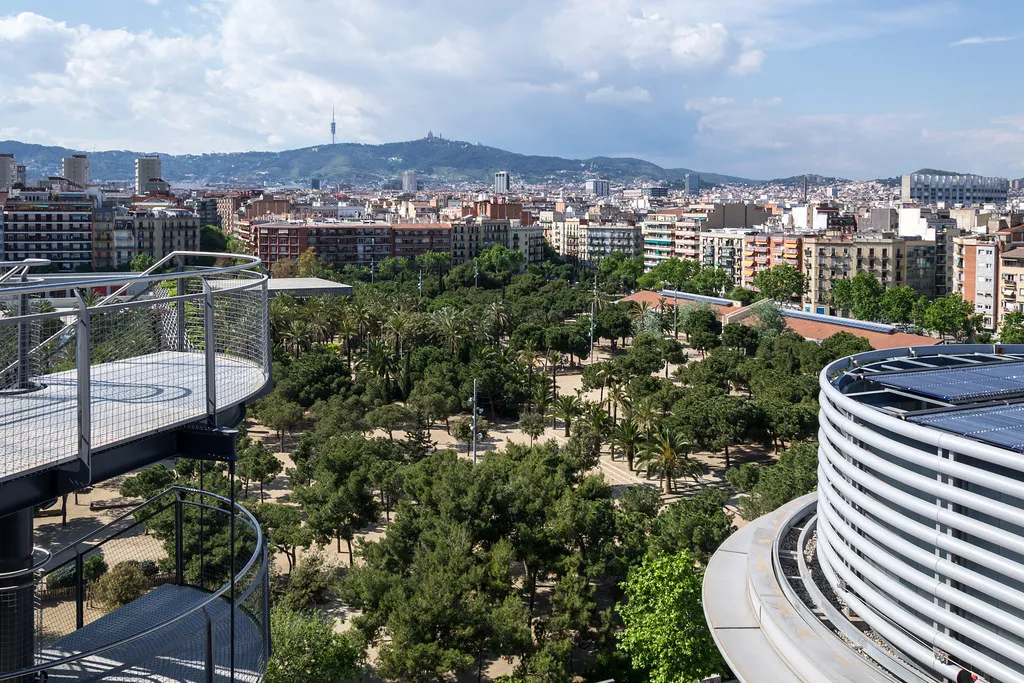
Construction ran from 1883 to 1885. Gaudí worked with a team of skilled craftsmen — masons, ceramicists, woodcarvers, and blacksmiths — and treated every surface as a canvas. The building that emerged was not a traditional Catalan villa. It was an explosion of color, geometry, and cultural reference that had no precedent in the neighborhood or the era.
The house passed through several private owners over the following century. It was bought in 2014 by the Andorran bank MoraBanc, which funded a major restoration. The museum opened in November 2017, giving the public its first sustained look inside. Prior to that, the building was largely invisible to tourists despite sitting on an otherwise ordinary residential street at Carrer de les Carolines 18–24.
Historians categorize Casa Vicens as the opening work of Gaudí's Orientalist period. He drew on Near Eastern, Mudéjar, and Moorish sources to create a design unlike anything else in late-19th-century Barcelona. Understanding this phase makes his later organic style — the melting facades of Casa Batlló, the mosaic-draped terraces of Park Güell — feel less like a sudden departure and more like a continuous evolution rooted in this first experiment. For a guided exploration of Barcelona's modernist treasures beyond Gaudí, Ruta del Modernisme maps all 115 key architectural works from the era.
Architectural Highlights: A Fusion of Orientalist and Mudéjar Styles
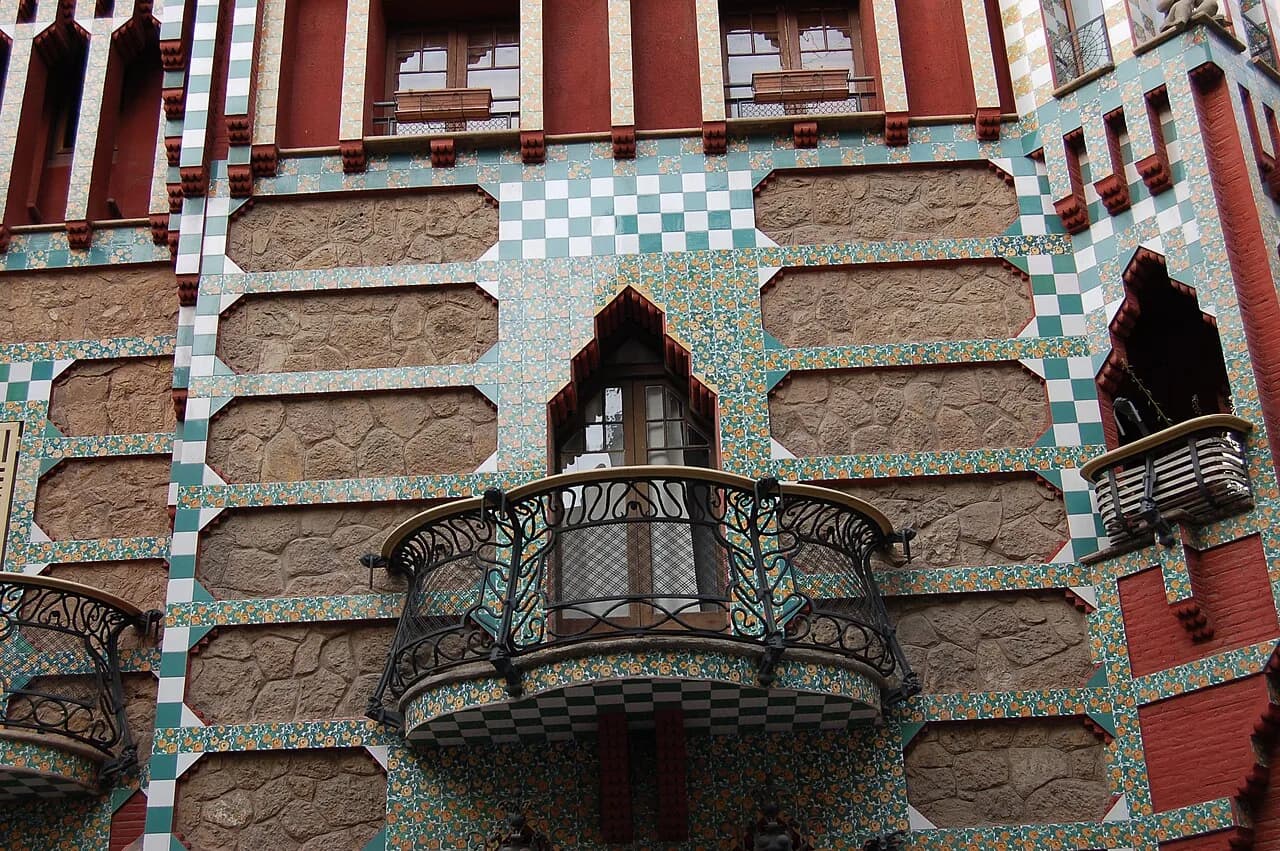
The facade stops you before you reach the entrance gate. Most buildings of the period used understated natural stone; Gaudí chose a vivid combination of red brick, white and green ceramic tiles, and terracotta. The tiles carry a repeating African marigold motif — a direct reference to the flowers growing in the garden, which Gaudí surveyed during the design phase. The rhythm of the pattern across the entire facade gives the building a festive, almost textile quality.
The wrought iron gate deserves close attention. Cast iron palm fronds fill the railings and balcony balustrades in asymmetric, naturalistic arrangements. Gaudí believed that every element of a building — including door handles and drainage spouts — should be designed with the same intention as the facade. The gate is among the finest examples of 19th-century decorative ironwork in Catalonia and hints at the organic iron structures he would refine in later decades.
Geometric shapes dominate the upper sections: horseshoe arches, corbelled overhangs, and a small western tower capped with a ceramic dome. These forms borrow from Mudéjar architecture, the Spanish style that blended Islamic and Gothic traditions. Unlike later Gaudí buildings, which dissolve geometry into curves, Casa Vicens maintains sharp lines and a tight grid. The color achieves the drama that the form withholds.
On the rooftop, curved terracotta tiles and three chimney caps clad in green and white ceramics anticipate the sculptural roofscapes of Casa Milà and the Sagrada Família towers. Gaudí also built the first accessible roof walkway here — a continuous path around all four sides of the pitched roof — years before it became a standard feature of his residential work.
Exploring the Interior: From the Smoking Room to the Dining Area
The most celebrated interior space is the Smoking Room on the ground floor. Gaudí lined the walls and ceiling with gilded polychrome stucco muqarnas — the honeycomb-like stalactite forms borrowed from Islamic architecture, most famously seen in the Alhambra. Palm leaf and bunch-of-grape motifs are woven through the gilded blue-and-gold surfaces. The effect is closer to a Moorish pavilion than a Catalan townhouse, and it remains one of the most singular interiors Gaudí ever created.
The Smoking Room muqarnas ceiling is the most photographed interior at Casa Vicens — linger here early in your visit before tour groups arrive, as the space comfortably holds only a dozen visitors at once.
The dining room opens onto what was once the main garden through a covered porch with a marble fountain. Gaudí painted the walls with birds and climbing plants to dissolve the boundary between inside and outside. He also designed the furniture himself, custom pieces built to harmonize with the architecture. Look at the ceiling: hand-painted beams, stucco floral reliefs, and a trompe-l'oeil dome on the floor above that depicts birds in flight as if the room were open to the sky.
The dining room is also where you can see the earliest known application of Gaudí's trencadís technique — the method of laying irregular shards of broken ceramic in mosaic patterns. On the terrace and porch surfaces, these early trencadís panels are rougher and more geometric than the fluid mosaics of Park Güell, but they are the origin point of a technique that would become one of his most recognizable signatures. No other building in his body of work can make this claim.
The museum chose to leave most rooms unfurnished, a deliberate decision to keep attention on the architecture itself. Without period furniture filling the sightlines, you can study the proportions of each room, the placement of windows, and the interaction between surface decoration and structural form. The upper floors have two bedrooms with sgraffito plasterwork — layers of colored plaster scratched through to reveal contrasting colors underneath — that carry the organic motifs through to the most private spaces of the house.
The Garden and Exterior: A Mediterranean Oasis in Gràcia
The original garden extended much further than what you see today. Over successive decades of private ownership and surrounding construction, the plot shrank significantly. The museum commissioned a study of historical records and old photographs to reconstruct the planting scheme as accurately as possible. What remains contains palms, magnolias, citrus trees, roses, and climbing plants — the same species Gaudí catalogued when he first surveyed the site in the early 1880s.
Gaudí integrated the garden directly into the building's design language. The ceramic tile motifs on the facade echo the marigolds in the flower beds. The iron palm fronds on the gate mirror the actual palms in the garden. A marble fountain on the covered porch cooled the air for family gatherings on hot summer evenings. The garden was not decorative backdrop; it was a source material that shaped every element of the architecture.
The exterior can be viewed from multiple angles along Carrer de les Carolines. Photographers get the best light on the main facade in the morning, when the sun hits the green tiles at a low angle. Late afternoon light softens the contrast between the brickwork and the ceramics and produces warm tones on the iron balustrades. Because the street is quiet and residential, you can take your time on the pavement without navigating tour groups.
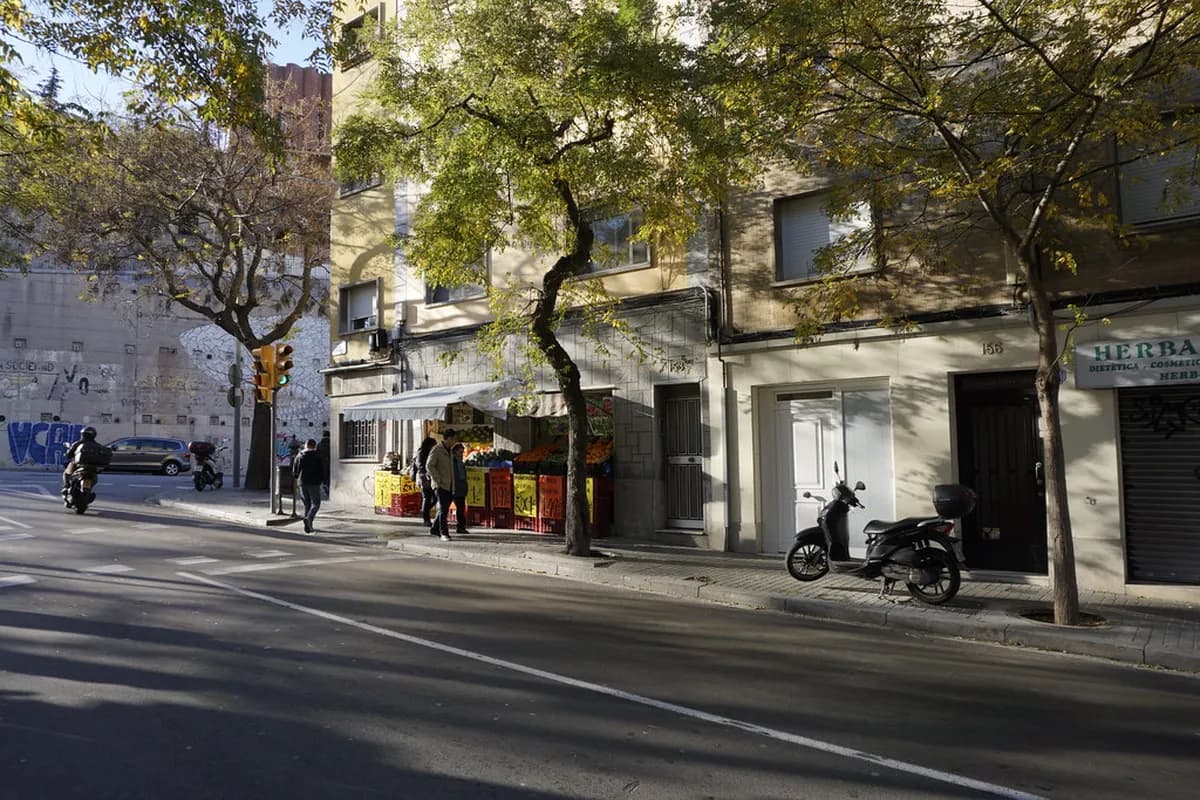
After your visit, the surrounding Gràcia neighborhood is worth at least an hour of exploration. The area retains a village character — small plazas, local grocery stores, independent cafes — that feels distinctly different from the tourist-dense streets around the Sagrada Família. The Mercat de la Llibertat on Carrer de la Llibertat is five minutes on foot and one of the most local-feeling covered markets in Barcelona.
The Crowd-Free Gaudí Visit Barcelona Rarely Offers
Barcelona received over 15 million overnight tourists in 2024 and has responded with new restrictions: limits on short-term rentals, cruise ship caps, and an expanded tourist tax. The Sagrada Família processes roughly 3 million visitors a year, and even morning entry slots sell out days in advance. Casa Batlló and Casa Milà each attract well over half a million visitors annually and charge €35–45 for standard adult entry.
Casa Vicens sits entirely outside this pressure zone. Annual visitor numbers are estimated at around 100,000 — roughly one-thirtieth of the Sagrada Família's footfall. On a typical weekday morning in 2026 you can move through the interior rooms without queuing and without the shoulder-to-shoulder compression of the major sites. The audio guide app, which you install on your phone before entry, is designed for self-paced exploration: you can linger in the Smoking Room muqarnas for ten minutes without anyone pushing past.
The entry price is €18 for adults (reduced rate for seniors, students, and disabled visitors). That is roughly half the cost of Casa Batlló and comparable to a standard Barcelona museum ticket. Combine this with the shorter travel time from most of the city's accommodation belt — Fontana metro station on the L3 line is a five-minute walk from the entrance at Carolines 18 — and the case for prioritizing Casa Vicens over the overcrowded alternatives becomes straightforward.
Bring your own earbuds for the audio guide app. The museum does not supply them, a detail that catches visitors off guard. The tour covers three floors plus the rooftop and runs approximately 75 minutes at a comfortable pace; allocate 90 minutes if you want to spend real time in the garden and on the roof. The gift shop and bookstore (La Capell, in the former coal cellar at basement level) stock architecture books, ceramic reproductions, and prints if you want to take something specific home.
Casa Vicens closes on 25 December and for a restoration window around 7–14 January each year — check casavicens.org before booking if your visit falls near those dates.
Why Casa Vicens Looks Nothing Like the Gaudí You Already Know
Visitors who arrive expecting the melting stone and bonelike curves of Casa Batlló or La Pedrera are sometimes surprised by how geometric and angular Casa Vicens is. That contrast is the point. This building belongs to the Orientalist phase, when Gaudí was still absorbing influences — Mudéjar architecture, Islamic geometry, Japanese decorative arts — rather than synthesizing them into an original language. The straight lines and precise tile grids here reflect a younger architect working within inherited frameworks.
By the time Gaudí designed Casa Milà (completed 1912), he had abandoned the grid entirely. Walls undulate, structural columns replace load-bearing walls, and the rooftop becomes sculpture. The distance between Casa Vicens in 1885 and Casa Milà in 1912 is roughly the distance between a student's first major exhibition and a mature artist's definitive statement. Seeing the first building makes the later trajectory legible in a way that starting with Sagrada Família or Park Güell cannot.
The comparison also reveals what remained constant. Gaudí's insistence on integrating architecture with natural forms — tiles that echo garden flowers, ironwork that mimics palm fronds, ceilings that simulate open sky — is as present at Casa Vicens as in any later work. The method changed; the obsession did not. That continuity is only visible to someone who has seen the starting point alongside Barcelona's broader Modernisme tradition.
Planning Your Visit: Tickets, Hours, and Location
The museum is open daily from 09:30 to 20:00 from April through October, and 09:30 to 18:00 from November through March. The last entry is 75 minutes before closing. The museum closes on 25 December and for a restoration window between approximately 7 and 14 January — check the official site at casavicens.org before booking around those dates.
Adult tickets cost €20; the reduced rate of €18 applies to visitors over 65, students up to 25 years old, disabled visitors, and children aged 11–17. Children under 11 enter free. Booking online in advance is strongly recommended during spring and summer: the museum operates timed-entry slots, and popular morning windows sell out. Tickets are available on the official website. The self-guided audio tour, delivered through the museum's own app (download before you arrive, and bring earbuds), is included in the entry price.
The address is Carrer de les Carolines 18–24, in the Gràcia district. The closest metro stop is Fontana on the L3 (green) line, a five-minute walk. Buses 22, 24, and 87 stop on nearby streets. The area is flat and the museum is fully accessible for wheelchairs. There is no dedicated parking on Carrer de les Carolines, but paid parking is available on nearby Travessera de Gràcia.
Allow 90 minutes for a thorough visit: three floors of rooms, the rooftop walkway, and the garden. If you plan to combine it with a broader 27 Unique Things to Do in Barcelona: Hidden Gems & Local Secrets itinerary, add 30–60 minutes to explore Gràcia's plazas and stop at the Mercat de la Llibertat before heading back into the city center.
Is Casa Vicens Worth It? How It Compares to Casa Batlló and Casa Milà
Casa Batlló charges €35–45 for standard adult entry, requires advance booking weeks ahead during peak season, and receives well over 500,000 visitors annually. The interior is spectacular, but you experience it shoulder-to-shoulder. Casa Milà (La Pedrera) is similarly priced and similarly crowded. Both are essential if you have never seen mature Gaudí; neither gives you the early career context that Casa Vicens does.
Casa Vicens at €18–20 is the cheapest of the three Gaudí houses open to visitors, the least crowded by a wide margin, and the only one that shows how the style originated. For a traveler who has already visited the city center landmarks, it fills an obvious gap. For a first-time visitor to Barcelona who wants to understand why Gaudí matters historically and not just visually, it is the most efficient starting point. The 12 Best Hidden Gems in Barcelona category rarely produces a site this well-preserved and this undervisited.
| Gaudí Site | Adult Ticket | Annual Visitors | Crowd Level | Visit Time |
|---|---|---|---|---|
| Casa Vicens | €18–20 | ~100,000 | Low | 90 min |
| Casa Batlló | €35–45 | 500,000+ | Very High | 60–75 min |
| Casa Milà (La Pedrera) | €25–35 | 400,000+ | High | 60–75 min |
| Sagrada Família | €26–47 | 3,000,000+ | Extreme | 90–120 min |
The practical difference in experience is significant. At Casa Batlló you follow a scripted route with timed audio cues and a crowd. At Casa Vicens you move freely, return to rooms that interest you, and spend as long as you want in the Smoking Room. The building is also smaller — about a third the floor area of Casa Batlló — which means the 90-minute window is genuinely enough rather than a rushed minimum.
If you are planning a dedicated Gaudí day in 2026, the most coherent sequence is Casa Vicens in the morning (opening slot at 09:30 at Fontana), a mid-morning walk through Gràcia, lunch at the Mercat de la Llibertat, and then the Sagrada Família or Park Güell in the afternoon. That sequence tells the story of a career in the right chronological order and distributes the morning crowd away from the major sites.
Frequently Asked Questions
Is Casa Vicens worth visiting compared to Casa Batlló?
Yes, Casa Vicens is definitely worth visiting if you prefer a quieter experience with fewer tourists. It costs less than Casa Batlló and offers a unique look at Gaudí's early career. You can see more details without the large crowds found at other 27 Unique Things to Do in Barcelona: Hidden Gems & Local Secrets.
How much time do you need to see Casa Vicens?
Most visitors spend between 90 minutes and two hours exploring the house and garden. This allows enough time to listen to the audio guide and take photos of the interior rooms. You should also leave some time to visit the museum shop and the small rooftop area.
Do you need to buy Casa Vicens tickets in advance?
While you can sometimes buy tickets at the door, booking online in advance is highly recommended. This ensures you get your preferred time slot and avoids any potential waiting lines during the busy summer months. Online booking also provides a small discount on the standard entry price.
Why is Casa Vicens unfurnished?
The museum decided to keep the rooms unfurnished to highlight the incredible architectural details and wall decorations. This approach allows visitors to focus on Gaudí's structural innovations and use of materials. It provides a clearer view of the original 1885 design without the distraction of period furniture.
Casa Vicens is an essential stop for anyone looking to understand the full scope of Gaudí's genius. The house offers a vibrant and peaceful alternative to the more crowded tourist sites in Barcelona. Plan your visit today to experience the colorful birth of Catalan modernism in the heart of Gràcia.
Continue exploring
More guides you'll find useful