Alter Sudfriedhof Munich Travel Guide
Explore Alter Südfriedhof in Munich, a free historic cemetery park with notable graves, opening hours, and quiet paths near the city center today.
On this page
Alter Südfriedhof Munich: A Historic Cemetery Guide
Alter Südfriedhof, or the Old Southern Cemetery, sits just south of Munich's historic center. Founded in 1563 as a plague burial ground, it served as Munich's only cemetery from 1788 to 1863. Today its shaded paths, weathered tombstones, and old-growth trees form a quiet, park-like retreat in the city.
Travelers searching for alter sudfriedhof munich often want history without the crowds of bigger landmarks. This cemetery-park delivers exactly that, mixing 19th-century monuments with squirrels, birdsong, and spring crocuses. It ranks among the more off-the-beaten-path attractions in Munich for a reflective afternoon.
What Is Alter Südfriedhof in Munich?
City authorities laid out Alter Südfriedhof in 1563 to bury victims of recurring plague outbreaks. Officials placed it outside the medieval city walls, a standard practice for pandemic-era burial grounds. Between 1634 and 1635 alone, roughly 15,000 Black Death victims went into unmarked mass graves here.
The cemetery later became Munich's primary burial site, serving as its only cemetery from 1788 to 1863. City leaders closed it to new burials shortly before the Second World War ended. Its 7-hectare grounds now sit inside the Ludwigsvorstadt-Isarvorstadt district, just outside the old Altstadtring ring road.
Around 5,000 historic graves remain on the property, and some have grown quietly overgrown with age. City authorities maintain it today as a public park rather than an active cemetery. The Alter Südfriedhof Wikipedia entry covers additional historical detail for a deeper visit.
Two surviving medieval gates, Sendlinger Tor and Isartor, once marked routes leading away from the walls near here. Sendlinger Tor once pointed the way toward Sendling, a town about 2.5 kilometers down the road. Isartor led travelers toward the Isar River, just a short walk to the east.
Notable Graves and Historic Monuments
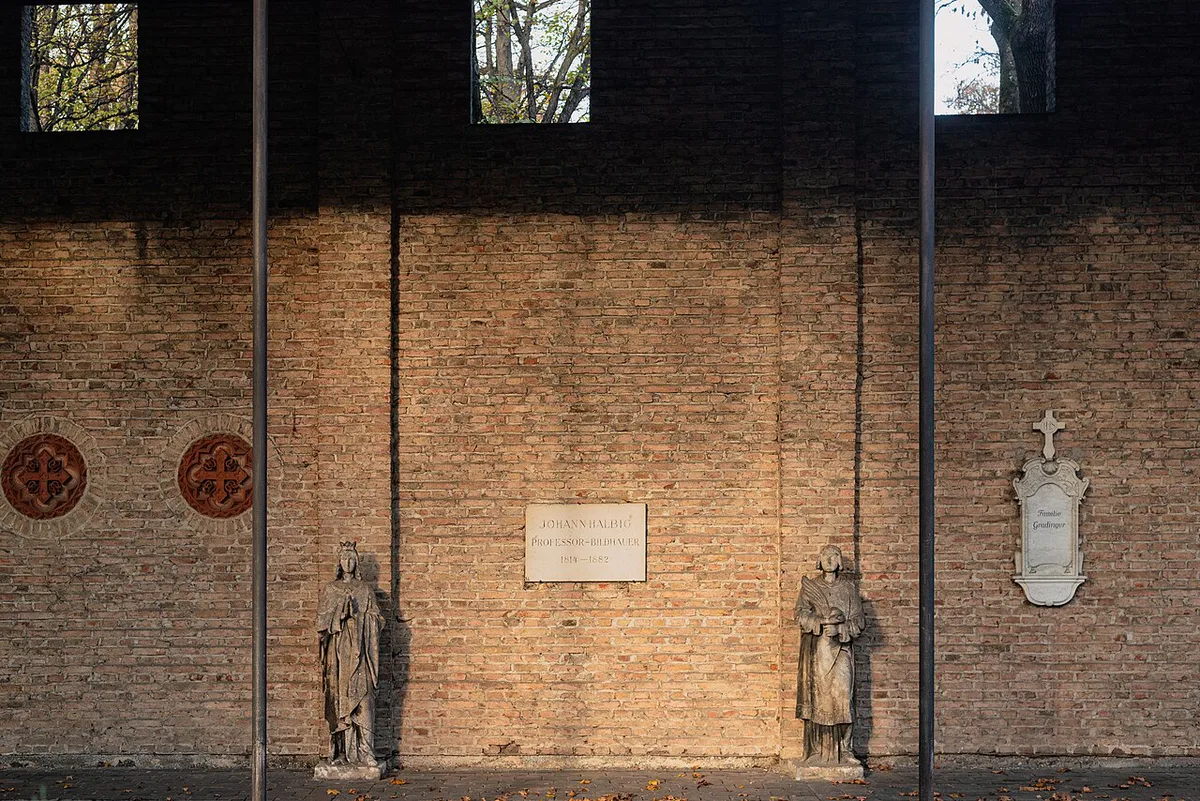
Grave markers here range widely in style and scale across the grounds. Some rise as grand red marble or granite monuments topped with carved angels. Others survive only as short, rain-worn stone stumps with no readable names left. That contrast turns a walk through the grounds into an open-air record of changing taste and status.
Max von Pettenkofer, a 19th-century hygienist and chemist, rests among the notable graves. He pushed Munich toward a public water supply and modern sewage system after linking poor sanitation to disease outbreaks. Pettenkofer worked alongside Robert Koch, whose name still marks Germany's leading public health institute.
Queen Therese of Bavaria, wife of King Ludwig I, also lies here. She died during the 1854 cholera epidemic, one of roughly 3,000 people the outbreak claimed in Munich. That epidemic later pushed city authorities to finally build proper water and sewage systems.
Several names come up often when visitors ask who is buried at Alter Südfriedhof. The short list below covers the figures most commonly referenced in guides to the site.
- Max von Pettenkofer, 19th-century hygienist
- Role: hygienist and chemist
- Known for: public water and sewage reforms
- Era: 19th century Munich
- Died: 1901 in Munich
- Queen Therese of Bavaria, cholera victim
- Role: wife of King Ludwig I
- Known for: author and traveler
- Died: 1854 cholera epidemic
- Notable: one of 3,000 victims
- Black Death mass graves, 1634 to 1635
- Period: 1634 to 1635
- Scale: about 15,000 burials
- Style: unmarked, shared mass graves
- Context: no individual coffins used
A Green, Park-Like Escape in Munich
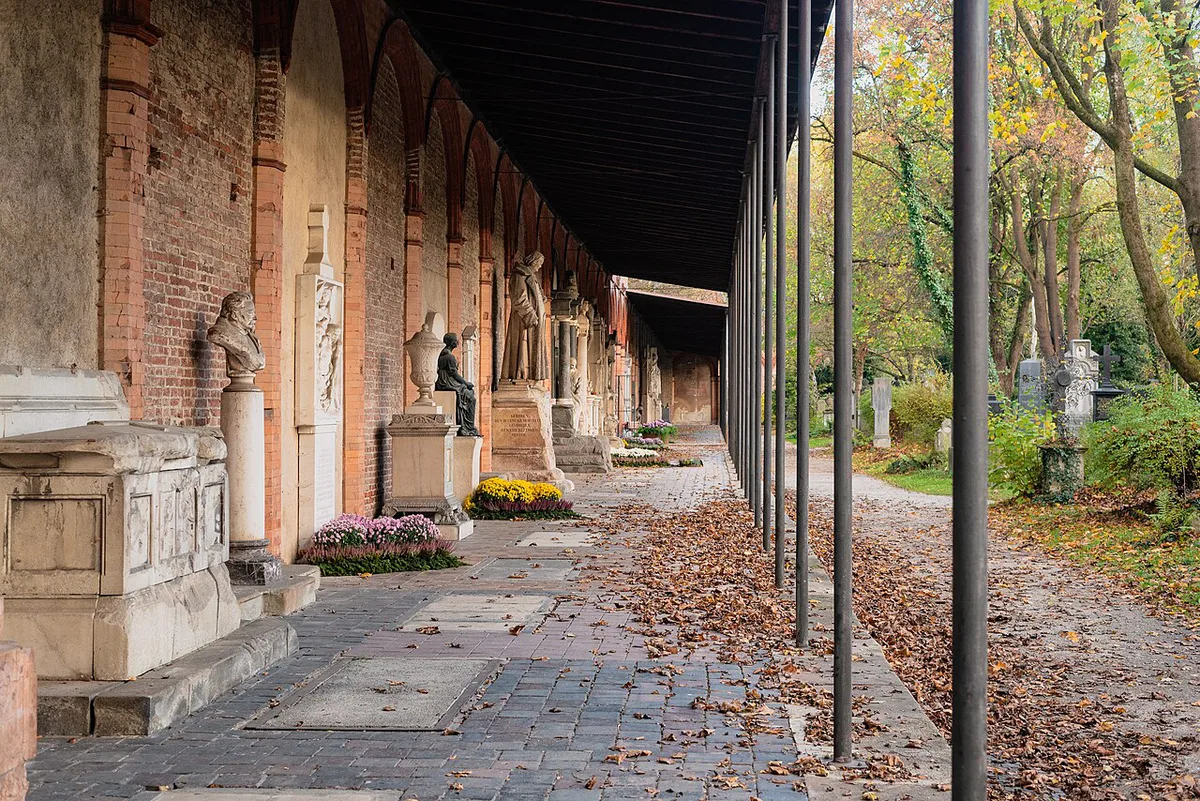
Old-growth trees tower over the grounds, softening the rows of stone monuments below. Their canopy gives Alter Südfriedhof the feel of a park more than a traditional cemetery. Locals often treat it that way, using its benches and paths for a quiet lunch break.
Keep voices low and pathways clear out of respect. Locals use the space for quiet lunches and walks, not games or picnicking near graves. This keeps it welcoming for mourners visiting family plots.
Red and gray squirrels dart across the paths and dig for nuts near the tombstones. Woodpeckers work the older trees overhead, and crocuses push up between the graves each spring. The mix of wildlife and blooming flowers softens the site's somber history for casual visitors.
That blend of nature and history places this cemetery-park among the more hidden gems across Munich. It rewards a slow pace rather than a quick photo stop. Bring comfortable shoes, since gravel paths crisscross the full 7-hectare grounds.
A preschool sits just outside the grounds, and its groups sometimes pass through on walks. That everyday use is a useful reminder that Alter Südfriedhof functions as a public park today. Visitors should keep pathways clear and voices low out of respect for both the setting and nearby residents.
Visiting Tips: Hours, Access, and Cost
Alter Südfriedhof charges no entrance fee, matching most public cemetery-parks across Germany. That makes it an easy stop for budget-conscious travelers filling out a Munich itinerary. Pair it with other 10 Free Things to Do in Munich in 2026 (Local Guide) to stretch a tight travel budget further.
Alter Südfriedhof charges no entrance fee. Gates typically open during daylight hours, but exact times shift with the season, so check current signage before early or late visits.
Gates typically open during daylight hours, though exact times can shift with the season. Check current signage at the entrance or the official city cemetery listings before an early or late visit. Overcast winter afternoons close earlier than long summer evenings, so plan accordingly.
Paved central paths work well for strollers, though some side paths stay gravel or uneven. Families can treat a visit as a short, educational walk rather than a full afternoon outing. Keep young children close, since ground can dip near older, unstable stone markers.
A common mistake is treating the grounds like a regular park for loud games or picnicking near graves. Locals use the space for quiet lunches and walks, not organized activities or group gatherings. Respectful, low-key behavior keeps the space welcoming for mourners visiting family plots nearby.
How to Plan a Smooth Alter Südfriedhof Visit
Weekday mornings offer the quietest walk through Alter Südfriedhof, with fewer joggers and dog walkers. Spring visits add blooming crocuses among the graves, while autumn brings colorful, old-growth foliage overhead. For broader seasonal advice, check the guide to the Best Time to Visit Munich Without Crowds (2026).
Most visitors spend roughly 30 to 45 minutes covering the main paths and notable graves. History-focused travelers often stay closer to an hour, reading inscriptions and comparing monument styles. Because it sits within the city center, it fits easily into any 2026 Munich itinerary.
| Season | Key Feature |
|---|---|
| Spring | Crocuses bloom among graves |
| Summer | Long daylight evenings |
| Autumn | Colorful old-growth foliage overhead |
| Winter | Afternoons close earlier |
Alter Südfriedhof borders the Ludwigsvorstadt-Isarvorstadt district, close to the Glockenbachviertel neighborhood. That area mixes cafes, small shops, and residential streets worth a slower wander afterward. The Glockenbachviertel neighborhood guide covers nearby spots for a coffee break or a late lunch.
Combine the cemetery with a walk to Sendlinger Tor for an efficient, low-cost city-center route. Wear layered clothing, since the shaded, tree-covered paths run several degrees cooler than open streets. A camera helps for the older monuments, though a respectful distance from active grave sites matters most.
Getting to Alter Südfriedhof: Address and Transit
Alter Südfriedhof sits along Thalkirchner Straße in the Ludwigsvorstadt-Isarvorstadt district, just south of Munich's old town. The closest U-Bahn stop is Poccistraße, served by lines U3 and U6, roughly a 5 to 10 minute walk from the cemetery's entrances. Sendlinger Tor, on lines U1, U2, U3, and U6, sits about 15 to 20 minutes north on foot and doubles as a landmark for combining the visit with a walk through the old city gate mentioned earlier in this guide. Surface trams and buses also run along nearby Bavariaring, though checking current MVV route maps before the trip is worth doing since routes shift over time. Entrances open onto Thalkirchner Straße and Bavariaring, so visitors arriving from Poccistraße typically enter from the Bavariaring side first.
- By U-Bahn: Poccistraße (U3/U6), about 5-10 minutes on foot
- By U-Bahn: Sendlinger Tor (U1/U2/U3/U6), about 15-20 minutes on foot
- By car: limited street parking along Thalkirchner Straße and side streets
Frequently Asked Questions
What is Alter Südfriedhof in Munich?
Alter Südfriedhof, or the Old Southern Cemetery, is a historic 7-hectare cemetery-park founded in 1563. It served as Munich's main burial ground into the 19th century before closing to new burials near the end of the Second World War. Old-growth trees and around 5,000 surviving graves now give it a quiet, park-like character.
Is Alter Südfriedhof the oldest cemetery in Munich?
Alter Südfriedhof is one of Munich's older public cemeteries, founded in 1563 as a plague burial ground. It became the city's only cemetery from 1788 to 1863, ahead of many newer sites. No single record confirms it as the oldest overall, so treat broad superlative claims with caution.
Which famous people are buried at Alter Südfriedhof?
Notable graves include Max von Pettenkofer, the 19th-century hygienist behind Munich's public water and sewage reforms. Queen Therese of Bavaria, wife of King Ludwig I, also rests here after dying in the 1854 cholera epidemic. Both graves draw history-focused visitors walking the main paths.
Is Alter Südfriedhof free to visit?
Yes, entry to Alter Südfriedhof costs nothing, similar to most public cemetery-parks in Germany. Gates generally follow daylight hours, though exact times shift by season, so confirm current signage before an early or late visit. That makes it a simple addition to a free-focused Munich itinerary.
Where can you eat near Alter Südfriedhof?
The surrounding Ludwigsvorstadt-Isarvorstadt and Glockenbachviertel areas hold cafes and casual restaurants within easy walking distance. For specific picks, the 10 Best Local Restaurants in Munich (2026) guide covers options near the city center. Most spots suit a quick coffee or a relaxed post-walk lunch.
Other City Cemeteries Worth an Hour
A cemetery that has become a public park without being tidied into one is a particular kind of European pleasure, and Munich is not alone in having one. Kraków's Rakowicki Cemetery holds the same mix of overgrown nineteenth-century monuments and everyday local use. Ljubljana's Žale was designed by Jože Plečnik as a small city of the dead, and Copenhagen's Assistens Cemetery is used as a park by the whole of Nørrebro.
Alter Südfriedhof rewards travelers who want Munich history away from the busiest landmarks. Its 1563 origins, notable graves, and park-like grounds pack real depth into a short visit. A free entry policy makes it easy to fit into almost any city itinerary.
Plan a quiet weekday visit, pair it with nearby Glockenbachviertel, and budget roughly half an hour to explore. For a wider look at German destinations beyond Munich, the more Germany travel guides hub offers additional planning ideas. Respectful, unhurried footsteps remain the best way to experience this historic cemetery-park.
Continue exploring
More guides you'll find useful