Hidden Gems in Catania: Lesser-Known Places Worth Seeking Out
A practical guide to Catania's lesser-known places, from underground Roman baths to a black-sand cove, with honest notes on what is ticketed and what is free.
On this page
Catania is a city built on layers: Roman remains beneath the streets, Baroque churches above them, and Etna's lava woven through both. Most visitors tick off the cathedral square and the fish market, then move on. But the places that make a stay memorable often sit just outside that circuit.
This guide focuses on lesser-known spots across the centre and the nearby coast. It separates free ground from ticketed interiors, flags sites with irregular or event-only access, and suggests safe backup plans. Use it to build a loose itinerary rather than a minute-by-minute schedule.
How to use this guide: free versus ticketed, and what depends on luck
Treat Catania's smaller sites as three groups. First, public ground: streets, piazzas, markets and the open-air lanes of San Berillo are free to wander. Second, ticketed interiors and terraces, where admission scope matters and should be checked on site. Third, irregular openings such as Cappella Bonajuto and Villa Zingali Tetto, which sources describe as opening occasionally or for events rather than on a fixed daily schedule.
That third group is where itineraries break. Do not build a day around a single chapel or villa that may not be open. Instead, pair each with a nearby free or reliably open backup. This approach keeps the day productive even if a door is locked.
If you want to anchor the day around free sights first, the Free Things to Do in Catania guide pairs well with this one. For orientation across the main sights, browse the Catania Attractions hub before choosing which minor sites to add.
Underground Catania: the Amenano river and the Roman baths beneath the cathedral square
The Amenano river once ran openly through the city but now flows beneath it, sealed under lava from the 1669 eruption. You can hear it at the Fontana dell'Amenano on Piazza Currò, where water spills from a marble basin into the darkness below, according to the Apartment in Catania hidden-gems guide. The fountain is a free, quick stop that hints at the hidden hydrology under your feet.
For a closer look, the Terme Achilliane sit directly beneath Piazza del Duomo, a second-century Roman bath complex rediscovered in the sixteenth century. Visitors descend several metres into barrel-vaulted chambers where water still pools on the ancient floor. Access is ticketed, and the exact scope of the ticket should be confirmed at the entrance rather than assumed to cover other nearby sites. The same source notes the baths are visited on fixed schedules, with a limited number of slots per day, so check locally before planning around them.
A third option is the bar inside a lava tube at Piazza Currò, where the underground river runs just metres from the tables and the temperature drops noticeably in summer. Entry is typically free with a drink purchase, according to the same local guide. That makes it an easy, low-risk way to experience the underground without committing to a timed visit.
Cappella Bonajuto: a small Byzantine survivor and why not to plan around it
On Via Bonajuto, squeezed between residential buildings, stands a sixth-century Byzantine chapel that survived the 1169 earthquake, the 1669 lava flow and the 1693 earthquake, as the Apartment in Catania guide explains. It has a tri-apsidal plan and thick walls of Roman-era brick and basalt, predating the Baroque city by more than a thousand years. The space is small, dark and heavy with age.
The catch is access. The chapel opens irregularly, often during FAI open-day events or by request to a local cultural association, according to the same guide. If you want to see it, check for upcoming open days before your trip and treat a visit as a bonus rather than a certainty. In the meantime, the exterior and the surrounding lanes are free to explore.
Quiet viewpoints: church terraces and the Museo Diocesano rooftop
For a city-centre panorama, the Museo Diocesano has a rooftop terrace with views along Via Etnea toward Etna and over the harbour. The museum occupies the eighteenth-century Palazzo dei Chierici next to the cathedral. The Apartment in Catania guide describes the terrace ticket as covering both museum and terrace, but ticket scope can change, so confirm what is included when you buy.
Church terraces offer alternatives. The Chiesa della Badia di Sant'Agata, just behind the cathedral, has a stone stairway to a terrace and dome with views over the city and the volcano; the Along Dusty Roads guide notes a rooftop entry fee is paid at the door. Separate churches, such as San Nicolò La Rena, also have roof access with city views, according to the Go Ask A Local guide. These are individual tickets rather than a combined church pass.
Clouds, mist or smoke often obscure Etna, so build flexibility into a viewpoint visit. A clear morning is better than a fixed afternoon slot. If the summit is hidden, the city rooftops and the coastline still reward the climb.
Architectural curiosities: Arco di San Benedetto and Villa Zingali Tetto's Liberty style
Halfway along Via Crociferi, the Arco di San Benedetto spans the street between the Monastery of San Benedetto and the church opposite. Local legend says it was built in a single night in 1704 to defy a city ordinance banning overhead structures across public roads. Whether or not the story is true, the arch physically connects the two Benedictine buildings so cloistered nuns could cross without touching public ground, according to the Apartment in Catania guide. Stand beneath it and look up at the coffered underside with carved lava-stone rosettes.
Villa Zingali Tetto is a different kind of curiosity: a Liberty-style villa built between 1925 and 1931 by architect Paolo Lanzerotti for the Zingali Tetto family. The facade features wrought-iron balconies with floral motifs, stained-glass windows and majolica tile work. Inside, original furnishings, hand-painted ceilings and a carved staircase survive intact, according to the same guide. The villa was donated to FAI and opens periodically for guided tours, so check the FAI calendar before making the trip to Via Etnea 742.
San Berillo Vecchio: street art and an unfinished regeneration story
San Berillo was once a dense, notorious quarter between Via Etnea and Corso Sicilia, partly demolished in a controversial 1950s urban-renewal project. What survived is now one of Sicily's more vibrant street-art districts. Murals by local and international artists cover entire building facades, and the neighbourhood's memory is told through the work, according to the Apartment in Catania guide.
This is not a finished attraction. The regeneration is genuine and ongoing, and each visit is slightly different as new works appear, the same source notes. Walk east from Via Etnea along Via Catajo or Via Di Prima to enter. Gammazita, a bar and community art space, anchors the cultural revival and hosts exhibitions and events. The area is free to explore.
Two markets, two moods: Pescheria fish market versus Fera 'o Luni
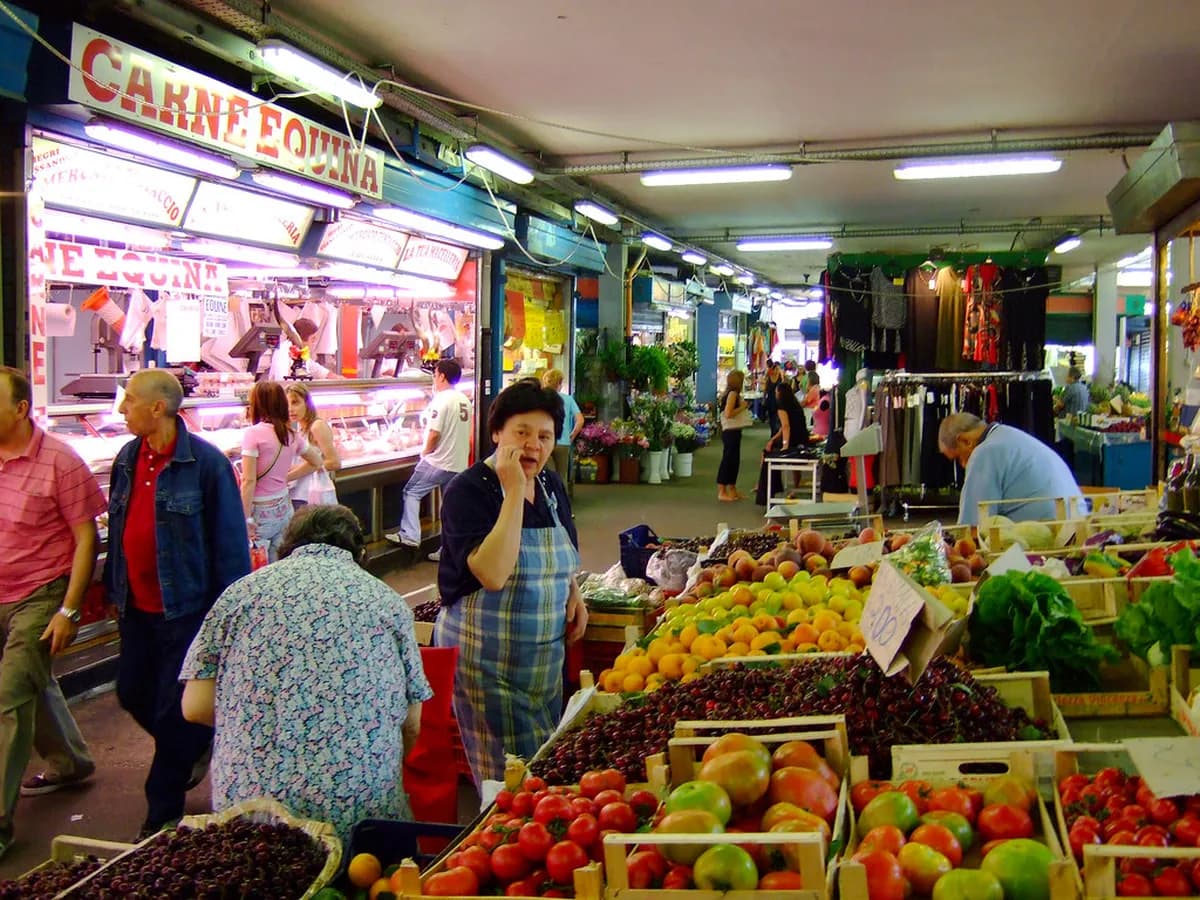
The Pescheria fish market, behind Piazza Duomo, is chaotic and colourful and best visited early in the morning. The market has taken place here since the nineteenth century and fans out under the arches of the Archi della Marina, according to the Along Dusty Roads guide. Food stalls nearby serve fried seafood in paper cones, but the market's rhythm is the main event.
Fera 'o Luni at Piazza Carlo Alberto is the everyday counterpart. Despite the name, which suggests Monday, the market runs every morning rather than only on Mondays, according to the Apartment in Catania guide. Stalls sell produce, vintage clothes, tools and counterfeit handbags. Come before mid-morning for the busiest atmosphere; things begin to wind down after early afternoon, the Along Dusty Roads guide adds.
If markets work up an appetite, the Catania Local Food Guide: What to Eat and Where covers pasta alla Norma, arancini and other local dishes. It helps to know what to look for before you start eating your way through the stalls.
Green pause: Orto Botanico on upper Via Etnea
Near the top of Via Etnea, where the shopping crowds thin out, a gate leads into the Orto Botanico, the University of Catania's botanical garden. Founded in 1858, the garden holds thousands of species, including a cactus collection adapted to volcanic soil, greenhouses and mature specimen trees. Benches under the palms offer shade and a kind of silence that feels impossible this close to the centre, according to the Apartment in Catania guide.
The garden is free to enter and rarely crowded, the same source states. It is an easy add-on to a walk up Via Etnea or a pause before continuing to Villa Bellini. Allow time to sit rather than rush through.
Volcanic coast: San Giovanni Li Cuti and the fishing villages north of the city
South-east of the centre, San Giovanni Li Cuti is a small cove with a black volcanic beach of basalt pebbles and dark sand. A tiny harbour at the northern end holds colourful wooden fishing boats still used by local fishermen, according to the Apartment in Catania guide. The contrast between the blue Ionian water and the black rock is striking, and the beach is free.
For a longer coastal outing, the Riviera dei Ciclopi stretches north of the city with towns such as Acicastello and Acitrezza built on volcanic rock. There are no long sandy beaches, but in summer wooden platforms are set up for sunbathing and swimming, according to the Go Ask A Local guide. Buses serve the area, but check current routes and times locally rather than relying on older schedules.
Farther north, the fishing villages of Ognina and Stazzo offer a slower seaside mood. The Apartment in Catania guide mentions Ognina's seafront promenade as a local favourite, where boats pull up on black-lava rocks at sunset. These are working places, not resorts, so go with a stroll-and-snack plan rather than an itinerary of attractions.
Suggested half-day and full-day pairings
For a half-day, combine the underground sites with a rooftop. Start at the Fontana dell'Amenano, check whether the Terme Achilliane are open, then climb to a church terrace or the Museo Diocesano roof for the view. This loop keeps you within a few minutes' walk of Piazza del Duomo and lets you adjust if a ticket line is long.
For a full day, spend the morning on markets and street art in the centre, then head to the coast in the afternoon. The Fera 'o Luni market is best before mid-morning, and San Giovanni Li Cuti is an easy bus or taxi ride from the centre. This pairing mixes urban and volcanic scenery without requiring a car.
If you are building a longer itinerary, the Best Time to Visit Catania Without the Crowds guide helps with seasonal timing. The Catania Self-Guided Walk: Baroque and Roman Highlights is a useful anchor for a day focused on the centre.
Practical cautions: irregular openings, changing prices and verifying before you go
Catania's lesser-known sites are rewarding precisely because they are not packaged for mass tourism. That also means irregular hours, limited tour slots and occasional closures. Cappella Bonajuto and Villa Zingali Tetto are the clearest examples: both open only occasionally, so check ahead rather than relying on a guidebook.
Prices cited in blogs and third-party guides may not match what you pay at the door. Confirm at the ticket office and ask what the ticket includes, especially where a museum and terrace are sold together. Do not assume that one ticket covers every part of a complex.
For a sense of what is free and what is ticketed across the city, and for festival dates such as the Feast of Sant'Agata in February, check official city or tourism sources close to your visit.
Plan Your Visit
Catania's appeal lies in its layers: the underground river, the Roman baths, the Baroque terraces, the street-art lanes and the black-sand coast. None of these require a full day, and most can be woven into a walk between the main sights. The key is to treat them as flexible additions rather than fixed stops.
Before you go, pick two or three lesser-known places that match your interests, check current opening details for the irregular sites, and leave room for a market breakfast or a coastal pause. The city rewards curiosity, but it rewards preparation more.
More Catania guides
- A Self-Guided Walking Tour of Catania
- A Slow Day Trip from Catania to Acitrezza and the Cyclops Coast
- Best Time to Visit Catania Without the Crowds
- Catania After Dark
- Catania City Centre
- Catania Local Food Guide
- Catania Neighbourhoods
- Catania on a Rainy Day
- Catania Seafront and Harbour
- Catania Street Food Guide
- Catania with Kids
- Catania's Lava-Stone Architecture
- Free Things to Do in Catania
- One Perfect Day in Catania
- Roman Catania
- Anfiteatro Romano di Catania
- Basilica della Collegiata
- Chiesa della Badia di Sant'Agata
- Monastero dei Benedettini
- Museo Civico Castello Ursino
- Orto Botanico di Catania
- Pescheria di Catania
- Piazza del Duomo and Cattedrale di Sant'Agata
- Teatro Romano di Catania
- Via Crociferi in Catania
- Via Etnea
- Villa Bellini (Giardino Bellini)
Frequently Asked Questions
Is Catania worth visiting beyond the main sights?
Yes, if you enjoy layered history and local life. The city's lesser-known places include underground Roman remains, small chapels and street-art lanes. Some open irregularly, so check ahead and keep backups.
Which Catania sights are free and which need a ticket?
Public streets, piazzas, markets, the San Berillo street-art area and the Orto Botanico are generally free to enter, though confirm the garden's current status. Church terraces, the Museo Diocesano rooftop and the Terme Achilliane are ticketed; ticket scope varies, so ask at the entrance.
When is the Fera 'o Luni market held?
Despite the name suggesting Monday, the Fera 'o Luni at Piazza Carlo Alberto runs every morning, not only on Mondays. Arrive before mid-morning for the busiest atmosphere; stalls begin to wind down after early afternoon.
Can you visit the underground Roman baths in Catania?
Yes, the Terme Achilliane beneath Piazza del Duomo are open to visitors on ticketed, scheduled slots. The number of slots per day is limited, so check locally before planning your day around them.
How many days do you need to see Catania's quieter corners?
Two full days is a reasonable base if you want to mix the main sights with a handful of lesser-known places. Add a third day if you plan a coastal outing or a market morning.
Sources
Continue exploring
More guides you'll find useful