Catania with Kids: A Family-Friendly Guide to Parks & Markets
Plan Catania with kids around a city park, a loud fish market, baroque piazzas and short walks, with realistic timing and tips for keeping children engaged.
On this page
Catania is a working port city under a volcano, and that is exactly what makes it interesting for children: a fish market that sounds like a theatre, streets paved in black lava stone, and a smiling stone elephant in the main square. It also means the city rewards families who plan short bursts rather than full sightseeing days. As a purely suggested duration, two nights gives you one market morning, one park afternoon and one relaxed evening walk without rushing anyone.
The practical spine of a family visit is the market's own rhythm. La Pescheria, the fish market behind Piazza del Duomo, opens Monday to Saturday from roughly 7:00am to 2:00pm, with peak activity between 9:00 and 11:00, and it closes all day on Sunday. When is the Catania fish market open? That question shapes the whole week, so plan at least one weekday morning around it and leave the rest of the day loose.
Set Expectations Before You Set Out
Catania is not a resort town with a promenade and a beach club at the end of every street; its appeal is noise, food, layered history and a certain scruffy energy. Children tend to respond well to that if the day is broken into anchor stops rather than a checklist. Pick one or two fixed points each day, such as a market morning plus a park afternoon, and let the baroque squares fill the gaps.
Two sensory details are worth flagging before you go. The centre is paved largely in dark volcanic stone, and the fish market floor is often wet by mid-morning, so closed shoes and a slower pace help everyone. The lane between the stalls is also loud and cramped at peak times, with trolleys moving through; a hand-hold and a short, purpose-built visit work better than an open-ended wander.
Villa Bellini: The Midday Reset
Villa Bellini, also called Giardino Bellini, is Catania's classic green space at the top of Via Etnea, and it works best as a reset between the crowded historic centre and the rest of the day. One family-oriented listing notes a music pavilion used for folk music on summer evenings and a floral calendar whose date is updated daily, which gives children something concrete to look for. Treat the park as unstructured time rather than a sight: shade, a run around, and a snack before the next stop.
Positioning the park midday matters in summer, when the lava-paved streets radiate heat and the baroque facades offer little shade. A morning market visit followed by park time and an indoor or shaded afternoon keeps everyone functional. In cooler months the same park works as a morning stop before the streets fill.
For a quieter green option further up the same street, the university's Orto Botanico sits near the top of Via Etnea and holds thousands of plant species, including a cactus collection adapted to volcanic soil. It is a different kind of stop from a playground park: slower, more botanical, and best for children who like naming plants. Check current access arrangements before building a day around it, since garden hours can vary by season.
La Pescheria Fish Market: What Children Actually Notice
Children rarely remember the species names at La Pescheria; they remember the chanting, the split-open swordfish, the coiled eels and the sheer volume of noise in a sunken alley behind Piazza del Duomo. Use that. Give each child one thing to spot, whether it is the biggest fish, the vendor flicking an eel to show it is alive, or the iced trays of prawns, and the visit becomes a game rather than a lecture.
Timing matters more here than almost anywhere else in the city. The market runs Monday to Saturday from around 7:00am to 2:00pm, most stalls begin packing up by about 1:30pm, and Sunday is a full closure with no tourist-season exception. The 9:00 to 11:00 window balances full stalls with walkable space; the first hour is the locals' wholesale rush with vans in the alleys, which is vivid but cramped with small children.
Two practical realities shape a family visit. Most stalls are cash-only, so carry small notes rather than a large bill, and the prices on display are not negotiated, so teach children that asking for a smaller piece is fine but haggling is not the done thing. The floor is often wet, close-up portraits of vendors need a quick request first, and the market feels visibly thinner in late July and August when some stalls take rolling holidays.
If your only free morning falls on a Sunday, do not force it. In that case the closed market piazza itself is still a quick, photogenic walk past the Amenano Fountain and Porta Carlo V, and the smaller Mercato di San Domenico off Via Plebiscito keeps some food stalls going at weekends, though it is far less spectacular.
Fera 'o Luni: The Lower-Pressure Market Alternative
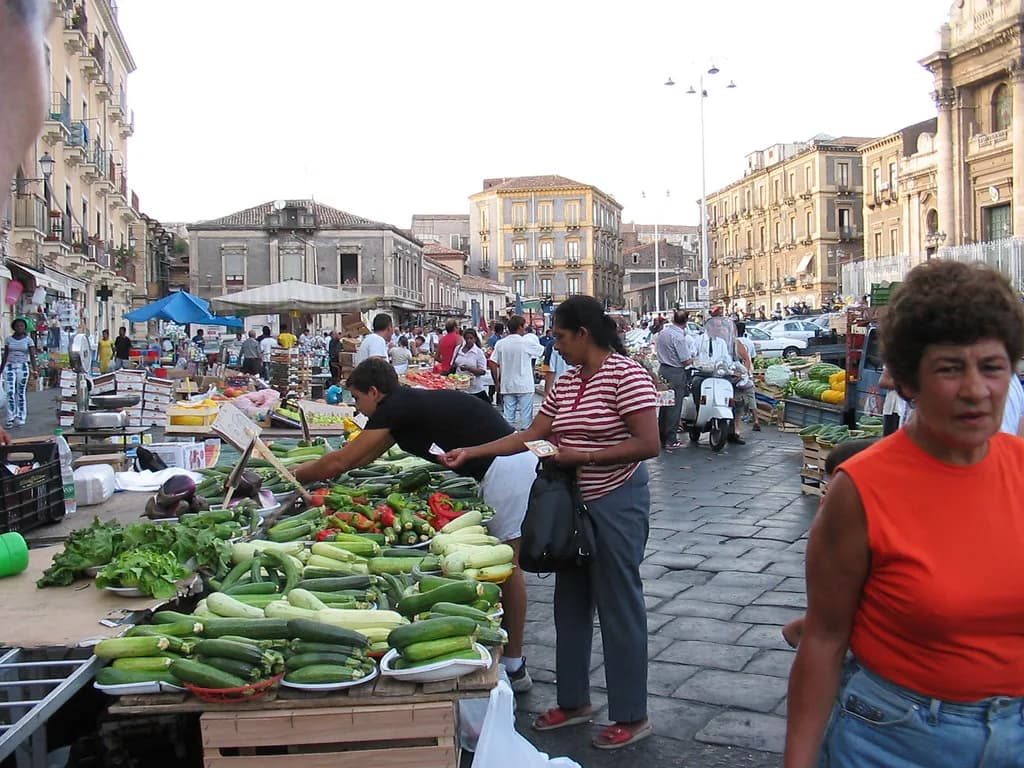
Fera 'o Luni at Piazza Carlo Alberto is the everyday counterpart to the fish market: general goods, clothes, produce and household items, with less of a camera scrum and no entry cost to browse. Despite the name, which means Monday Fair, it runs daily except Sunday, generally from about 8:00am to roughly 1:00pm. For families, that makes it a flexible filler rather than a scheduled set piece.
This is where children can watch tailors sewing on the spot, see produce piled on carts and hear Sicilian dialect bargaining, all without the blood-and-ice intensity of the fish stalls. Come before mid-morning for the busiest atmosphere, and keep expectations modest: it is a working market, not an attraction with facilities. Bring small cash and a bag if you plan to buy fruit for later.
Piazza del Duomo and Via Etnea: A Short Stroll, Not a March
Piazza del Duomo is the natural first stop because everything radiates from it. The centrepiece is the lava-stone elephant carrying an obelisk, known locally as Liotru, built in the 1730s on a site where the statue has served as a meeting point for centuries. Give children the story of the elephant and the nearby fountain rather than a list of architects, and the square becomes a five-minute highlight instead of a history lesson.
From there, Via Etnea runs about three kilometres in a straight line north toward Mount Etna, and the first stretch from Piazza del Duomo to the Quattro Canti is pedestrian, which makes it the easiest walking for children. Beyond that, buses and taxis share the road, so plan to turn back or cut into side streets. The street's early stretch packs churches, palaces and a university piazza into a short distance, and the evening passeggiata gives it a livelier feel than midday.
A useful loop for small legs: Piazza del Duomo, up a stretch of Via Etnea, a stop at Piazza dell'Università, then back through the side lanes toward the cathedral. That keeps walking under an hour with pauses, and you can slot a granita or arancino stop into the middle. Avoid presenting the whole street as a target; it continues for kilometres past the shopping zone.
Roman Remains Made Interesting
The Roman amphitheatre at Piazza Stesicoro is a good first ruin for children because so much of it is story and scale. It was likely built in the 2nd century AD, expanded in the 3rd, and once held a crowd in the thousands, with an arena roughly 70 by 50 metres and tiered seating above. Today it sits partly below street level, swallowed by the modern city, which is itself the hook: ask children to imagine the rest of it under the road they are standing on.
The Greco-Roman theatre area on Via Vittorio Emanuele II offers a second, more intimate ruin, built over an earlier Greek theatre and with a smaller Odeon beside it. It is a compact site suited to a short visit rather than a morning. Opening times and ticket arrangements are best checked directly with the site before you go, since third-party listings vary.
For families who want Roman layers without the heat, the Terme Achilliane beneath Piazza del Duomo descend several metres into vaulted chambers where water still pools on the ancient floor. Visits run on fixed schedules with a limited number of slots per day, so ask at the ticket point in the morning rather than turning up late. Pair it with the fountain above to explain how the buried river Amenano still runs under the square.
One Indoor, Story-Rich Option for Hot or Wet Days
Castello Ursino is the obvious castle choice: a 13th-century Swabian fortress that once stood on a promontory by the sea, then found itself landlocked after the 1669 lava flow pushed the coastline out. That single fact does more work than any date for a child. Inside, the museum holds archaeological collections, and the exterior and walls give you a free-to-walk-around landmark even if the mood does not stretch to galleries.
The Monastero dei Benedettini di San Nicolò l'Arena is the other strong indoor option, now home to part of the University of Catania and one of the largest monastic complexes in Europe. Visits are organised as guided routes, with a virtual tour available online and integrated tickets that include the Orto Botanico and Villa Cerami, so check what each ticket covers rather than assuming one pass opens everything. Guided tours are the way to see hidden rooms such as the majolica-tiled kitchen and the Roman domus below.
Choosing between the two is mostly about weather and mood. A castle is faster and more physical; the monastery is a longer, more structured walk through corridors and courtyards that rewards children who like behind-the-scenes spaces. Either way, book or check the current guided-visit slots before setting out, because access to the best rooms is often only with a guide.
Food as the Engagement Tool
Food is the simplest way to keep children interested in Catania. Pasta alla Norma, the aubergine and ricotta salata dish tied to the city and to Bellini's opera, is a reliable order almost anywhere, and arancini make an easy mid-morning stop. Build the day around snack anchors: a market tasting in the morning, a granita or gelato in the afternoon, and dinner somewhere with a short menu.
The market itself is the best food classroom. A freshly opened sea urchin in season, roughly November to April according to one local guide, or a slice of bread handed over the counter turns shopping into a tasting. Ask before touching anything, and let the vendor offer rather than reaching in. It is also worth explaining that the market's sung price calls are a performance passed between generations, not an argument.
For a bigger Sicilian food context beyond the city, the eastern Sicily family itinerary pairs market visits in Catania with chocolate-making in Modica and farm visits near Ragusa, which shows how food experiences can stretch across a week. Use that pattern for shorter stays: one market, one cooking or tasting stop, one farm or garden.
Where to Base Yourselves
A historic-centre base puts Piazza del Duomo, the fish market, Via Etnea and the Villa Bellini end of town within a walkable band, which matters most for naps and toilet breaks. The trade-off is noise and traffic in the evening, plus higher prices in the most photographed lanes. A quieter base near the castle or slightly outside the core buys space and calm at the cost of extra walking with tired legs.
Families planning day trips sometimes split a longer Sicily stay into two bases rather than driving daily. For a Catania-focused trip that is unnecessary, but if you intend to combine the city with Etna, Taormina or Syracuse, look at a short stay in the city and a second base further south. Do not underestimate the time lost to packing and moving with children.
A Seasonal Reality Check
Summer heat and the August market slowdown are the two biggest seasonal factors in Catania. Late July and August see some fish stalls close for rolling holidays, so the market feels thinner on a Tuesday in early August than in early October, even though the daily window stays broadly the same. Morning is the only sensible slot for the market in high summer; midday belongs to shade, parks and indoors.
Spring and autumn are easier for walking the baroque streets and taking the amphitheatre and theatre ruins at a child's pace. Winter is quieter and the passeggiata still fills Via Etnea in the evening, but shorter daylight hours mean you should front-load outdoor stops. Whatever the season, check official sources for opening times rather than relying on older blog posts, since arrangements change.
Getting Beyond the City
Catania is a practical base for the eastern side of Sicily, and the obvious family excursion is Mount Etna. Crater walking is only permitted as part of a licensed guided tour, so book accordingly rather than planning to scramble up independently. The Etna area's lower trails are easier with young children, and a guided nature walk can add lava caves and stories that keep the day interesting.
Along the coast, San Giovanni Li Cuti offers a black volcanic beach of basalt pebbles and dark sand very close to the centre, with a tiny harbour where fishing boats are pulled up on the dark shore. The contrast between the blue water and black rock is striking, and it works as a short, low-commitment break rather than a beach day. Watch footing on the pebbles and check conditions before swimming.
For a wider menu of smaller, less obvious places to slot into a family trip, from underground rivers to rooftop terraces and a hidden garden, the hidden gems in Catania guide covers options beyond the core sights. Use it to swap one anchor stop for something quieter on a day when the children need less noise and fewer crowds.
Plan Around the Market Clock
The most useful rule for Catania with children is simple: let the fish market set your weekday rhythm, then build a park and a square around it. La Pescheria runs Monday to Saturday from roughly 7:00am to 2:00pm with a 9:00 to 11:00 sweet spot, closes entirely on Sunday, and starts thinning out for August holidays. Plan those mornings first and everything else falls into place.
Keep the rest flexible. One indoor option for bad weather, one ruin for scale and stories, and a short looping walk from the elephant fountain up Via Etnea will cover more ground than a packed checklist. Check the Catania Attractions guides for individual sights, and confirm current opening arrangements with official sources before you rely on them.
Frequently Asked Questions
How many days in Catania is enough for a family?
Two nights is a sensible minimum for a family: one weekday market morning, one afternoon in the park, and one relaxed evening walk around Piazza del Duomo and the lower stretch of Via Etnea. Longer stays allow a castle or monastery visit on a hot or rainy day and a coastal or Etna excursion. This is a suggested pace, not an official recommendation.
Is the Catania fish market suitable for young children?
It can be, with preparation. The market is loud, the floor is often wet and most stalls are cash-only, so closed shoes, small notes and a short visit work best. The quieter window is mid-morning rather than the early wholesale rush or the post-lunch pack-up. Close-up portraits of vendors should be requested first.
What can families do in Catania on a Sunday morning?
The main fish market is closed all day on Sunday, so plan something else. The empty market piazza and the Amenano Fountain are a quick walk, and a smaller market in the Via Plebiscito area keeps some weekend food stalls, though it is much quieter than La Pescheria. Villa Bellini and the baroque squares are other straightforward options.
Which Catania sights work best for children in hot weather?
Below-ground and indoor options do the best job of escaping the heat: the Roman baths beneath Piazza del Duomo, the Castello Ursino museum, and the guided routes through the Monastero dei Benedettini. Pair one of these with a slow morning and leave the park for early evening rather than the middle of the day.
Can we visit Mount Etna's craters on our own?
Crater walking is only permitted as part of a licensed guided tour, so a family visit to the summit area should be booked rather than improvised. The Etna area's lower trails are easier with young children. Check current conditions and tour availability before travelling, as the volcano is active.
Sources
- Sicily with Kids: A 7-Day Itinerary in Eastern Sicily
- Official event website
- Catania Fish Market (La Pescheria): A 2026 Local Guide
- Via Etnea, Catania: what to see and tips | ZonzoFox
- Greek - Roman Theatre Tickets [2026] - Promos, Prices, Reviews & Opening Hours | Trip.com
- Roman amphitheatre of Catania
- Monastero dei Benedettini di San Nicolò l'Arena | Catania
- A Local’s Favorite Things to Do in Catania — Go Ask A Local
- Hidden Gems in Catania: 15 Unusual Places Locals Love
Continue exploring
More guides you'll find useful