Via Etnea, Catania: A Shopping and Strolling Guide
Walk Catania's Via Etnea from Piazza del Duomo to Villa Bellini: Baroque palazzi, lava-stone paving, shopping stretches and where the evening stroll happens.
On this page
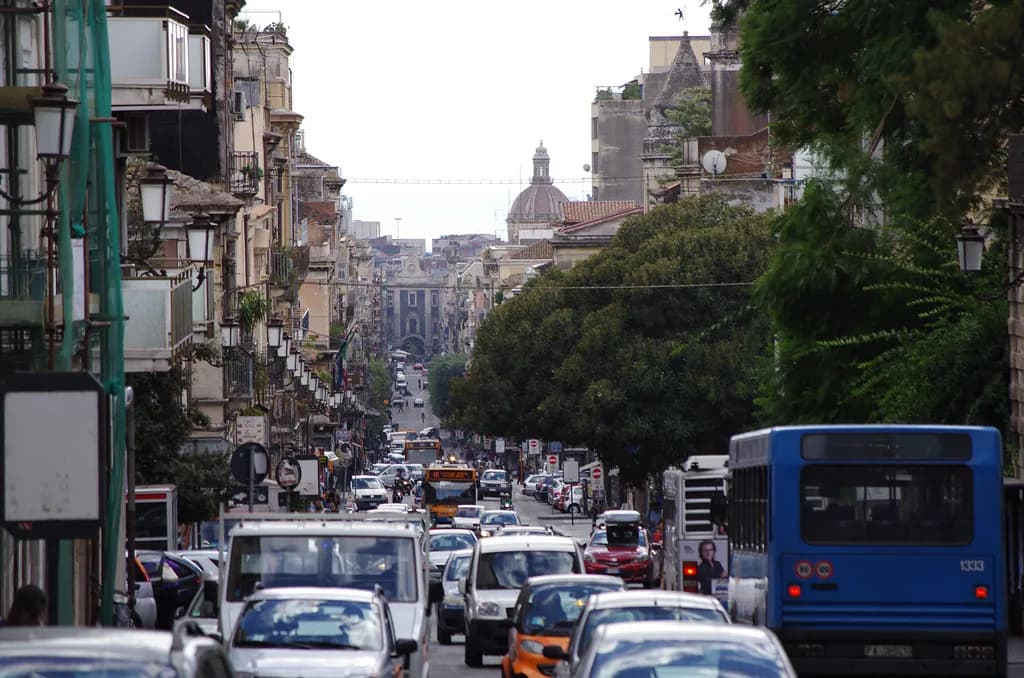
Via Etnea is Catania's main street, laid out as a straight three-kilometre line running north from Piazza del Duomo toward Mount Etna. Its first stretch works like a Baroque drawing room of churches and noble palaces, and then it shifts into the shopping and evening-stroll territory that keeps the centre busy after dark. Walking it end to end is the simplest way to read the city's layout in a single afternoon.
The paving underfoot is lava stone from Etna, dark and slightly uneven in places, which matters more than it sounds when you plan a long walk in summer heat. The stretch from Piazza del Duomo to the Quattro Canti crossroads is pedestrian, while beyond that toward the Villa Bellini only buses and taxis are allowed according to the street description published by ZonzoFox.
Orientation: The Three-Kilometre Line and Lava Paving
Think of Via Etnea as an axis rather than a shopping list. It begins at Piazza del Duomo, where the Palazzo degli Elefanti houses the city hall and the Liotru elephant fountain marks the meeting point, then runs due north with Etna framed at the far end. Because the route is straight and continuous, you can walk it in one direction and take a different street back without losing your bearings.
The street was laid out after the earthquake of 11 January 1693, which levelled Catania and killed about two-thirds of its people. The Duke of Camastra, sent to lead the rebuilding, set streets at right angles from the cathedral, and the new axis was first called Via Duca di Uzeda at roughly seven hundred metres long, ending at what is now Piazza Stesicoro. It later became Via Stesionea and finally Via Etnea because it points straight at the volcano.
In the twentieth century the street pushed past the boulevards as far as Piazza Cavour, which locals call Piazza Borgo, and from 1915 to 1934 it even carried tram tracks toward Acireale. That history explains why the lower and upper halves feel different: the first is the rebuilt Baroque centre, the second grew as the city expanded. Wear shoes with a little cushioning, since lava paving is hard underfoot over three kilometres.
Start at Piazza del Duomo and the Liotru
Begin at the square where Via Etnea meets the cathedral, the Palazzo degli Elefanti and the black lava elephant fountain known as Liotru. The fountain and its obelisk were built in the 1730s and have served as a congregation point ever since, which makes the square a natural place to orient yourself before heading north. The Museo Diocesano sits in the Palazzo dei Chierici next to the cathedral, so you can split a museum visit from the walk if you prefer.
Just past the square, the street narrows into the pedestrian section, with the university palace and Palazzo San Giuliano framing Piazza dell'Università. This is the part of Via Etnea to walk slowly, because the architecture is the attraction rather than the shop windows. Keep an eye on signage if you are driving or cycling, since the pedestrian and restricted stretches are enforced on the ground rather than by a national rule.
The Baroque Parade: Università, San Giuliano and the Collegiata
A few steps north of Piazza dell'Università stands the Basilica della Collegiata, the first in a row of churches that lines Via Etnea all the way to the Borgo. The palaces along this stretch were designed by architects including Giovanni Battista Vaccarini and Francesco Battaglia, whose work gives the street its consistent late-Baroque character. Treat the façades as the main event here: the street is a parade of stonework rather than a sequence of ticketed interiors.
The Basilica della Collegiata is one of the finest examples of Sicilian Baroque in the city, and its position means you can see it without detouring from the walk. If you want to step inside, check the notice on the door rather than relying on a guidebook, because church visiting hours are not published consistently across the centre. Allow a little extra time here before continuing to the Quattro Canti.
Quattro Canti Crossroads and Piazza Stesicoro
At the Quattro Canti crossing, Palazzo Gioeni and Palazzo San Demetrio mark the four corners, and the street begins to feel more commercial than ceremonial. Keep walking to Piazza Stesicoro, which is surrounded by Palazzo del Toscano and Palazzo Tezzano, with the main entrance to the Villa Bellini just beyond the post office building. This is where the street's two personalities meet: Baroque set pieces behind you, shopping and evening eating ahead.
Piazza Stesicoro hides one of the street's best surprises below road level: the remains of the Roman amphitheatre, once among the largest in Sicily and said to have held thousands of spectators. Because only a fraction of the structure is visible, it works as a street-level detour rather than a full museum stop. You can enter from Piazza Stesicoro and Vico Anfiteatro and admire the seating tiers and arches that once supported the arena.
The amphitheatre was built using volcanic stone from Etna, which gives it the same black-brown palette as the street's paving and palaces. Legend says the lava flow of 252 AD was halted by the veil of Saint Agata, though geological studies show the lava never reached the city; treat the story as local lore rather than history. If the site is open, a short look is enough before you continue north.
Upper Street and the Villa Bellini Entrance
Beyond Piazza Stesicoro, Via Etnea becomes the shopping stretch visitors picture, with the Villa Bellini's main entrance at the top. Villa Bellini (Giardino Bellini) is the oldest and largest green park in Catania, and its gates give you a natural place to pause or end the walk. The streets around it hold about a hundred places to eat and drink, from restaurants and beer halls to pubs and pizzerias, which is why the street stays busy late into the night.
Near the top of the street, where the shopping crowds thin out, the Orto Botanico gate leads into the University of Catania's botanical garden. That contrast is the reward for walking the whole length rather than turning back at Stesicoro: you pass from retail into green space within a few minutes. If you only have time for one pause, choose the Villa Bellini over a café stop for shade and legs-stretching.
Shopping and the Evening Passeggiata
The street's job changes as the day goes on. In the morning it belongs to commuters, shoppers and people heading to the university quarter; by evening the stretch around Piazza Stesicoro and toward the Villa Bellini fills with strollers, and the eating places stay open late. Plan to walk the lower Baroque section earlier and the upper shopping section later if you want to see both moods.
Shop names, opening hours and closing days along Via Etnea change with the season, and no reliable public list covers them. Check the door of any specific shop or café on the day rather than relying on an outdated guide, and keep small notes handy if you plan to buy from market-style stalls nearby. As a rule, compare prices in the windows before committing to a purchase.
Catania's other main market life sits just off the axis: the Pescheria fish market behind Piazza del Duomo and the Fera 'o Luni at Piazza Carlo Alberto. Neither is on Via Etnea, but both are close enough to work into a strolling day if you want produce, snacks or a more chaotic market scene. La Pescheria runs Monday to Saturday from around 7:00am to 2:00pm and is closed on Sunday, per an apartment guide that tracks the market.
Eating Near the Top of the Street
The cluster around the Villa Bellini entrance is the easiest place to eat after a long walk, because it mixes pizzerias, pubs and restaurants within a few blocks. This is not a curated list of specific venues: the trade is seasonal, and some kitchens close between lunch and dinner. Use the density of the area, check a menu at the door and choose what looks busy with local diners.
For a sit-down meal rather than a snack, Piazza Stesicoro and the streets around it offer another concentration of options between the amphitheatre and the upper street. If you have dietary restrictions, ask before you order, since ingredient lists and kitchen practices vary. Carrying cash helps at smaller places, and many sit-down restaurants accept cards.
A Suggested Half-Day Rhythm (Not an Official Itinerary)
As a suggestion rather than official guidance, give the walk two to three hours if you want to stop for a coffee and a look at the amphitheatre, or roughly ninety minutes if you walk briskly and skip interiors. Start at Piazza del Duomo in the morning, when the lower street is quieter, and finish with the Villa Bellini in the early afternoon. If you want the evening atmosphere, break the walk and return after dark for the upper stretch only.
A practical split: morning for Piazza del Duomo, Piazza dell'Università and the Collegiata, then lunch near Stesicoro, then a slow afternoon through the shops to the Villa Bellini. That keeps you off the hottest part of the lava paving and gives you two separate moods from one street. Save the market or a museum for another day rather than cramming everything into the same walk.
Practical Notes: Shoes, Cash and Enforcement
Lava stone is hard and can be slippery when wet, so comfortable closed shoes are the sensible choice, especially after rain. In summer the dark paving absorbs heat, so a hat and water make the three-kilometre walk more pleasant. If you have mobility concerns, plan to walk one direction and take a bus or taxi back rather than retracing the full length.
The pedestrian stretch from Piazza del Duomo to the Quattro Canti and the bus-and-taxi restriction beyond it are described in street guides, but enforcement details are best read from signage on the spot rather than assumed. If you are driving, park outside the restricted area and walk in. If you are cycling, dismount in the pedestrian section rather than weaving through the crowds.
The City of Catania publishes official notices and event information on its own site, so check there for temporary closures, road works or city events that could affect the street on your dates. Local news and the comune site are the most reliable way to catch a disruption that a printed guide would miss.
Plan Your Via Etnea Walk
Via Etnea rewards a simple plan: start at Piazza del Duomo, walk north through the Baroque stretch, pause at Piazza Stesicoro, and finish at the Villa Bellini. That route gives you the street's two moods in one line, and it keeps the orientation easy because the volcano is always ahead of you. For more city context, the Catania Attractions hub collects the individual sights, and the hidden gems in Catania guide covers the quieter corners off the main axis.
Before you go, check the official city site for any temporary disruption, and confirm any shop, café or restaurant you have your heart set on by phone or at the door. The street itself is open and free to walk, so the main variables are weather, footwear and how much time you want to spend looking up at the façades. For related planning, see Hidden Gems in Catania.
Frequently Asked Questions
How long does it take to walk Via Etnea from Piazza del Duomo to Villa Bellini?
Allow roughly ninety minutes at a brisk pace and two to three hours if you stop for coffee, photos and a look at the Roman amphitheatre at Piazza Stesicoro. This is a suggested planning figure, not official guidance, and your own pace will depend on heat, crowds and how many shop windows you browse.
Is Via Etnea pedestrian?
The stretch from Piazza del Duomo to the Quattro Canti is pedestrian, while beyond that toward the Villa Bellini only buses and taxis are allowed according to the street description published by ZonzoFox. Check signage on the spot, because enforcement and temporary changes are managed locally rather than by a single published rule.
What can you see along Via Etnea besides shops?
The route passes the Liotru fountain at Piazza del Duomo, Piazza dell'Università and Palazzo San Giuliano, the Basilica della Collegiata, the Quattro Canti, Piazza Stesicoro with its sunken Roman amphitheatre, and the Villa Bellini. Near the top, the Orto Botanico gate leads into the University of Catania's botanical garden.
When is Via Etnea busiest?
The street sees commuter and shopping traffic by day and fills with strollers in the evening, when the eating places around Piazza Stesicoro and near the Villa Bellini stay busy late. For a quieter walk, aim for the morning on the lower Baroque section and save the upper shopping stretch for late afternoon.
Can you see Mount Etna from Via Etnea?
The street points straight at Etna, and on clear days the volcano is visible at the far end of the axis. Clouds, haze or smoke can hide it, so plan your walk for a clear morning if the view matters to you, and look north along the street rather than sideways.
Where should you eat near the top of Via Etnea?
The streets around the Villa Bellini entrance hold a dense cluster of restaurants, pubs and pizzerias, which is why the area stays busy into the night. Piazza Stesicoro is another practical stop for a sit-down meal. Check menus at the door and confirm opening days, since venue schedules change seasonally.
Sources
- Via Etnea, Catania: what to see and tips | ZonzoFox
- Via Etnea - Catania Breaks
- Official event website
- Catania Fish Market (La Pescheria): A 2026 Local Guide
- Roman amphitheatre of Catania
- A Local’s Favorite Things to Do in Catania — Go Ask A Local
- Hidden Gems in Catania: 15 Unusual Places Locals Love
Continue exploring
More guides you'll find useful