Florence Artisan Workshops: Oltrarno Studios, Classes and Booking Tips
Compare bookbinding, marbled paper, leather and jewelry studios in Florence. Learn how to confirm a workshop welcomes visitors, what tours cost and when studios close.
On this page
Florence Artisan Workshops: How to Visit, Shop or Learn a Craft
Last updated October 2026. Florence artisan workshops are working production sites, not shops with a demonstration attached, so access depends on appointments and timing. This guide compares paper, leather, jewelry and stone studios, then shows how to choose between watching, shopping and making.
Florence artisan workshops: what a bottega visit really is
A bottega is a small workshop where one family or a few makers produce goods on site. Visitors step into a place where work is under way, so you are a guest at a bench.
Two experiences get mixed up online. A demonstration lets you watch a maker for a short stretch, usually on a guided walk. A workshop or class puts tools in your hands and runs for hours, days or weeks.
Most of the craft district sits in the Oltrarno, the "other side of the Arno". Piazza Santo Spirito and San Frediano anchor the area. A second cluster of studios sits around Santa Croce and Sant'Ambrogio. For the neighborhood layout, start with this Oltrarno neighborhood guide.
This kind of visit also works as an alternative to queueing at big museums. Our non-touristy Florence ideas follow the same logic.
Observe, make or train: which experience fits you
Pick the format first, then the craft. The format decides your budget, your calendar and how much access you get.
Guided walks suit first-time visitors. A 3-hour walk covers several studios with a guide who has existing relationships with the makers. Hands-on sessions suit families and DIY travelers. Multi-week courses suit people who want a real skill.
| Format | Typical time | Best for | Published example |
|---|---|---|---|
| Observer: guided artisan walk | 3 hours | Seeing 3–4 crafts without getting your hands dirty | Small-group walk starting near Piazza Santo Spirito, with 12 or fewer guests per Context Travel |
| Observer: private artisan walk | 3 hours, weekday mornings | Families, tailored craft choices | $375 per person for 1–2 adults, down to $159 each for 5–6 adults |
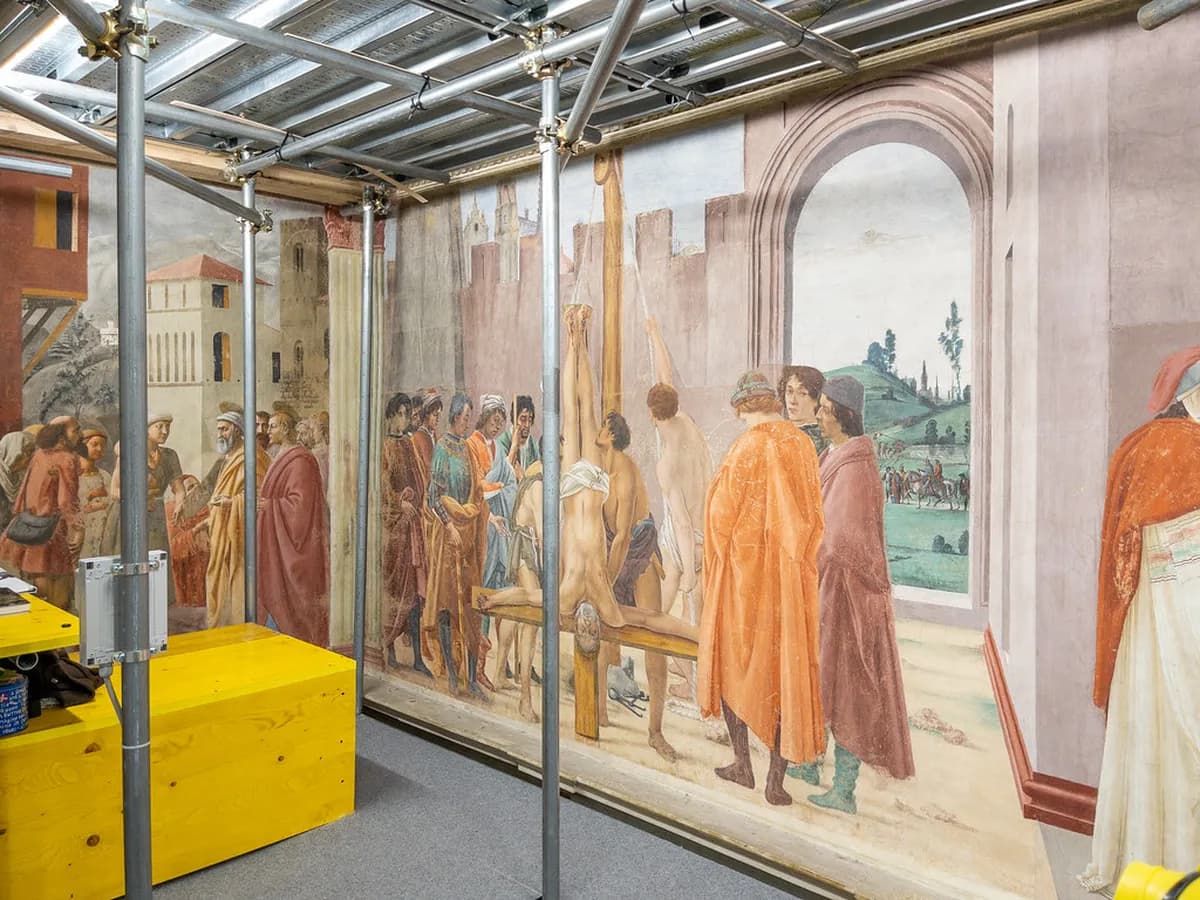
| Maker: hands-on private session | About 3 hours | Trying one technique, such as fresco painting | $728 for a private fresco workshop |
| Apprentice: academy intensive | 5 weeks | Serious drawing, painting or sculpture study | Florence Academy of Art intensive courses |
Bookbinding and marbled paper: Riccardo Luci
Paper marbling is the easiest craft to understand in one visit. Pigments float on a bath that contains algae. The maker layers colors, drags a comb through them and lays a sheet down to catch the pattern in one motion. No two sheets match.
Riccardo Luci Firenze is the studio the brief singles out for this craft. Its family has practiced bookbinding and marbling since 1908. That is over a century of continuous work, and the same techniques extend to journals, frames and leather items.
Bookbinding sits alongside it. One private Oltrarno tour lists book binding among its possible stops. Paper marbling is also the craft most often offered as a hands-on add-on for children.
Marbling works well for families because the result is quick and colorful. Expect a short wait for a sheet to dry. Ask whether a hands-on slot is possible before you arrive, because one tour operator notes that marbling can be swapped for etching, jewelry or leather on Saturdays.
Leather: bench-made bags at Pelletteria Artigiana Viviani
Leather is where the gap between market goods and bench work shows most clearly. At Pelletteria Artigiana Viviani, bags are designed, cut and assembled by hand. Leathers come from Tuscan tanneries, and even the linings are leather. Edges are colored by hand.
Renato Viviani founded the workshop in 1965. His daughter and grandson run it today. A line attributed to him says that if twenty days seems long to make a purse, it can last twenty years.
That mindset explains the price gap with street-stall leather. You pay for time and durability. Look at stitching, edge finish and hardware weight before you decide.
This is not a walk-in retail space. Small family studios such as this one expect an advance appointment, so ask ahead and do not turn up unannounced.
Jewelry and stone: goldsmiths and commesso mosaics
La Bottega degli Orafi sits near Piazza Santa Croce. Its window lets passersby see goldsmithing in progress. The maker works in the Florentine style of engraving, chiseling and hammering. Many of his tools are made by hand to suit his working style, and the workshop is built into the storefront.
I Mosaici di Lastrucci works inside the Spedale di San Francesco de' Macci, a fourteenth-century building. Makers there practice Florentine commesso, a technique developed in the sixteenth century. Natural stones are cut with a bow-shaped saw strung with iron wire. Pieces are assembled from behind using beeswax and pine resin.
Projects can take weeks or years. One replica of a Medici table took nearly a decade. To see the heritage side of stone inlay, add the Opificio delle Pietre Dure to your list. Our guide to 12 Small Museums in Florence Worth Your Time covers that kind of stop.
Comparing the four crafts side by side
Use this table to match a craft to your priorities. Bookbinding and marbling give the most visual payoff in the least time. Leather gives the most useful purchase. Goldsmithing rewards close-up watching. Mosaics reward patience.
| Craft | Studio named in the brief | What you will see | Booking note |
|---|---|---|---|
| Marbled paper and bookbinding | Riccardo Luci Firenze | Pigments floated on a bath, combed, then printed onto paper | Family tradition since 1908; ask ahead for a hands-on slot |
| Leather | Pelletteria Artigiana Viviani | Pattern tracing, cutting, hand finishing of edges | Appointment needed; not a walk-in shop |
| Jewelry | La Bottega degli Orafi | Engraving, chiseling and hammering at a visible bench | Window view from the street; visits by arrangement |
| Stone mosaic | I Mosaici di Lastrucci | Natural stones cut with a bow-shaped saw | Housed in a fourteenth-century hospital building |
How to confirm a working studio welcomes visitors
Do not assume an open door means an invitation. Studios are production sites first and retail stores second. Some workshops welcome visitors only as a favor to a guide they know, and those arrangements can change at the last minute.
Use this short checklist before you go.
- Email or call the studio and ask whether visitors are welcome on your date.
- Ask for a specific time slot, since small studios are not walk-in spaces.
- Check whether the visit is a demonstration, a shopping visit or a class.
- Confirm the studio is open on your dates, because many close in August.
- Ask permission before filming or photographing a maker at the bench.
- Book a guided walk if you want access without arranging each visit yourself.
What Florence artisan workshops cost in 2026
Published prices are mostly in US dollars. A private three-hour artisan walk is listed at $375 per person for 1–2 adults, $255 for 3 adults and $195 for 4 adults. For 5–6 adults it falls to $159 each. Youth discounts are shown at checkout, and a minimum of two adult tickets applies.
Groups of 5–6 adults pay $159 each, while a private fresco workshop is listed at $728, so the walk is the budget pick.
Hands-on private sessions cost more. A three-hour private fresco workshop is listed at $728. Budget upward of $700 for private hands-on formats.
A small-group walk limits groups to 12 or fewer guests. Check current rates on each operator's page, because 2026 prices can change. Purchases at studios are welcome but not required.
For general visitor information, check FeelFlorence visitor information before you book.
Academy courses and the Pietrasanta connection
Serious students can go further than a one-off class. The Florence Academy of Art lists 19 workshops on its workshop listing page. Two are 5-week intensive courses in drawing, painting and art history.
Other options include figure drawing, still life painting, etching and sculpture. Etching comes as an introduction and as Masters of Line. Several sessions run in short blocks. Figure Painting, the FAA Approach lists Jan 18–29, 2027 and Feb 22–Mar 5, 2027 among its dates.
Marble Carving in Pietrasanta is also on the list, with dates shown as to be announced in March. That course is outside the city, so plan travel and lodging separately. Join the newsletter if a date is not yet published.
Planning an Oltrarno artisan route
Weekday mornings work best. A private walk is listed Monday to Friday at 10am, and the market near Piazza Santo Spirito runs in the morning only.
A private walk runs Monday to Friday at 10am, and August is a no-go since most studios close for the whole month.
Start at Piazza Santo Spirito and walk toward San Frediano. Our Oltrarno walking route gives a street-by-street feel. For deeper neighborhood context, see the San Frediano area guide.
Try a pocket on the other side of town as well. Sant'Ambrogio and Santa Croce are linked on one tour to scagliola, egg tempera painting, ceramics and jewelry. Start with a forno (bakery) stop in Sant'Ambrogio, then walk to a jewelry studio near Santa Croce.
Plan lunch between studio visits. Our where locals eat in Florence page suggests places to stop. For more quiet corners, browse the lesser-known Florence sights.
Mistakes to avoid and why these crafts matter
Do not visit in August. Most studios close for the whole month, and one operator does not run its artisan tour then.
Do not treat a workshop as a souvenir stall. Buy if you love something, but never feel obliged.
Do not film without asking. Always ask before you point a camera at a maker.
Do not expect a fixed list. Guides tailor each walk to workshop availability, so a specific studio is never guaranteed.
These visits also help preserve techniques that are disappearing. Operators describe the crafts as carried on by a handful of family makers. Supporting them with your time or a purchase keeps those skills in use.
Frequently Asked Questions
Can I walk into a Florence artisan workshop without booking?
Usually not. Small family studios such as Riccardo Luci and Pelletteria Artigiana Viviani expect advance appointments. A guided walk is the easier route if you want access without arranging each visit.
When are Florence artisan workshops closed?
Most traditional studios close for August. Operators confirm that artisans take their annual break then. Saturdays and holiday periods can also change which studios you see.
How much does an artisan tour in Florence cost?
A private three-hour tour is listed from $159 to $375 per person, depending on group size. A private fresco workshop is listed at $728. Check current rates before you book.
Do I have to buy something at a studio?
No. Purchases are welcome as a gesture of appreciation but are not mandatory. Tell your guide if you want to buy, and they will fit it into the schedule.
Which craft is best for children?
Paper marbling is the usual choice. One operator offers hands-on marbling as an add-on for families. Ask in advance, since alternatives such as etching or leather replace it on some days.
Continue exploring
More guides you'll find useful