Roman Catania: Ancient Ruins Under the Baroque City
Plan a slow walk through Roman Catania, from the Roman Theatre to Castello Ursino, and learn to read the Greek, lava and baroque layers beneath it.
On this page
Catania is unusual among Italian cities in that its most visible history is not its oldest. The white limestone baroque that now defines the centre is a reconstruction after the 1693 earthquake, laid over a city whose layers reach back to the Greeks, Romans, Byzantines, Arabs and Normans. Almost every era left something in the centre that can still be visited, which is exactly what makes a walk here so rewarding.
The practical consequence is that you should arrive expecting layers rather than a single ruin field. Two volcanic events dominate the story: major Etna eruptions buried parts of the city, and the 1693 earthquake finished the job before the baroque rebuild began. The black lava used in that reconstruction is not decorative, it is the material the city literally sits on. Further visitor details appear in Catania History Guide - Historical Sites & Museums | Tripbase.
Why the Roman Layer Is Easy to Miss
Most visitors arrive expecting ancient masonry and find baroque set pieces instead. That is not a failure of preservation so much as a fact of the city's construction: rebuilding over itself is the Catania method, and each generation has partly buried the one before. Knowing this upfront converts mild disappointment into a more interesting way of looking.
The upside is density. Within a walk of under two kilometres you can pass a thirteenth-century castle, a second-century theatre built on Greek foundations, and a cathedral raised over Roman baths, with each era still physically legible in the fabric of the buildings. Few Italian cities compress the sequence so tightly, and almost none do it with so much volcanic stone underfoot.
A word on where to start: this guide treats the Roman remains as one thread inside a broader city walk, not as a separate excursion. If your interests run more to the baroque and the food, the wider picture of overlooked corners is covered in our guide to the hidden gems in Catania.
Roman Theatre and Odeon: The Strongest Roman Stop
If you see one Roman site in Catania, make it the theatre on Via Vittorio Emanuele in the historic centre. It is a second-century AD structure built over the site of an earlier Greek theatre, with a seating area carved into the hillside in the Roman manner and capacity once estimated at around 7,000 spectators. The interest lies less in grandeur than in context: houses were built over the ruins, and some still sit on or against the ancient masonry, so the monument is embedded in the living city rather than isolated from it. Further visitor details appear in Catania History Guide - Historical Sites & Museums | Tripbase.
Immediately adjacent is the Odeon, a smaller roofed theatre used for music and recitation. Seeing the two together is the point: one open to the sky, one covered, a pairing that tells you something about how Roman Catania staged public entertainment. The Odeon is easy to overlook if you fixate on the main cavea, so look for it deliberately before moving on.
Entry arrangements and any ticket price are not something this guide states, because they change and should be confirmed rather than assumed. Check the site's own notices or the city's tourism pages before you go, and budget for the possibility that interiors close earlier than exteriors. Our dedicated Teatro Romano di Catania: Visitor Guide covers the site in more depth.
How to Look at the Theatre Rather Than Photograph It
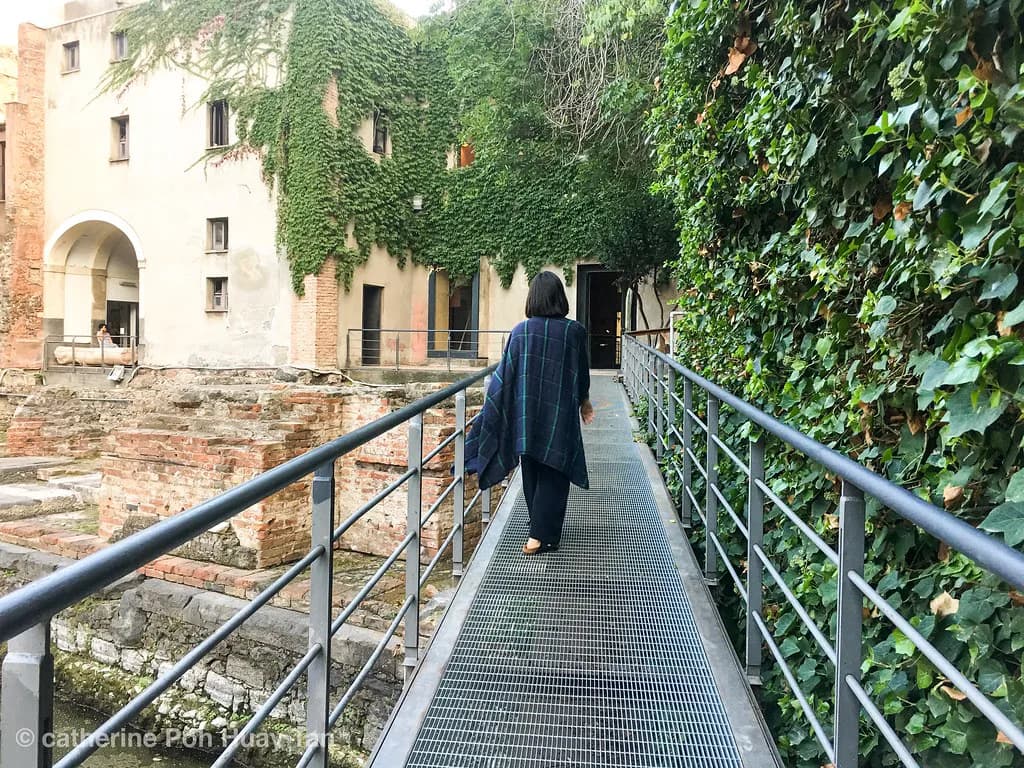
Stand at the top of the cavea and read the shape before reaching for a camera. The seating curve tells you how the hillside was used, and the way later buildings press into the ancient structure explains why the site reads as partly architecture, partly excavation. That overlap is the honest state of Roman Catania, and it is more interesting than a tidied ruin.
Then notice the material. Lava stone recurs throughout the centre, and seeing it in the ancient masonry and again in the baroque facades connects the two periods in a way no explanatory panel quite manages. The theatre rewards ten quiet minutes of looking far more than a quick circuit.
Castello Ursino and the Coastline That Moved
Castello Ursino, a short walk from the baroque centre, was built by Emperor Frederick II between 1239 and 1250 as part of his Sicilian defensive network. Its square plan with cylindrical towers is Hohenstaufen military architecture, largely intact and notably different in character from the churches and piazzas nearby. It is a reminder that medieval Catania was a fortified city long before it became a baroque one. Further visitor details appear in Catania History Guide - Historical Sites & Museums | Tripbase.
The castle's setting has changed dramatically. It originally stood on a promontory above the sea, but the 1669 Etna eruption extended the coastline and left it landlocked, which is why it now feels inland rather than coastal. Inside is the Museo Civico with Greek, Roman and medieval artefacts, including material from the city's colonial Greek period, so the collection extends the story well beyond the Roman era.
Many visitors skip it because it sits outside the densest baroque core, which is precisely why it is worth the ten-minute detour. Ticket prices and opening days should be checked with the museum directly before planning your day around it.
A Suggested Walk: Three Eras in About 1.5 Kilometres
One workable shape, offered as an editorial suggestion rather than an official route, runs from Castello Ursino through the post-earthquake baroque grid to the Roman Theatre, then the short stretch to the cathedral. That sequence moves you from the thirteenth century to the second and then into the eighteenth, which is a slightly odd chronology but a physically logical walk.
Allow a half day if you enter the castle, the theatre and at least one church, and a full day if you add the Via dei Crociferi churches and a monastic interior. Our Catania Self-Guided Walking Tour: Baroque and Roman Highlights sets out a fuller version of the same ground for anyone who wants more structure.
If your legs and appetite outlast your historical curiosity, the Riviera di Catania: Acltrezza and the Cyclops Coast Day Trip is a natural next-day pairing rather than a same-day add-on. Keep the two separate and each gets the attention it deserves.
The Cathedral Raised Over Roman Baths
The Cattedrale di Sant'Agata began as a Norman church built between 1078 and 1094 on the foundations of a Roman bath complex, was destroyed in the 1693 earthquake, and was rebuilt in its present form by Giovanni Battista Vaccarini between 1711 and 1758. It houses the relics of the city's patron saint, martyred in 251 AD, in a jewelled reliquary bust, and Bellini is buried in the cathedral too.
Before deciding whether to go inside, walk the exterior properly. Look at how the baroque facade sits on Norman foundations over Roman baths, and how the piazza around it performs as the city's civic stage. The cathedral is free to enter according to the source above, while the treasury involves a fee; confirm current arrangements on site rather than relying on older figures.
The piazza itself, with Vaccarini's civic buildings and the Fontana dell'Elefante of 1736, is a good place to pause. The basalt elephant carrying an Egyptian obelisk is the city's symbol and a useful reminder that Catania's references were Mediterranean and imperial long before they were Sicilian.
Baroque That Sits on Ancient Lava
Via dei Crociferi packs four baroque church facades into a single block, built in a concentrated burst of eighteenth-century construction, including San Benedetto of 1704 and San Francesco Borgia of 1728. The deliberate competition between facades is one of the most theatrical streets in Italy, and the arch bridging Sant'Agata al Carcere to the Benedictine convent adds a strange, almost stage-set quality.
The Monastero dei Benedettini di San Nicolò l'Arena, now housing part of the University of Catania, was rebuilt after the 1693 earthquake and shows the same combination of baroque grandeur and Etna lava. Parts of the interior can be visited on guided tours, and the mixture of grand cloisters, volcanic stone and older remains makes it one of the most layered sites in the city. Tour availability varies, so ask locally.
Free, Paid, and What That Means Here
A lot of Roman and baroque Catania costs nothing: streets, piazzas, the cathedral exterior, and the pleasure of walking Via Etnea to Piazza dell'Università. The ancient material is often in the walls beside you rather than behind a ticket desk, which is why the city suits slow wandering over tick-box sightseeing; the regional tourism portal spotlights the Valley of the Temples elsewhere on the island, a reminder that Sicily's ancient heritage is spread well beyond this city.
Ticketed sites are separate, and you should not assume one ticket covers several. Museums, church interiors and guided visits to monastic spaces are typically their own arrangements with their own conditions. Ask at each place rather than assuming a combined pass, and check official notices for current admission rules.
Whatever you pay, treat the free layer as the main event rather than the filler. The most memorable moments in Catania tend to be unplanned: a lava-stone doorway, a fragment of ancient masonry in a shop wall, the sudden sight of the elephant fountain at the end of a street.
Pacing, Heat and Volcanic Glare
Catania's lava-stone streets and pale baroque facades throw light back at you, and summer afternoons are unforgiving. Walk the exposed stretches in the morning, keep the middle of the day for interiors and long lunches, and return to the streets in the evening. This is ordinary local sense rather than a secret, and it makes a noticeable difference to how much you enjoy the ruins.
Fewer stops generally beat more. Two or three properly examined sites, with time to sit down between them, will teach you more about the layered city than a rushed circuit of six. If you only have one day, pick the theatre, the castle and the piazza, and leave the rest for a return visit.
Where Roman Catania Is Not
Travellers sometimes arrive looking for a visitable amphitheatre or an underground Roman bath complex. The evidence for Catania as a Roman city is not in doubt, but this guide does not present either as a straightforward attraction to plan around, because we cannot confirm current access. Ask at the tourist office or check the city's own cultural listings rather than trusting older blog posts.
That is not a reason to skip the city. The Roman layer is present, but it is read in the fabric rather than displayed in a dedicated park, and the layered approach is more satisfying once you accept it.
Leaving Catania Reading Buildings Differently
Catania rewards a specific shift in attention: stop looking for the Roman city and start looking for it inside the baroque one. Once you have noticed the Greek foundations under the theatre, the lava in the walls and the Roman baths under the cathedral, ordinary streets start to show their seams.
To plan the rest of a Sicilian trip, browse the Catania Attractions index for the fuller set of city guides, and treat the ancient layer as a thread running through your days rather than a separate errand. For related planning, see Anfiteatro Romano di Catania.
Frequently Asked Questions
What Roman ruins can you actually see in Catania?
The most substantial Roman site in the historic centre is the Roman Theatre on Via Vittorio Emanuele, with its adjacent Odeon and hillside seating carved in the Roman manner. Elsewhere the Roman layer survives in fragments and in the foundations of later buildings, including the cathedral, which was raised over a Roman bath complex. Expect to read the ancient city inside the baroque one rather than in isolation.
Was the Roman Theatre in Catania built on a Greek theatre?
Yes. The second-century AD Roman structure was built over the site of an earlier Greek theatre, and the Roman theatre in turn was built over older layers. That sequence is part of what makes the site interesting: it compresses the city's Greek and Roman phases into a single monument in the middle of the modern street grid.
Is the Roman Theatre in Catania free to enter?
Admission arrangements are not something we can confirm here, and ticket prices change. Check the site's own notices or the city's tourism information before you visit, and be prepared for the possibility that the monument is closed at certain times. Do not rely on prices quoted in older travel articles.
How long does it take to walk Roman and baroque Catania?
A suggested route from Castello Ursino to the Roman Theatre and on to the cathedral covers roughly 1.5 kilometres and can be walked in about half a day if you enter the castle, the theatre and at least one church. Add the Via dei Crociferi churches and a monastic interior and it becomes a full day. This is an editorial suggestion, not an official itinerary.
Can you visit the cathedral in Catania for free?
The cathedral itself is free to enter according to published city history sources, while the treasury involves a fee. Before relying on that, confirm current arrangements on site, since interiors and opening arrangements can change. Walking the exterior and the piazza costs nothing regardless.
Why is so little of Roman Catania visible today?
Repeated Etna eruptions buried parts of the city, and the 1693 earthquake destroyed much of what remained before a full baroque rebuild. The reconstruction used lava stone from the volcano, the same material the city sits on, which is why the visible heritage reads baroque first. The Roman city survives largely as foundations, fragments and one embedded theatre.
Sources
Continue exploring
More guides you'll find useful