Cyclops Coast Day Trip from Catania: Acitrezza Guide
Plan a slow day trip from Catania to Acitrezza and the Riviera dei Ciclopi, with the Cyclops Islands, the fishing harbour and legends of the lava coast.
On this page
Catania rewards a second look at its own doorstep. The coastline immediately north of the city turns quickly into a low lava shore of black rock, small harbours and offshore sea stacks, and the village of Acitrezza sits at the centre of it. Treating this as a relaxed excursion rather than a checklist stop is the best way to enjoy it.
The stretch is known as the Riviera dei Ciclopi, and the towns along it share the old name Aci: Aci Castello, Aci Trezza (often written Acitrezza), Acireale and smaller places nearby. Travel sources describe the coast as roughly 12 kilometres long, running from Acireale to Aci Castello. That scale is what makes it work as a day trip rather than a week.
This is an excursion guide for Catania visitors who want a slow coastal day. It is not a substitute for planning Taormina or Syracuse, which deserve separate days. Before you go, our Catania Attractions hub is a useful place to match opening days and other city sights.
What the Riviera dei Ciclopi Actually Is
The Riviera dei Ciclopi is a coastal band north of Catania rather than a single sight. Towns are strung along the lava base of Etna, and the villages carry the name Aci because of a shared myth rather than any administrative unity. Knowing this prevents the common mistake of treating Acitrezza as the whole coast.
The main stops are Aci Castello, with a Norman castle at its heart; Acitrezza, the fishing village; Acireale, built higher on old lava flows; and Capo Mulini, a small fishing port. Travel accounts put the distance between Aci Castello and Acitrezza at about 6 kilometres, which is short enough to link several places in one unhurried outing.
The landscape itself is the point: cobalt water against dark basalt, with Etna behind the villages. Because the towns sit so close together, a car is convenient but not essential to the idea of the day. What matters is choosing two or three stops and giving them time.
The Legend Layer: Polyphemus, Aci and Galatea
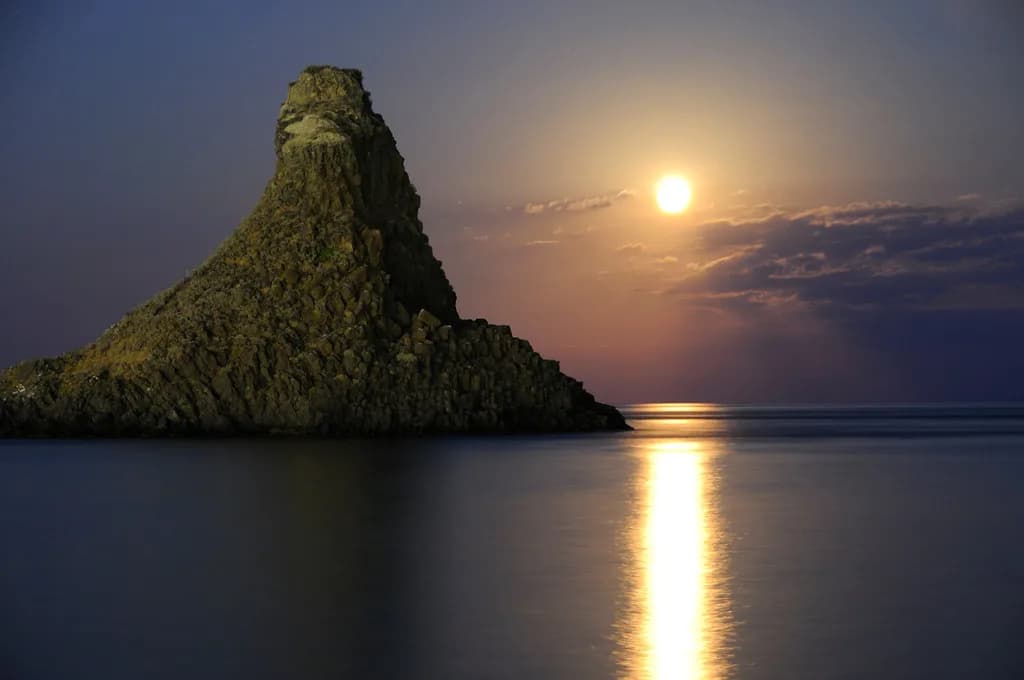
The offshore rocks gave the coast its name. According to the best-known version, the Cyclops Polyphemus hurled boulders at Odysseus after escaping the cave, and some accounts describe the sea stacks as the result. Whether you find that convincing matters less than the way the story fixes the place in visitors' minds.
A second legend explains the Aci place names. The shepherd Aci loved the sea nymph Galatea, and Polyphemus, jealous, killed him with a lava boulder; Galatea then turned his blood into a river so the two could be together at the sea. The river Aci no longer exists, and it is said to have disappeared after Etna's eruption in 1169. Nine places in the area still carry the shepherd's name.
Read the names on the map differently after that: Aci Castello, Acireale and Aci Trezza mark one continuous story rather than unrelated towns. The mythology is not a substitute for sights, but it gives the day a thread to follow between villages.
Acitrezza Itself: Harbour, Seafront and Pier
Acitrezza is a former fishing village of around 5,000 residents and the natural anchor for the day. The waterfront rewards a slow walk: grab a coffee and something sweet, look at the harbour, and walk the pier, which gives one of the best views back over the town. The village does get busy in high season, especially at weekends.
The lava character is visible in the details. On the coast you can see five- and six-sided basalt columns, formed when lava cooled, and the same geometric rock appearance in the harbour walls. This is something to look for rather than to pay for, and it is a good reason to walk slowly through the village.
Fresh seafood appears all along the coast, and the harbour in Acitrezza and the fish restaurants around Capo Mulini are obvious lunch choices. For a wider city context before you head north, the Catania Seafront and Harbour guide explains how this same lava coast shapes the city itself.
The Cyclops Islands: Lachea and the Faraglioni
Immediately offshore lie the islands that give the coast its character. The group includes Lachea, Faraglione Grande and Faraglione di Mezzo, plus a scatter of smaller rocks, all made of columnar basalt. A source gives their age as roughly 560,000 years, from the early period of Etna's formation.
The islands have been protected since 1998, when they were declared a nature reserve, and the University of Catania has looked after them since then. That is the status reported in the source; check the reserve's current arrangements before planning anything around the islands. Boat trips leaving from the harbour are offered, though schedules, prices and departures are not published in any reliable form here.
It is worth being careful about what a boat trip actually involves. Operators advertise excursions around the islands and past landmarks such as Lachea and the Norman castle, including a stop or view near Ulysses' Cave. Never assume landing on the islands is allowed. Confirm what a trip includes when you book.
A Literary Detour: Verga's I Malavoglia
Acitrezza is also a literary place. Giovanni Verga, born in Catania in 1840 and dead there in 1922, set his novel I Malavoglia in the town, describing a fishing family called the Toscano and their life in the house known as the Casa del Nespolo. The book is standard reading for Italian schoolchildren.
The novel was filmed in Acitrezza in 1948, and the Museo del Nespolo remembers both book and film; the museum also organises tours of the film locations. A monument to Verga stands in front of the church of San Giovanni Battista. Treat the museum as a possible stop rather than a fixed appointment: opening hours and any admission arrangements are not confirmed in the sources here.
Neighbouring Stops Along the Same Coast
Aci Castello is the easiest extension. The village grew around an eleventh-century Norman castle, and from its main square you get a broad view along the Riviera dei Ciclopi. Narrow alleys, seventeenth-century buildings and small lava beaches make it a natural stop either before or after Acitrezza.
Acireale sits higher on the old lava flows and offers a different texture: a Baroque church on its old square, a long history as a spa town whose thermal baths are still in use, and a famous puppet theatre and museum. Its spring Carnevale is often described as the best in Sicily. Combine it with Aci Castello only if you are driving or content to keep things slow.
Capo Mulini, at the mouth of the vanished Aci river, is essentially a fishing village with seafood restaurants and a lunch stop. Its waters saw naval battles between Carthage and Syracuse, and later Roman civil wars, so the quiet of the place hides a busier past. It suits the end of a slow day rather than a separate trip.
Getting There and Around: What You Need to Know
Aci Trezza lies just under 10 kilometres north of Catania on the Cyclops Coast, which is short enough for a comfortable half-day even with a late start. How you get there is less straightforward in print: bus and car both work, but specific routes, stops, fares and journey times vary and are not supported by the sources here. Check the operator's current timetable or your rental agreement before setting out.
If you drive, you get flexibility to link Aci Castello, Acitrezza and Acireale in one loop, at the cost of finding parking in the busier villages. If you use public transport, expect to base yourself in one or two villages and walk between them. Either way, check conditions on the day and allow slack for traffic.
Before you go, our guide to the Best Time to Visit Catania Without the Crowds explains how seasons and weekends change the city's rhythm. That logic applies to the coast too, where summer weekends are the busiest.
A Suggested Slow-Day Structure
Think in halves and leave the schedule loose. The account of the coast here is not an official programme. In the morning, start in Aci Castello for the square and the view, then move on to Acitrezza for the harbour and pier. That gives you the coast's two key notes before the crowds build up.
For a full day, add lunch on the coast, then a literary pause at the Casa del Nespolo or the Verga monument, and finish with Acireale in the late afternoon. If you want a boat trip around the islands, ask at the Acitrezza harbour first thing and shape the rest of the day around that.
If you are staying in the city, a short self-guided walk the evening before makes the coast easier to appreciate. The Catania Self-Guided Walking Tour explains the same lava-built fabric you will see in the villages.
Practical Trade-offs: Crowds, Heat and Timing
The most important trade-off is crowding. Acitrezza is popular, and in high season, particularly at weekends, the seafront and harbour become busy. Coming early, or saving the village for a weekday, changes the experience more than any other single decision.
Heat is the second. The coast is exposed, and on the dark lava the summer sun feels stronger than the seaside setting suggests. Carry water, plan the shaded lanes and café breaks, and avoid scheduling the long waterfront stretch for midday.
Finally, be clear about what is free and what is not. The seafront, harbour, pier and lanes are simply part of the village, and the mythology and basalt columns cost nothing to look at. The Verga museum and boat trips around the islands are separate, bookable or timed things whose current details are not confirmed here.
What to Verify Before You Go
A few items genuinely change. The nature reserve's current status and any access arrangements around the Cyclops Islands should be checked with the managing institution rather than assumed from older descriptions. The 1998 designation is history, not a promise of 2026 conditions.
For the Museo del Nespolo, confirm opening hours and any admission details locally or through the town's official channels, because they are not confirmed in the sources here. Boat excursions from Acitrezza's harbour should be confirmed with operators in person or by phone, and you should ask explicitly whether they land on the islands or only sail around them.
Finally, verify transport on the day and check the official city website for local notices before travelling. The city's website is the place for civic information; transport and attraction details sit with providers.
Plan Your Visit
The Cyclops Coast succeeds as a day trip because it is small and slow: a handful of villages, one legend, one nature reserve and a lot of dark rock meeting blue water. Acitrezza is the anchor, with Aci Castello and Capo Mulini as easy extensions and Acireale as the higher, more urban contrast.
Give it a day, not an afternoon squeezed between other excursions, and leave Taormina or Syracuse for their own separate trips. If you are still shaping your time in the city, our One Perfect Day in Catania route keeps the base city's sights in view while you plan the coast. For wider planning, see Hidden Gems in Catania.
Frequently Asked Questions
Is the Cyclops Coast worth a day trip from Catania?
Yes, if you want lava scenery, a working fishing village and mythology rather than a packed checklist. Acitrezza, Aci Castello and Capo Mulini sit close enough together to fill a slow day, and Acireale adds a higher, Baroque counterpoint.
How do you get to Aci Trezza from Catania?
Aci Trezza is just under 10 kilometres north of Catania, and both bus and car are used by visitors. Specific routes, stops, fares and journey times vary, so confirm with the operator or your rental company before travelling rather than relying on older descriptions.
Can you visit the Cyclops Islands?
The islands are a protected reserve, and boat excursions from Acitrezza harbour run around them. Whether any trip allows landing is not confirmed by the sources here, so ask the operator directly and do not assume access.
How long should you spend in Aci Trezza?
A suggested half day covers the harbour, the seafront and the pier without rushing. If you add Aci Castello or Acireale, plan a full day, and treat any boat trip around the Faraglioni as an extra whose timing you confirm on arrival.
What is the legend behind the Riviera dei Ciclopi?
Two legends overlap. Polyphemus is said to have thrown the boulders that became the sea stacks, and he also killed the shepherd Aci out of jealousy over Galatea, whose grief turned Aci's blood into a river. The Aci place names preserve that second story.
Is Aci Trezza crowded in high season?
The village is a popular excursion destination, and its waterfront and harbour get busy in high season, particularly at weekends. Arriving early or choosing a weekday makes the walk more pleasant.
Which nearby towns should you add to the day?
Aci Castello for its Norman castle and sea view, Capo Mulini for a seafood lunch, and Acireale for its Baroque square, puppet tradition and spa history. Pick two rather than trying to see everything.
Sources
Continue exploring
More guides you'll find useful