Catania Self-Guided Walking Tour: Baroque & Roman Route
Walk Catania's centre on your own: a step-by-step route linking Baroque churches, Roman remains, the fish market and an optional rooftop finale.
On this page
Catania packs an unusual amount of history into a compact centre: dark lava-stone Baroque facades sit directly on top of Greek and Roman layers, and a working fish market fills the space behind the main square most mornings. Because the stops sit close together, the city rewards a walk you order yourself rather than a fixed itinerary. This route starts at Piazza del Duomo in the early morning and gives you a clear shortcut if the day runs short.
Allow the better part of a day for the full loop at an unhurried pace, or roughly half a day if you stop at Piazza Stesicoro as the route suggests. That duration is a suggestion for planning, not an official schedule. If you want background on the city's older layers before you set out, Roman Catania: A Guide to the Ancient Remains pairs well with this walk.
Why Catania Suits a Self-Guided Route
The historic centre is walkable and dense, so the main stops follow each other naturally without transport between them. The reward is the layering: a cathedral built and rebuilt after eruptions and earthquakes, a Roman bath complex beneath it, and an amphitheatre half-swallowed by the modern street. A source walking tour of the centre describes the city as a treasure trove of Baroque architecture, and that is visible on almost every block.
You do not need a guide to see the streets, squares and exteriors; those cost nothing to look at. What you do need to plan for is separating free sights from paid interiors, because several stops on this route have a church or courtyard you can enter without charge and a separately ticketed element, such as the baths under the cathedral or the monastery rooftop. Treat each as its own decision rather than assuming one ticket covers a complex.
Before You Start: Meeting Point, Heat and Market Crowds
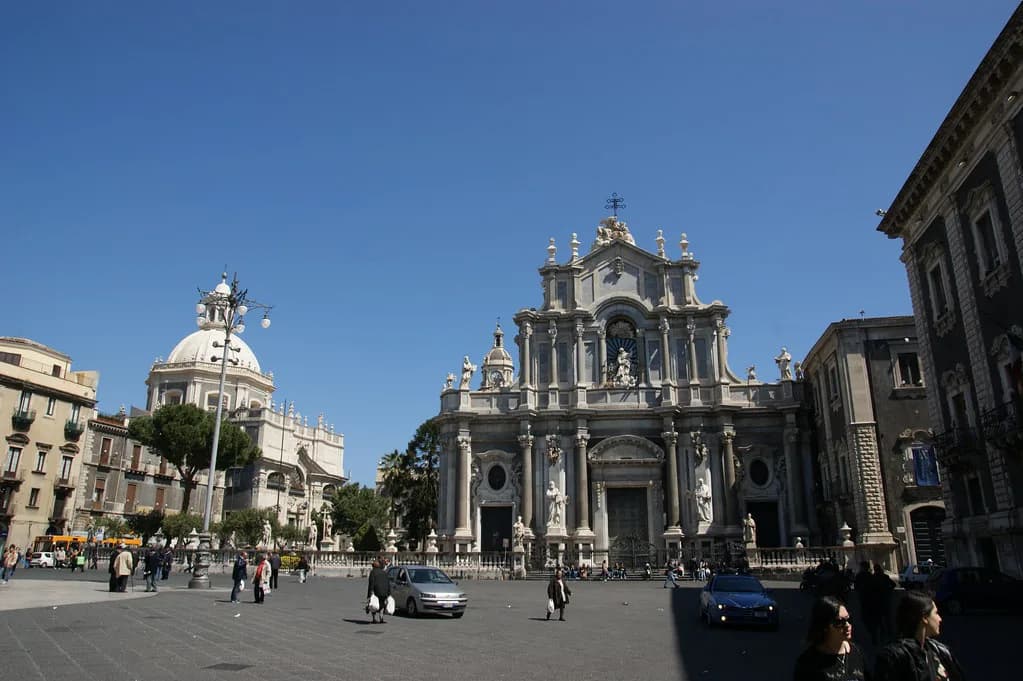
Begin at Piazza del Duomo, known as Elephant Square, where the black basalt elephant fountain marks the heart of the old centre. Guided tours of the city gather here by the pharmacy near the white flower pots, which makes the square easy to find even before the cafes open. Arriving early gives you the fountain and cathedral facade with fewer people in the frame.
Two practical points shape the morning. First, the fish market is at its liveliest early, so walk it before the heat builds; second, that market is wet, noisy and full of fish gutting, so closed-toed shoes make far more sense than sandals. Carrying water matters too, since the route has no planned rest stops and much of it is outdoors in exposed squares.
If you arrive by train at Catania Centrale, the walk to Piazza del Duomo takes about twenty minutes and involves crossing a large, chaotic roundabout. Buses stop at Piazza Borsellino instead, roughly five minutes from the square. Drivers should head for Parcheggio Borsellino and arrive early, because spaces fill with market visitors and bus passengers; pay at the machines in the centre of the lot before returning to the exit barrier.
Stop 1: The Cathedral and the Roman Baths Beneath It
The Cattedrale di Sant'Agata sits on the square's edge, its lava-stone exterior and Baroque facade the result of rebuilding after the 1693 earthquake. Inside and underneath, the Terme Achilliane preserves excavated Roman thermal baths; the entrance is outside the main doors, down stairs to the right as you face the church, with tickets sold in a small shop a few doors along toward the stone archway. That makes the baths a separate paid detour rather than part of a cathedral visit.
Across the square, the Palazzo degli Elefanti serves as city hall, and when the front gates stand open you can look in at the carriage used in the Festa di Sant'Agata procession and displays on the festival's history. Nearby, the Fontana dell'Amenano marks one of the few places where Catania's underground river shows itself above ground. Both are quick stops that fit naturally into the first half hour.
Stop 2: The Fish Market, the Amenano Fountain and the Umbrella Street
Steps behind the Fontana dell'Amenano lead down to a terrace overlooking the Pescheria, the daily fish market. Fishmongers call out samples, trade insults in Sicilian and gut fish in front of you, so expect sensory overload and watch your footing on wet stone. At the bottom of the steps, the Fontana dei Sette Canali, built in 1612, is one of the city's oldest fountains and another spot to see the underground water.
Around the market, side streets hold fruit and vegetable stalls, cheese and meat vendors, and pasta and wine shops, which makes this a sensible early lunch stop. For a quick bite, counter-service fish spots serve fried seafood in a paper cone; for a sit-down meal, Via Gisira, known as the umbrella street for the canopies strung overhead, is a short walk around the corner.
Stop 3: Castello Ursino and the Coastline That Moved
Castello Ursino began as a coastal fortress under Norman rule in the twelfth century, but the massive 1669 eruption sent lava from Etna down to the sea and pushed the shoreline further out. Today chunks of lava stone still protrude from the ground around the castle, a physical reminder that it once stood close to open water. Walk the exterior even if the museum is shut.
The castle houses a civic museum with archaeological, religious and artistic collections, and it has been closed for renovation at points, so check the official city website before building your day around it. Across Piazza Federico di Svevia, a traditional chiosco bar serves coffee and snacks, including a seltz limone e sale made with fresh lemon juice, soda water and salt, a drink traditionally popular on hot days.
Stop 4: The Greek-Roman Theatre Tucked Into the Streets
Catania's Greek-Roman theatre dates to the second century and is so well hidden among ordinary buildings that you can walk straight past it. The site also includes an Odeon, a smaller roofed structure built for musical performances. Part of the structure was built from lava stone taken directly from Etna's flows, which gives the ruins their distinctive dark texture.
This is the stop where a little preparation pays off. Check locally for current access and any admission charge rather than assuming the site is open or free, since individual monuments in the centre operate on their own terms. The Roman Catania guide covers the theatre and the amphitheatre in more depth if you want to plan which ancient sites to prioritise.
Stop 5: Via Crociferi, Catania's Baroque Showpiece
Turn onto Via Crociferi from Via Vittorio Emanuele II and you enter a street lined with eighteenth-century churches, monasteries and palaces. Near the start, the Arco di San Benedetto connects the Chiesa di San Benedetto with the monastery of the same name. Pause in the small piazza before the arch to see the church dedicated to Saint Francis of Assisi and the birthplace of composer Vincenzo Bellini.
Past the arch, the street continues past the churches of San Francesco Borgia, San Giuliano and San Camillus, each with its own facade and opening pattern. Walking the street costs nothing; going inside depends on whether a given church is open when you pass. Our Via Crociferi: Baroque Street Guide goes deeper on the individual buildings if you want to plan which doors to try.
Stop 6: The Benedictine Monastery and the Rooftop Option
The Monastero dei Benedettini di San Nicolò l'Arena is a UNESCO World Heritage Site built in lava stone and now used by the University of Catania. You can wander the halls, cloisters and gardens on your own or join a guided tour for more context. Next door, the Chiesa di San Nicolò l'Arena has an unfinished facade that exposes medieval lava-stone construction predating the 1693 earthquake.
Inside the church, look for the frescoes, a World War II memorial and a sundial stretching some thirty-seven metres across the floor. The real draw, though, is the rooftop tour, reached by a circular stone staircase and rewarded with 360-degree views across the city to Etna. One account describes it as costing a few euros, so confirm the current arrangement on arrival rather than budgeting from an old figure.
Food Stops Along the Way
Catania's street food is part of the walk, not a break from it. For a Sicilian breakfast, order granita con brioche, a semi-frozen fruit or sugar ice served with a soft roll, at a cafe on Piazza del Duomo. Near Villa Bellini, two historic pastry shops face each other across the street: try a cipollina, a flaky pastry filled with ham, cheese, onion and tomato, or an arancino, a breadcrumbed and fried rice ball.
Later in the route, the chiosco bar by Castello Ursino is a good pause for a coffee or a seltz limone e sale. The underground restaurant near Piazza Currò, where some tables sit beside the hidden river, needs booking ahead if you want that setting. The San Berillo district is another option for dinner at the end of the day, with reservations recommended for the popular tables.
The Shortcut: Ending at Piazza Stesicoro
If time runs short, treat Piazza Stesicoro as your finish line. The square holds the sunken remains of a Roman amphitheatre built around 300 BC, now sitting beside ordinary city traffic, and it is a natural place to stop because the metro station there gives you an easy way back. From Piazza Stesicoro, a metro ride returns you toward the station area; continuing on foot down Via Etnea brings you back toward Elephant Square.
The square is also tied to the Agatha story: the church here, Chiesa San Biagio in Sant'Agata alla Fornace, is dedicated to her torture and death, and it marks the start of the first procession during her annual festival. Taking the shortcut means skipping the Villa Bellini, San Berillo and opera-house stretch, so decide at this point rather than doubling back later.
The Extended Loop: Villa Bellini and San Berillo
With time in hand, continue up Via Etnea to Villa Bellini, a city park with gardens, fountains, shaded paths inlaid with lava stone and benches. It is the simplest place on the route to sit down and cool off with a granita or spritz, and there is a small kiosk bar near the entrance. From the park, wander downhill toward San Berillo.
San Berillo, once the city's red-light district, is now known for colourful murals and small art displays in its narrow alleys, and it makes a good spot to return to for dinner. If you would rather keep costs low, the free squares, streets and parkland on this route cover most of the ground; our guide to Free Things to Do in Catania adds more no-cost stops nearby.
Sunset Finale: The Opera House and the Badia di Sant'Agata
The Teatro Massimo Bellini, named for the composer, was inaugurated in 1890 with a performance of his opera Norma and anchors the piazza around it. Government buildings in Baroque style frame the square, and the cafes here suit an afternoon coffee or an early evening drink before the final climb. Time your walk so you reach the Badia di Sant'Agata just before sunset.
The Chiesa della Badia di Sant'Agata, an eighteenth-century church built on the grounds of a Benedictine abbey, offers views of Etna from its dome, and the rooftop is a fitting end to the day if the light cooperates. If you have another day in the region, the Cyclops Coast Day Trip from Catania makes a relaxed contrast to the dense historic centre.
Mapping and Timing Tips
Build your own map rather than trusting a fixed app route: mark the stops in the order above, then check the walking direction between the fish market and Castello Ursino, which is the least obvious leg. Self-guided audio options exist for the centre, with products advertised online, but confirm what is currently offered and how it is delivered before relying on one. Walking works best in the old town, while the metro is useful for longer hops; driving into the centre is best avoided.
For a guided alternative, third-party operators run a two-hour Baroque walking tour of the historic centre, meeting near Piazza del Duomo. That is a separate product with its own booking terms, not a description of this route, so read the provider's current inclusions and cancellation rules directly. Our Catania Attractions hub lists individual sight guides if you want to plan interiors in more detail.
When to Walk
Late April to June and September into early October tend to be the most comfortable months for a long walking day, when the market and Via Crociferi are pleasant without the harsh midday heat. July and August can feel too hot and crowded for this much time outdoors, so start earlier and plan a shaded break. Winter walking is quieter but colder and wetter, so pack accordingly.
The Festa di Sant'Agata, held in early February, transforms the city with white-clad devotees and tall candles moving through the streets overnight. It is a memorable time to visit, but it also means crowds and disrupted routes in the centre, so check the current programme with the city before planning a walk around it. Avoid assuming dates from previous years; confirm the edition you plan to attend.
Plan Your Visit
The route works because it gives you choices: see the free squares and streets, then decide where to pay for interiors like the Roman baths or the monastery rooftop. Stop at Piazza Stesicoro if time is tight, or continue to the park and finish at the Badia dome before sunset. Either version covers the Baroque and Roman highlights without a guide.
Before you set out, check current opening arrangements for Castello Ursino and the Greek-Roman theatre, and confirm any admission charges on site rather than relying on older figures. Bring closed-toed shoes, water and a map you have built yourself. For more quiet corners beyond this walk, our hidden gems in Catania guide is the natural next read.
Frequently Asked Questions
What should you not miss on a self-guided walk in Catania?
Prioritise Piazza del Duomo and the Elephant Fountain, the fish market behind the Amenano fountain, and the Baroque stretch of Via Crociferi. If you have time, add the sunken Roman amphitheatre at Piazza Stesicoro and the views from the Badia di Sant'Agata dome near sunset. The cathedral's Roman baths and the monastery rooftop are worthwhile paid extras rather than essentials.
How long does a self-guided Catania walking tour take?
Allow the better part of a day for the full route at a relaxed pace, including lunch and a rooftop stop, or roughly half a day if you finish at Piazza Stesicoro. These are planning suggestions, not official durations. Your own pace, market time and any interior visits will change the total significantly.
Can you do a free self-guided walking tour of Catania?
Yes. The squares, the fish market, the exterior of Castello Ursino, Via Crociferi and Villa Bellini cost nothing to visit. Paid elements such as the Roman baths under the cathedral and the monastery rooftop are separate, and individual churches may be free to enter but only when open, so check each site locally.
What should you wear or bring for the fish market?
Closed-toed shoes are the key item, because the market floor is wet and fish are gutted at the stalls. Bring water, since the route has no planned drink stops, and expect noise and strong smells. If you are sensitive to crowds, go early in the morning before the market reaches its busiest.
Sources
Continue exploring
More guides you'll find useful