Free Things to Do in Catania: Markets, Piazzas and Views
Plan a no-ticket day in Catania with piazzas, markets, baroque streets, parks and a black-sand beach, plus which interiors cost money and which stay free.
On this page
Catania is built for walking, and much of what makes it memorable costs nothing: a lava-stone square, a shouting fish market, a park full of palms, a dark pebble cove. The trick is knowing where the free experience stops and a separately ticketed interior begins, because the city's lapped architecture hides paid museums and rooftop terraces right behind grand facades. A sensible plan for a free day is roughly half a day on foot through the centre, which is a suggestion rather than any official itinerary.
Two ground rules keep expectations honest. First, treat churches and their facades as the free layer, and assume that crypts, terraces, cloisters and museums inside or beside them are separate paid visits unless signage says otherwise. Second, check the official city site and individual venue pages before you set out, because restoration closures and seasonal market rhythms are not fixed in any guidebook, including this one.
What Is Actually Free in Catania
The free layer of Catania is mostly outdoor and public: squares, streets, the open-air parts of markets, parks and the coastline. That is where a low-cost day should concentrate. Paid elements tend to be enclosed spaces — museum collections, church rooftops, Roman baths beneath the piazza — so the decision is less about money than about whether you want to step inside.
The fish market gives a good example of the distinction. It sits in a sunken area behind Piazza del Duomo, reached by a staircase descending from beside the Amenano Fountain, and the surrounding piazza and lanes are ordinary public streets you simply walk into. There is no gate to pass, but it is a working market, so behave accordingly and understand that the neighbouring restaurants and any tastings are separate purchases.
For a wider map of the city's overlooked corners, from Byzantine chapels to street-art lanes, see this guide to hidden gems in Catania — useful for filling the gaps between the headline sights without adding ticket costs.
Piazza del Duomo and the Elephant Fountain
Piazza del Duomo is the natural starting point and costs nothing to walk through. At its centre stands the lava-stone elephant carrying an Egyptian obelisk, known locally as Liotru and adopted as the city's symbol. Look for the contrast between the dark volcanic stone and the pale marble of the surrounding baroque buildings — that black-and-white palette is what gives Catania its nickname, the Black City.
The square is also the junction of the main streets, with the cathedral on its eastern side and the Porta Uzeda gate leading toward the port. Sources date the gate to 1696 and describe the square's current form as an eighteenth-century rebuilding, which helps explain why so much of the centre looks uniformly baroque. The cathedral itself is a working place of worship, so entry arrangements and any restricted areas should be confirmed on site rather than assumed.
Via Etnea: A Free Baroque Walk Toward the Volcano
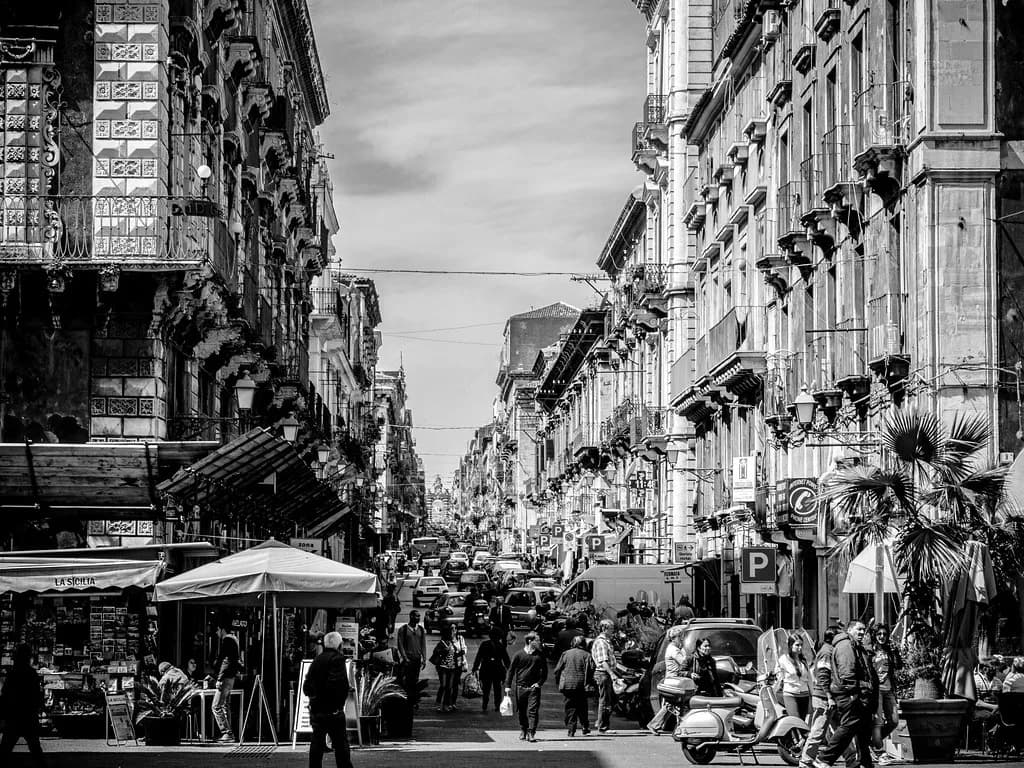
Via Etnea runs roughly three kilometres in a straight line north from Piazza del Duomo toward Mount Etna, and its character shifts along the way. The first stretch is the architectural showpiece, lined with churches and noble palaces designed by architects including Giovanni Battista Vaccarini and Francesco Battaglia. Walking it is free and gives you the clearest sense of how the city was rebuilt after the 1693 earthquake.
The stretch from Piazza del Duomo to the Quattro Canti crossroads is pedestrian, while the section beyond toward the Villa Bellini Catania Visitor Guide admits only buses and taxis. That matters if you are planning a loop on foot: choose the pedestrian spine for lingering and cross to the parallel lanes for quieter pavements.
If you would rather follow a structured route through the baroque centre, this Catania self-guided walk covers the Roman and baroque highlights in a logical order and saves you from doubling back.
La Pescheria: Visiting the Fish Market Without Buying
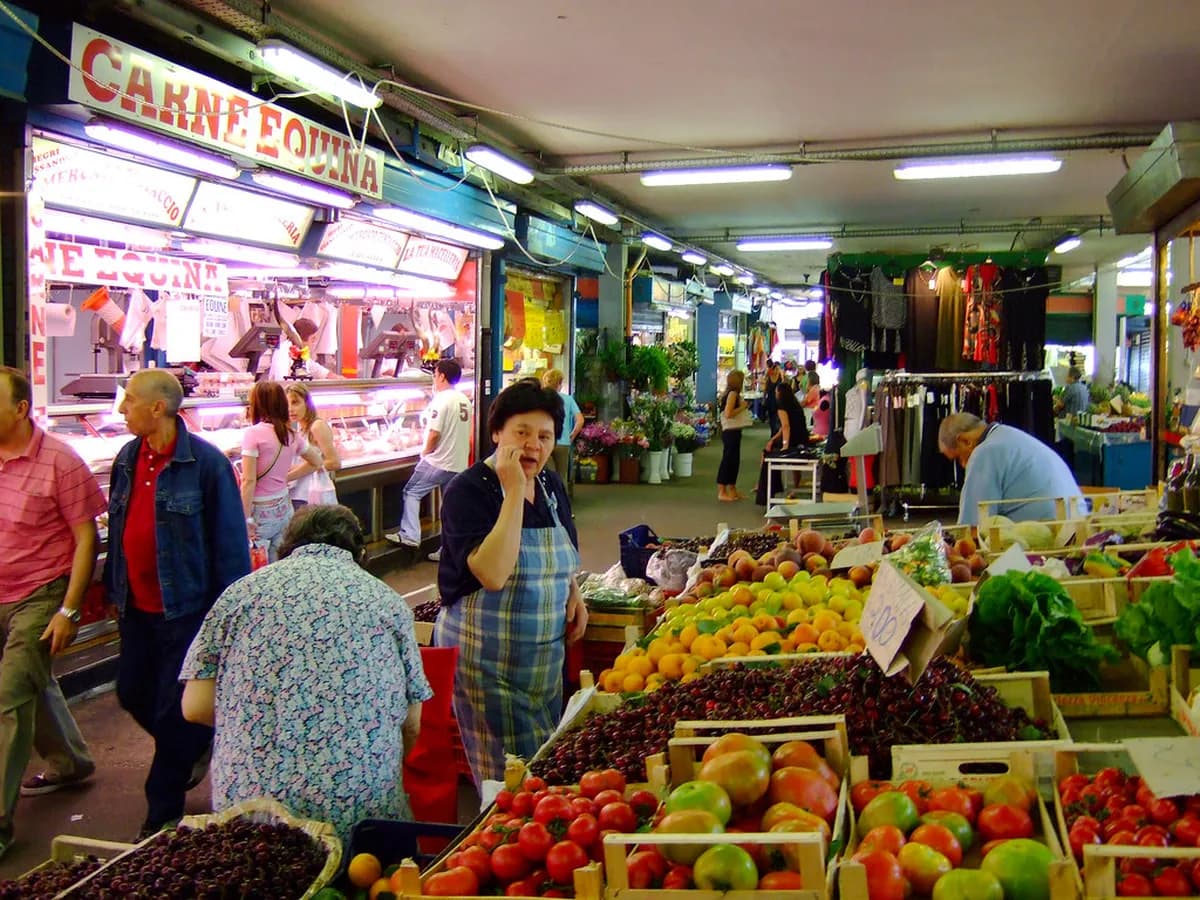
La Pescheria is the city's working fish, fruit and vegetable market, and a source with long local familiarity describes it as open Monday to Saturday, roughly from early morning until early afternoon, with the liveliest window around mid-morning. It is closed on Sundays, so do not build a Sunday plan around it. Stallholders begin packing up well before the published closing time, and summer holidays can thin the stalls.
Photography has its own etiquette here. Wide shots of the market scene are generally accepted, but close portraits of vendors should be asked for, flash should be switched off, and children should not be photographed. Bring small notes if you intend to buy anything, since many stalls operate on cash, and wear closed shoes because the floor is often wet.
If your only free morning falls on a Sunday, the empty market piazza is still photogenic and takes only a quarter of an hour as part of an old-town walk. Alternatively, shift the market visit to Monday morning, when the pace is calmer than on a Saturday. For the full picture of zones, stallholders and entry points, the Pescheria di Catania: Market Visitor Guide covers the details.
Fera 'o Luni at Piazza Carlo Alberto
The general market at Piazza Carlo Alberto di Savoia is known as Fera 'o Luni, the Monday fair, although a local guide notes it runs every morning rather than only on Mondays. Stalls sell produce, clothes, tools and household goods under awnings strung between buildings, and the produce section is where Catania's everyday shopping happens. Browsing costs nothing.
Arrive before mid-morning for the fullest atmosphere, and expect things to wind down after lunch. This is a market where people are working, so keep bags zipped and ask before photographing people at their stalls.
Villa Bellini: A Free Green Hour
Villa Bellini (Giardino Bellini): Visitor Guide sits near the upper end of Via Etnea and is free to wander. It began as a prince's garden in the eighteenth century before passing to the city and being enlarged by later architects, and it now mixes formal paths, fountains and statues with dense subtropical planting, including unusually large fig trees. The composer Vincenzo Bellini, the park's namesake, appears among the busts.
Plan an hour at a slow pace rather than treating it as a through-route. Shade and benches make it a sensible midday pause between the baroque centre and the shopping stretch of Via Etnea.
Piazza Stesicoro and the Roman Amphitheatre From Street Level
At Piazza Stesicoro you can see part of Catania's Roman amphitheatre from the street without buying anything. The structure was enormous — sources describe an arena of roughly 70 by 50 metres and seating for around 15,000 spectators — and much of it now lies beneath the modern road surface, with visible remains framed by the surrounding buildings. Reading the exposed tiers and arches from the pavement is free.
If you want a deeper Roman layer, including the theatre and the baths beneath the cathedral square, that is a separate visit and generally carries its own ticket. Check current access before relying on any opening arrangement.
San Giovanni Li Cuti: The Black Volcanic Beach
North-east of the centre, San Giovanni Li Cuti is a small cove of dark basalt pebbles and black sand with a tiny harbour where colourful fishing boats are pulled up on the shore. It is free to visit and genuinely striking for the contrast between the blue Ionian water and the volcanic rock. It is a local swimming and evening spot, not a resort, so come for the scenery rather than sun-lounger service.
Treat it as a short coastal stop rather than a beach day. In summer, small bars above the shore serve evening drinks; in winter the cove is quiet and dramatic.
Via Crociferi and the Arco di San Benedetto
Via Crociferi is the city's most theatrical baroque street, a short run of churches and monasteries where the facades crowd close to the pavement. Walking it costs nothing. Halfway along, the Arco di San Benedetto spans the street between the monastery and the church opposite; local legend says it was built in a single night to defy an ordinance against overhead structures, a story worth repeating as legend rather than fact.
Look up as you pass beneath the arch: the underside carries carved lava-stone detail. The street is a link between the Roman theatre area and the Monastero dei Benedettini, which makes it a natural connector on a free walking loop.
Guided visits to the monastery and its library sit in a different category — those are bookable tours run by the institution, with their own arrangements and any associated costs confirmed at booking.
San Berillo Vecchio: A Free Street-Art Wander
San Berillo Vecchio, the dense quarter between Via Etnea and Corso Sicilia, was partly demolished in a controversial mid-century renewal scheme, and what survived has become one of Sicily's livelier street-art districts. Murals cover whole facades and new works appear over time, so the walk changes between visits. Wandering the lanes costs nothing.
Go in daylight and treat it as a residential neighbourhood rather than an open-air gallery with a route. If rain sets in, this Catania on a rainy day guide is a better fallback than pressing on through exposed lanes.
Which Nearby Highlights Are Not Free
Several of Catania's most photographed experiences sit behind a ticket, and it is worth knowing which so you can budget deliberately. The Church of the Badia di Sant'Agata, just behind the cathedral, is famous for its rooftop panorama of the city and Etna; a travel source lists rooftop entry at seven euros, paid at the door, with daytime and later afternoon visiting windows that are worth confirming before you climb.
Castello Ursino, the thirteenth-century fortress in Piazza Federico di Svevia, houses the civic museum; a guide lists adult and child admission in the region of six and three euros respectively and daily opening from ten in the morning until seven in the evening, though it also flags a temporary closure for restoration with no confirmed reopening date. Check the castle's official page before making the walk. For wider planning, see Museo Civico Castello Ursino: Visitor Guide.
Underground sites also carry charges. The Terme Achilliane, a Roman bath complex beneath the cathedral square, is described in one local guide as a combined ticket with the Museo Diocesano at around six euros, with short guided slots through the day. The Museo Diocesano's own roof terrace is listed at roughly seven euros including the museum. Treat all of these as indicative and verify with the venue.
Mount Etna is the biggest non-free decision. Independent access to certain areas is possible, but walking the crater is only permitted with a licensed guide, and tours bundle transport from the city. Over a wider trip, the Catania Attractions hub is the fastest way to compare which paid sights deserve your budget.
A Suggested Free Half-Day on Foot
This route is a suggestion, not an official itinerary, and assumes four to five hours including pauses. Start at Piazza del Duomo to see the Liotru fountain and the baroque ensemble, then descend into the fish market while the stalls are still busy — mid-morning on a weekday is a reasonable target, but confirm the market is running before you commit.
Climb back up and walk the pedestrian stretch of Via Etnea, detouring through the Quattro Canti and along Via Crociferi to see the Arco di San Benedetto. Break the walk at Villa Bellini, then continue to Piazza Stesicoro for the street-level view of the amphitheatre. Finish at San Giovanni Li Cuti if the light holds, or fold in San Berillo Vecchio on the way back toward the centre.
Keep the route loose. Markets wind down early, churches restrict access during services, and summer heat makes an afternoon on lava-paved streets harder than it looks. Carrying a refillable bottle and wearing shoes with grip matters more than covering every stop.
Plan Your Visit
Catania's free day works because the city's best material is outdoors: black lava facades, a shouting market, a palm-shaded park and a dark pebble cove. Budget for the enclosed extras — rooftops, museums, Roman baths and any guided Etna trip — only where they genuinely interest you, and check current opening status on the day rather than trusting any published list.
For the wider picture, the hidden gems guide covers the quieter corners, while the attractions hub sets out what each paid sight involves. Walk slowly, carry small change, and let the city's scruffy energy do the rest.
Frequently Asked Questions
Is Catania Cathedral free to enter?
The cathedral is an active place of worship in Piazza del Duomo, and churches in Italy are typically free to enter, though restricted areas, roof access or museums attached to them may not be. Confirm entry arrangements and any service times on site, and dress respectfully if you plan to go inside.
Why is Catania called the black city?
The nickname comes from the dark volcanic stone used across the historic centre. After the 1693 earthquake, the city was rebuilt in baroque style using lava stone alongside pale limestone, producing the black-and-white palette you see on churches and palaces along Via Etnea and around Piazza del Duomo.
What is the most beautiful street in Catania?
Via Crociferi is often named for its dense run of baroque churches and monasteries, while Via Etnea offers the grandest long view, straight toward Mount Etna. Both are free to walk. Via Etnea's character changes along its length, from palaces near the cathedral to shopping and the evening stroll further north.
Are Catania's markets open on Sunday?
The main fish market, La Pescheria, is described as closed on Sundays all year, and the Fera 'o Luni general market also generally rests on Sunday. Seasonal variation and holiday closures happen, so if a market is the centrepiece of your day, check before travelling and keep a Sunday alternative in reserve.
What can you see in Catania for free in one day?
A realistic free day covers Piazza del Duomo and the Elephant Fountain, a walk along Via Etnea and Via Crociferi, a browse through the fish market or Fera 'o Luni, Villa Bellini park, and the street-level view of the Roman amphitheatre at Piazza Stesicoro. Add the black beach at San Giovanni Li Cuti if you have energy left.
Is San Giovanni Li Cuti free to visit?
Yes, it is a public cove and costs nothing to visit. It is a small black-sand and pebble beach with a fishing harbour rather than a resort, so bring suitable footwear for the volcanic rock and expect limited facilities. Small bars nearby sell drinks in the warmer months.
Do you need to pay to see the Roman amphitheatre in Catania?
Part of the amphitheatre is visible from street level at Piazza Stesicoro without a ticket, which is enough for most visitors. Any deeper access, guided tours or related Roman sites such as the theatre and baths are handled separately, so check current arrangements before planning around them.
Sources
Continue exploring
More guides you'll find useful