Catania Lava-Stone Architecture: Walking the Black City
See how Catania rebuilt itself in black lava stone after 1669 and 1693. A walking guide to Via Etnea, Piazza del Duomo and the city's dark baroque details.
On this page
Catania is nicknamed the Black City because so much of its centre is built from dark volcanic stone, a material that gives the streetscape its distinctive colour and texture. A walk here is less about ticking off monuments than learning to read that palette: black lava walls, white limestone accents, and the bright Sicilian light that falls between them.
The route suggested below is entirely a suggestion, not an official itinerary: a short form covers the cathedral square and the first stretch of Via Etnea, while the long form continues north past Quattro Canti and Stesicoro to the Benedictine complex. Allow roughly half a day for the longer version to include pauses, and remember that churches and palazzi are free to admire from the street even when interiors are separate, ticketed visits.
Why Catania is called the Black City
The dark buildings you see are largely made from lava stone, a volcanic material that links the city physically to Mount Etna. Coupled with pale limestone and contrasting white trim, it creates a black-and-white decorative scheme that is unusual among Sicilian baroque towns and gives Catania its own identity.
This is a deliberate, sophisticated aesthetic, not simply a city built from whatever was lying around: facades play dark stone against lighter carved elements, and the paving on the main street echoes the same grey-black tone. Travelling around Sicily, you will notice Catania as the outlier, the city that looks carved from ash and shadow.
The disasters that shaped the streetscape: 1669 and 1693
Two catastrophes explain modern Catania. In 1669 an eruption of Mount Etna sent lava to the edge of the city and reshaped the surrounding landscape, and barely a generation later, on 11 January 1693, the Val di Noto earthquake destroyed most of what stood. The centre you walk through today was largely rebuilt in the early eighteenth century, which is why its architecture appears so coherently baroque.
The rebuilding used local stone, and from that combination of disaster and reconstruction comes the city's motto-like spirit of rising from ashes. Keep that history in mind as you walk: the neat grids and confident facades are the product of a city that had to start over, not of slow medieval growth.
Start at Piazza del Duomo: the Liotru fountain and the black-and-white contrast
Begin in the cathedral square, where the symbol of the city stands: a smiling elephant carved from volcanic rock carrying an obelisk. Known locally as Liotru, the fountain was built in the 1730s and has served as a meeting point ever since, making it a natural place to start an architectural walk.
Stand back and compare the elephant's dark stone with the pale marble and limestone of the surrounding buildings. Nearby the Amenano Fountain uses white Carrara marble, and the contrast with black lava paving behind it is the whole story of the city in miniature. Locals call the fountain the linen sheet because water seems to pour over the edge like fabric, a detail worth pausing over.
The cathedral square's dark palazzi and Vaccarini's baroque backdrop
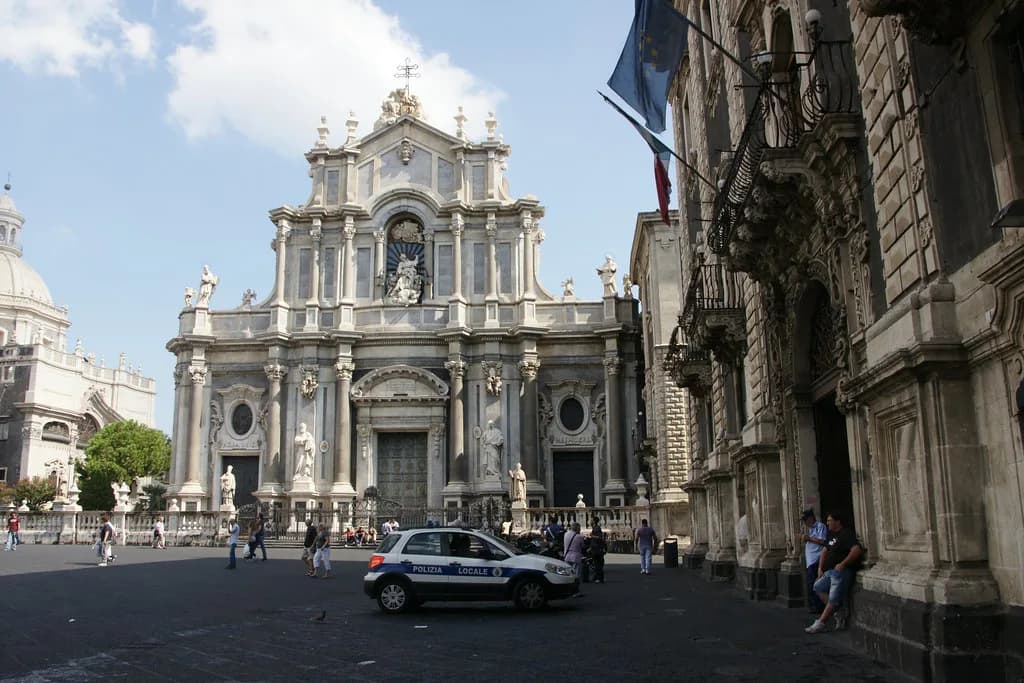
Around the square, the cathedral, the town hall at Palazzo degli Elefanti and the gates and churches framing the space were largely shaped or rebuilt in the eighteenth century by the city architect Giovanni Battista Vaccarini. His work gives the square a studied, theatrical composition of facades that reward a slow turn on the spot.
Look at how darker stone is deployed at ground level and on corners while lighter stone marks cornices, window surrounds and statues. It is this alternation, rather than unrelieved black, that makes the architecture legible at a glance and gives each building its rhythm.
Walk Via Etnea north: paving, pedestals, portals
Leave the square and follow Via Etnea, which runs in a straight line towards Mount Etna and serves as the spine of Catania. The paving along it is made of lava stone, and the first stretch from the cathedral square to Quattro Canti is pedestrian, making it the easiest part of the walk for close-up observation.
For a fuller route through the historic centre, compare this lava-focused walk with the Catania Self-Guided Walking Tour: Baroque and Roman Highlights, which covers overlapping ground and helps you decide what to prioritise if you only have a short stay. For the purpose of this palette study, though, slow down rather than adding stops.
Observation prompts for this stretch: door portals carved from dark stone with lighter keystones, iron balconies supported by carved brackets, shopfronts cut into lava walls, and the occasional pedestal or bollard that shows the rough texture of the material up close. Look down at the pavement joins as well, since the way the dark slabs meet is part of the overall decorative effect.
Quattro Canti, Piazza Stesicoro and the buried amphitheatre
Where the straight street crosses several others at Quattro Canti you find palazzi arranged on the four corners, another set-piece of dark facades and carved detail. Continue north to Piazza Stesicoro, where the sunken remains of the Roman amphitheatre lie partly below street level, a reminder that modern Catania was built over older layers.
The amphitheatre was among the largest in Sicily, constructed in the second century and eventually engulfed by later construction and volcanic material, which is why only fragments are visible today. Estimates of its original size vary between sources, so treat any single figure for capacity or dimensions with caution and simply appreciate the sliver of tiered stone you can see from the piazza.
From here Via Etnea becomes a long shopping and evening-stroll axis, with the Villa Bellini garden at its northern end. That makes this a natural point to turn back if you are on the short version of the walk.
Where the dark stone meets daily life: La Pescheria and the market piazza
Detour briefly back towards the sea side of the cathedral square to reach La Pescheria, the open-air fish and produce market set in a sunken piazza near Porta Carlo V. The black-and-white arches, the darker alleys and the stone steps descending from street level give you a chance to see lava architecture in a working, unpolished setting rather than a tidied one.
It is a good place to observe the way dark stone absorbs and reflects changing light across the day, and to notice how the market's low eaves and steep sides frame the sky. If the market is closed, the surrounding lanes and the gate are still worth a short loop before you return to Via Etnea.
Look up in churches and former monastic complexes
Interiors are where the palette turns more sumptuous. Golden stucco, frescoed ceilings, inlaid marble and dark stone columns combine in the churches along the historic centre, and it pays to look up at arches, capitals and altars rather than only at eye level. Many churches are free to enter, while some adjacent museums and terraces are separate, ticketed visits, so check the notice at each door rather than assuming one ticket covers several sites.
Vaccarini's town palaces and the interiors of noble houses such as Palazzo Biscari show the same taste for dark elements set against light, with mirrors, stucco and frescoes layered in the main ballroom. A handful of these interiors can be seen on guided visits, but they are private palaces and the rooms open vary, so verify directly before planning them into the day.
The grandest architectural finale on the walk is the former Benedictine Monastery of San Nicolò l'Arena, one of the largest monastic complexes in Europe and now home to part of the University of Catania. Its courtyards, corridors and gardens are best experienced on a booked visit, since guided routes reach areas that are not otherwise open.
Guided visits, evening tours and ticket arrangements change through the year, and no single pass covers every site in the city. Check the monastery's own site for current visit formats before you go, and treat paid interiors as optional additions to a free street-level walk.
A shorter and a longer version of the walk, and how to pace it
For a short version, spend an hour or two between Piazza del Duomo, the first stretch of Via Etnea and Quattro Canti. That is enough to read the black-and-white palette, the fountain and the baroque facades without tiring, and it is easy to do on foot.
The longer version continues north to Piazza Stesicoro and the Villa Bellini gardens, then returns through the market area and on to the Benedictine complex, which can fill a half day once interiors and pauses are included. These durations are only suggestions; pace yourself in the heat and split the route across two mornings if you prefer, since most of the central streets are on level ground.
Practical viewing tips: heat, light, wet ground
The best light for photographing dark stone is usually the softer morning and later afternoon, when white limestone trim stands out clearly without glare. Bring water and comfortable shoes, as the paving can be uneven and polished by wear, and the market floor is often wet by mid-morning.
Inside churches, keep shoulders and knees covered and lower your voice; many are active places of worship rather than museums. For a deeper look at the city's baroque streetscape beyond Via Etnea, the Via Crociferi: Baroque Street Guide covers a concentrated run of churches and villas a few minutes from the Duomo side of the centre.
Where to go next from Via Etnea
The Catania Attractions guide page collects visitor-oriented entries for the individual sights this walk touches, so you can decide which interiors justify a dedicated stop. Pair the theme with a slower day out if you want contrast: the Cyclops Coast Day Trip from Catania explores the volcanic coastline north of the city, where lava meets the sea in a very different register.
Sicily's regional tourism site is a useful broad source for what is happening across the island in 2026, but for a return visit focus on the streetscapes rather than a checklist: the pleasure of Catania is the way its black baroque changes with the weather and time of day.
Walk Slowly Through the Black City
Catania rewards the traveller who stops to notice the material itself: dark volcanic stone underfoot and overhead, pale accents catching the sun, and centuries of disaster and rebuilding built into every wall. A loosely planned walk from Piazza del Duomo to the Benedictine complex, with a market detour, can cover the essential themes in a single day.
Before you build in any paid tour or interior visit, check directly with the site for current arrangements, since these change seasonally. Bring water, go early, and treat the route as an invitation to wander rather than a fixed list.
Frequently Asked Questions
Is Catania's black stone really volcanic?
Yes. Much of the historic centre is built from lava stone, and the material's dark tone, combined with pale limestone accents, is what gives the city its distinctive look. A walk through the streets shows the material in walls, paving and decorative details.
How long does a lava-stone walk in Catania take?
A short version between Piazza del Duomo and Quattro Canti can take an hour or two, while a longer route to Stesicoro, the Villa Bellini area and the Benedictine complex may fill roughly half a day once interiors are included. These are suggestions, not an official route, so pace yourself.
What is the best time of day to photograph the black baroque?
Morning and the later afternoon usually give softer light that shows the contrast between dark stone and pale trim. Midday sun can be harsh, while wet paving and market floors add interest but demand care with footing.
Where does the walk start?
Piazza del Duomo is the natural start, with the Liotru elephant fountain as the meeting point and the cathedral square as the first set-piece of baroque facades to read.
Can I see the Benedictine monastery interiors?
Yes, but the full experience generally requires a booked guided visit, and formats change through the year. Check the monastery's own website for current options and whether combined tickets exist before you plan your day around it.
Is the walk on flat ground?
Most of the central route between Piazza del Duomo and Piazza Stesicoro is on level streets with paved surfaces, though some paving is uneven and the market floor is often wet. The monastery visit involves stairs.
Sources
Continue exploring
More guides you'll find useful