Palazzo Spada Visitor Guide: History, Art & Borromini's Illusion in Rome
Plan your visit to Palazzo Spada in Rome. Discover its rich history, the stunning Galleria Spada art collection, and Borromini's famous forced perspective illusion.
On this page
Palazzo Spada Visitor Guide: Unveiling Rome's Hidden Gem
Discover Palazzo Spada, a compact palace in the historic center of Rome with a state art gallery, a Renaissance-Baroque setting, and one of the city's most memorable architectural illusions.
This 2026 Palazzo Spada visitor guide covers what to see, how long to allow, how to get there, and accessibility limits.
The Galleria Spada houses a 17th-century collection displayed in intimate rooms. Francesco Borromini's forced perspective gallery is the signature sight, but the best visit balances the illusion with time for the paintings, courtyard, and surrounding Regola district.
Why Visit Palazzo Spada?
Palazzo Spada is easy to fit into a central Rome itinerary without feeling like another large museum. The visit is short, focused, and usually calmer than the city's headline sights, making it a strong choice for travelers who like architecture, optical illusions, and Baroque painting.
The main draw is Borromini's Perspective Gallery. The corridor looks dramatically longer than it really is because the floor rises, the ceiling descends, and the columns shrink toward the rear. Seeing the illusion in person is much clearer than seeing it in photos.
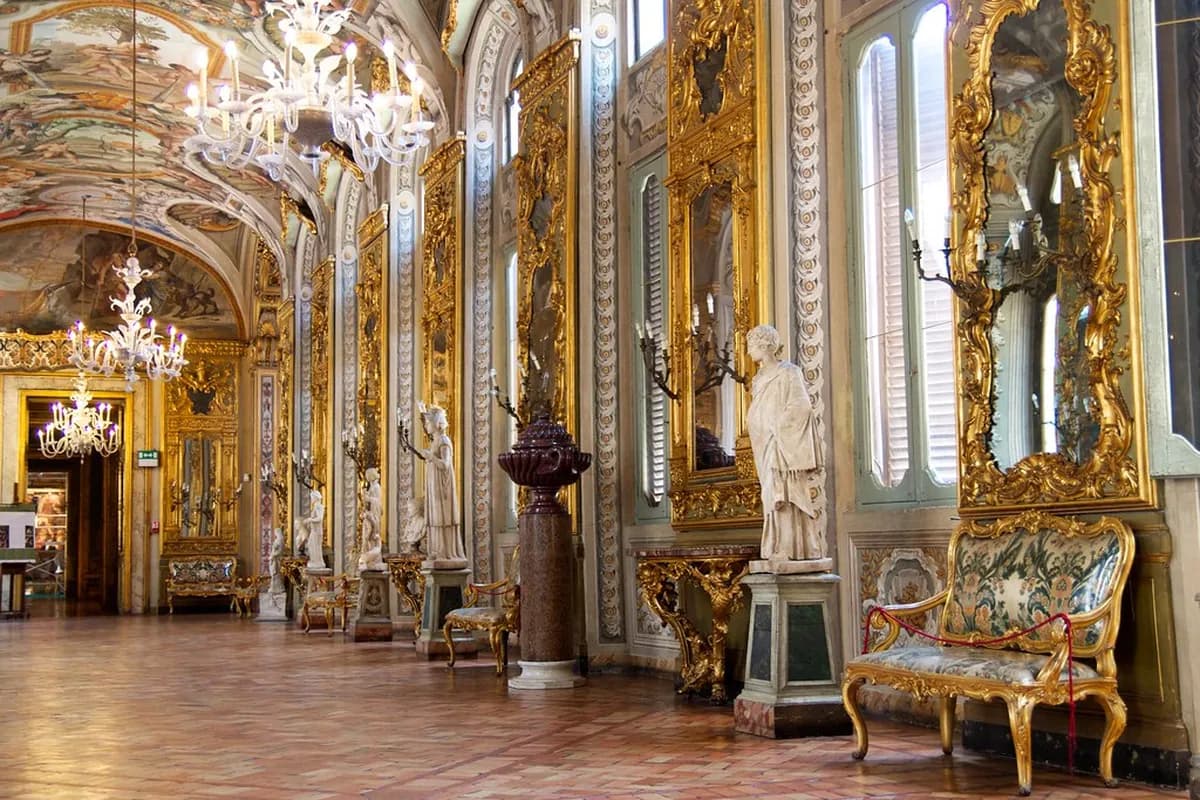
Beyond the illusion, the Galleria Spada preserves the feel of a private aristocratic collection. Visit if you want a Rome hidden gem near Campo de' Fiori, a quieter art stop between outdoor landmarks, or a short indoor break on a hot or rainy day.
A Brief History of Palazzo Spada
The history of Palazzo Spada dates back to the 16th century. It was originally built for Cardinal Girolamo Capodiferro in 1540, with Giulio Mazzoni and Bartolomeo Baronino associated with its Renaissance design.
In 1632, Cardinal Bernardino Spada acquired the palace and later commissioned Francesco Borromini for renovations. Spada was a prominent patron and collector, and his paintings and sculptures became the core of the present-day Galleria Spada.
The Spada family preserved the palace for centuries. In 1927, the Italian state purchased Palazzo Spada, which now houses both the Council of State and the Galleria Spada.
The Galleria Spada: Art Collection Highlights
The Galleria Spada features works primarily from the 16th and 17th centuries, with Italian and European artists represented across a compact sequence of rooms. It feels like a focused private collection rather than a broad survey museum.
Notable artists associated with the gallery include Guido Reni, Guercino, Artemisia Gentileschi, Mattia Preti, Titian, and Rubens. Expect portraits, religious scenes, mythological subjects, and still lifes arranged in a way that reflects Cardinal Bernardino Spada's collecting taste.
Do not treat the gallery as only the approach to Borromini's illusion. The small rooms are part of the attraction's value, especially if you enjoy close looking. For another private Roman collection, pair Palazzo Spada with the Galleria Doria Pamphilj.
Borromini's Forced Perspective Gallery: The Illusion Explained
Francesco Borromini's Perspective Gallery is the true marvel of Palazzo Spada. It makes a short corridor appear much longer than it is by combining many small distortions at once.
The gallery is actually only 9 meters (29.5 feet) long. Yet, it appears to stretch for about 37 meters (121 feet). Borromini achieved this with converging lines, compressed scale, and a carefully controlled viewpoint.
The floor rises, the ceiling lowers, and the columns gradually get smaller toward the end. A small statue at the far end appears larger and farther away than it really is. From the entrance, your eye reads the space as a long classical colonnade; from the side, the trick becomes easier to decode.
Pause at the entrance before moving closer. Take one photo from the central viewpoint, then step aside and compare the actual depth of the corridor. The gallery is a short architectural demonstration, not a long walk-through attraction, so the best experience comes from slowing down at the viewpoint.
Francesco Borromini: The Man Behind the Masterpiece
Francesco Borromini (1599-1667) was a leading architect of the Roman Baroque. Born in Switzerland, he began as a stone carver before working in Rome under Carlo Maderno and Gian Lorenzo Bernini.
His career was marked by a rivalry with Bernini. Where Bernini often favored sculptural drama and classical grandeur, Borromini pushed geometry, compression, and spatial surprise. Palazzo Spada's perspective gallery is a small but memorable example of that approach.
His major works include San Carlo alle Quattro Fontane and Sant'Ivo alla Sapienza. Seeing Palazzo Spada helps explain why Borromini remains central to Rome's Baroque identity.
How to Visit Palazzo Spada: Practical Information
Most visitors need 60 to 90 minutes at Palazzo Spada: less if you only want the perspective gallery, more if you plan to study the paintings room by room.
For 2026, the best time to visit is usually a weekday morning or late afternoon outside free-entry rush periods. The palace is generally quieter than major Rome attractions, but the viewing point for Borromini's corridor can still bunch up when several visitors arrive at once.
The Galleria Spada is on an upper level, and historic-palace access can involve stairs, thresholds, and uneven surfaces. Travelers with mobility needs should verify current access arrangements before committing. Common mistakes are arriving on Tuesday, treating the perspective gallery as a large standalone attraction, and searching maps without the exact address, Piazza Capo di Ferro 13.
Tickets & Opening Hours for Palazzo Spada
Admission to the Galleria Spada and Borromini's corridor requires a ticket. The full-price combined ticket for the Galleria Spada and Borromini's perspective corridor is €6. A reduced €2 ticket applies to EU citizens aged 18-25, and admission is free for EU citizens under 18 and over 65.
The Galleria Spada is open from 8:30 a.m. to 7:30 p.m., with the last ticket sold at 7:00 p.m. It is closed on Tuesdays. Entry is also free on the first Sunday of each month.
For most visitors, buying at the door is the simplest approach. Free first Sundays are useful for budget travelers but can reduce the calm, hidden-gem feel. Bring identification for age-based concessions and check for special closures if your itinerary has only one possible time slot.
Getting to Palazzo Spada: Address & Transportation
Palazzo Spada is at Piazza Capo di Ferro 13, 00186 Roma RM, Italy, in the Regola district near Campo de' Fiori and Piazza Farnese. Save the address before you leave, because the entrance sits on a small piazza rather than on a broad landmark street.
Many visitors arrive on foot while moving between the historic center, Trastevere, and the river. From Largo di Torre Argentina, served by numerous city buses, the walk takes about 8 minutes. Bus lines listed in the verified page data include 46, 56, 62, 64, 70, 81, 87, 492, and 628.
For tram users, Arenula/Cairoli is one of the closest practical stops. On foot, allow about 10 minutes from Campo de' Fiori, around 15 minutes from Piazza Navona, roughly 20 minutes from the Pantheon or Trevi Fountain area, and 25-30 minutes from the Colosseum.
What's Near Palazzo Spada? Nearby Attractions
Palazzo Spada's central location makes it easy to combine with other Roman sights. The most natural pairing is Campo de' Fiori, a few minutes away, followed by Piazza Farnese and the surrounding lanes of the historic center.
Within a 15-20 minute stroll, you can reach Largo di Torre Argentina, Piazza Navona, and the Pantheon area. Those stops create a classic half-day route: Palazzo Spada for the hidden-gem art stop, then larger open-air landmarks for the rest of the walk.
Art lovers can build a gallery-focused route by pairing Palazzo Spada with the Galleria Doria Pamphilj or Palazzo Colonna. If your day is already packed with the Colosseum or Vatican Museums, use Palazzo Spada as a lighter add-on rather than another major commitment.
Tips for Your Palazzo Spada Visit
To fully appreciate Borromini's illusion, look first from the main viewing point before moving closer. The effect depends on alignment, so off-center photos may look less surprising.
Allow enough time for the art collection. The palace is small, but the rooms are dense, and rushing straight to the perspective gallery misses much of the visit.
Avoid the last-ticket window if this is a priority stop. Even a short visit needs time for security flow, ticketing, and lingering over the paintings.
Use Palazzo Spada before lunch at Campo de' Fiori, after a walk from Piazza Navona, or as a quiet indoor pause between outdoor landmarks.
Frequently Asked Questions
Is Palazzo Spada worth visiting?
Yes, Palazzo Spada is definitely worth visiting for its unique blend of art, history, and architectural genius. The highlight is Borromini's forced perspective gallery, an incredible optical illusion. The Galleria Spada also houses a valuable collection of Baroque art, offering a quieter cultural experience.
Is Palazzo Spada free to visit?
Palazzo Spada is not generally free to visit. Standard adult tickets cost €6. However, it offers free admission on the first Sunday of each month. EU citizens aged 18-25 can also enjoy a reduced ticket price of €2. Always check official sources for the latest information on prices and free entry days.
How long does it take to tour Palazzo Spada?
Most visitors spend between 1 to 2 hours touring Palazzo Spada. This allows enough time to fully appreciate the art collection in the Galleria Spada and experience Borromini's famous perspective illusion. The smaller size of the palace makes for a more manageable and focused visit compared to larger museums.
What is Palazzo Spada famous for?
Palazzo Spada is most famous for Borromini's forced perspective gallery. This architectural marvel creates an optical illusion, making a 9-meter corridor appear 37 meters long. It is also renowned for the Galleria Spada, which houses a significant collection of 16th and 17th-century Baroque art, including works by masters like Guido Reni.
What art is in Galleria Spada?
The Galleria Spada features an impressive collection of Baroque art, primarily from the 16th and 17th centuries. You can find works by prominent artists such as Guido Reni, Guercino, Artemisia Gentileschi, and Mattia Preti. The collection includes portraits, religious scenes, and still life paintings, reflecting the tastes of Cardinal Bernardino Spada.
What is Borromini's perspective gallery?
Borromini's perspective gallery is an architectural optical illusion inside Palazzo Spada. Its rising floor, lowering ceiling, shrinking columns, and small end statue make a short corridor look much longer than it really is.
Palazzo Spada is best for travelers who want a compact cultural stop with a strong payoff: Borromini's illusion, a historic palace, and a focused Baroque collection in one central location. Add it to your Rome itinerary when you want something memorable without committing half a day.
Explore more Rome favorites in our guides to unusual things to do in Rome and our Hidden Rome 3-day itinerary.
For authoritative information, refer to the Palazzo Spada on Wikipedia, Palazzo Spada official site and Palazzo Spada official site.
Continue exploring
More guides you'll find useful