Anfiteatro Romano di Catania: A Piazza Stesicoro Visitor Guide
Plan a visit to Catania's Roman amphitheatre in Piazza Stesicoro: what survives, seasonal hours, ticket tiers, closure dates and access limits.
On this page
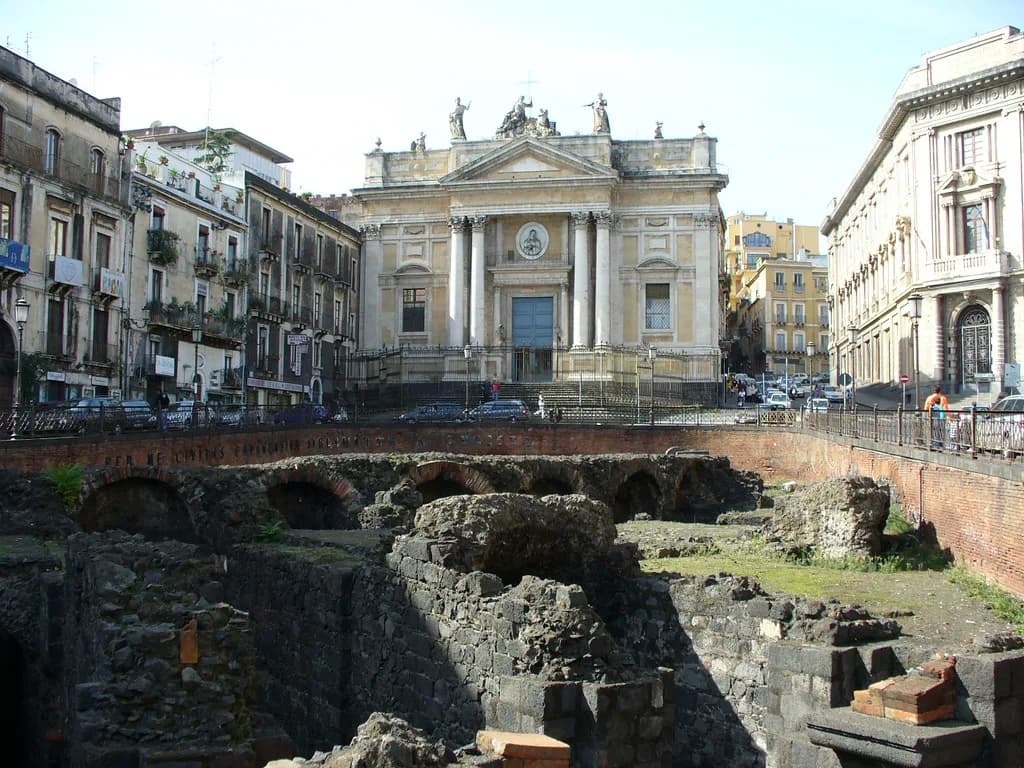
Most people crossing Piazza Stesicoro notice a sunken oval of pale stone beside the traffic and keep walking. That oval is the Anfiteatro Romano di Catania, once the largest amphitheatre in Sicily and now reduced to a fragment that sits below the level of the modern street.
The main thing to understand before you go is scale. The structure that survives above ground is a small share of what the Romans built, so the visit is short and the experience is intimate rather than monumental. A second useful detail: looking down from the pavement is free, while going inside the excavated area is ticketed and follows published hours. Further visitor details appear in Anfiteatro Romano di Catania | CoopCulture.
Quick Answer: Where the Amphitheatre Is and How Much You See
The amphitheatre stands in Piazza Stesicoro, on the lower stretch of Via Etnea, the long straight street that runs north from Piazza del Duomo toward Mount Etna. The CoopCulture listing gives the address simply as Piazza Stesicoro, Catania, which makes it easy to combine with a walk along the city's main axis.
What you see is the north-western portion of the original building, roughly a tenth of the whole, exposed in a rectangular excavation below street level. The rest lies under the piazza and the blocks around it, which is why the ruin reads as a partial curve of stone rather than a complete arena.
Why Only About a Tenth of the Structure Is Visible
After the 1693 earthquake the amphitheatre was effectively buried, and later construction finished the job. Buildings put up in the 18th and 19th centuries sit directly over parts of the structure, so the excavation reveals only the slice that later city planning happened to leave accessible.
The stone itself had been quarried away long before that. Over the centuries residents reused the amphitheatre's masonry for other buildings, leaving the surviving arcades and seating tiers as the exception rather than the rule.
From Arena to Buried Ruin: The Short History You Need
Construction is usually dated to around the middle of the second century AD, in the era of Hadrian and Antoninus Pius. As the consulted sources describe it, the amphitheatre could seat roughly 15,000 spectators and belonged to the same class of grand structures as the Colosseum and the Arena di Verona. Further visitor details appear in Anfiteatro Romano di Catania | CoopCulture.
Its decline was gradual rather than sudden. Permission to reuse the stones was granted as early as the 5th century, and the entrances were later used by troops during medieval conflicts before the ruin was absorbed into fortifications and, eventually, private building.
Systematic interest began in the 18th century, when Prince Biscari funded excavations that brought a whole corridor and several large arches of the outer gallery back into view. The site reopened to the public in July 2024 under a new arrangement between the Comune di Catania and the regional archaeological park.
What Is Actually in Front of You at Piazza Stesicoro
Inside the excavation you look down onto a curved stretch of seating tiers and the network of arches that once supported the upper structure, built from volcanic stone from Etna. Because the block is so compressed, the pleasure is in the details — the cut of the lava blocks, the curve of the corridor — rather than in any sense of a complete arena.
Set your expectations accordingly and the stop takes perhaps twenty minutes, longer if you read the panels and photograph the stonework. It is a modest, slightly melancholy place, and it rewards visitors who have already seen the city's Baroque overlay and want a reminder of what came before.
Practical Visiting Facts: Seasonal Hours, Last Entry and Closure Dates
The site publishes two seasonal windows, with the last entry half an hour before closing. From 1 April to 31 October it is listed as open Monday to Sunday, 9:00 to 19:00, with last entry at 18:30; from 1 November to 31 March the day ends earlier, with last entry at 16:30. Further visitor details appear in Anfiteatro Romano di Catania | CoopCulture.
The listing names two closures: 25 December and 7 September 2026. It also flags a European Night of Museums opening on 23 May 2026, from 20:00 to midnight with last entry at 23:30 — a one-off evening rather than a regular pattern, so treat it as history rather than something to plan around.
Hours can shift for holidays, maintenance or special events, and the safest approach is to check the operator page and the city's museum ticket portal on the day before you travel. Neither page is a guarantee of live availability, but both are far more reliable than a guide written months earlier.
Tickets and Who Qualifies for Reduced or Free Entry
CoopCulture's listing gives a full ticket of 4.00 euro and a reduced ticket of 3.00 euro, the latter covering groups over ten people, university students under 26 with a student card, over-65s, military personnel, Catania residents, qualifying family groups and the first Sunday of each month. School groups are listed at 2.00 euro. Further visitor details appear in Anfiteatro Romano di Catania | CoopCulture.
Free entry is set out for a long list of categories, including visitors with disabilities and their companions, children under 10, licensed tourist guides, ICOM members, journalists and accompanying teachers. Bring the document that proves your category, because the reduction depends on it.
Tickets are handled through the city's museum system rather than sold at a private gate, so check the Comune di Catania portal for current purchase routes before you set out. Do not assume the amphitheatre ticket also covers other Catania monuments — the listing describes a single site.
Accessibility: What the Site Itself States
The operator's listing states plainly that the site is not accessible to visitors with motor disabilities. That matters for planning: the excavated area sits below street level and is reached by steps, so anyone with limited mobility should plan on the street-level view instead. Further visitor details appear in Anfiteatro Romano di Catania | CoopCulture.
If accessibility is the deciding factor, ask the city's museum service directly about current conditions before travelling, since infrastructure and temporary works can change what is possible on a given day. Do not rely on generic claims that the site is fully accessible.
Street-Level Viewing Versus Going Inside
You can see the excavation from the pavement around Piazza Stesicoro without buying anything, and this free view is genuinely worthwhile for a passing look. It is also the only option outside opening hours, when the gates are shut and the site is simply part of the streetscape.
Paying to enter buys you proximity: the chance to stand among the arches rather than above them, and to read the site's context at close range. At the published price the trade-off is easy to weigh, but if the site is closed on your dates, the free view plus the history above is a reasonable substitute.
Pairing the Amphitheatre With Piazza Stesicoro and Via Etnea Sights
Piazza Stesicoro itself holds the monument to Vincenzo Bellini and is framed by Palazzo del Toscano and Palazzo Tezzano. From there, Via Etnea runs north through the Quattro Canti and the university square toward Villa Bellini, which makes a natural half-day route on foot.
Walk south instead and you reach Piazza del Duomo, the fish market and the tangle of lanes around them, where the underground Amenano river surfaces at the fountain. Our guide to the hidden gems in Catania covers several of these layers, including the Roman baths beneath the cathedral square.
For a second Roman site, the Teatro Romano di Catania on Via Vittorio Emanuele II is a short walk away and offers a different experience: a theatre embedded in later buildings rather than an amphitheatre sunk below a piazza.
If you prefer museums indoors, the Museo Civico Castello Ursino holds the Biscari collections in a Swabian castle whose moat was filled by the 1669 lava flow. It pairs well with the amphitheatre because both tell the story of the same family's antiquarian enthusiasm.
Common Mistakes: Combined Tickets and a Full Arena View
Two assumptions trip people up. The first is expecting a complete arena; the second is assuming a single ticket covers the amphitheatre and the city's other Roman and Baroque monuments. Neither holds — the listing describes a modest single-site visit with its own price tiers.
A third is timing. Arriving just before the published last-entry time leaves no room to see the site properly, and arriving on a listed closure date means a locked gate. Check the seasonal window and the specific closure dates before you build the stop into an itinerary.
Where to Go Next in Catania
Beyond the Roman layer, Catania rewards a slow walk through the rebuilt Baroque centre, from Piazza del Duomo along Via Crociferi, and a longer stop at the Monastero dei Benedettini, now home to the university and open for guided visits.
The wider Roman Catania: A Guide to the Ancient Remains covers the theatre, the baths and the underground traces in one route, useful if antiquity is your main interest. The Catania Attractions hub lists the rest of the sights for planning a fuller stay.
Plan Your Visit
Treat the amphitheatre as a short, focused stop rather than a headline sight. Check the seasonal hours and closure dates on the operator page, confirm the ticket tier you qualify for, and accept that the excavated area is not accessible to visitors with motor disabilities.
Then build the rest of the day around it: Via Etnea north to Villa Bellini, or south to Piazza del Duomo and the market. The amphitheatre works best as one layer in a city that has been rebuilt many times over, and the fragments make more sense once you have seen the rest.
Frequently Asked Questions
How much of the Roman amphitheatre in Catania can you actually see?
The exposed north-western portion, roughly a tenth of the original structure, in a sunken excavation in Piazza Stesicoro. The remainder lies beneath the piazza and the surrounding buildings, which date largely from the 18th and 19th centuries.
Where is the Anfiteatro Romano di Catania located?
In Piazza Stesicoro, on the lower stretch of Via Etnea in central Catania. It is within walking distance of Piazza del Duomo and the city's main Baroque sights, so it fits easily into a walking route.
What are the opening hours for the amphitheatre?
The operator lists longer summer hours from April to October and shorter winter hours from November to March, with last entry half an hour before closing. Verify the current schedule on the operator page before travelling, since holidays and events can change it.
How much does entry cost and who gets in free?
The operator lists a full ticket, a reduced tier for students, seniors, residents and other qualifying visitors, and a lower rate for school groups. Free entry covers several categories including children under 10, licensed guides and visitors with disabilities plus companions; bring proof of your category.
Is the amphitheatre accessible for wheelchair users?
The site's own listing states that it is not accessible to visitors with motor disabilities, since the excavated area sits below street level. Visitors with limited mobility can still view the ruins from the pavement around Piazza Stesicoro.
Can you see the amphitheatre from the street without a ticket?
Yes. The excavation is visible from the surrounding pavement and can be viewed free of charge outside opening hours as well. Entering the excavated area itself requires a ticket and is possible only during published hours.
Is the amphitheatre open on public holidays?
The operator names specific closure dates rather than a full holiday schedule, so do not assume normal opening on public holidays. Check the operator and city museum pages for the dates of your trip.
How long should you spend at the site?
Around twenty minutes is enough for most visitors, a little longer if you read the panels and photograph the stonework. Combine it with Via Etnea or Piazza del Duomo to fill a morning.
Sources
Continue exploring
More guides you'll find useful