Teatro Romano di Catania: A Practical Visitor Guide
Plan a visit to Catania's Roman theatre on Via Vittorio Emanuele II, with the Odeon beside it, what survives, and how to combine it with the old town.
On this page
Catania keeps its ancient past close to the surface. The Teatro Romano lies on the lower slopes of Montevergine, the hill that was the acropolis of the ancient city, and today it sits between ordinary streets rather than in a cleared archaeological park. That setting shapes the visit: you are reading a monument that the city has grown around for centuries. A third-party listing suggests one to two hours for the attraction, but that is an editorial guideline rather than an official visiting time.
This guide focuses on the theatre on Via Vittorio Emanuele II and the Odeon next to it, and separates them from the amphitheatre at Piazza Stesicoro. It also flags what the available sources do not confirm about fees, hours and access to the covered passages, so you can plan without relying on stale figures.
Where the Theatre Sits
The theatre occupies the southern edge of Montevergine, the ancient acropolis, between today's Via Vittorio Emanuele II and the streets that climb the hill. The official regional parks page describes this position, which helps explain why the ruins feel tucked into the city rather than set apart from it. The address most listings give is Via Vittorio Emanuele II 266.
Because the site is inside the historic grid, it fits naturally into a walking day. From Piazza del Duomo you can reach the area on foot, and the rest of the old town is close at hand. Plan it as one stop on a route rather than a separate excursion.
A practical approach is to start at the Duomo square and walk west along Via Vittorio Emanuele II. The route passes the Fountain of the Elephant and several Baroque facades, so the walk itself earns the detour. Use the theatre as a marker in the middle of the day rather than a destination in its own right.
What Actually Survives
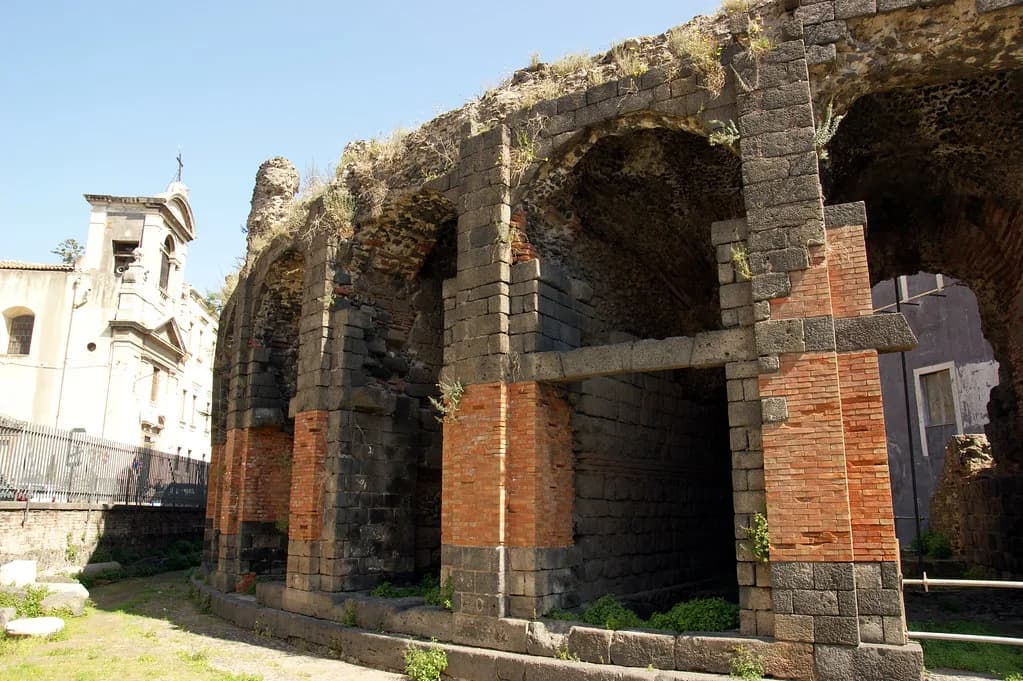
Roman theatres follow a recognisable plan: a semicircular stepped seating area, the cavea, facing a stage building, with vaulted passages supporting the rows. At Catania, later construction has absorbed much of the structure, so what you see is a fragment read against the buildings that swallowed it. The regional parks page notes the theatre's position on the acropolis slope and the presence of the Odeon, which is a separate, smaller roofed theatre beside the main one.
Treat the Odeon as its own structure with its own footprint, not as a wing of the larger theatre. When you look at the site, work out where each building begins rather than reading the whole area as one auditorium. The two buildings served different scales of performance, and that distinction makes the ruins easier to interpret.
A detail worth knowing before you go concerns the stage. After rain, water can pool in the stage area and reflect the surrounding city, which changes the character of the ruins completely depending on the weather. If you visit in wet months, take that as a photographic opportunity rather than a reason to skip the site.
Why the Monument Is Lodged in Later Buildings
Catania has been rebuilt repeatedly after eruptions and earthquakes, and later generations reused ancient stone and built directly on and over older structures. That history explains why the theatre does not stand free like a rural ruin but appears in slices between streets and houses. The city's Baroque fabric, much of it in black lava stone, sits literally on top of the ancient layer.
Seeing the theatre first makes the later city easier to read. The long straight Via Etnea, the churches along Via Crociferi and the palaces around the Duomo all belong to the rebuilding that followed the 1693 earthquake. The Roman fragment beneath them gives that rebuilding a starting point.
Greek Origin, Roman Rebuild, Acropolis Setting
The structure is usually described as Greco-Roman because a Greek theatre preceded the Roman one on the same ground. The Roman version dates to the imperial period, when the city's public buildings were expanded, and it took advantage of the slope of the hill for seating. The official regional parks page frames the theatre within this long sequence of use and rebuilding.
Knowing the site sits on the acropolis hill helps make sense of the geography. The theatre was part of a civic centre on high ground, not an isolated entertainment venue, and the surrounding streets still follow the contours of that hill today. As you walk between the theatre and the Duomo, notice how the ground rises and falls.
Practical Visiting: What Is and Is Not Confirmed
Third-party attraction listings vary, and a commercial booking page shows an hours window that should not be taken as the official schedule. Before you go, check the regional archaeological parks site or ask at the site itself rather than relying on a reseller listing. Opening times at archaeological sites can change with seasons and conservation work.
Fees and ticket scope are the other moving part. The available sources do not confirm a current entrance price or how the theatre and Odeon are ticketed together, so treat the visit as one to verify on arrival. Carry cash and expect to ask at the entrance, and do not build a budget on figures from older listings.
Access to the covered passages and any vaulted substructures beneath the seating is not something to promise yourself in advance. Those areas may be closed, opened only for guided groups, or restricted for conservation, and the sources here do not settle the question. Ask on site, but plan your visit around what is openly visible.
The site is not marketed as a secret or a local-only spot, and it should not be treated that way. It is a known city monument embedded in a busy district, so expect traffic noise, neighbouring buildings and other passers-by rather than a hushed archaeological park.
How Long to Allow
As an editorial suggestion rather than an official figure, forty-five minutes to an hour is comfortable for the visible remains, a walk around the Odeon and a few photographs. If the site turns out to have more open than expected, or if you want to read every information panel, allow a little more.
If you find that the main theatre is largely closed or only partly visible on the day you visit, shorten the stop and fold it into a wider walk rather than waiting. The surrounding streets, the Baroque centre and the Duomo square are all within easy reach and will fill the time well.
A third-party listing recommends one to two hours for the attraction, which is a fair upper bound if you combine the theatre with nearby sights. Use that as a planning guideline, not as a published duration for the monument itself.
The Stage, the Rain and Your Camera
The rain-pooling detail rewards a flexible approach. After wet weather, the flooded stage can mirror the surrounding buildings and sky, giving a very different image from the dry months; in summer, the same area is simply dry stone. If you want that shot, visit after rain rather than chasing it in high summer.
For general street photography, the paving, the lava-stone facades and the hill setting matter as much as the ruins. Early morning and late afternoon give softer light, and the site is easier to photograph when fewer people are passing through. Whatever the time, keep the footwear sensible: the terrain is uneven and the stone can be wet.
Combining the Theatre with Piazza Duomo and the Underground
From the theatre, walk back down towards Piazza del Duomo, where the Fountain of the Elephant and the Cathedral sit at the heart of the historic centre. The square is also the point of convergence for the city's main streets, which makes it a natural base for the rest of a walking day.
Around the square, the underground Roman baths known as the Terme Achilliane sit beneath the piazza, and the Amenano river runs hidden under the streets, surfacing at the fountain beside the square. These are separate visits with their own access arrangements, so do not assume one ticket covers them all.
Nearby religious buildings and the Museo Diocesano rooftop are alternative vantage points if you want a view over the city and towards Etna. Some of these spaces are free to enter and others are ticketed, so check before you commit time and money to any particular one.
Theatre Versus Amphitheatre at Piazza Stesicoro
The Roman amphitheatre at Piazza Stesicoro is a different monument with a different shape. It is an oval arena rather than a semicircular theatre, and it sits partly below the modern street level, which gives the remains a sunken quality rather than a stage-facing one.
Sources often blur the two, which is why it is worth seeing them as separate stops. The amphitheatre was among the largest in Sicily and could hold a very large crowd, according to a heritage summary; that scale is the point of interest there, while the theatre on Via Vittorio Emanuele II is about staging and performance.
If your time is short, choose based on what interests you. If you want to imagine a performance, go to the theatre; if you want to feel the scale of Roman public entertainment, go to the amphitheatre, which is visible from the piazza itself and needs less planning.
Baroque Catania Around the Ruins
The theatre sits at the edge of the Baroque city, and the short walk to Via Crociferi takes you past a dense sequence of churches and palaces rebuilt after the 1693 earthquake. Via Etnea, the long straight street pointing towards Etna, is the other major axis worth following for architecture and evening life.
The Arco di San Benedetto spans the street between monastic buildings, and the Monastero dei Benedettini, now a university site, offers guided visits and hosts occasional evening events. Check the monastery's own programme for what is on during your dates instead of relying on older listings.
For music lovers, the Teatro Massimo Bellini and the composer's birthplace complete the Bellini trail through the centre. These are separate sites with separate visiting arrangements, so treat them as their own stops rather than as add-ons to the theatre.
Free Stops and Paid Interiors
One of the pleasures of this part of Catania is that a lot of it costs nothing to walk through. The squares, the streets, the exterior of the theatre and the general Baroque fabric of the centre are open to anyone on foot, so a low-budget day is entirely possible if you plan around exteriors and public space.
Paid interiors, museums and rooftop terraces add context but need budgeting. Check current prices at each door or on the operator's own site before you commit, because the figures quoted in older guides and blogs go stale quickly and vary by season and by combined ticket.
Castello Ursino, the thirteenth-century fortress now housing a civic museum, is another paid stop that pairs well with a walking day in the centre. It sits a short walk from the Duomo and gives a very different perspective on the city's history.
Practical Tips for the Visit
Wear closed shoes with a little grip. Lava stone and old paving are uneven and can be slick after rain, and you will likely be walking between several sites rather than staying in one place. A hat and water are sensible in summer, when the exposed stone holds heat.
Go early or late in the day if you want photographs and fewer people. The middle of the day is busiest around the Duomo and Via Etnea, and the light is harder on the stone. If you plan to visit the fish market, note that it runs in the morning and closes in the early afternoon, so the two fit together best before lunch.
Manage expectations honestly: this is a fragment of a monument inside a working city, not an open-air archaeological park with long interpretation boards. If you arrive expecting a complete Roman theatre, you will be disappointed; if you arrive expecting to read the city's layers in stone, it will repay the stop.
Where to Go Next in Catania
After the theatre, head for the fish market before it packs up, climb to a rooftop for a view towards Etna, or take a day trip out to the Riviera dei Ciclopi and the volcano itself. Each works best as its own half-day rather than as a rushed addition to the same afternoon.
Whichever route you choose, verify the day's opening details at the door or on the operator's own site. Catania rewards slow walking and a willingness to double back, and the ancient fragments are best seen as part of that unhurried circuit rather than as a single tick-box stop.
Frequently Asked Questions
Do you need tickets for the Teatro Romano di Catania?
The available sources do not confirm a current ticket price or whether a single ticket covers both the theatre and the Odeon. Check at the entrance or on the regional archaeological parks site before you go, and carry cash in case payment is taken on site.
What are the opening hours of the Roman theatre in Catania?
A commercial attraction listing shows one hours window, but it should not be treated as the official schedule. Confirm on the day with the site or the managing authority, since seasonal variation and closures for conservation are common at archaeological sites.
Is the Odeon included with the theatre visit?
The Odeon is a separate, smaller roofed theatre beside the main one rather than a section of it. Whether one ticket covers both is not settled by the sources here, so ask at the entrance and plan around what is visibly open.
How long does it take to see the Roman theatre?
Allow roughly forty-five minutes to an hour as an editorial suggestion, not an official figure. If the site is only partly open, fold the stop into a wider old-town walk rather than waiting around.
Is the Roman theatre the same as the Roman amphitheatre in Catania?
No. The theatre is a semicircular performance building near Via Vittorio Emanuele II, while the amphitheatre is an oval arena at Piazza Stesicoro, partly below street level. They are separate monuments with separate histories and visiting experiences.
Is the theatre worth visiting if you only have a day in Catania?
Worth it if you want to read the city's ancient layer, especially combined with the Duomo square and the underground Roman baths nearby. If you prefer unbroken Baroque streetscapes or volcano views, prioritise those instead and treat the theatre as optional.
Can you walk into the covered passages under the seating?
Access to vaulted passages and underground areas is not confirmed by the sources available. These spaces may be closed, restricted or opened only for guided groups, so ask on site and do not plan the visit around entering them.
What else is within walking distance of the theatre?
Piazza del Duomo, the Fountain of the Elephant, the underground Roman baths, Via Etnea and the Baroque churches around Via Crociferi are all reachable on foot. The amphitheatre at Piazza Stesicoro is a longer but manageable walk for a full day.
Sources
Continue exploring
More guides you'll find useful