Terme Achilliane Catania: Guide to the Underground Roman Baths
Plan a visit to the Terme Achilliane, the Roman baths beneath Catania's cathedral square: what survives, how to check access, and what to see nearby.
On this page
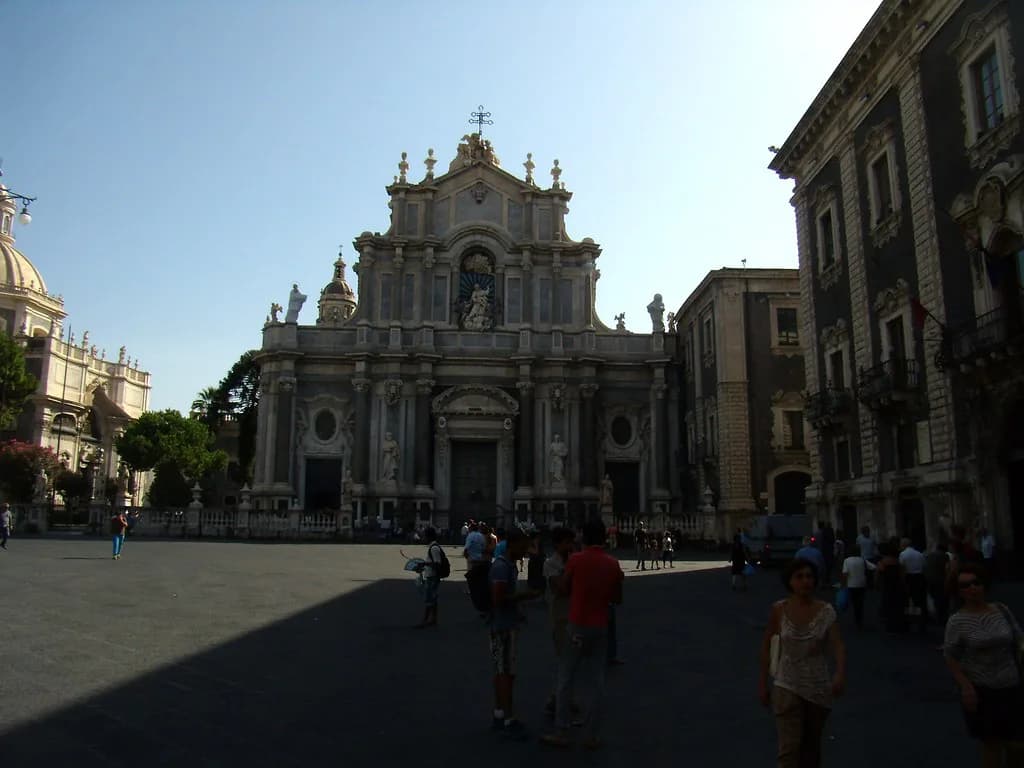
The Terme Achilliane are a set of Roman bath chambers beneath Piazza del Duomo in Catania, reached through an underground passage described as lying beside the cathedral facade. Their survival below the modern street makes them a different kind of Roman sight from the city's open-air ruins: you go down, not out. This guide explains what the baths are, how they relate to the underground Amenano river and the square above, and which details you should confirm with the operator before setting out.
One useful framing for planning: treat the baths as a short underground stop rather than a half-day museum. The evidence for visiting conditions is thin, so the sensible move is to check current opening arrangements for the day you plan to be in Catania and keep a flexible slot in your old-town walk.
What the Terme Achilliane Are
The Achillian Baths rank among the principal public bathing establishments of Roman date surviving in Catania, alongside the Terme dell'Indirizzo and the Terme della Rotonda. They sit beneath Piazza Duomo, which puts them directly under one of the busiest corners of the historic centre and makes them easy to slot into a walking route. The underground setting also means the experience is enclosed and dim rather than panoramic, so set expectations accordingly.
Access is described as coming through a narrow underground passage next to the principal facade of the cathedral. That detail matters for planning: the entry point is small, easy to walk past, and tied to a landmark you will almost certainly visit anyway. Rather than building a separate trip around the baths, fold them into the hour you spend around the square.
The chambers form part of a broader underground Catania, where lava flows and the buried Amenano river have repeatedly reshaped what visitors can see. Roman vestiges here sit close to Baroque monuments above ground, which is characteristic of a city rebuilt after the 1693 earthquake. That layering is the real reason to descend rather than just photograph the cathedral steps.
Where They Sit in Catania's Roman Bathing Landscape
Catania holds several Roman bath sites and they are not interchangeable. The Terme della Rotonda are Roman bath ruins on which a frescoed church was later built, giving a church-and-ruin combination rather than a purely underground experience. Knowing the difference helps you choose which baths match your interests if you only have time for one.
The Achilliane stand apart because of their location beneath the square and their vaulted rooms decorated with stucco work. Because they lie under the modern city, they read as archaeology in situ rather than as monument on display. If you enjoy the sensation of history layered beneath ordinary streets, this site delivers it more directly than the open ruins.
For a fuller picture of Roman Catania, pair this visit with the city's other ancient remains rather than treating each in isolation. The theatre, the amphitheatre at Piazza Stesicoro and the bath sites together show how much of the ancient city still sits within the modern grid. Grouping them across a couple of days keeps each one legible instead of a blur of stone.
The Name and the Greek Inscription
The name comes from a fragmentary Greek inscription on a slab of Carrara marble, found around the middle of the 18th century. The inscription is attributed to the middle of the 5th century AD and is now displayed in the Museo Civico at Castello Ursino rather than at the baths. The baths, in other words, carry a name borrowed from a portable object that travelled to a museum.
If that inscription is the detail that interests you most, consider adding Castello Ursino to your itinerary, keeping in mind that the castle's own access arrangements change and should be checked locally before you go. Note that the mid-5th-century attribution applies to the inscription, not to the baths themselves, so avoid treating it as a construction date. Treat the name as a paper trail linking a marble fragment to a monument.
What Survives Underground
Inside the complex, the surviving features are the vaulted rooms, with stucco decoration depicting human figures, vines and animals. These are not grand mosaics or marble halls but the quieter architectural fabric of a working bath building. Look up and along the walls rather than just down at the floor, since the decorative detail is what distinguishes the chambers.
The interiors were reproduced in 18th-century drawings by Grand Tour travellers, which is part of why these baths interest historians as much as casual visitors. Those drawings offer a record of how the chambers were understood before modern conservation, and they show that the site had admirers long before mass tourism. Keep that in mind when the lighting or enclosed space feels modest compared with open ruins.
For context on how Roman bath complexes were engineered and used, a visit here is helped by some prior reading on heating and bathing culture. Baths of this kind were social and cultural hubs as much as places of hygiene, with gardens, libraries and exercise spaces often integrated into the complex. That framing turns a few vaulted rooms into a legible slice of urban life.
The Amenano River Below the Square
Catania's underground geography is shaped by Mount Etna's lava flows, which have repeatedly covered the city and its river Amenano over the centuries. That buried water explains why so much of Roman Catania sits below street level and why descent is part of the experience. Understanding the river makes the enclosed rooms beneath the square feel like part of a system rather than an isolated oddity.
On the other side of the same piazza, the river surfaces at the Fontana dell'Amenano, built in 1867 by the Neapolitan sculptor Tito Angelini using Carrara marble and representing the river as a young man holding a cornucopia. Locals call it the funtana o' linzolu because the water falls like a sheet. After seeing the baths, walking across the square to the fountain closes the loop and turns an abstract underground river into something visible.
The square's layout helps you connect the pieces without expert knowledge. The Amenano fountain sits beside the steps down to the fish market, so the water, the marketplace and the underground baths are all within a short walk. Plan a single circuit rather than three separate outings, and you will cover the same ground with less repetition.
The Square Above: What to Pair With a Visit
Piazza del Duomo holds several distinct stops, and only some are free to enter. The cathedral of Sant'Agata and the elephant fountain known as Liotru are the obvious starting points, with Porta Uzeda nearby and the Diocesan Museum offering views toward Etna. Treat each as its own decision rather than assuming a single ticket covers everything.
The Diocesan Museum and the church rooftop terraces are separate experiences from the underground baths, and the baths are not documented as bundled with them. Budget and time should be allocated per site until you confirm otherwise. If your priority is views over Catania toward the volcano, the terraces serve that better than the enclosed bath chambers.
Walking north from the square along Via Etnea gives the visit a wider frame, taking in the Baroque street plan laid out after the 1693 earthquake. The stretch is lava-paved and busy, so it works best as a slow stroll rather than a checklist. Consider following it after the baths, when the contrast between underground dimness and street life is sharpest.
Other Roman Sites to Combine
The Greek-Roman theatre on Via Vittorio Emanuele was built on the site of an earlier Greek theatre in the 2nd century AD, with a smaller Odeon alongside it. Some listings post visitor opening times, but these change with seasons and events, so check before travelling across the city for it. The theatre makes an easy companion to the baths for anyone tracing Roman Catania in a single day.
At Piazza Stesicoro, the Roman amphitheatre survives partially below street level and could once hold an audience of roughly 15,000. Entry is possible from the piazza and from Vico Anfiteatro, though only a fraction of the structure is visible. It gives a sense of scale that the small underground bath chambers cannot, so the two sites complement each other well.
To move beyond the baths without leaving the old town, the Teatro Romano nearby offers the closest thing to an outdoor counterpoint. For practical framing of what you will see and how to pace it, this Teatro Romano di Catania: Visitor Guide is a useful next read. A paired visit works best earlier in the day, when the heat is milder and the streets are calmer.
Practical Planning: What to Confirm First
Visitor details for the Achillian Baths are thin, and the third-party audio-guide listing posts hours and a phone contact that should be treated as indicative rather than official policy. Before travelling, confirm access with the cathedral-side operator or the diocesan museum. Do not assume the passage is open every day, and do not assume there is a published ticket price, because none is confirmed in available sources.
No source consulted confirms accessibility features, group access, guided-tour availability or booking arrangements for the baths. If you use a wheelchair, travel with young children, or need step-free access, ask directly rather than relying on expectation. The entrance is described as a narrow underground passage, which suggests access could be constrained, but that is an inference, not a confirmed rule.
Metropolitan Catania's institutional websites and the comune portal publish general civic information, but they do not set out a visitor policy for the baths, so checking institutional pages for opening notices is speculative. Phone the contact listed for the site, or ask at the Diocesan Museum in person when you are in the city. Build the visit as an optional stop in your day, and you will not lose time if it is shut.
How Much Time to Allow and How It Fits a Walk
As a suggested duration rather than an official recommendation, allow around 30 to 45 minutes for the underground chambers, with extra time in the square for the cathedral, fountain and museum. That keeps the baths proportionate to their size and leaves room for the rest of Catania's old town. The compact distance between stops is what makes a slow half-day here realistic.
If your interests lean toward architecture above ground, the Basilica della Collegiata on Via Etnea is a fine example of Sicilian Baroque and a natural companion to the square. The Basilica della Collegiata: Visitor Guide covers what to notice in the facade and interior. Grouping it with the baths gives you both ends of the city's historical range in a single walk.
Wear closed shoes for any underground visit and carry a light layer, because below street level tends to feel cooler and surfaces may be uneven. These are practical suggestions, not confirmed conditions at this specific site. Ask at the entrance whether photography or bags are restricted before you descend, as policies vary between Catania's underground sites.
Is the Terme Achilliane Worth Adding?
The Achillian Baths reward curiosity more than spectacle. Their appeal lies in the vaulted rooms, the stucco detail and the unusual sensation of standing beneath a famous piazza, all of which suit a slow traveller who has already seen Catania's headline sights. If you only have a few hours in the city, prioritize the square and the cathedral, and treat the baths as a bonus if access happens to be open.
For travellers building a broader Roman itinerary across Italy, comparing Catania's baths with better-documented complexes elsewhere clarifies what to look for here. Details of what to see at the Baths of Diocletian in Rome offer a useful benchmark for bath architecture and later reuse as a church. Use the comparison as background, not as a substitute for checking Catania's own arrangements.
An honest summary: the site is small, access is uncertain, and the official visitor information is limited, so the baths work best as part of a wider exploration of the square and its underground layers. Confirm before you commit a morning to it, and you will meet the site on its own terms rather than on an itinerary's assumptions.
Plan Your Visit
Start with the cathedral square and confirm access to the baths on the day you are there rather than weeks in advance, since the public information is limited and a phone call is worth more than an assumption. Keep the visit short and pair it with the Amenano fountain, the Diocesan Museum and a walk up Via Etnea. That combination reflects the city's real strength: layers of history in close range.
If the baths are closed, the surrounding stops still justify the trip. Use Catania Attractions as a planning base and treat each site individually rather than expecting shared tickets.
Frequently Asked Questions
What are the Terme Achilliane in Catania?
They are Roman bath chambers beneath Piazza del Duomo in Catania, with vaulted rooms decorated with stucco human figures, vines and animals. They are numbered among the city's principal surviving public bathing establishments and are reached through a narrow underground passage described as beside the cathedral facade. Access and opening arrangements should be confirmed with the operator before visiting.
Where is the entrance to the Terme Achilliane?
Public listings place the entrance in a narrow underground passage next to the principal facade of the cathedral in Piazza del Duomo. Because it is small and easy to miss, look for it on the square rather than relying on signs inside the cathedral. Check with the operator in person before expecting to go down.
Do I need to book the Terme Achilliane, and is there a ticket?
Neither booking arrangements nor pricing are confirmed in public sources, so it is not safe to assume either a ticket or free entry. Contact the site's operator or ask at the Diocesan Museum once in Catania, where staff can confirm current practice. Do not build a tight itinerary around a specific entry time until this is checked.
How long does a visit to the Terme Achilliane take?
As a suggested duration rather than an official figure, around 30 to 45 minutes covers the underground chambers comfortably. Add extra time for the cathedral, the elephant fountain and the Diocesan Museum around the square. The compact old-town layout makes a half-day including all of these practical.
Why are they called the Achillian Baths?
The name derives from a fragmentary Greek inscription on a slab of Carrara marble found around the middle of the 18th century. The inscription is attributed to the middle of the 5th century AD and is now displayed in the Museo Civico at Castello Ursino, not at the baths. That date refers to the inscription, not to the building's construction.
What else is near the Terme Achilliane?
Piazza del Duomo holds the cathedral, the elephant fountain known as Liotru, Porta Uzeda and the Diocesan Museum, and the Amenano fountain marks where the underground river surfaces. The fish market sits just below the square, and Via Etnea runs north from it. All of these are separate stops with their own access arrangements.
Is the site accessible for wheelchairs or strollers?
Accessibility has not been confirmed in available sources, and the entrance is described as a narrow underground passage beneath street level. Ask the operator directly about step-free access, group visits and any restrictions before bringing a wheelchair or stroller. Do not rely on assumptions from other underground sites.
Sources
- Visiting the Baths of Diocletian Rome: Secrets to Know
- Audio guide for Terme Achilliane, Catania | SmartGuide
- Via Etnea, Catania: what to see and tips | ZonzoFox
- Greek - Roman Theatre Tickets [2026] - Promos, Prices, Reviews & Opening Hours | Trip.com
- Cathedral Square - Piazza del Duomo
- 13 Wonderful Things To Do in Catania | Sicily's Alternative City — ALONG DUSTY ROADS
- A Local’s Favorite Things to Do in Catania — Go Ask A Local
- Official event website
Continue exploring
More guides you'll find useful