Florence Street Art: 8 Best Artists & Spots (Clet Abraham, Blub)
A local's hunt for Florence's best wheatpastes and stickers: 8 spots and artists including Clet Abraham, Blub, and the Sottopasso delle Cure alley.
On this page
8 Best Artists and Spots for Florence Street Art
After my fourth visit to Florence, I realized the city's beauty extends far beyond the Uffizi Gallery walls. The narrow alleys now breathe with a modern energy that contrasts beautifully against medieval stone. I have spent countless hours tracking down elusive wheatpastes and stickers across the historic center.
Florence lacks the massive mural districts of Berlin or East London, but its street art scene is more intellectually ambitious than almost anywhere in Europe. The artists here are in dialogue with Botticelli, Michelangelo, and Dante — not competing with them. That tension is what makes even a sticker on a utility box feel loaded with meaning.
Many visitors miss these details while rushing between major landmarks like the Duomo. Taking the time to explore unusual things to do in Florence reveals a vibrant, living culture. This guide covers the key artists, the best neighborhoods, and practical details to help you build your own walking route.
The Evolution of Street Art in Florence
Florence has long been defined by its Renaissance heritage and strict preservation laws. For decades, any form of modern intervention on historic buildings was strictly forbidden. However, a new generation of artists began using removable media — vinyl stickers, wheatpaste, paper — to bypass these rigid constraints without damaging the stone.
The movement gained momentum around 2010 when Clet Abraham began his playful street sign project. His work proved that urban art could be respectful and actually enhance the city's character. Soon, other artists followed with wheatpastes and temporary installations that sit lightly on the surface and peel off cleanly.
Today, the city council even sponsors certain mural projects to revitalize neglected neighborhoods. This shift marks a significant change in how Florence views its own artistic identity. The city is no longer just a museum but a living canvas for contemporary social commentary — and a few of the works are now almost as famous as the landmarks beside them.
Clet Abraham: The Master of Street Signs
Clet Abraham is a French artist who has lived in Florence since 2000 and become the city's most recognizable street art presence. He works by applying removable vinyl stickers directly onto standard road signs, transforming bureaucratic objects into tiny narratives. A standard red circle with a white bar becomes a figure struggling to carry the bar away, or a sinner dragging a cross — the variation is endless.
His most famous works cluster in the San Niccolò neighborhood south of the Arno, and you will spot them on Via dei Bardi, Ponte alle Grazie, and several side streets between Piazza Poggi and Piazza della Passera. The signs are on public roads and free to view at any hour. The best light for photography is early morning before tour groups arrive.
Clet maintains a physical studio and shop at 8r Via dell'Olmo in San Niccolò, open most days from around 10:00 to 19:00 (hours vary — check the Guide Me Florence - Clet Abraham page for current details). The studio sells original prints, stickers, and small sculptures at a wide range of prices. It is also the single most useful anchor point for building your walking route, since Blub works and Exit/Enter stick figures cluster within ten minutes' walk.
The best light for photographing Clet's street signs and Blub's wheatpastes is between 07:00 and 09:00, before tour groups arrive and before direct sunlight flattens the colors.
Blub: Iconic Underwater Renaissance Art
Blub is anonymous — the artist's real identity has never been confirmed. Since around 2014, Blub has been printing and pasting what he calls "L'arte Sa Nuotare" (Art Knows How to Swim): photographs of iconic Renaissance figures wearing diving masks and submerged underwater. The Mona Lisa, Botticelli's Venus, Michelangelo's David, and Caravaggio's subjects have all taken the plunge.
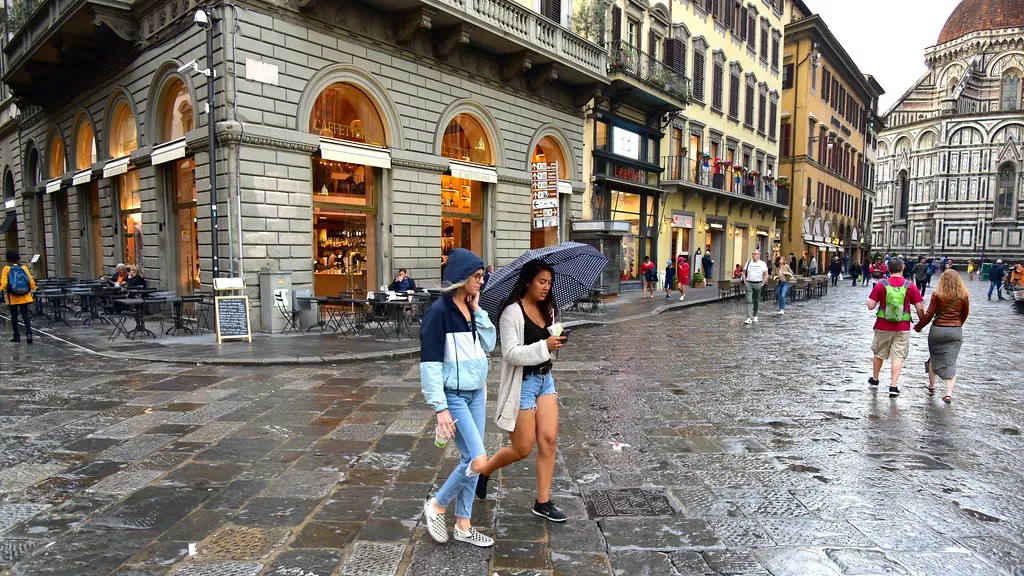
The works are printed on water-resistant paper and pasted at eye level on utility boxes, building corners, and doorways throughout the historic center. You will find them near the Duomo, along Via dei Tornabuoni, and concentrated heavily in the Oltrarno. Because they are wheatpaste, individual pieces rotate as weather and the city's cleaning crews take their toll — but there are always new ones appearing.
Spotting the scuba-masked Mona Lisa near the Duomo is a local rite of passage. If you cannot find a specific piece, check Instagram using the hashtag #blubflorence — the community there updates locations weekly.
Exit/Enter: Poetic Stick Figures
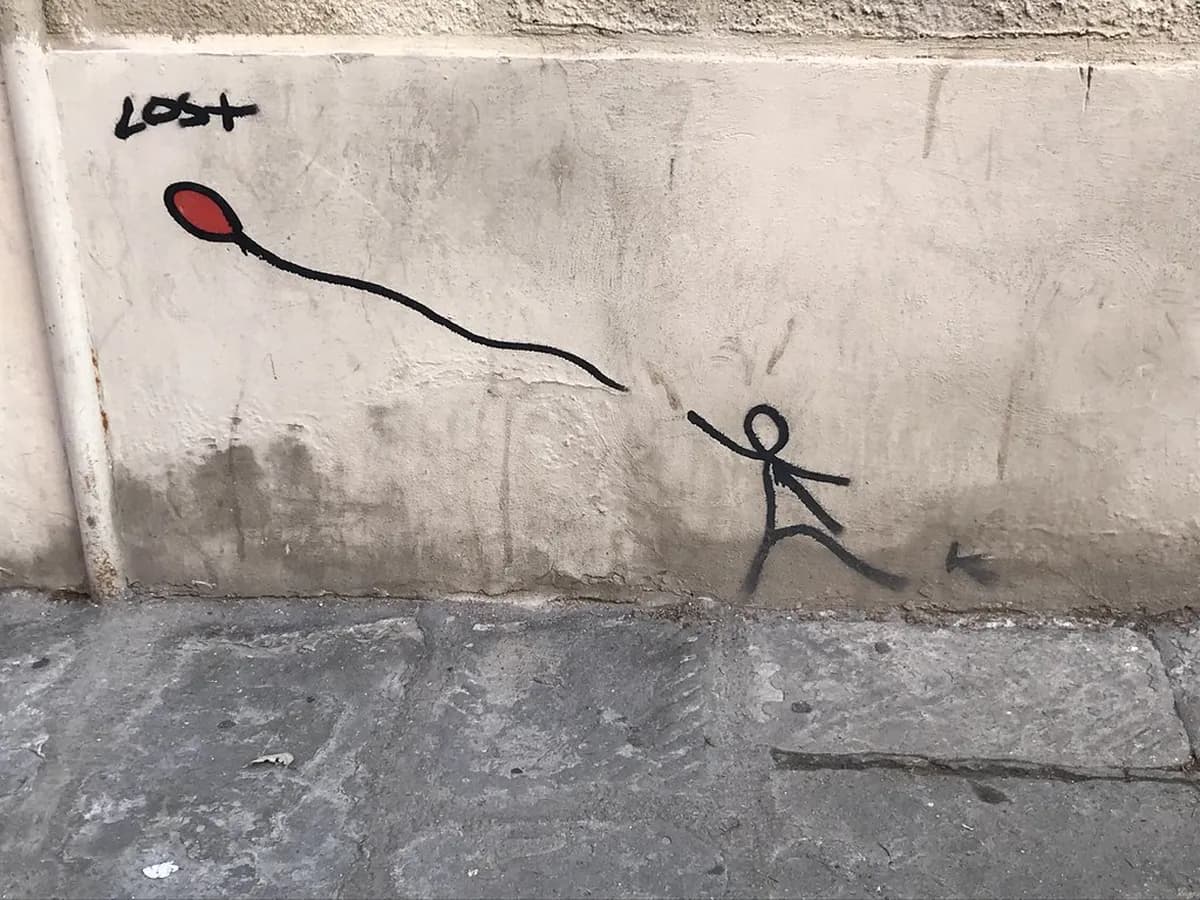
Exit/Enter — sometimes signed simply as "K" — creates minimalist stick figures that interact with the urban landscape in quiet, meditative ways. A figure floats upward clutching a red balloon. A tiny human leans against a giant crack in a wall. Two figures hold a red heart between them on a crumbling surface. The drawings are spray-painted directly onto weathered stone and plaster, usually just 20–30 cm tall.
The simplicity is the point. Exit/Enter chooses ruined, forgotten walls — the kind that no preservation law bothers to protect — and brings them back to life with the minimum possible mark. You will find the highest concentration in the Oltrarno, particularly along the quieter streets of San Frediano between Piazza del Carmine and Borgo San Frediano.
Because the works are so small and unobtrusive, they reward slow walking over frantic sightseeing. Build time into your Oltrarno walk to double back through the same alleys from different directions — you will spot works you missed the first time on almost every return pass.
Jorit and Bosoletti: Monumental Murals
If stickers and wheatpastes feel too subtle, Florence also has a handful of large-scale commissioned murals worth the extra journey. Naples-born Jorit painted a hyper-realistic portrait of Nelson Mandela on a social housing building in Piazza Leopoldo, in the northern outskirts of the city. The red tribal stripes across Mandela's face are Jorit's signature — he uses them on every portrait to signal shared humanity. The mural is free and accessible around the clock.
Jorit returned to paint a second major work celebrating Antonio Gramsci on Via Canova 25/22, marking the 130th anniversary of the philosopher's birth. The composition uses the same bold realism and is best viewed from the opposite side of the street. Both Jorit works require about 20 minutes by bus from the city center but are straightforward on the number 14 or 20 lines from Stazione di Santa Maria Novella.
Francisco Bosoletti painted six large-scale murals in the Galluzzo neighborhood — a homage to Dante titled "Last Judgement" — at Via Corbinelli in a social housing compound. Bosoletti's negative-image technique is most striking when viewed through a phone camera set to invert colors, which reveals hidden depth in the portrait details. These three artists together define the monumental side of Florentine street art, all free and permanently installed as of 2026.
| Artist | Style | Main Area | Entry Cost |
|---|---|---|---|
| Clet Abraham | Vinyl stickers on road signs | San Niccolò, Via dei Bardi | Free |
| Blub | Wheatpaste Renaissance figures in diving masks | Oltrarno, Duomo area | Free |
| Exit/Enter | Spray-painted stick figures on weathered walls | San Frediano, Oltrarno | Free |
| Jorit | Hyper-realistic commissioned portraits | Piazza Leopoldo, Via Canova | Free |
| Francisco Bosoletti | Large-scale negative-image murals | Galluzzo neighborhood | Free |
| Sottopasso delle Cure | Legal graffiti wall (rotating artists) | Via Don Minzoni tunnel | Free |
Sottopasso delle Cure: Florence's Urban Art Gallery
The Sottopasso delle Cure is the city's only legal zone for graffiti and large-scale spray-paint murals. This pedestrian tunnel connects Via Don Minzoni with Piazza delle Cure via an underground passage that is completely covered floor-to-ceiling with rotating works. Visiting this spot is one of the best free things to do in Florence for anyone serious about urban art.
Artists from across Italy travel here specifically to paint the walls, so the gallery never looks the same twice. A famous mural by Hopnn Yuri on political and ecological themes anchors the space, but the surrounding work changes constantly. Local community groups use the tunnel for workshops that teach younger residents about responsible urban art — the initiative has measurably reduced tagging on nearby historic monuments.
The tunnel is busiest and most atmospheric on weekend afternoons when artists are actively working. During the week it is quieter and better for photography. The atmosphere is generally welcoming; as with any pedestrian underpass, daytime visits are more comfortable than late-night ones. Getting here takes about 15 minutes on foot from Piazza della Libertà, or a short bus ride on line 6 from the center.
Blub's wheatpaste works rotate frequently — individual pieces can disappear within weeks due to weather or cleaning. Check #blubflorence on Instagram for up-to-date locations before your walk.
Beyond the Murals: Agata Anna Chrzanowska and Historic Cemeteries
Agata Anna Chrzanowska reinterprets classical female portraits using bold street art aesthetics — gold leaf, strong line work, and a sense of authority that the original Renaissance portraits often denied their subjects. Her works appear primarily in the Oltrarno and are among the most distinctive pieces in the city precisely because they operate in the same visual language as the masterpieces inside the nearby galleries. You can find more details on her latest project locations through the BLocal Travel Guide.
Combining the street art walk with a visit to the Cimitero delle Porte Sante reveals a deeper thread running through Florentine visual culture. This monumental cemetery opened in 1848 next to the Church of San Miniato al Monte, and its neo-Gothic chapels and elaborately carved graves reflect the same obsession with permanent mark-making that drives street artists today. Carlo Collodi (author of Pinocchio) is buried here. The view from the hilltop over the city is exceptional. Entry is free.
The smaller Cimitero degli Inglesi in the middle of Piazzale Donatello — marooned on an island in a traffic roundabout — offers a stranger, quieter experience. Both cemeteries repay the visit even if you have no particular interest in graves; they read as outdoor sculpture parks and connect naturally to the themes that Chrzanowska and Jorit explore in their public work.
Michelangelo Carved the First Street Art in Florence
No competitor guide mentions this, but the oldest piece of informal public mark-making in Florence predates spray paint by about 500 years. On the wall of Palazzo Vecchio, facing the inner courtyard near the old entrance, there is a simple profile of a man's face carved directly into the stone. According to Florentine tradition, Michelangelo carved it with his back turned and his hand reversed as a bet — a demonstration of pure muscle memory from someone who had spent years working with chisel and stone.
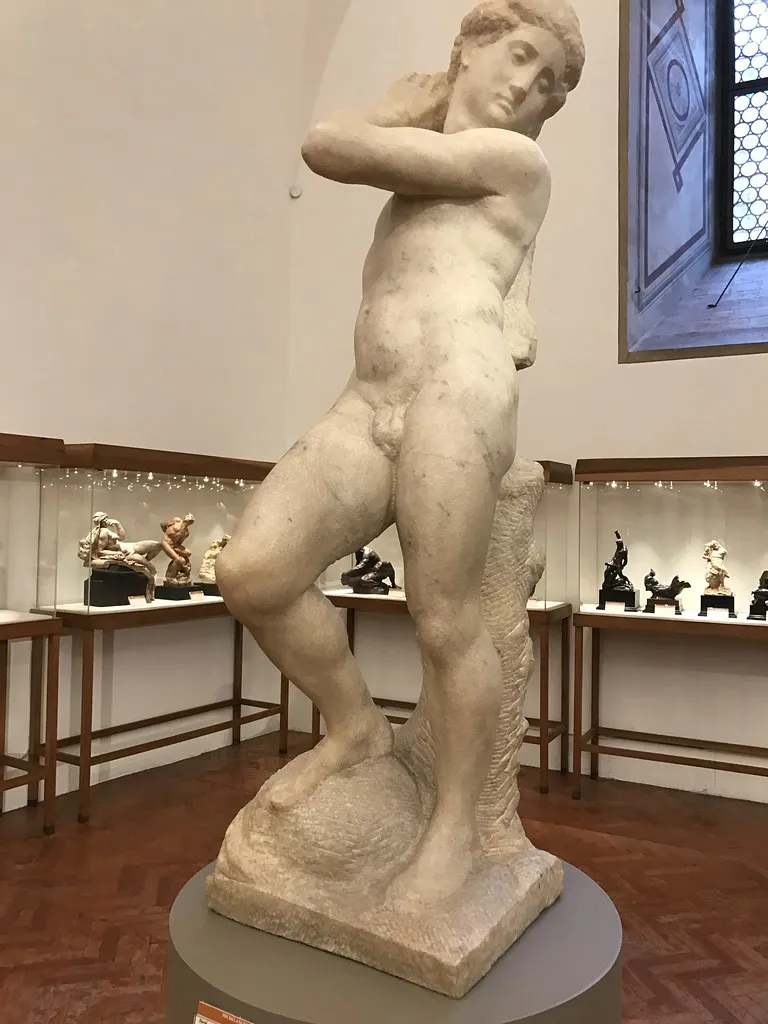
Whether the story is fully true is contested, but the carving is real and visible to anyone who looks. It sits at roughly shoulder height on the rusticated stone and is easy to miss against the texture of the wall. Most visitors walk straight past it on their way into the courtyard. Finding it turns a standard stop at the Palazzo Vecchio into a small act of discovery — which is exactly the mindset you need for the rest of the street art walk.
This is worth mentioning to companions before the walk because it reframes the entire day: the impulse to leave a mark on a public wall in Florence is not a modern transgression but a five-century tradition. Clet, Blub, and Exit/Enter are, in that sense, working in a very long lineage.
Where to Eat Near the Street Art Hubs
The Sant'Ambrogio market, in the neighborhood east of the Duomo, is the most useful food stop for a morning walk. The market square around the church is where locals eat lampredotto — calf stomach simmered in broth and spiced with salsa verde — from standing street food carts for around €4 to €5. It is significantly cheaper and more authentic than anything in the tourist center, and the neighborhood around Piazza Sant'Ambrogio has a cluster of Blub works on utility boxes within a two-minute walk.
In the Oltrarno, All'Antico Vinaio at Via dei Neri 74r is the most famous sandwich stop in Florence and draws long queues by mid-morning. Arrive before 10:30 or after 14:30 to skip the worst of the wait. A schiacciata sandwich with finocchiona and stracchino runs around €6 to €8. The queue itself is a useful social observation: it is a rare place in central Florence where tourists and locals actually share the same line for the same reason.
L'Appartamento, a café near the Oltrarno that doubles as a music venue, is worth knowing because its main room contains a large mural by Hopnn Yuri — the same artist whose work anchors the Sottopasso delle Cure. You can, in other words, end your street art walk with a coffee inside a mural, which has a satisfying circularity to it.
Practical Tips for a Florence Street Art Tour
The most efficient route starts at Clet Studio at 8r Via dell'Olmo in San Niccolò, then works north through the Oltrarno toward Piazza della Passera and Borgo San Frediano. This covers Clet signs, Exit/Enter figures, and Blub works within a roughly two-hour walk without backtracking. Most of the art is free and visible from the street at all hours.
Wear comfortable shoes — the cobblestones in the Oltrarno district are uneven and the best pieces often require ducking into unpaved side streets. Bring a fully charged phone for photos and for checking updated location maps. A free digital street art map of Florence is available through BLocal's website and is worth downloading before you go.
The art changes constantly. Wheatpastes deteriorate within weeks in wet weather and the city removes pieces from high-visibility areas quickly. If a specific work is missing, check Instagram for updated sightings before assuming it has been removed permanently — it may simply have moved to a new wall nearby. Most of the scene is best photographed in the 07:00 to 09:00 window before the light goes flat and the foot traffic increases.
For those searching for things to do in Florence for young adults, the street art walk is a top recommendation. It costs nothing, covers terrain the standard tour buses ignore, and consistently produces the most memorable photos of any Florence visit.
Frequently Asked Questions
Where is the best street art in Florence?
The best street art is located in the Oltrarno district, specifically the San Niccolò and San Frediano neighborhoods. You will find a high concentration of works by Clet and Blub in these areas. The Sottopasso delle Cure is also a major hub for larger murals.
Who is the artist who does the street signs in Florence?
Clet Abraham is the artist responsible for the modified street signs found throughout Florence. He uses removable vinyl stickers to create humorous scenes on standard traffic signs. His studio is located in the San Niccolò area and is open to the public.
Is the Sottopasso delle Cure safe to visit?
Yes, the Sottopasso delle Cure is generally safe for visitors during daylight hours. It is a well-used pedestrian tunnel that connects residential areas to the city center. Like any urban area, it is best to remain aware of your surroundings when visiting alone.
Florence street art offers a refreshing way to experience one of the world's most famous cities. By looking beyond the marble statues, you discover a community of artists who are keeping the city's creative spirit alive. Whether you are a solo traveler or looking for things to do in Florence for young adults, this urban gallery is essential.
The mix of humor, politics, and classical beauty makes the Florentine scene truly unique in Europe. The walk from Clet Studio through the Oltrarno, with a coffee inside a Hopnn Yuri mural at the end, is one of the best half-days Florence has to offer. Safe travels as you explore the ever-changing walls of the cradle of the Renaissance.
Continue exploring
More guides you'll find useful