10 Best Free Things to Do in Florence: A Budget Guide (2026)
Discover the best free things to do in Florence, from the Duomo to hidden gardens. Save money with our local tips on free museum days and scenic viewpoints.
On this page
10 Best Free Things to Do in Florence
During my last three trips to Florence, I discovered that the most profound moments happen outside the museums. Walking through the city feels like browsing a massive, open-air gallery where every corner reveals a Renaissance masterpiece. You do not need a massive budget to experience the soul of this historic Tuscan capital.
Last refreshed May 2026, this guide reflects the most current hours and access rules for budget travelers. I have personally vetted these locations to ensure they remain accessible without a ticket in 2026. Florence remains a top destination for those who know how to navigate its hidden corners and public squares.
Finding the best hidden gems in Florence is the key to a successful low-cost itinerary. By mixing iconic landmarks with quiet local haunts, you can see the city's highlights without spending a single Euro. This guide provides the practical details you need to plan your perfect cost-free adventure.
Piazza Del Duomo
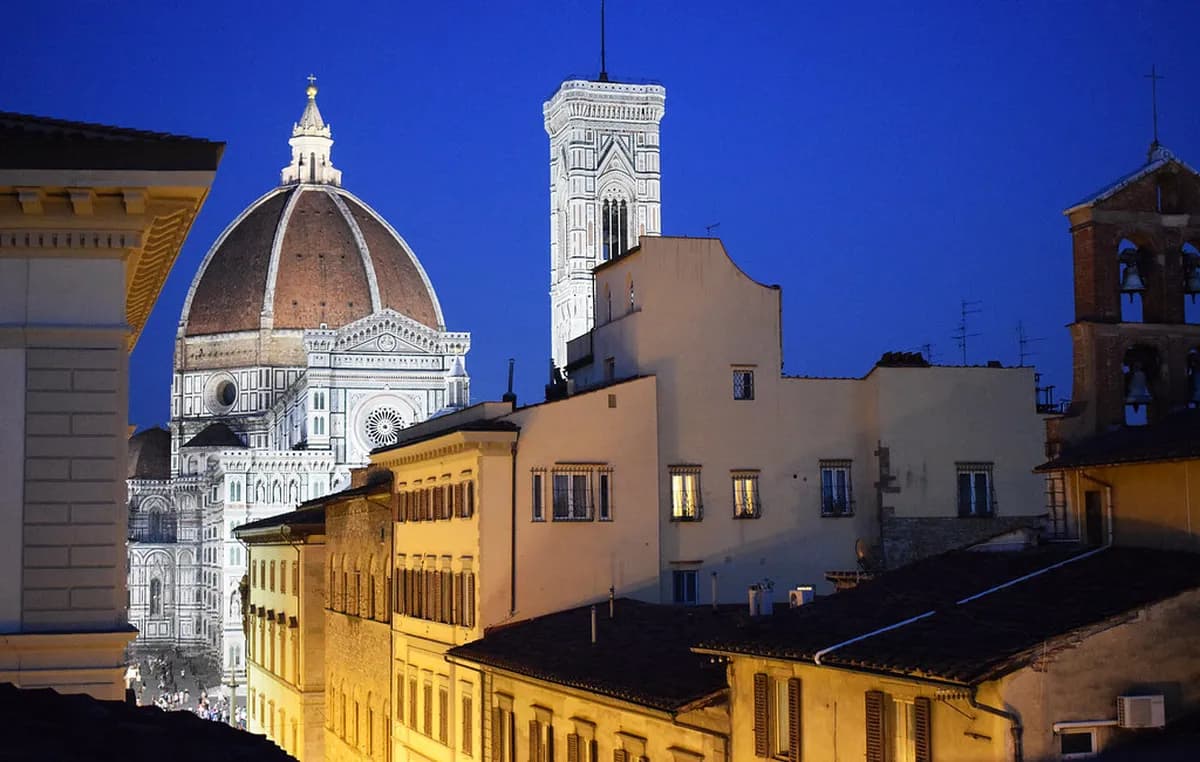
Piazza del Duomo is the most dramatic public space in Florence and requires no ticket to stand in and absorb. The square is ringed by the Cathedral, the Baptistery, and Giotto's Campanile — three of the greatest buildings of the medieval world, all visible from the same cobblestone square. Simply walking through it at different times of day reveals a completely different city: chaotic and tourist-dense at midday, atmospheric and hushed just after 19:00 when the crowds thin.
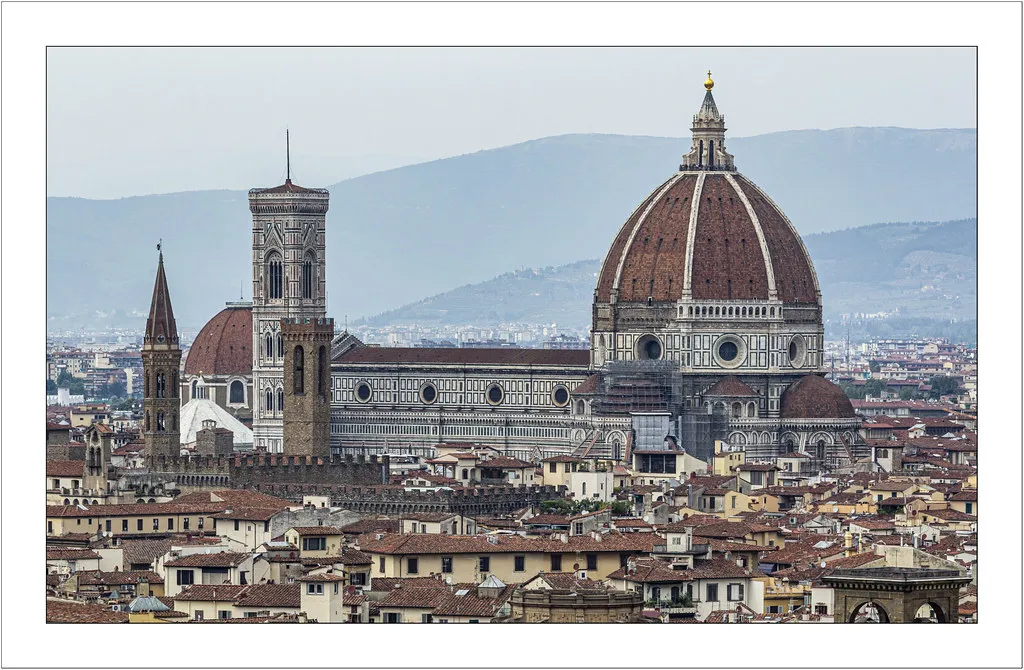
The Cathedral of Florence — the Duomo — is free to enter on the main floor, open daily from 10:15 until 15:45. Dress code is enforced: covered shoulders and knees are required. Security queues are longest between 11:00 and 14:00; arriving around 16:00 typically cuts the wait to under 15 minutes. Once inside, walk to the front near the altar and look directly up at the frescoes of the Last Judgement painted by Giorgio Vasari across the inside of Brunelleschi's dome. The scale only becomes clear when you stand beneath it.
Before you leave the square, examine the eastern doors of the Baptistery — the ones Michelangelo called the Gates of Paradise. Lorenzo Ghiberti spent 27 years casting these gilded bronze panels, and you can study every scene in detail from the pavement without paying a cent. One practical note: the dome climb, the bell tower ascent, and the Baptistery interior all require the combined Duomo pass (currently around 30 EUR in 2026). The cathedral floor, the piazza itself, and the exterior of all three buildings are free.
Piazza della Signoria and Loggia dei Lanzi
Piazza della Signoria is Florence's civic heart and its greatest open-air sculpture gallery. At its centre stands the original site of Michelangelo's David (now replaced by a replica — the original is in the Accademia). Around it you will find the Fountain of Neptune by Ammannati, an equestrian statue of Cosimo I, and the brooding bulk of Palazzo Vecchio, all free to observe from the square. The Palazzo's inner courtyard, decorated with frescoes and a Verrocchio bronze, is also accessible without a ticket during opening hours — just walk past the ticket desk.
The Loggia dei Lanzi, positioned at the southeastern corner of the square, is the single best free art experience in the city. This 14th-century vaulted arcade shelters a permanent collection of authentic Renaissance and Roman masterpieces under open arches, accessible 24 hours a day. Benvenuto Cellini's Perseus with the Head of Medusa stands here — a bronze of extraordinary technical ambition that would cost you museum entry anywhere else in Europe. Giambologna's Rape of the Sabine Women and a set of ancient Roman female figures complete the collection. Visit early in the morning before tour groups arrive to photograph the statues in clean light.
The square itself is best experienced in the early evening. Arrive after 19:00 when the guided-tour crowds have dispersed and the locals claim the stone benches. The Palazzo Vecchio is illuminated after dark, and the replica David catches the floodlights in a way that makes the marble look almost warm. This is also when street musicians set up near the Neptune fountain, which is a genuinely good reason to linger.
The Loggia dei Lanzi is open 24 hours and free — Cellini's Perseus and Giambologna's Rape of the Sabine Women are best photographed before 09:00 in clean morning light with no tour groups in frame.
Ponte Vecchio
Ponte Vecchio is Florence's oldest bridge and one of the most distinctive medieval structures in Europe. Built in 1345 and uniquely lined with workshops on both sides — today occupied by gold and jewellery merchants — it has spanned the Arno continuously since the 14th century. It is the only bridge in the city that the retreating German army did not destroy in 1944, reportedly spared on Hitler's personal order. Walking across it costs nothing.
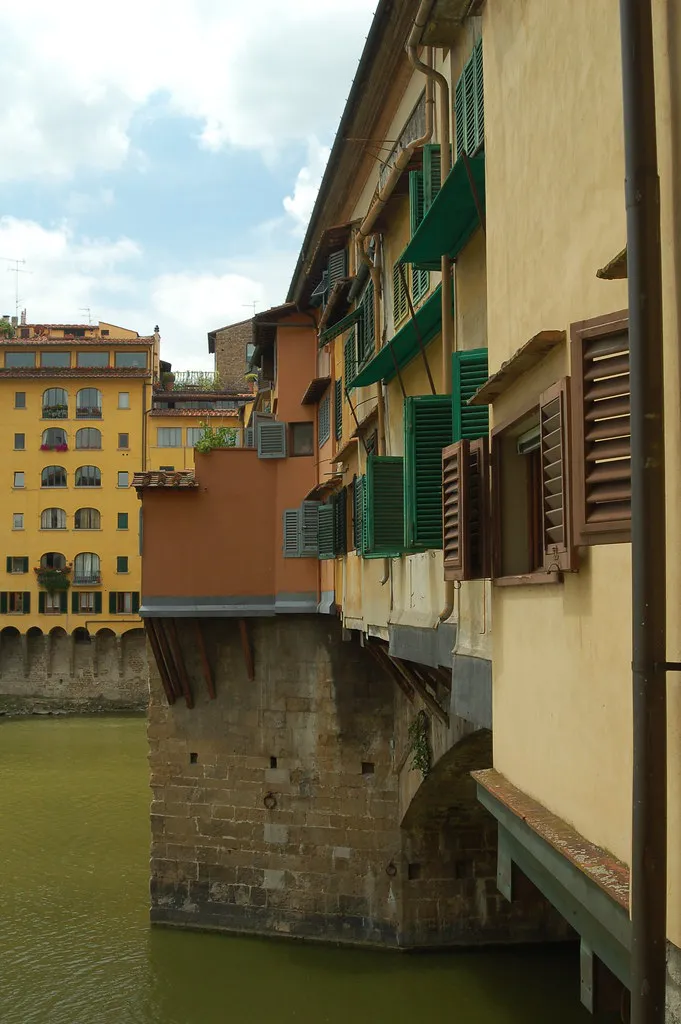
The best way to experience Ponte Vecchio is actually from the riverbanks rather than on it. Stand on either bank of the Arno to see the overhanging buildings cantilevered over the water — the structure only makes visual sense from a distance. The Vasari Corridor runs above the bridge connecting the Uffizi to Pitti Palace; you can spot the windows of this elevated passageway from the walkway below. At sunrise and sunset, the bridge and its reflection in the Arno produce the photograph that defines the city.
Crossing the Oltrarno neighborhood via Ponte Vecchio is itself a free itinerary. The streets immediately south of the bridge — Via dei Bardi and Borgo San Jacopo — are lined with artisan workshops where you can watch leather workers, jewellers, and restorers at work through open workshop doors. None of this costs anything, and it provides a cleaner window into the craft traditions Florence is actually famous for than any market stall.
Piazzale Michelangelo and the Rose Garden
Piazzale Michelangelo delivers the panoramic view that appears on every postcard of Florence: the Arno curving through the city, the Duomo's terracotta dome rising at centre, and the Tuscan hills stretching north. The terrace is always open and always free. Walk up from the San Niccolo district via the stone staircase to avoid the tourist mini-trains that serve the square. The climb takes around 15 minutes and passes through a shaded lane that most visitors miss entirely.
Sunset is the obvious draw, and the terrace fills up around 30 to 45 minutes before dusk. For a quieter version of the same view, descend slightly to the Giardino delle Rose, which sits on the terrace just below the main piazza. The garden is open daily from 09:00 until sunset and holds over 350 varieties of roses across its terraced beds. May and June are the peak weeks for blooms. Scattered throughout the paths are bronze sculptures by Belgian artist Jean-Michel Folon — whimsical, human-scale figures that make the garden feel inhabited rather than merely decorative.
Immediately above Piazzale Michelangelo is San Miniato al Monte, a Romanesque basilica built in the 11th century that is often described as the finest Romanesque church in Tuscany. It is free to enter. The monks of San Miniato still sing Gregorian vespers at 17:30 on weekdays (check seasonally, as times shift). Sitting in the nave while the chant fills the stone interior is one of the few genuinely transcendent free experiences available in any major European city. The cemetery behind the basilica contains the tombs of Carlo Lorenzini (Collodi, author of Pinocchio), cookbook pioneer Pellegrino Artusi, and designer Enrico Coveri — all mapped on a board at the cemetery entrance.
Free Parks and Markets
Le Cascine is Florence's largest public park, running for three kilometres along the north bank of the Arno. It is free to enter daily and is where Florentines actually spend their weekends — jogging, cycling the riverside paths, and taking children to the small zoo. Every Tuesday morning from 07:00 until around 13:00, the park hosts the largest open-air market in the city, stretching hundreds of stalls along the main boulevard. Fresh produce, cheeses, clothing, and household goods are all here. You do not need to buy anything; walking through it is a free immersion in how the city actually functions outside the tourist centre.
Mercato Centrale, housed in a 19th-century iron-and-glass building near San Lorenzo, is free to enter and browse. The ground floor food vendors — selling truffle products, aged cheeses, cured meats, and fresh pasta — operate from 08:00 until 14:00. The upper floor food hall is open until midnight and turns into a lively social space in the evenings. Walking through both floors costs nothing and provides a reliable sense of what Tuscan ingredients actually look and smell like at market quality. The atmosphere alone is worth the detour.
The Piazza Santo Spirito market in the Oltrarno runs every morning except Sunday. On the second Sunday of the month it expands to a flea market; on the third Sunday it hosts an organic food market with local honey, seasonal vegetables, and artisan goods. The square itself — presided over by Brunelleschi's Santo Spirito basilica — is one of the most authentically Florentine public spaces in the city and feels notably less staged than the main tourist squares north of the river.
The Oblate Library Terrace
The Biblioteca delle Oblate sits directly behind the Duomo on Via dell'Oriuolo and is one of the most underused free viewpoints in the city. Take the stairs to the top floor, walk through the reading rooms to the open terrace, and you will find yourself looking at Brunelleschi's dome from almost exactly the same height and less than 100 metres away. No rooftop bar charges this. No hotel charges this. It is a public library and it is free.
The library is open Monday from 14:00 to 19:30, Tuesday through Friday from 08:30 to 19:30, and Saturday from 08:30 to 13:30. It is closed Sundays. The cafeteria on the same floor serves espresso and light meals at local prices — a practical contrast to the tourist-rate cafes ringing the Piazza del Duomo fifty steps away. The terrace is popular with students and largely unknown to first-time visitors, which means it is almost always uncrowded even when the square below is packed.
This is also where you understand, in practical terms, the engineering achievement of the dome. From street level it is imposing but abstract. From the Oblate terrace at eye level, the scale of Brunelleschi's double-shell construction — the fact that no external scaffolding was used during its building in the 15th century — becomes viscerally clear. It is one of those small, free moments that repays the effort of finding it.
First Sundays of the Month - #DomenicalMuseo
The Italian government sponsors a program that offers free entry to state museums on the first Sunday of the month. In Florence, this includes the Uffizi Gallery, the Accademia (home to the original David), the Bargello, the Medici Chapels, and Pitti Palace with the Boboli Gardens. These are collectively among the most expensive museum entries in Italy, so the savings on a single visit can exceed 60 EUR per person.
Lines for the Uffizi can stretch for several hours during these free days. Arrive at least 60 to 90 minutes before the doors open at 08:15. Pick one major museum to focus on rather than trying to visit several in one day — the Uffizi alone warrants three to four hours if you intend to do more than walk through it. The Bargello and the Medici Chapels attract significantly smaller queues and are worth considering if you want a more relaxed experience with equally important art.
Between October and March, the program applies consistently on the first Sunday. Between April and September, the ministry has historically introduced variations — sometimes limiting free entry to mornings only, or excluding certain venues. Always verify the current rules on the official Ministry of Culture website before planning your visit around this day. Smaller state sites like the Museo Nazionale del Bargello are often less crowded and equally rewarding as an alternative.
The first-Sunday free museum rules change between seasons. Between April and September the ministry sometimes limits free entry to mornings only or excludes certain venues — always check the Ministry of Culture website before building your visit around this day.
What to Skip and What to Watch For
Many visitors fall for the "Skip the Line" vendors who approach travelers near the major museums. These tickets are often significantly marked up and rarely offer the time savings they promise. It is much better to book directly through official museum websites if you decide to pay for entry on non-free Sundays.
The Medici Villa at Pratolino — long listed in free Florence guides, including older versions of this one — is no longer free as of the end of 2025. The UNESCO-listed park north of the city still contains the remarkable Colossus of the Apennines statue by Giambologna, one of the most surreal monumental sculptures in Tuscany. But entry now carries a charge, and traveling 30 minutes north on ATAF bus 25 from Piazza San Marco only makes sense if you verify the current ticket price and confirm weekend opening times via the Pratolino Park page before you go.
Overpriced cafes directly on Piazza del Duomo or Piazza della Signoria should generally be avoided. A simple espresso can cost five times more if you sit down at a table in these areas. Walk two blocks into a side street to find a bar where locals stand for their coffee at standard prices. The leather market stalls near San Lorenzo are free to walk through, but do not feel pressured to buy. Authentic Florentine leather is better found in the small workshops of the Santa Croce and San Frediano districts where craftspeople still work on-site.
Is Florence Expensive to Visit?
Florence can be as expensive or as affordable as you choose to make it. A budget traveler can expect to spend around 50 to 70 EUR per day excluding accommodation. This covers affordable street food, local transport, and a few small incidental costs. The city's public drinking fountains — the Nasone spouts found throughout the historic centre — supply cold, safe tap water at no cost, saving several EUR daily if you carry a refillable bottle.
Understanding the Florence neighborhoods helps you find the most affordable areas for dining. Crossing the river into the Oltrarno consistently leads to lower prices and more authentic local experiences. Check out our guide on where locals eat to save meaningfully on your food budget without eating worse.
The city's best free experiences — the Loggia dei Lanzi, Piazzale Michelangelo, the Duomo floor, the Oblate terrace, Ponte Vecchio at sunrise — require nothing except time and comfortable shoes. Florence is one of the few cities in Europe where a day spent entirely on free activities does not feel like a compromise. It feels like the point.
| Free Attraction | Cost | Best Time to Visit | Notes |
|---|---|---|---|
| Duomo (main floor) | Free | Around 16:00 | Covered shoulders/knees required |
| Loggia dei Lanzi | Free (24 hrs) | Before 09:00 | Cellini, Giambologna originals |
| Ponte Vecchio | Free | Sunrise / sunset | Best viewed from the riverbanks |
| Piazzale Michelangelo | Free | 40 min before sunset | Climb via stone staircase from San Niccolò |
| Rose Garden (Giardino delle Rose) | Free | May–June bloom season | Daily 09:00 to sunset |
| Oblate Library Terrace | Free | Weekday mornings | Closed Sundays; eye-level Duomo view |
| State Museums (1st Sunday) | Free | Arrive 60–90 min early | Verify rules Apr–Sep on Ministry site |
Frequently Asked Questions
Which free things to do in Florence fit first-time visitors?
First-time visitors should prioritize Piazza del Duomo and Piazzale Michelangelo. These iconic spots offer the most famous views and architecture without an entry fee. They provide a perfect introduction to the city's history.
What should travelers avoid when planning free activities?
Avoid visiting the Cathedral during the middle of the day when tour groups are largest. Skip the unofficial ticket resellers found on the streets near major landmarks. Stick to official sites and public squares for the best experience.
Is the Cathedral of Santa Maria del Fiore always free?
The main floor of the Cathedral is free to enter for everyone. However, climbing the Dome or the Bell Tower requires a paid ticket. Always check for special religious closures before your visit.
Florence is a city that rewards those who take the time to explore its public spaces and hidden corners. By focusing on these free attractions, you can experience the best of the Renaissance without financial stress. The beauty of Tuscany is accessible to everyone if you know where to look.
Whether you are watching the sunset from a hilltop or admiring statues in a public square, the city inspires. Pack your walking shoes and a sense of wonder for your next budget-friendly Italian adventure.
Continue exploring
More guides you'll find useful