12 Best Things to Do in Florence Off the Beaten Path (2026)
Explore Florence off the beaten path with our 2026 guide to 12 hidden gems, quiet gardens, and local markets away from the crowds.
On this page
12 Best Things to Do in Florence Off the Beaten Path
After my fifth visit to the Tuscan capital, I realized that the real magic hides in plain sight. The city offers so much more than the crowded corridors of the Uffizi Gallery. I found that stepping just two blocks away from the main piazzas reveals a completely different atmosphere. This guide explores the quieter side of the city for those seeking a deeper connection.
I last refreshed this guide in April 2026 to ensure all pricing and hours are accurate. Many of these spots require less planning than the major landmarks but offer equal beauty. Exploring these sites allows you to avoid the overwhelming tour groups that dominate the center. You will discover a version of the city that feels lived-in rather than just visited.
Must-See Florence Hidden Gems
Finding hidden gems in Florence is easier than most travelers think. The selections below are divided by theme and neighborhood: hidden chapels, overlooked museums, local markets, peaceful gardens, and the artisan streets of the Oltrarno. Each category offers a distinct way into the city that the standard itinerary skips entirely.
For first-timers, the most accessible starting points are the Bardini Garden and the Sant'Ambrogio Market. Both are within walking distance of the historic center and require no advance booking. They deliver spectacular payoffs — panoramic skyline views and authentic local food — without competing with the major queues. From there, you can deepen your exploration one neighborhood at a time.
Budget travelers will also find these spots far easier on the wallet. Many of Florence's hidden churches and gardens carry lower entry fees or are completely free. You can encounter world-class art without spending large sums on a single museum pass. That leaves more money for a slow dinner in the Oltrarno or a leather souvenir from an actual artisan.
Hidden Chapels and Fresco Masterpieces
Some of Florence's most powerful artwork lives inside small chapels that most visitors walk straight past. These are intimate rooms where Renaissance politics, personal ambition, and religious devotion quietly intersect. Standing inside them feels nothing like a museum visit — you are standing where the Medici stood, looking at frescoes that changed how artists everywhere learned to paint.
The Brancacci Chapel inside Santa Maria del Carmine is the essential starting point. Painted in the 1420s, the fresco cycle by Masaccio is considered the Sistine Chapel of the early Renaissance. Only 30 visitors are allowed inside at once, which keeps the atmosphere genuinely calm. Book a time slot online through the official Brancacci Chapel website — third-party platforms charge a premium for the same ticket.
The Magi Chapel at Palazzo Medici Riccardi is another jewel-like room most travelers miss. Painted by Benozzo Gozzoli in 1459, the frescoes depict the Three Magi's journey but are really a celebration of Medici power — family members including a young Lorenzo il Magnifico appear among the biblical figures. The room is small enough that you stand close enough to the gold-leaf detail to appreciate individual brushstrokes. Book ahead online to guarantee entry, especially in peak season.
The Brancacci Chapel admits only 30 visitors at a time. Book your timed entry online through the official website — third-party platforms charge extra for the identical ticket.
The San Marco Museum rewards a different kind of attention. Each monk's cell upstairs contains a fresco by Fra Angelico, painted not for public display but for private contemplation. The colors are soft and the gestures restrained. At the top of the staircase, Fra Angelico's Annunciation remains one of Florence's most serene masterpieces — you share it with far fewer visitors than the Uffizi's famous version of the same subject.
The Cloister Most Visitors Never Find: Chiostro dello Scalzo
At Via Cavour 69, a few minutes' walk from the San Marco Museum, sits one of Florence's most overlooked interiors. Between 1509 and 1526, Andrea del Sarto painted almost the entire fresco cycle inside this small cloister by himself — sixteen scenes depicting the life of St. John the Baptist, all executed in grisaille (shades of grey designed to simulate stone relief). Vasari called del Sarto "the faultless painter," and this is the work that explains why.
Grisaille was typically reserved for decorative borders and minor architectural details. Del Sarto used it for an entire narrative cycle spanning nearly two decades, and the restraint of the technique only intensifies the emotional power of each scene. The Dance of Salome and the Beheading of the Baptist are particularly striking — intimate, almost uncomfortably human. Two panels were completed by his contemporary Franciabigio while del Sarto was working in France for Francis I.
Entry costs €5. The cloister is open Monday through Saturday from 08:30 to 13:20, though hours can shift seasonally — confirm on the official Chiostro dello Scalzo website before visiting. Because this space is not on any standard tour itinerary, you will almost certainly have it entirely to yourself. That kind of solitude inside a Renaissance fresco cycle is exceptionally rare in Florence in 2026.
Museums, Art, and Culture in Florence
The Bargello sits steps from the main tourist corridors and yet remains significantly less crowded than the Uffizi or the Accademia. This former medieval prison now houses some of the most revolutionary sculptures in art history — Donatello's David, the first free-standing nude since antiquity, sits here alongside breathtaking terracotta works by the della Robbia family. When the rooms begin to feel overwhelming, step into the sun-drenched courtyard, which is open to the sky and entirely at odds with the building's history.
The Palazzo Davanzati is a 14th-century merchant home frozen in time. Walking through its rooms reveals a household that was wealthy, cultured, and inventive: lavishly frescoed bedchambers painted with peacocks and parrots, a dining room arranged for a Renaissance feast, and a kitchen deliberately placed at the top of the building to keep fire and cooking smells away from the family's living quarters. It costs around €7 to enter and closes early on Sunday afternoons. Check the official Palazzo Davanzati website for the current guided tour schedule for the upper floors — those rooms are not self-guided.
The Museo Galileo sits directly next to the Uffizi but sees a fraction of the footfall. It houses the telescopes Galileo himself used, alongside Medici-owned astrolabes, globes, and surgical instruments. Entry costs €14 per adult. It is open daily from 09:30 to 18:00 and represents some of the best value per hour of any museum in the city — intellectually rich, air-conditioned, and rarely crowded.
La Specola, founded in 1775 and housed in the Palazzo Torrigiani, is Europe's oldest scientific museum and among the strangest. Its 18th-century anatomical wax models — muscles and tissue rendered with sculptural precision, expressions left eerily serene — occupy an uncomfortable space between art and medicine that feels entirely Florentine. A taxidermied hippopotamus that once lived as a Medici pet in the Boboli Gardens stands nearby. The contrast with the Renaissance chapels a few streets over is jarring and worth it.
Beyond the Renaissance: Science and Eccentricity
Florence's story did not end in 1500, though many history books suggest it did. The centuries following the Renaissance were filled with scientific inquiry, Enlightenment collecting, and global curiosity. Aristocratic families in the 17th and 18th centuries were obsessed with cataloguing the world — filling their palaces with exotic animals, scientific instruments, and fashion from distant continents. Exploring this layer of the city reveals a Florence that was always looking forward, not only backward at its own golden age.
The Stibbert Museum, located in a hillside villa about 30 minutes north of the center by bus line 4, is the most eccentric expression of this collecting impulse. Frederick Stibbert was an Anglo-Italian heir with vast resources and no apparent desire to edit himself. The result is a hall of sixteen fully-suited knights on horseback alongside Ottoman kaftans, samurai swords, Renaissance tapestries, and Meiji-era lacquerware. Entry costs around €10 per adult and the museum stays open until 18:00 most days. Even the commute out there shows you a residential side of Florence most tourists never see.
Modern Florence continues this tradition of reinterpretation through its culinary scene. For a high-end break, visit ATTO di Vito Mollica to see how contemporary chefs reinterpret local Tuscan flavors. This blend of old and new is what keeps the city vibrant and relevant. You can taste the history of the region while sitting inside a building that itself has centuries of stories layered into its walls.
Parks, Gardens, and Outdoor Spots in Florence
Florence is surprisingly green if you know where to climb. The most popular viewpoint is Piazzale Michelangelo, but the real reward is going a step further. The Rose Garden sits just below Piazzale Michelangelo on the climb up from the center — a blink-and-you'll-miss-it entrance that most visitors walk straight past. Entry is free, the views of the city are just as good as from the piazzale, and between April and June the whole garden blooms and smells extraordinary.
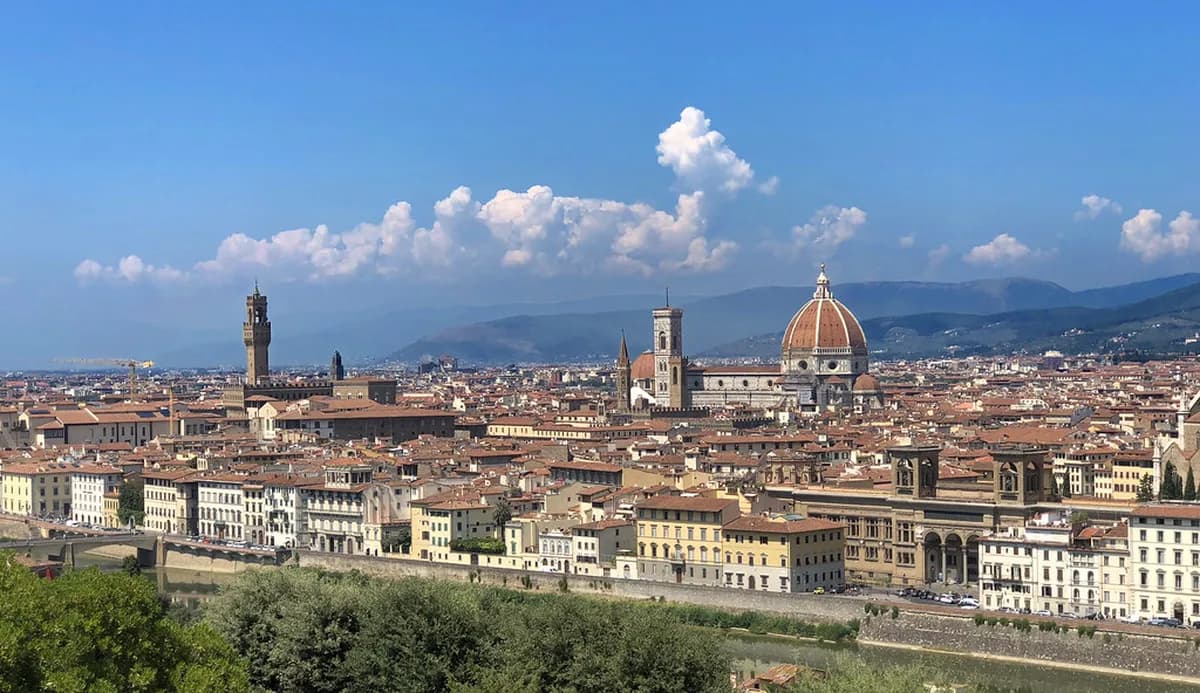
The Bardini Garden offers one of the most photographed perspectives of the Duomo — through purple wisteria tunnels in spring — but sees far fewer visitors than the neighboring Boboli Gardens. A combined ticket with Boboli costs around €12. Enter through the Via de' Bardi gate to avoid the steepest climb. If you visit in April during the wisteria bloom, arrive by 09:00 — that is the one exception when the garden does attract a crowd.
The San Miniato al Monte basilica sits above Piazzale Michelangelo at the highest point of the city. The Romanesque exterior dates to the 11th century, and the interior mosaics are among the finest in Tuscany. Entry is free. The monks conduct Gregorian chant services in the late afternoon — confirm the schedule on the basilica's official website before making the climb. Those who time it right come away with one of the most memorable sound experiences the city offers.
For a half-day escape entirely outside the city limits, the hilltop town of Fiesole offers cooler air, sweeping valley views, and Etruscan-era ruins. Bus 7 from the city center costs under €2 and takes about 25 minutes. The Roman theater ruins cost around €10 to enter. Pack a picnic to eat in the park behind the main cathedral square — there is no better view of the valley below Florence and no queue to reach it.
Hidden Gems in the Oltrarno District
The Oltrarno district is the most authentic part of the city center. Located across the river, it has long been the home of artisans and craftsmen. Walking through these narrow streets feels like stepping back into a quieter era. You will see woodcarvers and paper marblers working in their open-door studios — not as a performance for tourists, but because this is where they have always worked.
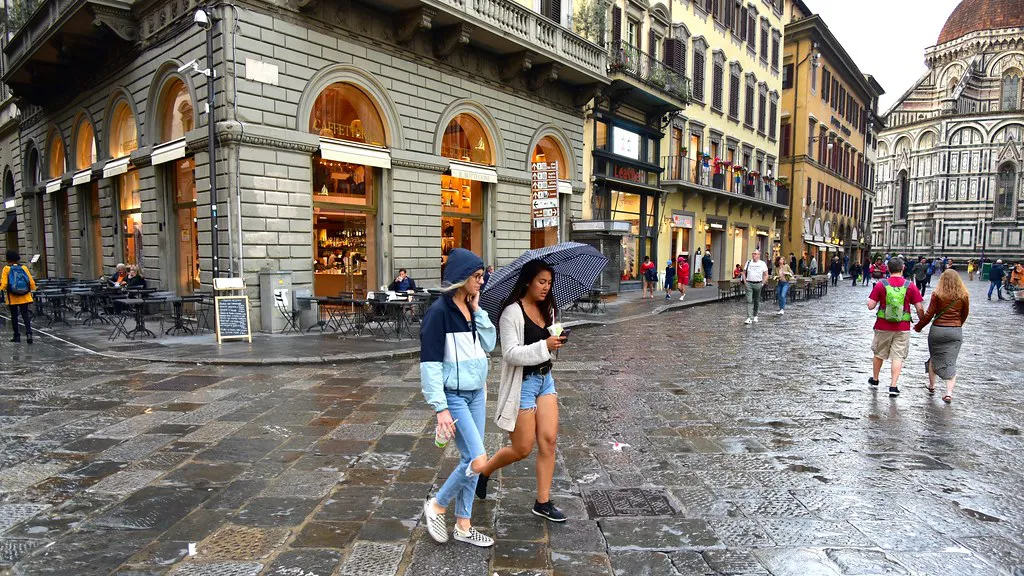
The neighborhood of San Frediano is particularly famous for its genuine local atmosphere. Despite growing recognition from international travel media, it still maintains an unpretentious energy at night. It is the right place to find a small wine bar or a family-run trattoria where the menu is handwritten and the staff has no patience for theatrics. Piazza della Passera, a few minutes' walk from the Pitti Palace, is a tiny square with outdoor tables and the kind of unhurried afternoon energy that Piazza della Repubblica has long since lost.
The Santo Spirito Basilica anchors the Oltrarno's social life. Brunelleschi designed the interior, and hidden inside is a wooden crucifix attributed to a young Michelangelo. The surrounding piazza hosts a Sunday morning antiques market. The church itself is free to enter, though some side chapels may ask for a small donation. This square is also the best spot to join the evening passeggiata — locals circling slowly, stopping to talk, watching the light change on the stone facades.
The wine windows (buchette del vino) in the Oltrarno are only active at a handful of locations. Ask at a local enoteca for the nearest working window — not all marked on tourist maps are still operational in 2026.
Look for the wine windows — buchette del vino — set into the stone walls throughout the Oltrarno. Dating to the 17th century, these small portals allowed noble families to sell wine by the glass without opening a formal shop (and, reportedly, without paying the associated taxes). Several were reactivated after 2020 as a contactless novelty. A few remain genuinely active in 2026, particularly around the Via de' Bardi and Via dello Sprone streets — ask at any enoteca in the neighborhood for the nearest working window.
Local Markets and Neighborhood Food
The Sant'Ambrogio Market in the eastern part of the city, near the Santa Croce area, is where Florentines actually buy their food. The outdoor produce stalls still feel genuinely local, and the indoor section adds cheeses, cured meats, and small lunch counters. Entry is free; bring cash for the stalls. Arrive before noon to see the market at its most energetic. Right next door is the Mercato delle Pulci (flea market), the best place in the city to find a one-of-a-kind souvenir that didn't come off a tourist production line.
The Officina Profumo-Farmaceutica di Santa Maria Novella on Via della Scala is one of the oldest pharmacies in the world and free to enter. The frescoed ceilings alone justify the detour. The perfumes, soaps, and lotions on sale trace recipes back as far as 1533 — the potpourri recipe has not changed in centuries. It functions as both a shopping destination and a piece of living history.
For a more modern Florentine institution, the Fotoautomatica vintage photobooths scattered around the city produce black-and-white photo strips using machines restored from the 1960s. The booth on Via dell'Agnolo is the most centrally located. Each strip costs around €3 and the machines are available 24 hours. They accept specific euro coins — keep small change ready. The result is a physical souvenir that no souvenir shop can replicate.
Family-Friendly and Budget-Friendly Options in Florence
Families with children will find the Stibbert Museum unusually effective — the hall of armored knights on horseback has an immediate theatrical impact that holds children's attention without any effort. The hillside villa setting also provides outdoor space to decompress between rooms. The Fotoautomatica booths work well as a mid-afternoon activity reset for children who have reached their museum limit.
Budget travelers can structure an entire day around free or low-cost entry points. San Miniato al Monte costs nothing to enter. The Rose Garden is free. The Sant'Ambrogio Market is free to walk through. The Chiostro dello Scalzo costs €5. Santo Spirito Basilica is free. A day structured around these spots costs under €15 per person in entry fees, with the remaining budget directed toward food — which is where the real money should go in Florence anyway.
For those traveling with mobility limitations, note that many of the city's hidden churches involve uneven stone floors and narrow pews with limited seating. The Museo Galileo and the Bargello have better accessibility infrastructure than most. The Bardini Garden involves a steep uphill path — use the Via de' Bardi entrance, which requires less climbing than the alternative gates. The Sant'Ambrogio Market is entirely flat and easy to navigate at any pace.
| Hidden Gem | Entry Cost | Opening Hours | Advance Booking |
|---|---|---|---|
| Brancacci Chapel | Paid (book online) | Limited daily slots | Required (max 30 visitors) |
| Chiostro dello Scalzo | €5 | Mon–Sat 08:30–13:20 | Not required |
| Museo Galileo | €14 per adult | Daily 09:30–18:00 | Not required |
| Bardini Garden | ~€12 (combined with Boboli) | Daily, seasonal hours | Not required |
| San Miniato al Monte | Free | Daily, vespers 17:30 | Not required |
| Sant'Ambrogio Market | Free | Mon–Sat mornings | Not required |
How to Plan a Smooth Florence Attractions Day
The most effective structure is one major site in the morning and one hidden gem in the afternoon. Major sites — Uffizi, Accademia, Duomo complex — consume energy and require early starts. Hidden gems are better savored slowly, in the afternoon when the light in the Oltrarno turns amber and the piazzas empty out. This pacing prevents the museum fatigue that turns the second half of a Florence day into an endurance exercise.
Book ahead for any site with strict visitor caps. The Brancacci Chapel limits entry to 30 people at a time — walk-ins during peak season often wait 45 minutes or more. The Magi Chapel at Palazzo Medici Riccardi also benefits from advance booking. Everything else on this list — the Bardini Garden, San Miniato, Sant'Ambrogio Market, the Oltrarno streets — requires no reservation and rewards spontaneous visits.
Wear shoes with thick, rigid soles. The historic center is almost entirely cobblestone, and the hills south of the river add significant elevation change. The city provides free, clean drinking water from public fountains throughout — fill a bottle at any nasone (the iron tap spigots on street corners) rather than buying bottled water. This is a practical detail that saves both money and the inconvenience of carrying weight.
Finally, avoid the Mercato Nuovo and the bronze boar (the Porcellino) during peak hours. The queue is long and the experience feels transactional. Walk a few blocks further in any direction and you will find an equally interesting courtyard or loggia with no queue at all. The real Florence is always just around the corner from where the tour groups stop.
Tips for Enjoying Florence Off the Beaten Path
Walk into random churches. This is true across all of Italy but especially in Florence. There are dozens of small, quiet churches throughout the city — heavily frescoed, incense-scented, and nearly empty — that charge nothing to enter. The Church of Santa Trinita on Via de' Tornabuoni is one accessible example. Orsanmichele, the former grain market converted into a church on Via dei Calzaiuoli, is another — its original guild sculptures by Donatello and Ghiberti are preserved upstairs in conditions far more intimate than any major gallery.
Don't wait in famous panino queues. A Tuscan sandwich with cured meats and cheese is one of the great simple lunches in Italian food, and you do not need to spend an hour in line for it. Il Cernacchio and Il Panino del Chianti are both reliable and far less crowded than the chains that have expanded beyond Florence in recent years. The quality difference between a mediocre famous sandwich and a great anonymous one is essentially zero.
Pick a piazza and sit in it as the sun goes down. Piazza della Passera and Piazza Santo Spirito, both south of the Arno, offer the kind of slow, social evening energy that the north bank has largely lost to tour groups. Bring gelato from a nearby shop, find a low wall, and watch the city do nothing in particular. This is not a listed activity. It is the point.
Relaxing at the Vita Nova spa inside the historic Palazzo Portinari Salviati provides a genuine escape from the cobblestones. Taking breaks is essential when you are exploring the city on foot across multiple days. Hydration is free and easy — the city's public drinking fountains are plentiful, clean, and cold.
Frequently Asked Questions
Is Florence off the beaten path worth including on a short itinerary?
Yes, including one or two hidden gems provides a necessary break from the intense crowds at major sites. These spots often require less time and offer a more relaxed atmosphere for photos and reflection.
Which Florence off the beaten path options fit first-time visitors?
The Bardini Garden and the Sant'Ambrogio Market are perfect for first-timers. They offer spectacular views and authentic food without taking you too far away from the main historic center.
How much time should you plan for hidden gems in Florence?
Most smaller museums and gardens require about ninety minutes to two hours for a thorough visit. Planning one major site in the morning and one hidden gem in the afternoon is a great balance.
Exploring the lesser-known corners of this city transformed how I view Italian history. You will find that the most memorable moments often happen away from the famous statues. The quiet gardens and local markets provide a sense of peace that the Duomo simply cannot. I encourage you to take at least one day to wander without a strict map.
For more tips on visiting the region, check out our guide to Italy. The beauty of Tuscany lies in its layers of art, science, and everyday life. By stepping off the beaten path, you are participating in a long tradition of discovery. Enjoy your journey through the secret side of this magnificent Renaissance city.
Continue exploring
More guides you'll find useful