Valley of the Temples Visitor Guide: What to See in Agrigento
Plan a visit to Agrigento's Valley of the Temples: which temples to see, how the park route works, ticket options to check and how much time to allow.
On this page
The Valley of the Temples is the reason most travellers come to Agrigento, and it is easy to underestimate. The archaeological park is a UNESCO World Heritage Site spread across a long limestone ridge just outside the modern city, and the main walking path alone runs for roughly 2.5 kilometres, much of it without shade. That single detail should shape your day: this is a hike between monuments rather than a museum circuit.
The park preserves the remains of Akragas, the Greek colony founded here in the 6th century BC, and its temples survive in wildly different conditions. One is almost intact, one is a set of four reconstructed columns, and one was never finished at all. Knowing why each looks the way it does makes the walk far more interesting than ticking off ruins.
Orientation: Where the Park Sits and Why It Matters
The park lies a short distance from Agrigento's city centre rather than in open countryside, and it stretches across a large area rather than clustering around one gate. That means the entrance you choose determines the order in which you meet the temples, and leaving from a different gate than you entered can save you a long walk back. Decide your direction before you arrive rather than at the ticket desk.
A third-party guide describes parking near main entrances such as the Giunone area and Porta V at Sant'Anna, and mentions city bus routes dropping visitors near the Temple of Juno. Treat these as reported details rather than current operator guidance: parking availability, fees and local bus arrangements change, so confirm them with the park or your accommodation before relying on them.
The park's own site is the place to settle the practical questions of hours, entry points and ticket terms. Check it close to your visit date rather than trusting any guide, including this one, on volatile details.
The Temple of Concordia: The Survivor
Built around 430 BC, the Temple of Concordia is the park's showpiece and one of the best-preserved Doric temples anywhere in the Greek world. It stands on a four-step base with six columns on the short sides and thirteen on the long sides, reaching about thirteen metres in height. If you photograph one monument here, it will be this one.
Its survival is not luck. In the 6th century AD the building was converted into a Christian basilica dedicated to Saints Peter and Paul, with the gaps between columns walled up and arches cut into the interior. That reuse protected it from the destruction that levelled most pagan sanctuaries, and 18th-century restoration later stripped away part of the Christian alterations to recover the classical form.
Because it sits roughly mid-route, Concordia makes a natural halfway marker. If you are pacing yourself in summer heat, plan a proper pause here in whatever shade you can find before continuing to the western cluster.
Juno and Hercules: The Eastern Ridge
At the eastern end of the park, the Temple of Juno was raised around the mid-5th century BC and oriented so that morning light would reach the statue inside the inner chamber. Traces of fire on its stones are linked to the Carthaginian invasion of 406 BC, and enough Doric columns still stand to frame wide views over the valley and the sea. The surviving altar in front of it hints at the sacrifices once held there.
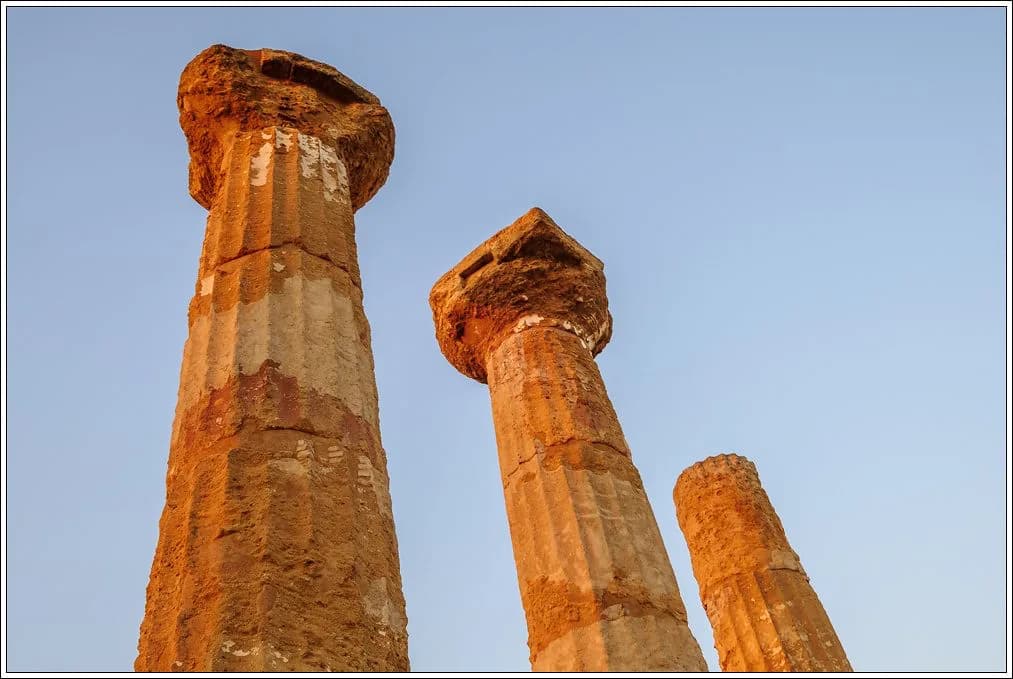
The Temple of Hercules is the oldest in the park, dating to the late 6th century BC, and originally carried 38 columns across a peripteral plan. Only eight remain, rebuilt in the 20th century using a technique called anastylosis, in which original fragments found on site were reassembled. The attribution to Hercules comes from Cicero, who mentioned a statue of the hero inside.
Starting at the eastern ridge means you meet Juno first and walk downhill toward the rest of the park, which many visitors find easier than climbing in the heat. It also puts the oldest and most damaged temples at the start, when your attention is freshest.
Temple of Olympian Zeus: Unfinished Grandeur
The Temple of Olympian Zeus was designed as one of the largest Doric temples of the ancient world, roughly 113 metres long and 56 metres wide, and was intended to commemorate the victory at Himera in 480 BC. It was never completed. Its most distinctive feature was a row of Telamons, statues over seven metres tall used as supporting columns and representing men holding up the structure.
Little survives today beyond the monumental altar, one of the largest in the Greek world, because the site was later quarried for building stone in the Middle Ages. That is why the area can feel like a field of fragments after the drama of Concordia. Read the information panels and the picture becomes much clearer.
This is the section where a small reference to the Telamons in the Agrigento Archaeological Museum pays off, since the original figures are displayed there. Save the museum for after the park if you have energy left, rather than trying to do both in a rushed morning.
The Dioscuri and the Park's Emblem
The Temple of the Dioscuri, dedicated to Castor and Pollux, was built around the mid-5th century BC with 34 columns and was damaged repeatedly, first by the Carthaginians and later by earthquakes. What you see today, four Doric columns on three steps, is a 19th-century partial reconstruction assembled from material found on site. It is the image most often used to represent the whole park.
Knowing it is a reconstruction changes how you look at it. The columns are a tidied fragment rather than a surviving building, and the decorative rosette on one corner is a small reward for looking closely. It sits near the Sanctuary of the Chthonic Deities, so fold both into the same stop.
Beyond the Temples: Garden, Villa, Walls and Necropolis
The Garden of Kolymbethra began as a 5th-century BC water reservoir fed by the Feace aqueducts, and today covers about five hectares of citrus groves, old olives and Mediterranean scrub. The FAI, Italy's environmental heritage fund, restored it and reopened it in 1999 after decades of neglect. Its aqueducts can be visited, making it the most rewarding detour for anyone with an extra hour.
Villa Aurea, named for the British archaeologist Alexander Hardcastle, who bought it in 1921, now hosts exhibitions and gardens inside the park. The city walls, begun with the city's founding in 580 BC and once stretching about twelve kilometres, are visible along the southern side, and Roman and Byzantine tombs fill the necropolis areas. These are quieter stops than the temples, but they explain how the site functioned as a city rather than a sanctuary alone.
If you enjoy the layered history here, the wider collection of hidden gems in Agrigento covers corners of the city that most day-trippers never reach. It pairs well with a late afternoon in the old town after the park.
Practical Route Planning: Entrances, Heat and Pacing
A sensible order is eastern ridge first, then the central temples, then the western cluster and garden if the day allows. The terrain is exposed limestone with little shade, so an early start or a late afternoon visit matters more here than at most Italian sights. The same guide that measures the main path at about 2.5 kilometres advises water, sun protection and proper shoes, and notes that summer evening openings illuminate the temples.
Whether evening visits run on your dates is something only the park can confirm, so check its official pages before building an evening around it. The site is where current opening hours and ticket terms are settled, and no guide can promise them on your behalf.
If you only have one day in Agrigento, resist squeezing the park, the museum and the old town into it. Choose two, do them without rushing, and leave the third for a return trip. The temples in low light at the end of the day are worth more than a hurried extra stop.
Ticket Scope and Combined Options
A park ticket and a museum or garden ticket are not automatically the same thing, and the combined options are where visitors most often get confused. One third-party guide, written before current terms were set, reported adult entry, reduced rates for young EU citizens and combined tickets including the Kolymbethra Garden and the Pietro Griffo Archaeological Museum. Those figures are historical and should not be treated as today's prices.
Before you buy, decide what you actually want to see. If the Kolymbethra Garden is on your list, an add-on may make sense; if you plan to spend an hour with the Telamons in the museum, check whether a combined ticket includes it. The operator's own pages are the only reliable source for what each ticket currently covers, and they are also where reductions are defined.
Any guide, including this one, that quotes a figure is describing the past. Confirm the scope and price at the ticket office or on the official site on the day, and keep the receipt if you add the garden, since entry there is managed separately by the FAI.
How Much Time to Allow
As a suggestion rather than an official figure, allow two to three hours for the temples alone at an unhurried pace, and add an hour if you want the garden. If the museum is part of your plan, budget at least another hour for the Pietro Griffo collections, which hold the material removed from the temples themselves.
Families and photographers usually need longer than they expect, because the ridge is long and the views keep interrupting progress. Conversely, if you are visiting in high summer, shorter and earlier often beats longer. Pick a finish time and work backwards from the heat rather than from a monument checklist.
Pairing the Park With Agrigento Itself
The park sits outside the centre, so many visitors see the temples and leave without ever walking Agrigento's old town. That is a mistake: the historic centre climbs a hill with churches, lanes and the Pirandello House Museum, and it makes a natural evening after a morning at the temples.
If you are building a longer Sicilian itinerary, the Valley of the Temples slots neatly alongside the Scala dei Turchi coast and the literary landscapes around Girgenti. Spreading them over two days gives each site room to breathe.
For a shorter list of the city's other sights, the Agrigento Attractions hub is the place to start planning what comes next.
Plan Your Visit
The Valley of the Temples works best as a planned walk rather than a spontaneous stop. Decide your entrance, start early or late, carry water, and accept that you will cover a few kilometres on exposed ground between monuments. That preparation is what separates a memorable morning from a hot slog.
Then settle the details that change: current hours, ticket scope and any combined options, all of which the park publishes and which no guide can promise on your behalf. Everything else, from the fire-blackened columns of Juno to the four rebuilt columns of the Dioscuri, is there to reward a slower look.
Frequently Asked Questions
How long does it take to walk the Valley of the Temples?
There is no official duration, but as a suggestion allow two to three hours for the temples at an unhurried pace. The main path alone runs about 2.5 kilometres on exposed ground, and adding the Kolymbethra Garden or the archaeological museum will extend your visit by roughly an hour each.
Do you need tickets for the Valley of the Temples, and what do they include?
Yes, the archaeological park is ticketed. A basic park ticket should not be assumed to cover the Kolymbethra Garden or the Pietro Griffo Archaeological Museum, which are sometimes offered as combined options. Check the park's official pages or the ticket office for what each ticket currently includes and which reductions apply, since terms change.
Which temple in the Valley of the Temples is best preserved?
The Temple of Concordia is the best preserved, largely because it was converted into a Christian basilica in the 6th century AD, which protected it from the destruction that hit other sanctuaries. Later restoration removed some of those Christian alterations and recovered its classical form. It is also the most photographed monument in the park.
Can you visit the Valley of the Temples at night?
Evening visits with illuminated temples have been offered in some seasons, but they are not guaranteed year-round. Check the park's official site for current evening openings and ticket terms before planning your day around one, rather than relying on older guidebooks.
Sources
Continue exploring
More guides you'll find useful