Temple of Juno Guide: Agrigento's Hera Lacinia Ridge
Plan a visit to the Temple of Juno in Agrigento's Valley of the Temples: what survives, the fire traces, the ridge views and how to reach it from the east entrance.
On this page
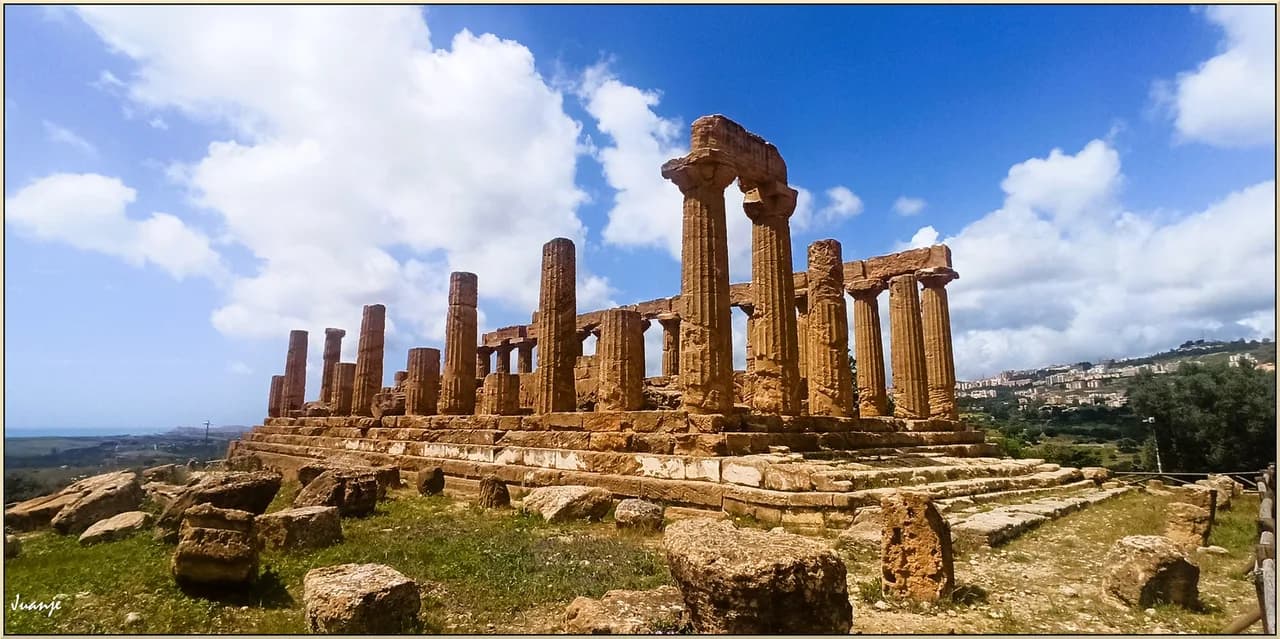
The Temple of Juno sits at the eastern tip of the long limestone ridge that carries Agrigento's temples, at the highest point of the Sacred Hill, with the sea behind it and the rest of the ancient city stretching west. It is the first monument many visitors meet when they enter from the eastern gate, and for a moment the columns and the drop to the water do most of the talking.
This guide treats the temple as a single place rather than a box to tick: what the Doric structure actually is, which parts survive, what the burnt stone means, and how to decide between the eastern entrance and the longer approach from the far side of the park. It also shows how the visit fits into a wider walk along the ridge.
What the Temple of Juno Actually Is
The temple was built around 450 BC in the Doric order, standing on a four-stepped foundation engineered to level out the uneven hillside. Its original plan was monumental: 34 columns arranged in a rectangle six wide and thirteen long around the perimeter. This ridge was the religious heart of the Greek city of Akragas, one of the leading poleis of Sicily. For wider planning, see Temple of Concordia Guide.
The name is traditional rather than certain. The dedication to Juno, whom the Greeks called Hera, rests on long-standing convention; one reading traces the identification to a misinterpretation of a text by Pliny the Elder that actually described a temple in Calabria. Treat the name as the label the monument has carried for centuries, not as settled archaeological fact.
A legend recorded in later sources holds that the temple once held a painting of Juno by the Greek artist Zeuxis. No trace of such a work survives, so it belongs with the site's stories rather than its physical record, and it is worth hearing as storytelling when a guide raises it.
How Much of the Temple Survives
Twenty-five of the original columns are still standing, and fifteen of them still carry their architraves, which gives a far better sense of the building's height and rhythm than a bare field of drums would. Because the temple stands on a hilltop, the surviving columns read against open sky and sea, and the silhouette is the reason so many photographs of the park begin here.
The most interesting detail is in the stone itself. About fifty years after construction, the Carthaginians sacked Akragas and set fires that damaged the temple; traces of that burning are still visible on some blocks today. The building was later restored in the Roman era, so what you see is a structure that was damaged, rebuilt and then left to the weather for two millennia. Further visitor details appear in Valley of the Temples Agrigento: Sicily's Greatest Ancient Site.
If your priority is the most complete Doric architecture in the park, the better-preserved building is the Temple of Concordia, roughly 0.7 kilometres west along the ridge. Juno compensates with position: it is the highest and most dramatically sited monument, and its value lies in the combination of standing columns and the view back over everything else.
The Altar, the Orientation and the View West
A few metres from the eastern facade lies the remains of a large monumental altar, once the focus of the rituals staged outside the temple itself. Greek temples here were oriented so that the first light of day reached the cult statue inside the inner chamber, and the altar in front of the east front completed the arrangement. Standing between the two, you can reconstruct how a ceremony would have been framed. Further visitor details appear in A Guide to the Valley of the Temples: Unveiling Ancient Akragas - Slow Sicily.
The view is the other half of the visit. Looking west you follow the whole sacred ridge: Concordia 0.7 kilometres away, Hercules about 1.3 kilometres, the Temple of Olympian Zeus and the Pietro Griffo museum around 1.4 kilometres. Beyond the ridge line the sea shows in the distance, which makes this the natural orientation point before you start walking. For wider planning, see Temple of Heracles in Agrigento.
Choosing Your Entrance: Juno Gate or Porta Quinta
The park has two practical approaches. The eastern entrance sits right by the Temple of Juno, with a ticket office and parking, so you begin at the high point and walk downhill and west through the rest of the monuments. That is the efficient choice if your time is limited or if you want the climb out of the way at the start.
The alternative is Porta Quinta in the western part of the valley, which puts you at the far temples first and saves Juno for the end of the walk. The trade-off is real: you finish at the highest ground and at the far end from your car or bus, which means either retracing the full ridge or arranging a return. Decide before you buy a ticket, because the two entrances effectively create two different days.
Once inside, expect a short uphill pull to reach the temple itself, since it occupies the summit. The main path through the park runs about 2.5 kilometres end to end, so the distance between monuments is modest, but the surface is uneven limestone and dirt rather than pavement. For wider planning, see Valley of the Temples Visitor Guide.
Getting There from Agrigento
Local city buses are the usual way up from Agrigento, with services reported to stop near the park entrances and to take roughly a quarter of an hour; treat specific line numbers and timings as reported by travel sources rather than as a timetable. Taxis are quicker and more expensive, and are best booked rather than hailed on the street. Further visitor details appear in A guide to Valley of the Temples in Agrigento, Sicily | Musement.
Agrigento itself is served by rail and by long-distance buses from Palermo and Catania, with the station a few kilometres outside the historic centre. If you arrive by train, plan the last leg into town and on to the park in advance rather than assuming a connection will present itself.
The park's own site is the authority for access arrangements, entrance locations and any temporary changes to routes. Check it shortly before travelling, because gate arrangements and internal paths can be affected by works or seasonal organisation.
How Long to Budget
As a suggestion rather than official guidance, allow roughly thirty to forty minutes at the temple if you want to walk the perimeter, read the interpretive panels and take in the panorama without hurrying. That is enough to see the altar, the standing columns and the view, and it leaves the rest of the day intact.
For the whole archaeological park, most independent guides suggest at least three to four hours, and that figure rises if you add the museum or the Garden of Kolymbethra. The practical consequence is that Juno should be a deliberate stop on a longer walk rather than a separate outing.
If you have only a couple of hours, start at the Juno gate, see the temple, and walk as far as Concordia before turning back. This gives you the two most memorable monuments on the ridge and avoids committing to the full traverse with a return leg attached.
Byzantine Tombs on the Road to Concordia
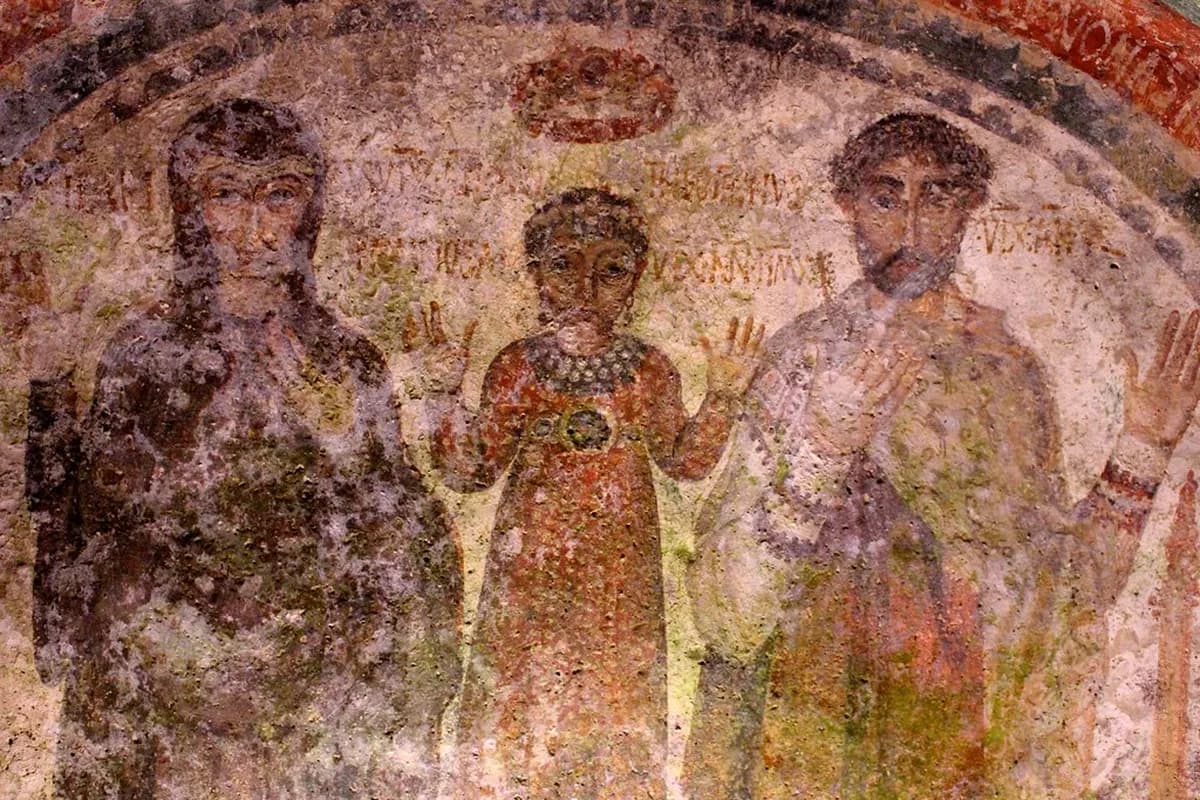
The path west from Juno toward Concordia passes more than temples. Cut into the rock beside the ancient fortifications are Byzantine arcosolia, burial niches carved into the cliff face, along with the remains of an early Christian necropolis. Many visitors walk straight past them on the way to the next set of columns.
These are worth a pause because they show the site's long afterlife. The temples belong to the Greek city, but the ridge was reused for centuries afterwards, and the tombs record a Christian community living among and inside the ruins of Akragas.
Tickets, Hours and What to Verify
Entry is charged at park level rather than per temple, and separate tickets or supplements may apply for the museum and the Garden of Kolymbethra. Do not rely on prices quoted in older travel blogs; figures circulating online conflict and may be out of date. Check the current tariff on the official park site, where the ticket scope is also set out.
Opening hours likewise vary by season and have been reported differently across sources, including a summer evening opening. The park publishes its own schedule, and that is the only figure worth planning around, particularly if you are aiming for a late slot. Reconfirm the day before you go.
Buying in advance is widely recommended for peak periods, but treat it as sensible advice rather than a stated requirement unless the operator says otherwise. If you book a guided tour, note that skip-the-line tickets usually grant priority at the ticket office only; security checks still apply to everyone.
Heat, Shade and the Time-of-Day Decision
The ridge is almost entirely exposed, with very little shade on the limestone. In high summer, midday at the Temple of Juno is genuinely uncomfortable, and planning around early morning or late afternoon is not fussiness but the difference between an enjoyable hour and an exhausting one.
Early morning has a second advantage: the light falls on the eastern facade and the columns stand clear against the sky, and the site is at its quietest. Late afternoon suits the view west toward Concordia, when the ridge and the distant sea soften. Either way, carry water and wear closed shoes with grip, because the stone is worn and uneven.
Pairing Juno with the Rest of the Park
On a Juno-first route, the natural sequence is the temple, then the tombs and the walk to Concordia, then the western zone with the Temple of Olympian Zeus. The Pietro Griffo museum sits near the park and holds the material that explains the temples, including finds from the site; it is the right place to end if you want the archaeology to make sense. For wider planning, see Agrigento Archaeological Museum Guide.
Two gentler add-ons reward a slower day. The Garden of Kolymbethra fills a green hollow below the ridge with citrus and old irrigation channels, and Villa Aurea, once the base of the archaeologist Alexander Hardcastle, sits among the monuments with gardens and displays. Both break up the stone-and-sky rhythm of the temples.
If the heat or the crowds wear you down, the larger set of overlooked places in the area, from hill-town streets to quieter gardens, gives you somewhere to slow down after the ridge. The hidden gems in Agrigento round-up gathers those alternatives in one place.
Plan Your Visit
The Temple of Juno rewards a small amount of planning: choose your entrance deliberately, arrive when the ridge is cool and the light is good, and give the temple enough time to look at the burnt stone and the altar rather than just photographing the columns. It is one stop on a walk, not a detour.
Confirm tickets and opening times on the park's official site before you set out, since published third-party figures vary and the schedule changes with the season. Everything else, including how far you walk and where you finish, is yours to decide.
Frequently Asked Questions
Is the Temple of Juno worth visiting on its own?
Yes, if you accept it as a viewpoint as much as a monument. Twenty-five columns and fifteen architraves survive, the Carthaginian fire traces are visible on the stone, and the hilltop position gives the widest view along the ridge. It takes only a short while to see properly, so most visitors combine it with Concordia and the western temples.
How do you reach the Temple of Juno from the main entrance?
From the eastern gate beside the temple you are already there, with only a short uphill walk to the summit. From Porta Quinta in the west, you follow the main path through the park past the other monuments, a walk of a couple of kilometres over uneven ground. Choose based on whether you want the climb at the start or the finish.
How long does it take to see the Temple of Juno?
Allow around half an hour, longer if you want to sit with the view or examine the altar and the fire-damaged blocks. That is an editorial suggestion, not official guidance. The full park typically takes three to four hours, more if you add the museum or the Garden of Kolymbethra.
Are there still fire marks on the Temple of Juno?
Traces of burning from the Carthaginian sack of Akragas in 406 BC are still visible on some of the stone. Look closely at the blocks rather than the reconstructed elements, since the temple was restored during the Roman period and later partly re-erected, so not every surface is ancient in its present position.
Can you enter the Valley of the Temples at the Temple of Juno entrance?
Yes, there is an entrance by the temple with a ticket office and parking, and a second at Porta Quinta on the western side. Which one suits you depends on whether you plan to walk the full ridge or return to your starting point. Confirm current gate arrangements on the park's official site before travelling.
What is the best time of day to visit the Temple of Juno?
Early morning gives soft light on the eastern facade and the fewest people, while late afternoon brings out the view west toward Concordia and the sea. Avoid midday in summer, when the limestone ridge is fully exposed and shade is almost absent. Carry water and wear shoes with grip.
Is the Temple of Juno the same as the Temple of Hera?
Effectively yes, in the sense that Juno is the Roman name for the Greek Hera, and the two names are used interchangeably for this building. The identification is traditional rather than proven. One reading links it to a misreading of Pliny the Elder, so the dedication should be described as convention, not certainty.
Should I visit the Temple of Juno or the Temple of Concordia first?
Start with Juno if you enter from the east, since it stands at the high point and sets the geography of the ridge in your mind. Concordia, about 0.7 kilometres west, is the better-preserved building and makes a strong second stop. Reverse the order if you begin at Porta Quinta.
Sources
- Temple of Juno in Agrigento: Ancient Greek History & Guide
- Official event website
- Temple of Juno, Agrigento - Sicily - Nomado Travel
- A Guide to the Valley of the Temples: Unveiling Ancient Akragas - Slow Sicily
- Valley of the Temples Agrigento: Sicily's Greatest Ancient Site
- A guide to Valley of the Temples in Agrigento, Sicily | Musement
Continue exploring
More guides you'll find useful