Temple of Heracles in Agrigento: Ruins and Visiting Guide
Learn what survives of Agrigento's oldest Doric temple, why its name is uncertain, and how to fit its standing columns into a Valley of the Temples walk.
On this page
The Temple of Heracles is usually the first great ruin you meet on the eastern side of Agrigento's archaeological park, and it is also the hardest to read. It dates to the late sixth century BC, making it the earliest of the city's monumental Doric temples, but only a fragment of its colonnade stands today.
Most visitors give it a few minutes on the way to Concordia and remember it less than its neighbours. That is a fair trade-off if your time is short, but a little context changes the experience: knowing which stones are ancient, which were put back in the twentieth century, and why the dedication itself is uncertain turns a row of columns into a legible story.
Why the Temple of Heracles Matters
Among the temples strung along the ridge, this is the one that shows how Agrigento's sacred architecture began. Google Arts & Culture dates it to the late sixth century BC and describes it as the most archaic of the great Doric temples in the city, built from local limestone.
That early date explains its proportions. The columns taper noticeably toward the top, their capitals are flattened rather than richly carved, and the spacing between the outer colonnade and the inner chamber is unusually wide, all traits that later temples in the park refined and tightened.
If you have already seen the Temple of Concordia, the contrast is the point. Concordia survives almost whole and carries the site's reputation for preservation, while Heracles survives as a partial outline that asks you to imagine the rest. Neither is more worth your time, but they reward attention in different ways.
Where the Ruins Sit on the Ridge
The Temple of Heracles stands on the eastern stretch of the park's main walk, on the road between the Temple of Concordia and the vast ruins of the Temple of Olympian Zeus. Travellers regularly describe it as a stop along that route rather than a destination in itself, which matches what you see on the ground.
Its position near the ancient city's gate area is part of the reason the attribution to Heracles was proposed at all: the hero was a fitting guardian for arrivals. Approach it on foot along the ridge path from either entrance, and you will pass it naturally between the eastern sanctuaries and the western zone.
One correction before you go looking: some online pages place a Temple of Hercules in Villaseta and describe it as a Hindu temple. That listing conflates a modern place of worship with the Greek ruin; the temple discussed here is in Agrigento's archaeological park, in Sicily, and is a Doric monument of ancient Akragas.
What the Original Building Looked Like
Reconstructions describe a peripteral Doric temple with six columns across each short front and fifteen along each long side, giving a total of 38 when complete, as Slow Sicily sets out. The plan included a porch, the main chamber and a rear vestibule, a standard arrangement that later temples repeated at greater scale.
The material was local limestone rather than marble, which shaped how the building has aged. The original roof line was finished with gutters carrying lion-head spouts, and two series of these terracottas have been identified, one from the late sixth century and one from the early fifth, hinting at later repair work.
East of the temple, within the grounds of Villa Aurea, lie the remains of a small archaic sanctuary. Architectural terracottas from that area are displayed in the regional museum, so if the sculptural detail interests you more than the standing columns, plan the museum as a companion stop.
A Name Built on Inference
Do not treat the word Hercules as a certainty. The identification rests on a passage in Cicero mentioning a temple of Hercules in the city's agora, combined with the position of these ruins near the northern edge of that area. That is suggestive rather than conclusive, and the conventional name has simply stuck.
Slow Sicily notes a further wrinkle: Cicero's mention of a statue of the hero inside the building is part of what anchors the attribution, and later writers repeated the name until it became standard. When a label is this old and this useful, guides rarely bother to qualify it, so treat any confident claim about the dedication with mild scepticism.
What You Actually See Today
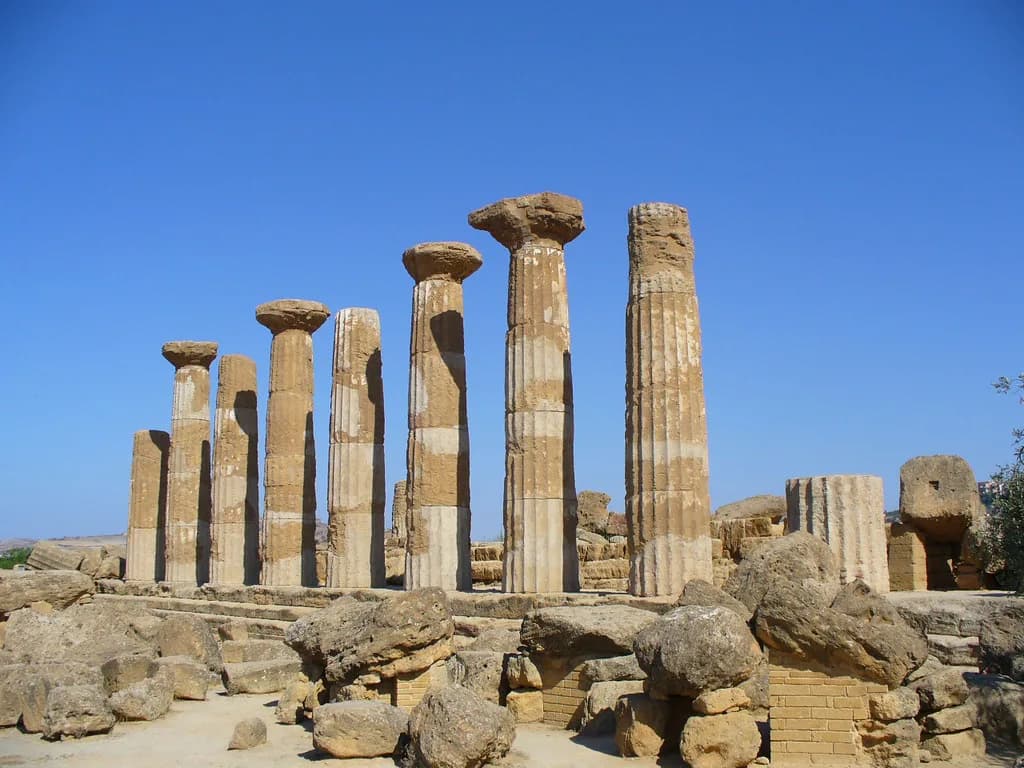
The ruin is exactly that: a partial structure, not a standing temple. A line of eight columns forms the recognisable image, with the base course and fragments of the surrounding platform visible around them. Two travel accounts agree that little else rises above ground level, which is why the stop is short.
On the eastern side, the remains of a large monumental altar survive, where offerings would have been made in front of the temple. It is easy to walk past because it reads as low masonry rather than architecture, but it completes the picture of how the sanctuary functioned.
Set aside roughly fifteen to twenty minutes for the temple itself, and rather more if you want to read the information panels and examine the masonry closely. The figure is a sensible planning estimate, not an official recommendation, and it assumes you are already walking the ridge path.
Rebuilding Versus Authenticity
The upright columns you photograph are not all original in place. They were re-erected in the twentieth century using fragments found on the site, a technique known as anastylosis that reassembles original pieces rather than carving new ones. Slow Sicily credits the work of British archaeologist Alexander Hardcastle, based at Villa Aurea, with part of the restoration effort.
Knowing this changes how you look at the stones. Look for the seams where drums have been rejoined and for the difference in surface weathering between pieces that lay buried and pieces that stood exposed; the columns are honest about their own reconstruction once you know to look.
The same logic applies across the park, where several temples were partly reassembled in the nineteenth and twentieth centuries. Treating restoration as part of the site's history, rather than as a flaw, is the more useful habit when you move on to the Temple of the Dioscuri and the Zeus platform.
Nearby on the Same Walk
From here the path continues to Concordia, the park's most complete temple and the one most visitors photograph first. A Valley of the Temples visitor guide helps you sequence the ridge, but the practical rule is simple: walk the eastern zone in one direction and the western zone in the other, so you are not doubling back along the exposed track.
Beyond Concordia, the western stretch holds the Temple of Olympian Zeus, never finished and now a field of fallen masonry, and the Temple of Juno on the high eastern tip. The Garden of Kolymbethra sits between the zones and offers shade, citrus groves and traces of ancient water channels, making it a natural midpoint break.
If you want context before or after the walk, the Museo Archeologico Regionale Pietro Griffo holds the finds that explain the site, including material from the archaic sanctuary near Villa Aurea. Some travellers also rate the old town above the ridge, with its medieval streets and churches, as the more restful half of an Agrigento day.
Beyond the Park: Overlooked Corners of the City
Agrigento is more than one ridge. If the park has taken your morning or afternoon, the city above it offers a quieter second half to the day, and our pick of hidden gems in Agrigento is a useful starting point for choosing between them.
The medieval core rewards slow wandering on foot rather than a checklist approach. The Cathedral of San Gerlando, the small churches along the lanes and the colourful Scalinata degli Artisti are easy to fold into a stroll from Via Atenea, and several appear in local advice on things to do in Agrigento beyond the temples.
Where the temples are a ticketed archaeological park, the streets and many of its monuments are free to walk through, and churches vary in whether interior areas are open to casual visitors. Treat the old town as a public city, not a single attraction, and keep an eye on signage at each doorway rather than assuming entry.
South of the city, the coast changes the mood entirely. Sources describe San Leone as Agrigento's main seaside resort, sandy and popular with families, and further afield the white ridges of Punta Bianca are described as an uncrowded natural reserve reached by a rough dirt track — pleasant, but not a formal promenade.
Timing and Comfort on an Exposed Ridge
The temples stand on a limestone ridge with almost no shade, and the heat in high summer is genuinely punishing at midday. Guides consistently recommend arriving at opening or returning in the late afternoon, when the light is better and the walking is cooler; sunrise visits are the quietest option of all.
Carry more water than you think you need and wear closed shoes with grip. The surfaces are uneven in places and the path between the zones is a genuine walk rather than a stroll between monuments, so anyone with mobility concerns should ask the park about the terrain before committing to the full route.
Spring brings almond blossom and wildflowers along the ridge, autumn offers softer light and thinner crowds, and winter is quiet but comes with shorter days. Whatever the season, build in a rest stop rather than treating the park as a single push from one end to the other.
Practical Planning Before You Travel
Ticketing, hours and last entry change with the season, and the Temple of Heracles has no separate admission of its own: you see it as part of the wider archaeological park. Check the official park site for current hours, ticket scope and any combined options before you fix your day, rather than relying on a third-party listing.
Some parts of the area, such as the garden and the museum, may be ticketed separately or bundled, so confirm what each ticket covers before you assume one purchase opens everything. The park's own information and the ticket office at the entrance are the reliable places to resolve that.
If you are staying in Agrigento, the site is close enough to reach by local transport or taxi, and the historic centre is walkable in its own right. Plan the temple as one stop of perhaps a half day outdoors, then decide separately whether to add the museum or the old town.
Seeing the Oldest Temple Well
The Temple of Heracles rewards a slower look than its fragmentary state suggests. Read it as the earliest chapter of Agrigento's temple building, check the seams left by twentieth-century restoration, and give the altar area on the eastern side a moment before moving on along the ridge.
Confirm the current park arrangements on the official site, start early or late in the day, and let the ruin be a short, well-understood stop within a longer walk rather than a destination in its own right. For the rest of the city's sights, the Agrigento Attractions hub is the place to build the itinerary. For related planning, see Temple of Olympian Zeus, Agrigento: Reading Sicily's Unfinished Colossus.
Frequently Asked Questions
When was the Temple of Heracles built?
It is dated to the late sixth century BC, which makes it the earliest of Agrigento's great Doric temples. The building was constructed from local limestone, and the lion-head roof gutters suggest later repair work in the early fifth century.
Is the temple really dedicated to Hercules?
The dedication is uncertain. It rests on a passage in Cicero mentioning a temple of Hercules in the city's agora, combined with the position of these ruins. The name is a long-standing convention rather than a proven fact.
How many columns of the Temple of Heracles are standing today?
Eight columns stand in a line, re-erected in the twentieth century from original fragments found at the site. The temple was originally designed with six columns across the fronts and fifteen along each side.
Where is the Temple of Heracles within the Valley of the Temples?
It stands on the eastern part of the park, along the main ridge path between the Temple of Concordia and the ruins of the Temple of Olympian Zeus. Ignore any listing that places it in Villaseta as a Hindu temple; the Greek ruin is in Agrigento.
How long does it take to see the Temple of Heracles?
Plan around fifteen to twenty minutes for the temple itself, longer if you read the panels and study the masonry. It works best as a short stop within a half day given to the wider park.
Do I need a separate ticket for the Temple of Heracles?
No separate ticket is sold for this temple; it is visited as part of the wider archaeological park. Check the official park site for current hours, ticket scope and any combined options, since these change with the season.
Sources
Continue exploring
More guides you'll find useful