Catania Neighbourhoods: Where to Stay and What to Expect
Compare Catania's historic centre, university quarter, Borgo-Sanzio and Ognina coast, with honest trade-offs on noise, parking, markets and sea access.
On this page
Catania rewards travellers who choose a base deliberately. The city runs from the lava-stone Baroque core around Piazza del Duomo to a working port, a student quarter and a volcanic coastline, and the district you book decides whether your mornings start with a market or a bus ride.
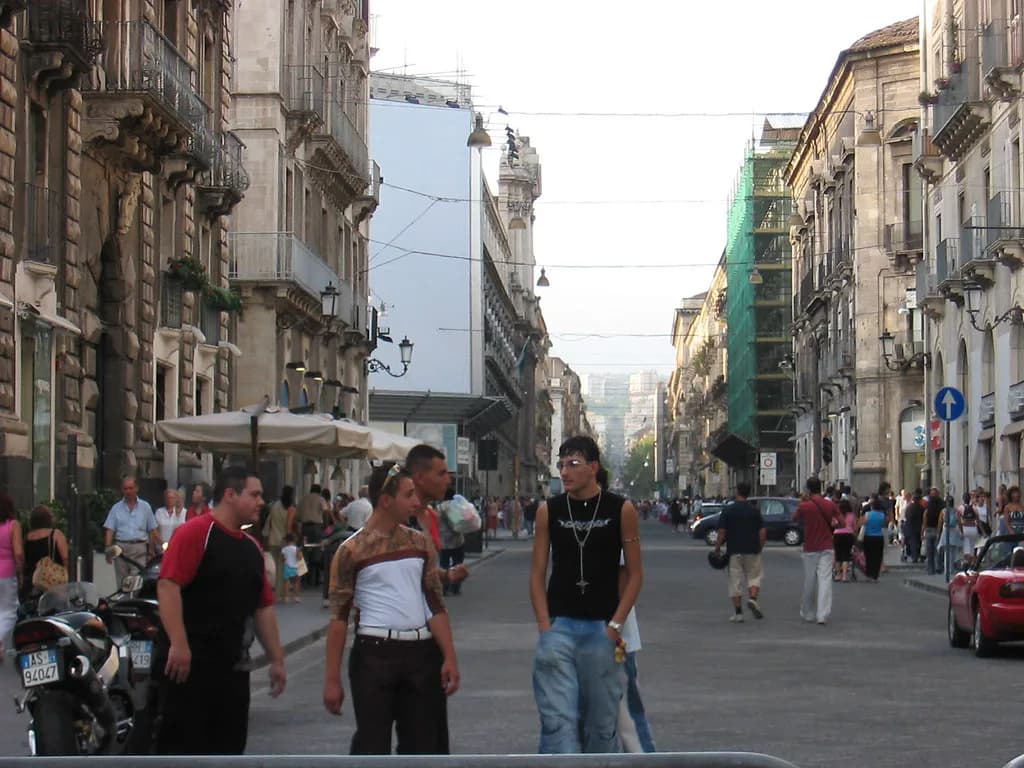
The centre is compact enough to walk. Via Etnea runs three kilometres in a straight line north from Piazza del Duomo toward Mount Etna, and its first stretch is a dense sequence of churches and palaces before it turns into the city's shopping and evening promenade.
The following guide frames four districts as trade-offs rather than a ranking: the historic centre, the university quarter around Via Crociferi, Borgo-Sanzio and the harbour, and Ognina with the north coast. Each section says what you gain, what you give up and where to verify details that change.
How Catania's geography works
Via Etnea is the city's spine. The stretch from Piazza del Duomo to the Quattro Canti crossroads is pedestrian, and from there toward Villa Bellini only buses and taxis are allowed, which explains why the upper street feels calmer than the lower one in the evening.
The street was laid out after the 1693 earthquake, initially about seven hundred metres long and named after the viceroy, then extended north over the centuries to Piazza Cavour, which locals call Piazza Borgo. The Baroque showpieces cluster near the cathedral while the northern end turns into shopping, parkland and residential blocks.
For visitors, the practical consequence is simple. Anything between Piazza del Duomo and Piazza Stesicoro is walkable for sightseeing, while Villa Bellini and the streets beyond require either a comfortable stroll or a short bus ride. Etna stays to the north the whole time.
Historic centre: Piazza del Duomo and lower Via Etnea
The historic centre holds the heavy hitters: the cathedral dedicated to Sant'Agata, the lava elephant fountain locals call Liotru, the Porta Uzeda gate and the corridor of Via Etnea heading north past the university palace and the Basilica della Collegiata. Staying here means you can see most of it without a bus ticket.
The square was rebuilt in the early 1700s on the footprint of the medieval piazza, and its present look is largely the work of the city architect Giovanni Battista Vaccarini, whose buildings frame the fountain at the centre. That coherence makes the centre easy to navigate on foot, and also busy.
Behind the square, La Pescheria fish market sits sunken below street level next to the Amenano Fountain, reached by stairs from the piazza or through the Porta Carlo V gate. It is a working market, not a display, and the practical advice is to arrive mid-morning when the stalls are full but walkable.
The trade-off is noise and crowds. Via Etnea becomes a pedestrian promenade in the evening, which is wonderful for an aperitivo and less wonderful if your room faces the street. The absence of through traffic on the lower stretch does not mean silence; it means conversation and closing shutters until late.
Who the centre suits, and who should skip it
The centre works best for first-timers with two or three nights and no car. You can walk to the cathedral, the markets, the Baroque churches and the Roman theatre without planning transport, and the station area is within reasonable walking distance for day trips.
Skip it if you are a light sleeper, travelling with a car, or staying in high summer. Parking in the immediate core is scarce, and a courtyard-facing room is worth asking for specifically rather than assuming. In peak season, hosts in the centre advise booking well ahead because rooms near the cathedral are the first to go.
If you want the atmosphere without the late-night soundtrack, look at the streets between Piazza Stesicoro and Villa Bellini. You stay on the same axis, keep the walking advantage and gain a little distance from the busiest evening crowds.
University quarter and Via Crociferi
Around the University of Catania and Via Crociferi, the city turns younger and cheaper. The street itself is a Baroque sequence of churches and monasteries, including the Arco di San Benedetto, an arch said to have been built in a single night in 1704 so nuns could cross without touching public ground.
The university was founded in 1434 and remains the oldest in Sicily, which explains the student presence in the surrounding bars, bookshops and cafés. It also explains the noise profile: evenings here are lively rather than hushed, and the sound carries into the side streets.
On the edge of the quarter, San Berillo Vecchio was partly demolished in a controversial 1950s renewal scheme and has since become the city's most visible street-art district. Nearby Via Gemmellaro and its small piazza concentrate bars and casual restaurants, making this a sensible base for a sociable, budget-conscious stay.
Expect to walk a little further to reach the cathedral than you would from Piazza del Duomo, and expect more late-night sound. In exchange, you get cheaper rooms, better coffee bars and a neighbourhood that feels lived-in rather than staged.
Borgo-Sanzio and the harbour area
Borgo-Sanzio sits west of the centre and is often described as calmer and more local in feel, with the port and the coast within reach. It is a sensible middle ground for travellers who want to combine sightseeing with beach days without committing to a fully residential suburb.
The caveat is transport. Ferries and excursion boats run from the port, but schedules change by season and operator, so check the day before rather than relying on a guidebook figure. Buses and taxis link the area to the centre, and the walk is manageable if you are not carrying luggage.
This is a good compromise for families and for anyone arriving by car who wants easier parking than the core allows. You give up some of the Baroque doorstep experience, and you gain space, quieter nights and quicker access to the water.
Ognina and the north coast
Ognina and the small towns along the north coast offer the opposite of the centre: sea views, black-lava coves, fishing boats and quiet mornings. San Giovanni Li Cuti, a short trip north of the centre, has a small harbour with wooden boats pulled up on dark pebbles and sand, and it is free to visit.
Be honest about the beaches. This stretch is volcanic rock and pebble rather than sand, which suits swimmers and photographers but not families expecting a long beach. The city's own long sandy beach lies south of the centre, and reaching it takes planning.
A car helps here, especially for coastal viewpoints and for photographing Etna across the water. Without one, you rely on buses and taxis into the centre, and evenings are much quieter than in town, which is either the point or the problem depending on your trip.
Cross-city comparisons: walking, parking and market days
Walking times decide more than maps suggest. Piazza del Duomo to Piazza Stesicoro is an easy stroll; from there to Villa Bellini takes another stretch of the same street; and from the centre to the station is a reasonable walk with luggage in daylight but not a pleasant one at speed.
Parking is realistic in Borgo-Sanzio, the harbour edges and Ognina, and difficult in the immediate core. If you are driving, confirm garage arrangements with your host before booking, and treat a courtyard room and a parking space as two separate questions.
Markets should shape your base too. La Pescheria runs Monday to Saturday from around 7am to 2pm and closes all day on Sunday, so a Sunday-only stay in the centre misses its signature morning. The Fera 'o Luni general market at Piazza Carlo Alberto keeps similar weekday hours and also closes on Sundays.
If your only full morning is a Sunday, either shift the market visit to Monday or plan a different start: the empty market piazza is still photogenic, and the smaller Mercato di San Domenico off Via Plebiscito keeps a few stalls open at weekends.
Matching district to trip type
First visit, two nights, no car: stay in the historic centre. Couple wanting atmosphere and restaurants: the streets around Piazza Stesicoro or the university quarter. Family with a car: Borgo-Sanzio or the harbour side, where parking and space are more realistic.
Budget traveller: the university quarter offers cheaper rooms and cheap eats without losing walkability. Food-focused stay: base near the markets and Via Gemmellaro. Etna day-tripper: anywhere along the Via Etnea axis works, since tours collect from central points.
If you want the sea as your priority, Ognina is the honest choice, provided you accept rock and pebble beaches and a quieter evening. If you want both sea and city, Borgo-Sanzio is the compromise, not a perfect solution.
Our hidden gems in Catania guide covers the smaller sights that make a district worth lingering in, from underground Roman baths to rooftop terraces, so you can judge a base by what you will actually do on foot rather than by hotel photos.
Mistakes to avoid
Do not book a cathedral-facing room in peak season and then complain about noise. Ask for courtyard-facing accommodation if you sleep lightly, and confirm it in writing rather than assuming a quiet side.
Do not expect Sunday markets. La Pescheria is closed every Sunday all year, and the Sunday closure catches out visitors who assume a Mediterranean fish market peaks at the weekend.
Do not assume every seafront is sandy. The northern coast is basalt and pebble, which looks spectacular and feels different underfoot; bring suitable shoes and skip the parasol expectations.
Finally, do not treat the centre as the whole city. The markets, the monastery complex and the student quarter are what give Catania its texture, and a base that ignores them leaves you with Baroque facades and little else.
Where to go next
If you are still choosing, read our guide to Catania Attractions to see which sights matter most to you, then decide how close you need to be to them. A district is only right if it shortens the journeys you actually care about.
For a deeper look at the core, the Catania City Centre guide walks through the Baroque streets in detail, while the Catania Seafront and Harbour guide covers the port, the fishing quarter and the coastal paths north of the city.
If your dates are flexible, our guide to the Best Time to Visit Catania Without the Crowds explains how the seasons change the centre's mood, and the Catania Self-Guided Walking Tour helps you test a neighbourhood on foot before you commit to a hotel.
Plan Your Visit
Pick your base by what you want to do first thing in the morning. Markets and Baroque churches point to the centre; cheap dinners and street art point to the university quarter; sea air points north to Ognina.
Whichever you choose, verify the details that change, such as ferry schedules, event notices and any works affecting squares or streets, and confirm quiet rooms and parking with your host directly rather than relying on listing descriptions.
Catania rewards a little planning and a lot of walking. Choose a district that matches your pace, and the city's mix of lava, markets and sea will do the rest.
Frequently Asked Questions
Where is the nicest part of Catania to stay for a first visit?
For a first visit, the historic centre around Piazza del Duomo and lower Via Etnea is the most practical base. You can walk to the cathedral, the fish market and the main Baroque streets, and evening life happens on your doorstep. If you sleep lightly, ask for a courtyard-facing room or move a few blocks north toward Piazza Stesicoro.
Is it better to stay in Catania's historic centre or near the sea at Ognina?
It depends on your mornings. The centre gives you markets, churches and restaurants on foot; Ognina gives you sea views, volcanic coves and quiet evenings, but you will rely on buses or a car to reach the centre. Travellers splitting a stay between the two often do the city first and the coast second.
Which Catania neighbourhood is best for nightlife and budget travellers?
The university quarter around Via Crociferi and Via Gemmellaro suits both. Student bars and casual restaurants keep prices lower than the cathedral area, and San Berillo Vecchio's street art adds interest to an evening walk. Expect more late-night sound than in the centre's quieter side streets.
Do I need a car to stay in Ognina or the north coast?
A car makes the north coast much easier, especially for coastal viewpoints and for day trips toward Etna. Without one, you can still stay there and use buses and taxis to reach the centre, but plan your evenings around a quieter local pace rather than spontaneous trips into town.
Is the Catania fish market open on Sundays?
No. La Pescheria is closed all day on Sunday, all year, which surprises visitors who expect a weekend peak. It generally runs Monday to Saturday from around 7am to about 2pm, with the best balance of full stalls and walkable space mid-morning. If your only morning is a Sunday, shift the visit to Monday or try the smaller San Domenico market.
How many nights should I base in Catania?
Two nights covers the historic centre comfortably on foot, including a market morning and an evening passeggiata. Add a third night for a day trip toward Etna or the coast, and consider a longer stay if you want beach time or slower exploration of the student quarter and the monasteries.
Sources
- Best Neighborhoods to Stay in Catania: Hotels & B&Bs
- Catania Fish Market (La Pescheria): A 2026 Local Guide
- Via Etnea, Catania: what to see and tips | ZonzoFox
- Cathedral Square - Piazza del Duomo
- Università di Catania
- Monastero dei Benedettini di San Nicolò l'Arena | Catania
- A Local’s Favorite Things to Do in Catania — Go Ask A Local
- Hidden Gems in Catania: 15 Unusual Places Locals Love
- Wander the palm-lined paths of Villa Bellini, Catania's oldest park - Guide.en-vols
Continue exploring
More guides you'll find useful