12 Unusual Places to Visit in London for Free (2026)
Discover 12 unusual places to visit in London for free, from Brutalist jungles to Roman ruins. Includes booking tips and local secrets for a 2026 budget trip.
On this page
12 Unusual Places to Visit in London for Free
London rewards those who look slightly sideways. While the crowds queue for the Tower of London, a medieval ruin garden sits empty a few streets away. A tropical jungle hides inside a Brutalist tower. Roman gladiatorial walls wait beneath a gallery basement. Every single one of these places costs nothing to enter in 2026. This guide covers all twelve, with honest booking lead times and practical location notes drawn from regular visits.
Some of these spots require advance booking even though they are free. The Barbican Conservatory and Sky Garden both release tickets on a fixed weekly schedule and they vanish fast. If you are visiting London in the next few weeks, scroll down to the booking lead time section before you plan your days. Grouping visits by neighborhood also saves significant Tube spending — see the cluster guide at the end of this article.
1. St Dunstan in the East: The Gothic Ruin Garden
Tucked between Cannon Street and Lower Thames Street, St Dunstan in the East is a 12th-century parish church that the Blitz reduced to a shell in 1941. Rather than rebuild it, the City of London Corporation turned the roofless nave into a public garden. Ivy now climbs the pointed Gothic arches, ferns colonise the sills, and mature trees grow where the congregation once sat. On a misty weekday morning it feels otherworldly.
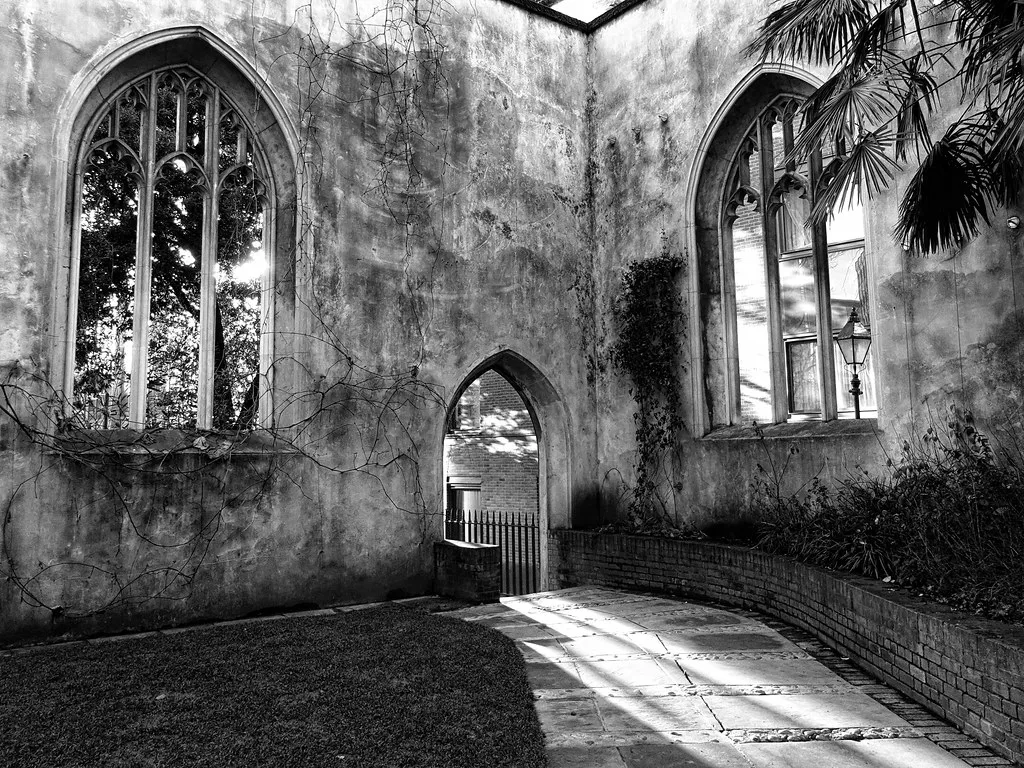
The steeple and west tower were designed by Sir Christopher Wren after the Great Fire of 1666. They survived the bombing intact, which makes the contrast between stone ruin and green vegetation even more striking. The garden is open daily from 8:00 to dusk and entry is free with no booking required. It is a five-minute walk from Monument station. Bring a wide-angle lens — the framing of Gothic arches against sky is one of the best free photography compositions in the city.
St Dunstan in the East is free and open daily from 8:00 to dusk with no booking required. Arrive on a weekday before 09:00 for the most atmospheric experience — City workers fill the garden at lunchtime.
2. The Barbican Conservatory: A Brutalist Jungle
Hidden on level 3 of the Barbican Centre is the second-largest conservatory in London. Over 2,000 species of tropical plants — palms, succulents, cacti — grow between raw concrete walls and a glass ceiling. Terrapins and koi carp occupy the ground-level ponds. The effect is startling: the harshest residential architecture in Britain enclosing the lushest possible greenery.
Entry is free, but tickets must be booked on the Barbican website. New slots are released every Thursday at 9:30am for the following week, and they typically sell out within minutes of going live. Set an alarm, book on the dot, and plan your visit accordingly. The Barbican or Moorgate stations both work. Allocate around an hour to walk the multi-level walkways properly. If you are exploring hidden gems in London, this is the one that impresses people most.
Barbican Conservatory tickets are released every Thursday at 9:30am for the following week and sell out within minutes. Missing the Thursday window means waiting another full week — set a calendar alarm for 09:25 Thursday.
3. The Hunterian Museum: Anatomical Oddities
Inside the Royal College of Surgeons at Lincoln's Inn Fields, the Hunterian Museum houses over 3,500 anatomical, pathological, and zoological specimens collected by 18th-century surgeon John Hunter. The centrepiece is the Crystal Gallery — a multi-level glass case containing thousands of spirit-preserved specimens. Nearby stands the skeleton of Charles Byrne, the so-called "Irish Giant," who stood 2.31 metres tall and died in 1783 at the age of 22.
The collection also includes the Evelyn Tables, the oldest anatomical preparations in Europe, and a dental cast belonging to Winston Churchill. This is not a conventional museum experience — it is closer to encountering a private 18th-century cabinet of curiosities that has been given a world-class display. Admission is free, though timed entry booking is recommended. The museum is open Tuesday to Saturday from 10:00 to 17:00. Holborn station is a short walk away along High Holborn.
4. The Watts' Memorial: Everyday Heroes in Postman's Park
Postman's Park takes its name from the nearby General Post Office workers who used to eat their lunch here. Hidden along its north wall is one of London's most quietly devastating monuments: a Victorian loggia of hand-painted Doulton ceramic tiles commemorating ordinary people who died saving others. Artist and sculptor George Frederic Watts conceived it in 1900 to honour the heroism that never makes official history.
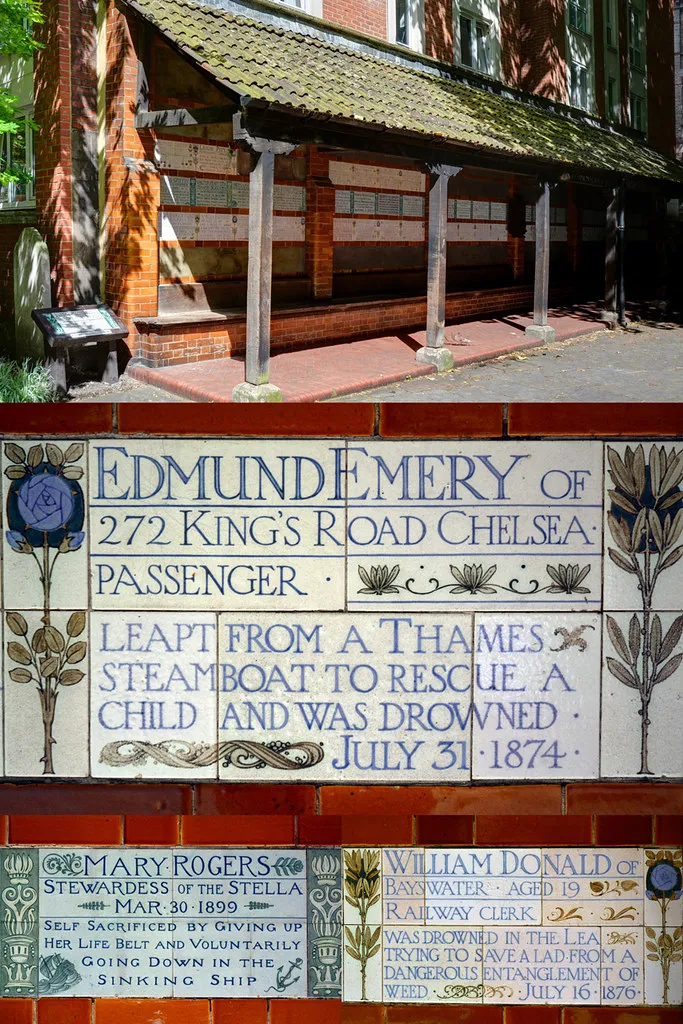
The 54 tiles record specific acts: a nursemaid who threw a child from a burning window and died in the fall, a young clerk who drowned pulling a stranger from the Thames in winter. The tile of Alice Ayres, who died saving three children from a Southwark house fire in 1885, inspired a pivotal scene in Patrick Marber's play and the film Closer. The park is open from 8:00 to dusk and entry is free with no booking required. It is a five-minute walk from St Paul's station and the entire memorial takes about twenty minutes to read properly.
5. The Guildhall Roman Amphitheatre: Beneath the City
In 1988, construction workers digging foundations below the Guildhall Art Gallery discovered the remains of Roman Londinium's amphitheatre. Dating from around AD 70 and later expanded to seat approximately 6,000 spectators, this was the arena where Londoners watched gladiatorial combat and public executions. The ragstone and flint entrance walls are original and can be touched. A surviving drainage sump — used to clear the arena floor after heavy rain or fighting — is still visible.
Access is through the Guildhall Art Gallery, which is also free, making it a double visit for zero cost. The entrance to the underground ruins is in the gallery basement; look for the curved black line marked on the pavement outside in the courtyard — it traces the exact perimeter of the buried arena. Modern lighting projections help reconstruct the missing wooden tiers. Opening hours are typically 10:30 to 16:00 daily. The nearest stations are Bank and Moorgate, both under ten minutes on foot.
6. Neal's Yard: A Colorful Hidden Courtyard
Neal's Yard is a narrow courtyard off Monmouth Street in Covent Garden that has been an independent enclave since the 1970s. Every surface is painted in bright blues, greens, and yellows. Natural food shops, a dairy, a juice bar, and a herbal apothecary occupy the ground floor units. The visual contrast with the grey streets leading in makes the first glimpse genuinely surprising for visitors who find it by accident.
The courtyard itself is a public space and free to enter at any time. The surrounding streets — Neal Street, Shorts Gardens, and Earlham Street — form a small pedestrian zone with independent record shops, vintage stores, and bakeries. Covent Garden station is the logical entry point, but Seven Dials is the better orientation landmark: look for the six-way junction and the Yard is just off the northwest arm. Weekday afternoons see the most shop activity; early mornings give you the architecture without the foot traffic.
7. Sky Garden and Horizon 22: Free Skyline Views
Sky Garden sits on floors 35–37 of 20 Fenchurch Street (the "Walkie Talkie"). The space combines floor-to-ceiling glass with planted terraces and an outdoor viewing deck. Horizon 22 occupies floors 58–60 of 22 Bishopsgate and sits around 100 metres higher, making it the tallest free public viewpoint in the city. Both are free. Both require advance booking. The experience is quite different.
Sky Garden has tiered seating, a bar, and west-facing terraces that catch the setting sun directly. The planted areas create a sense of destination rather than just a lookout. Horizon 22 is entirely glass-enclosed and stripped of furniture — it exists purely for the view. On clear days you can see Windsor Castle to the west and the North Downs to the south. For photography, Horizon 22 is better for its height and clean sightlines; Sky Garden is better for atmosphere and lingering. Both venues have airport-style security, so avoid large bags.
Sky Garden tickets are released on Mondays via the official Sky Garden site for the following three weeks and go within hours. Horizon 22 releases are less predictable and often have same-week availability. If Sky Garden is sold out, check Horizon 22 first before giving up on free views. Both are in the City cluster (see the neighborhood section below), so they pair naturally with the Guildhall Amphitheatre and Leadenhall Market.
8. The Wellcome Collection: Where Art Meets Science
The Wellcome Collection on Euston Road explores the relationship between medicine, art, and human experience. The permanent "Being Human" gallery brings together medical instruments, religious artefacts, artworks, and personal objects in a way that resists easy categorization. Henry Wellcome, the founder, was a pharmaceutical magnate who spent his fortune buying objects that illustrated how cultures across history had understood the body — the result is one of London's most intellectually surprising free museums.
Entry to the permanent collection is free. The museum is open Tuesday to Sunday from 10:00 to 18:00, with Thursday closings at 22:00. The Reading Room on the upper floor is a calm, well-designed space that is open to the public for quiet reading or working — one of the most pleasant free rooms in central London. The venue is directly next to Euston station, making it easy to fold into a day arriving or departing by train.
9. Platform 9¾ at King's Cross: For Harry Potter Fans
A luggage trolley embedded in the brick wall of King's Cross station marks the fictional departure point for the Hogwarts Express. It is free to visit. The installation is on the main concourse, near the Harry Potter shop. A queue forms during peak hours — roughly 10:00 to 15:00 on weekends — where staff with House scarves help visitors with posed shots and provide their own camera service.
The professional photos from staff cost money; taking your own is entirely free. Arrive before 09:00 on a weekday and the queue is often non-existent. If you arrive during peak hours and do not want to wait, the trolley itself is still visible from the corridor without queuing. The adjacent Harry Potter shop sells merchandise but entering and browsing costs nothing. For a broader look at off-the-beaten-path London, combine this with a walk to the Granary Square fountains at Kings Cross, which were redeveloped in 2012 and are open and free all year.
10. Queen Elizabeth Rooftop Garden: South Bank Secret
Above the Royal Festival Hall on the Southbank Centre complex sits a planted rooftop garden with wildflower beds, fruit trees, and unobstructed views of the London Eye, Westminster Bridge, and the Hungerford footbridge. It operates during summer and early autumn, typically from late April through October. Access is via the bright yellow staircase on the exterior of the building, facing the river.
Opening hours run roughly 10:00 to 22:00, though the garden occasionally closes for private events or during sustained bad weather. The Southbank Centre website lists closures a few days in advance. Entry is free and no booking is needed. It is a substantially quieter alternative to the crowded riverside promenade one floor below. The Southbank Centre also runs occasional free "garden sessions" with live music in the early evenings during summer — check the website when you plan your trip.
11. Richmond Park: Finding the Wild Deer
Richmond Park is the largest of the eight Royal Parks and covers 955 hectares of ancient woodland, grassland, and ponds in South West London. Over 600 red and fallow deer roam freely across the terrain — the herd has grazed here since Charles I enclosed the land in 1637. On a clear morning, the sight of deer moving through Isabella Plantation or grazing on the open hill above the Pen Ponds is genuinely spectacular.
Entry is free and the park is open to pedestrians year-round. During the deer rut in autumn (October and November), the red stags become highly active and unpredictable — stay at least 50 metres away. The park is best reached by taking the District Line to Richmond, then a 371 bus or a 20-minute walk to the Richmond Gate entrance. Cyclists are welcome on designated paths. Allow at least three hours for a proper circuit. Pembroke Lodge, within the park, has a cafe and stunning views across the Thames Valley to Windsor Castle on clear days.
12. Leadenhall Market: Victorian Splendor and Movie Magic
Leadenhall Market has occupied this site since the 14th century, though the current cast-iron and glass structure was designed by Horace Jones in 1881. The painted roof — burgundy, cream, and olive green — covers a grid of cobbled lanes lined with wine bars, butchers, and fishmongers. It served as the filming location for Diagon Alley in Harry Potter and the Philosopher's Stone and for several scenes in Tinker Tailor Soldier Spy.
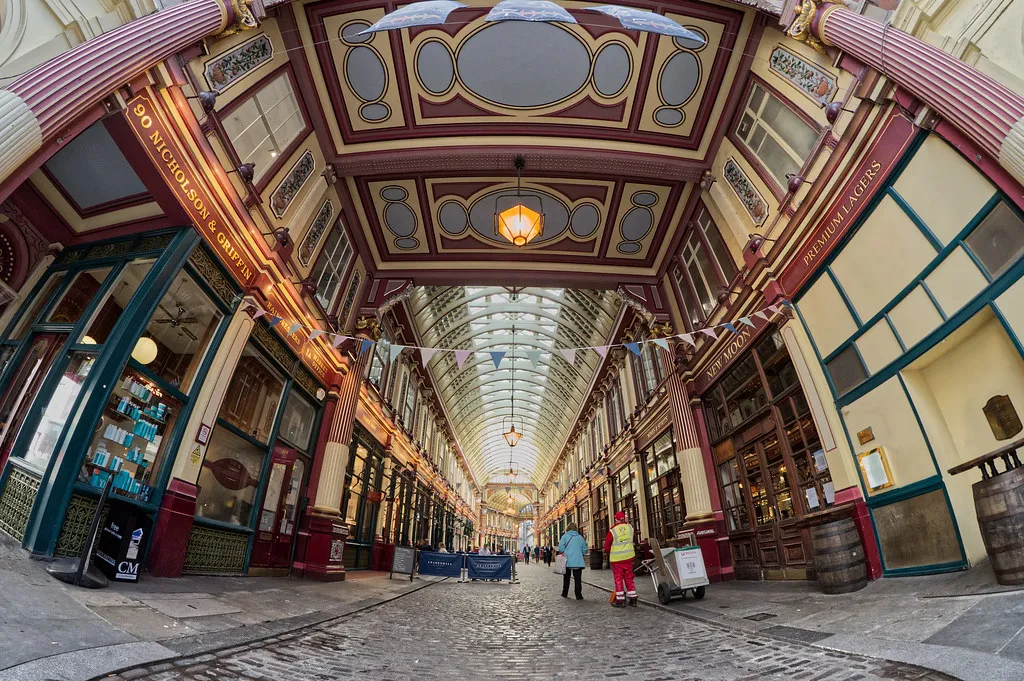
The market is a public thoroughfare and free to walk through at any hour. The shops and pubs operate primarily Monday to Friday for the City financial crowd, so weekend mornings offer the architecture without the lunchtime crush. The nearest station is Bank, a three-minute walk via Lombard Street. Combine with the Guildhall Amphitheatre, Monument, and Sky Garden for a full City cluster day. The alleyways surrounding the market — including Ball Court and Whittington Avenue — are Victorian in character and easy to miss even with a map.
Booking Lead Times and Neighborhood Clusters
Not every site on this list requires a ticket. Six of the twelve are walk-in, any time. The other six need either a booked slot or a check before you leave the hotel. Here is what the 2026 booking situation looks like in practice:
- Barbican Conservatory — Book Thursday 9:30am sharp on the Barbican website for the following week. Slots go in under five minutes.
- Sky Garden — Book Mondays on the official skygarden.london website for the following three weeks. Sunset slots go first.
- Horizon 22 — No fixed release day. Check the Horizon22 website weekly. Same-week slots often available mid-week.
- Hunterian Museum — Timed-entry booking recommended but not always mandatory. Book via the Royal College of Surgeons website.
- Wellcome Collection — Walk-in accepted, but booking a timed slot avoids queues on busy weekends.
- All others — St Dunstan, Postman's Park, Neal's Yard, Guildhall, Platform 9¾, Queen Elizabeth Garden, Richmond Park, Leadenhall — no booking required.
| Place | Entry Cost | Booking Required | Opening Hours | Nearest Station |
|---|---|---|---|---|
| St Dunstan in the East | Free | No | Daily 8:00–dusk | Monument (5 min) |
| Barbican Conservatory | Free | Yes – Thursdays 9:30am | Sundays 12:00–17:00 | Barbican / Moorgate |
| Hunterian Museum | Free | Recommended | Tue–Sat 10:00–17:00 | Holborn |
| Sky Garden | Free | Yes – Mondays | Daily (check website) | Monument |
| Horizon 22 | Free | Yes – check weekly | Daily (check website) | Liverpool Street |
| Wellcome Collection | Free | Optional | Tue–Sun 10:00–18:00 | Euston |
| Richmond Park | Free | No | Year-round (dawn–dusk) | Richmond then bus 371 |
| Leadenhall Market | Free | No | Daily (shops Mon–Fri) | Bank (3 min) |
To minimize Tube costs and walking time, group these into three neighborhood clusters. The City cluster pairs St Dunstan in the East, the Guildhall Amphitheatre, Sky Garden (or Horizon 22), and Leadenhall Market — all within a 15-minute walk of Bank station. The South Bank cluster links the Queen Elizabeth Rooftop Garden and the Wellcome Collection (10 minutes apart via Waterloo); the Walk routes along the Southbank between them pass through the London food markets at Borough and Bermondsey. The West End and Holborn cluster connects the Hunterian Museum, the Barbican Conservatory, Neal's Yard, and Platform 9¾ using the Central and Circle lines with under 20 minutes between each stop. Richmond Park stands alone as a half-day trip from Zone 1.
Free Museums and Galleries: The National Collections
Beyond the unusual spots above, London's major national museums remain free for their permanent collections in 2026 — a policy that has been in place since 2001 and remains unchallenged. The British Museum near Russell Square holds the Rosetta Stone, the Elgin Marbles, and Egyptian mummies. The National Gallery on Trafalgar Square covers Western European painting from the 13th to 19th centuries. The V&A in South Kensington houses applied arts and design from every period and culture.
Tate Modern on the South Bank is free for its permanent collection, with paid temporary exhibitions. The Natural History Museum is free and draws large family crowds on weekends — visit before 10:00 or after 15:30 to reduce queue times. The National Portrait Gallery reopened in June 2023 after a three-year renovation and offers a chronological survey of British history through portraiture, entirely free. None of these require booking for the permanent galleries, though timed entry is sometimes requested for specific blockbuster rooms during peak season. Always check the museum website the day before.
Quirky Neighborhoods: Camden Market and Beyond
Camden Market is free to enter and covers several interconnected indoor and outdoor spaces along the Regent's Canal. The original Lock Market, Stables Market, and Buck Street Market all operate daily and charge nothing for browsing. Street food stalls cluster around the lock itself, and the canal towpath is a pleasant free walk east toward King's Cross or west toward Regent's Park. Arrive by 11:00 on weekends before the crowds make the covered passages uncomfortable.
Shoreditch is worth a specific mention for its permanent outdoor street art. Brick Lane, Hanbury Street, and the lanes off Curtain Road carry work by internationally recognised artists including ROA, Ben Eine, and Zabou. The murals change regularly and cost nothing to see. A self-guided walk from Old Street station through Brick Lane to Spitalfields Market takes around 90 minutes. Check the London street art guide online before you go for an updated map of active walls.
Frequently Asked Questions
Do I need to book the Barbican Conservatory in advance?
Yes, booking is essential as tickets are limited and very popular. They are typically released on the Barbican website every Thursday morning for the following week's slots.
Are all London museums free to visit in 2026?
Most major national museums like the British Museum and V&A remain free for their permanent collections. However, some smaller private museums and special temporary exhibitions usually require a paid ticket.
What is the best free viewpoint in London for sunset?
The Sky Garden is widely considered the best for sunset because of its west-facing terrace and social atmosphere. Ensure you book your slot at least three weeks in advance to secure a sunset time.
For the broader picture, pair this with our London hidden gems guide — the curated overview of off-the-beaten-path London this free-spots roundup builds on.
London's true magic often lies just a few steps away from the crowded tourist trails. By visiting these unusual places, you gain a perspective on the city that most visitors completely miss. Whether you are standing in a Roman arena or a Brutalist jungle, these experiences cost nothing but offer immense value. I hope this guide helps you navigate the capital's secrets while keeping your budget intact during your 2026 trip.
Remember to check for unusual things to do in London as you plan each day. The city is constantly evolving, and new free spaces are opening every year for public enjoyment. Pack your walking shoes, keep your camera ready, and enjoy the incredible, free diversity of London.
Continue exploring
More guides you'll find useful