Hidden Gems in Arezzo: Quiet Corners, Views and Local Rituals
Explore Arezzo's quieter corners, from frescoes and a Vasari clock tower to Roman remains and a monthly antiques fair, with practical planning advice.
On this page
Arezzo sits on a hill in south-eastern Tuscany, wrapped by four valleys, and its historic centre is compact enough to cross on foot in a single unhurried day. That shape is exactly why it suits slow exploration: instead of shuttling between sights, you can drift from a fresco chapel to a fortress park to a market square without a bus. Use this guide to pick the corners that match your interests and to know which details you should confirm directly before travelling.
The city also carries layers that many Tuscan stops lack. Sources describe visible traces of Etruscan and Roman heritage beneath medieval streets and Renaissance art, which means a modest-looking lane can sit on top of an amphitheatre or an older acropolis. Treat that as your organising idea for a visit: one Renaissance masterpiece, one Roman fragment, one street-level pleasure and one long view per day is a realistic rhythm.
Why Arezzo rewards slow exploration
Arezzo is often framed as the calmer alternative to Florence and Siena, and that framing holds up in practical terms: the centre is walkable, the main sights cluster on one hill, and you rarely need to queue for a bus or a ticket window before you have even seen the city. Travel writing describes it as a hilltop city surrounded by the Val Tiberina, Valdarno, Val di Chiana and Casentino valleys, which is a useful mental map when you are deciding whether to walk up or start high and descend.
The trade-off is that Arezzo does not hand you a single headline monument the way Florence does. Its rewards are distributed: a chapel fresco here, a painted ceiling there, a market that fills the main square once a month. If you want a checklist of headline sights and their visiting basics, start with the Arezzo Attractions hub and then return here for the quieter material.
Plan around a morning and a late afternoon rather than a tight midday block. Church interiors and museums tend to absorb more time than expected, and the light over the valley edges is the reward for climbing the hill twice. The Arezzo old town neighbourhood guide is the natural companion for orientation, since it explains how the streets connect the station end to the upper squares.
Piazza Grande and the Vasari clock tower
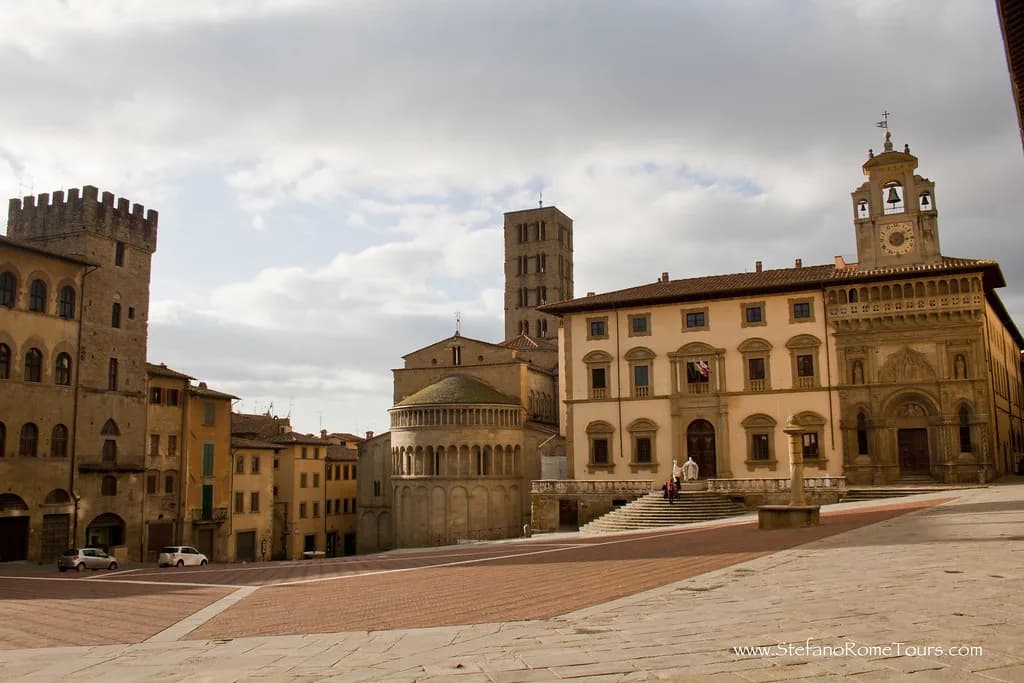
Piazza Grande is the obvious starting point and the least hidden place in Arezzo, but its surrounding buildings are where the quieter interest lies. The square is also the city's event stage, hosting antique markets and the Christmas village at different times of year, so what you see depends heavily on the calendar. Arrive on an ordinary weekday if you want the space itself rather than a crowd.
Just off the square, the Palazzo della Fraternita dei Laici has functioned as a museum since 2010 and is a sensible first stop for the city's history, covering everything from the Vasari Aqueduct to its art collection. The building's Sail Clock Tower, designed by Giorgio Vasari, gives a rooftop view out over Piazza Grande and the surrounding hills; this is a shorter, lower climb than a full campanile and correspondingly gentler on the legs.
Do not assume the palace and tower share one simple ticket arrangement or fixed daily hours. The sources describe the museum and the tower but do not give reliable current opening times or entry costs, so check the operator's own information for the day you intend to visit and build in a fallback if the tower is closed. A good fallback is simply to walk the square's perimeter and look at the loggia facades from below, which costs nothing.
San Francesco and Piero della Francesca's fresco cycle
The Basilica of San Francesco holds the Legend of the True Cross, Piero della Francesca's fresco cycle in the Bacci Chapel and the single strongest reason many travellers come to Arezzo. The church building itself began before the end of the thirteenth century and looks deliberately plain outside, so the impact is concentrated indoors. Allow more time than you think, because the chapel is a place to sit and read rather than glance at.
This is also where you should be most careful about planning. Fresco chapels in Italy often run on timed entry, limited group sizes or seasonal hours, and the available sources do not confirm current arrangements for the Bacci Chapel. Before you commit a day to it, check the basilica's published visiting information and, if your dates are fixed, consider asking your accommodation to confirm the chapel is open on that specific day.
If the chapel turns out to be unavailable, Arezzo still holds several Piero works elsewhere, including pieces in the civic museum and the artist's birthplace, which now operates as a museum (Visititaly). That gives you a genuinely useful alternative rather than a wasted morning, and it spreads the Renaissance art across the city instead of concentrating it in one interior.
The archaeological museum and the Roman amphitheatre
Arezzo's archaeological collection sits in a former monastery, and the reason to go is not only the artefacts but the Roman amphitheatre remains alongside it. For travellers interested in the city's older layers, this is the most direct way to see them without leaving the centre. Set aside a modest block of time, since the museum is small enough to feel manageable rather than exhausting.
One practical anecdote is worth repeating because it shapes expectations: a visitor found the amphitheatre grounds locked, assumed they were off-limits, then asked at the front desk and was told the gate could be opened on request (Our Escape Clause). Treat that as a nudge to ask staff rather than a guaranteed arrangement, and do not count on it during busy periods or outside normal opening. The lesson is simply that a closed gate in an Italian museum complex is sometimes a question, not a verdict.
Giorgio Vasari's house: a small museum with painted ceilings
Vasari was born in Arezzo and decorated his own house here, covering ceilings and walls with paintings he executed himself. The result is a compact museum that many visitors walk past without noticing, and its size is part of the appeal: you can see it properly in under an hour and still have the afternoon free. If you have already noticed Vasari's name on the clock tower, the house completes the picture.
Because it is small, it is also the kind of place where opening restrictions bite hardest. The sources describe the interior but do not confirm current days, hours or admission arrangements, so verify before making a special trip and keep it as a flexible stop rather than the anchor of your day. Photographing painted ceilings is difficult in low light, so plan to look rather than to capture.
The Medici Fortress and its park
The Medici Fortress dates to the sixteenth century and stands on the high ground where the city began, above the former Etruscan acropolis. Its position at the top of the Hill of San Donato gives wide views in every direction, and the park outside the walls makes an attractive approach on foot from the historic centre. This is the best free, open-air counterweight to a day of church and museum interiors.
Between the cathedral and the fortress, Prato Park forms a large green space on top of the hill, with views over the city and the surrounding countryside and room for children to run. It is a public park rather than a ticketed attraction, which makes it a reliable low-cost pause when you need one. Combine the two green spaces in a single loop so you climb the hill once.
Corso Italia and everyday street life
Corso Italia runs from near the train station up towards and past Piazza Grande, which makes it both the most practical street in the city and a pleasant one in its own right. You will pass bars, shops and outdoor tables, and you would struggle to avoid it while walking between the station and the upper town. Treat it as the connective tissue of a day rather than a sight to tick off.
This is also where a slower visit pays off. Rather than marching uphill, break the walk with a coffee or an aperitivo and watch how the street changes between morning errands and evening strolls. If you only have a single day, the One day in Arezzo itinerary sequences these stops sensibly so you are not doubling back.
Arezzo Cathedral and what to verify before you go
The Cathedral of Saints Peter and Donatus has been under construction across centuries, with Gothic architecture still prominent and frescoes inside, including Piero della Francesca's Mary Magdalene painted in 1459. It also holds the Holy Face reliquary and works by Vasari, so it rewards more than a cursory look. Entering a working cathedral is often free while separate chapels, museums or cloisters may be ticketed, and the sources here do not settle which applies on any given day.
Build your own checklist before visiting: confirm whether the main nave is open without a ticket, whether any fresco area carries a separate charge, and whether photography is restricted. Signs at the entrance are usually the final word, but checking the diocese or cathedral website in advance saves a wasted climb. Dress respectfully, since this is an active place of worship rather than a gallery.
If you want the other monuments in the same complex handled one at a time, the Arezzo Attractions guides break down each sight separately so you do not accidentally assume one ticket covers everything.
The monthly antiques fair and how to time your dates
Arezzo's antiques market fills Piazza Grande and the surrounding streets, and travel sources describe it as recurring on the first Sunday of each month plus the preceding Saturday (Visititaly). They report that it spreads across the historic centre with furniture, paintings, jewellery, rugs and books among the offerings. Because the exact calendar can shift, treat the pattern as a planning rule and confirm the specific weekend with the organiser before booking travel around it.
If your dates miss the fair, Arezzo still has permanent antique dealers in the centre, so the interest is not entirely lost. Conversely, if your dates hit it, expect the square to be busy and the surrounding streets slower to walk; plan Museum visits for the morning and the market for the afternoon. The Arezzo antiques fair and markets guide goes further into what the stalls tend to sell and how the weekend changes the city.
Arezzo at Christmas and the seasonal crowd trade-off
In the Christmas season Piazza Grande hosts a Tyrolean-style village of wooden chalets, with regional food and gifts recreating an Alpine market atmosphere without travelling north (Visititaly). Elsewhere in the city, the Prato area becomes a family-oriented Christmas park with light installations, and an illuminated route guides people along the Corso. This is the busiest, most commercial version of Arezzo and it is worth knowing that before you book.
The trade-off is straightforward: December gives you atmosphere and crowds, while spring and autumn give you the churches and museums closer to yourself. Neither is wrong, but they are different trips. The sources describe the Christmas installations without confirming current-season dates, so check what is running in the year you travel rather than assuming the full programme repeats.
Autumn foliage and green escapes beyond the walls
The province around Arezzo changes colour from roughly September to November, with foliage described as peaking between late October and mid-November. Nearby options include the Val d'Ambra Nature Reserve with its oak, beech and chestnut woods, the Casentino Forests National Park, and viewpoints such as the Castle of Poppi (Visititaly). Weather shifts quickly in autumn, so check conditions on the day and wear shoes suited to wet trails.
These are day trips rather than city strolls, and several need a car to reach comfortably. If foliage is your main motivation, base yourself accordingly and keep a wet-weather alternative in Arezzo's museums. Leave trails and trees as you found them, and carry your rubbish out with you.
Getting there and when a car actually helps
Arezzo is well connected by rail, and travel accounts describe the run from Florence as roughly an hour of scenic Tuscan countryside (Our Escape Clause). The station sits below the historic centre, which means a walk uphill to reach Piazza Grande unless you start at the Corso Italia end. If you are arriving by car, park outside the walls and walk in, since the centre is pedestrian-heavy.
A car becomes worthwhile when you want Cortona, Montepulciano or Umbrian destinations such as Lake Trasimeno, which are awkward by train. For a city-only visit it is a liability rather than an asset. The hilltop description of Arezzo as a base for both nature and culture is the right way to decide: if you plan to leave the city each day, rent; if not, take the train.
Treat journey times as traveller-reported rather than published, and confirm schedules on the operator's own site for your travel date, particularly on Sundays and public holidays. If your plans run beyond one day, the Two days in Arezzo itinerary shows how to split a longer stay without commuting unnecessarily.
One day versus three days: what to keep and what to skip
With one day, keep Piazza Grande, the Palazzo della Fraternita and its tower, San Francesco if the chapel is open, and the fortress park for the view at the end. Skip anything requiring a special trip. That combination gives you Renaissance art, a rooftop view and open space without sprinting between them, and it fits an unhurried rhythm rather than a tour-group one.
With three days, add Vasari's house, the archaeological museum and amphitheatre, the cathedral interior and a half-day outside the walls, either for foliage in autumn or a valley village. The extra time does not mean seeing more churches; it means seeing the same places when they are quieter and leaving room for a long lunch. Keep the antiques fair as a fixed point if it falls on your weekend, and shape the rest of the days around it.
Readers continuing through Tuscany can compare the approach in hidden gems in Florence, though Arezzo's appeal is precisely that it offers a slower, smaller version of the same pleasures.
Plan Your Visit
Arezzo works best when you resist the urge to treat it as a reduced Florence. Choose one fresco cycle, one old stone fragment, one long view and one street to linger on, then confirm the details that matter for your dates: chapel access, museum days, tower opening and, if relevant, the fair weekend. Everything else can be decided on the day, which is the point of a city this compact.
Start with the Arezzo Old Town Guide for orientation, then use the individual attraction pages for anything you intend to book or build a day around. If you are coming from Florence, compare it with hidden gems in Venice only as a reminder of how different a quiet Italian city can feel when you slow down.
More Arezzo guides
- Arezzo Antiques Fair and Markets
- Arezzo Goldsmiths and Artisan Workshops
- Arezzo Nightlife Guide
- Arezzo Old Town Neighbourhood Guide
- Arezzo on a Rainy Day
- Arezzo with Kids
- Best Time to Visit Arezzo Without the Crowds
- Day Trips from Arezzo
- One Day in Arezzo
- Two Days in Arezzo
- What to Eat in Arezzo
- Badia di Arezzo
- Basilica di San Francesco, Arezzo
- Casa Vasari Arezzo
- Chiesa di San Domenico in Arezzo
- Duomo di Arezzo Visitor Guide
- Fortezza Medicea Arezzo
- Museo Archeologico Nazionale Gaio Cilnio Mecenate
- Piazza Grande Arezzo
- Piero della Francesca's Legend of the True Cross in Arezzo
- Santa Maria della Pieve in Arezzo
Frequently Asked Questions
What is Arezzo known for beyond the main sights?
Arezzo is known for Piero della Francesca's fresco cycle in the Basilica of San Francesco, its monthly antiques market in Piazza Grande, and a compact hilltop centre with Etruscan and Roman layers beneath medieval and Renaissance streets. Less obviously, it has a small museum in Vasari's own house with painted ceilings, a fortress park on the highest ground, and a cathedral holding works by Vasari and Piero. Many of these are modest in scale, which is part of the appeal.
Are the Roman amphitheatre grounds open to visitors?
That depends on the day and on staff at the archaeological museum, and the available sources do not confirm a standing arrangement. One traveller found the grounds locked, asked at the front desk, and was told the gate could be opened on request. Ask when you arrive rather than assuming, and treat any access as a bonus.
When is the Arezzo antiques fair held?
Travel sources describe the fair as recurring on the first Sunday of each month plus the preceding Saturday, spreading through Piazza Grande and nearby streets. Because organisers can adjust the calendar, confirm the specific weekend before booking travel around it. On fair weekends, plan museum visits for the morning and the market for the afternoon.
Is one day in Arezzo enough?
One day covers Piazza Grande, the Palazzo della Fraternita and its clock tower, the Basilica of San Francesco if the chapel is open, and the fortress park for a view. It is not enough for the archaeological museum, Vasari's house, the cathedral interior and a trip outside the walls. If those matter to you, allow two or three days and keep the pace slow.
Is Arezzo quieter than Florence or Siena?
Sources consistently describe Arezzo as a smaller, calmer alternative to those cities, with a walkable centre that rarely feels overwhelmed outside market weekends and the Christmas season. That does not mean empty: the antiques fair and the December market draw real crowds. On ordinary weekdays, the churches and squares are usually comfortable to explore.
Do you need a car to visit Arezzo and nearby towns?
For Arezzo itself, no: the centre is walkable and the station puts you below the historic centre. A car helps for Cortona, Montepulciano or Umbrian destinations such as Lake Trasimeno, which are awkward by rail. If you plan to stay in the city and take day trips by train, skip the rental and confirm schedules with the operator.
Sources
Continue exploring
More guides you'll find useful