Arezzo Old Town Guide: Walking the Historic Centre
Walk Arezzo's old town from sloping Piazza Grande up to the cathedral and Parco il Prato. See how Corso Italia links the sights and where to base yourself.
On this page
Arezzo sits inland between Florence and Perugia, and its historic centre rewards a different approach from a flat grid of sights. The core climbs a hill, so the order you walk it in matters as much as the list of things to see. This guide treats the old town as connected neighbourhoods and explains what each one asks of your legs and your time.
One concrete starting detail: the antique market fills Piazza Grande, Piazza San Francesco and the Logge Vasari on the first Sunday of each month plus the Saturday before, according to To Tuscany's city guide. That single fact can reshape a visit, because those squares are also the natural crossroads of any walk. Check the market calendar before you fix your dates, then plan the rest around it.
Orientation: A Hill Town, Not a Grid
Think of Arezzo as three tiers. Piazza Grande and the Corso sit in the middle of the slope, the cathedral and Parco il Prato occupy the highest ground toward the Medici fortress, and the Basilica di San Francesco anchors the lower southern lanes. Walking uphill first and letting gravity bring you back down is the most efficient way to cover the centre without doubling back.
Arriving by rail is straightforward: the station lies on the Bologna-Rome line, and To Tuscany notes you can reach the antique fair area from the terminal in just over ten minutes on foot. That proximity makes a station-side base practical for short trips. If you want to move between districts without climbing repeatedly, staying inside the centre reduces the daily hill work but removes the easy luggage-and-train convenience.
Piazza Grande: The Sloping Heart
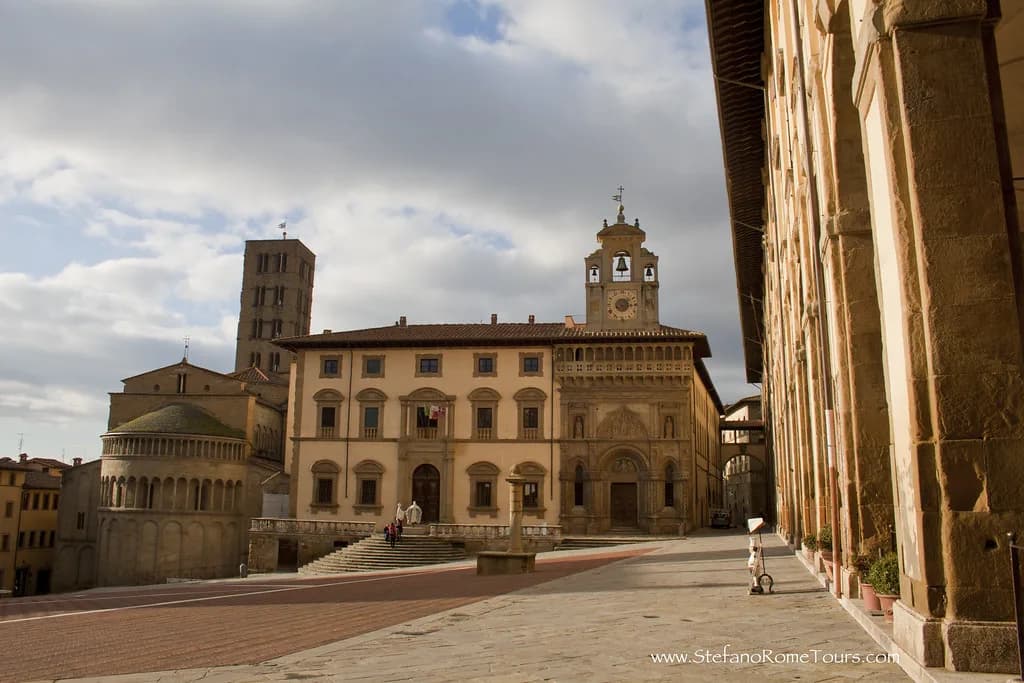
Piazza Grande has a deliberately uneven pavement, and that tilt is part of its character rather than a flaw to route around. The piazza took shape in the thirteenth century and has been amended over the centuries, which is why the buildings around it read like a timeline of the city. Sit at one of the bars under the loggia and the square becomes a vantage point rather than a checklist item. For wider planning, see Piazza Grande Arezzo.
Two facades deserve a slow look. The Palazzo delle Logge carries Giorgio Vasari's elegant loggia, while the Palazzo della Fraternita dei Laici displays an ornate front with one of Europe's oldest astronomical clocks, still working and linked to the bells above. Neither requires a ticket to admire from outside, which makes this the cheapest strong first impression in the city. Further visitor details appear in Adventures with Sarah | Blog | The Spectacular Town Of Arezzo.
Corso Italia and Santa Maria della Pieve
Corso Italia is the connective tissue of the centre, running past the southern flank of Piazza Grande where Santa Maria della Pieve rises with its carved facade and the so-called tower of a hundred holes. The church is among the oldest in the city, with origins traced to the sixth century, though most of what stands today dates to the thirteenth. Step inside for a quieter moment between the bustle of the square.
Use the Corso as your orientation line rather than a shopping destination; sources describe it as the street linking the square and the Pieve, not as a retail spine. Walking it end to end gives you a feel for how compact the centre really is, and it puts you within a few minutes of the cathedral climb and the southern lanes.
The Top of the Hill: Cathedral and Parco il Prato
Arezzo's cathedral, the Duomo dei Santi Donato e Pietro, presents a plain exterior that hides a soaring Gothic interior with stained glass, ceiling frescoes and a Mary Magdalene by Piero della Francesca. Donatello had a hand in the hexagonal baptismal font, and Vasari contributed architectural work over the centuries. The contrast between the sober facade and the interior is the reason to climb the hill rather than photograph it from below. Further visitor details appear in Adventures with Sarah | Blog | The Spectacular Town Of Arezzo.
Behind the cathedral, Parco il Prato stretches across the top of the hill toward the Medici fortress, and it is the original heart of the city rather than a decorative add-on. The paths give you views back over the cathedral and a genuine breather after the climb. Whether church interiors and any fortress sections are open, and on what terms, changes seasonally; confirm current arrangements with the Fondazione Arezzo Intour before building a day around them. For wider planning, see Fortezza Medicea Arezzo visitor guide.
Basilica di San Francesco and the Southern Lanes
The Basilica di San Francesco holds Piero della Francesca's cycle of frescoes, the Legend of the True Cross, in the Bacci Chapel. The paintings survived an earthquake, lightning and an attack by Napoleonic troops, which is part of why art lovers treat this church as a pilgrimage rather than a detour. It anchors the southern lanes, so pairing it with Piazza San Francesco makes a natural lower-town loop. Further visitor details appear in Uncover Arezzo: Your Ultimate Insider's Guide to Tuscany's Hidden Gem.
Budget for a visit inside the chapel rather than a glance from the door, and check access rules before you travel. The frescoes sit in a confined space, and viewing arrangements are the kind of detail that changes without much notice. Note that a church interior and a ticketed museum collection are different things here; do not assume one entry covers everything you plan to see.
Casa Vasari and the Roman Amphitheatre
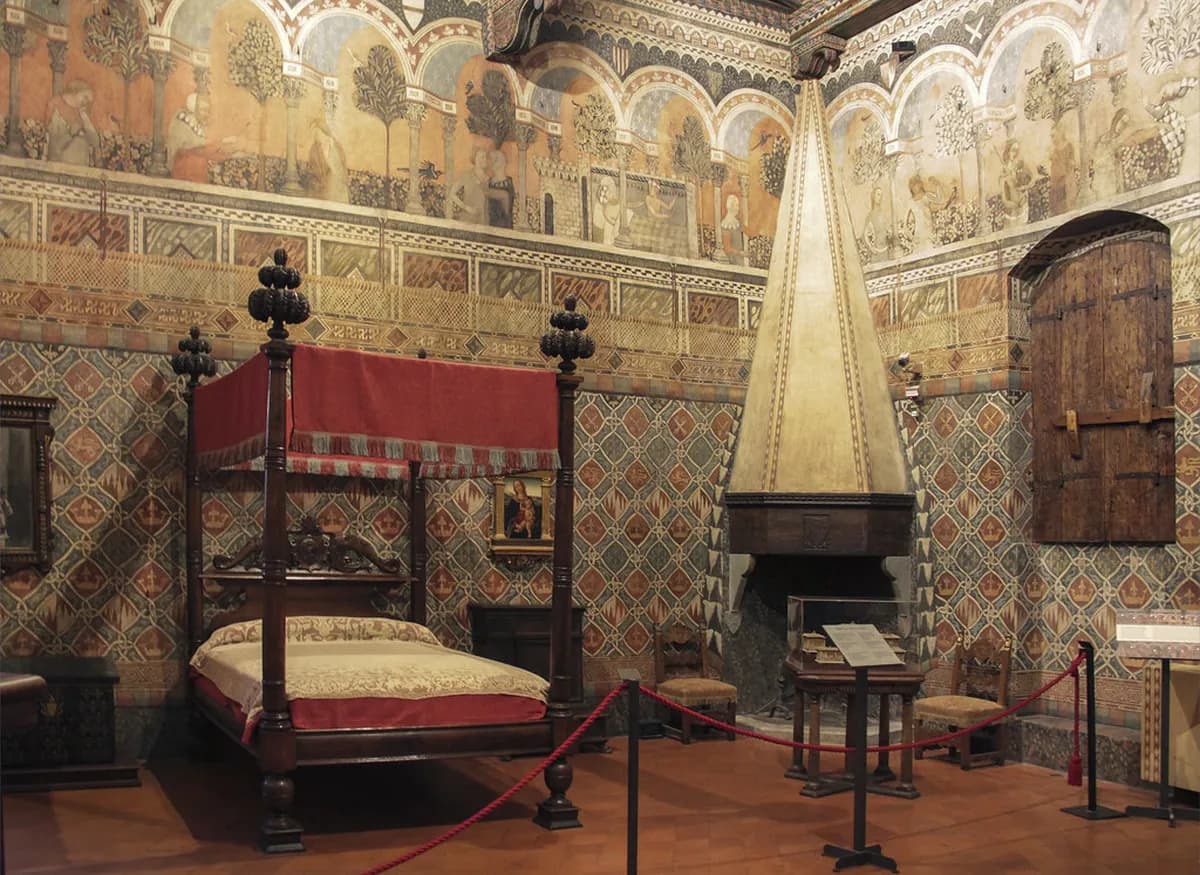
Casa Vasari, the family home Giorgio Vasari decorated over roughly two decades after buying it in 1541, became a museum after the Italian state purchased it in 1911. Rooms restored with frescoes of the artists he admired give you a sense of the man behind the loggia you saw at Piazza Grande. It is a compact, focused visit rather than a sprawling collection. Further visitor details appear in Adventures with Sarah | Blog | The Spectacular Town Of Arezzo.
South of the centre, the Museo Archeologico Gaio Cilnio Mecenate overlooks the remains of a Roman amphitheatre that once held around ten thousand spectators. Inside, prehistoric finds, Etruscan material and Roman pieces spread over two floors in a building curved along the ancient structure's foundations. The garden ruins are a separate experience from the museum galleries, so treat them as two stops even on one outing. Further visitor details appear in Adventures with Sarah | Blog | The Spectacular Town Of Arezzo.
Two Rhythms That Reshape the Streets
The antique market is the largest and oldest of its kind in Italy, established in 1968 through the efforts of dealer and collector Ivan Bruschi. It spreads through Piazza Grande, Piazza San Francesco and the Logge Vasari on the first Sunday of the month and the preceding Saturday. If your dates land on that weekend, expect the squares to be full and plan museum visits around the crowds. Further visitor details appear in Uncover Arezzo: Your Ultimate Insider's Guide to Tuscany's Hidden Gem.
The Giostra del Saracino runs twice a year, in June at night and September by day, with knights from the four quarters jousting in period costume and Renaissance-era rules. The current event dates from a 1931 revival of a lapsed tradition, and locals take the result seriously. Neither the market nor the joust publishes a fixed annual date far in advance, so verify the current year's schedule before booking. Further visitor details appear in Adventures with Sarah | Blog | The Spectacular Town Of Arezzo.
Choosing a Base: Old Town or Station
Staying inside the historic centre buys atmosphere and short walks to Piazza Grande, the cathedral and the basilica, but it means climbing with luggage through narrow lanes. A base near the station trades charm for flat access, straightforward arrivals and a ten-minute walk to the fair area. For a one-night stop, convenience usually wins; for two or three nights, the centre pays you back in mornings.
Practical Walking Notes: ZTL, Parking and Hours
Arezzo's centre is covered by a restricted traffic zone, and driving into the heart of the city without a permit is not allowed. Signage marks the boundary, but the exact perimeter and permit rules are administrative details that change; ask your accommodation or the tourism office before you drive in. The practical workaround is to park outside the restricted area and walk up, which also keeps you honest about the hill. Further visitor details appear in Adventures with Sarah | Blog | The Spectacular Town Of Arezzo.
Opening hours and ticket terms for churches, museums and the fortress are the least stable facts in any Arezzo plan. Some interiors are free to enter, others are ticketed and separately administered, and closures for restoration happen. Check the official sources close to your travel date rather than relying on a cached listing, and treat any guide, including this one, as orientation rather than a schedule.
Plan Your Visit
Arezzo rewards a walking plan built around its slope: start at Piazza Grande, climb through the Corso and the cathedral plateau, then descend into the southern lanes for Piero della Francesca and the amphitheatre. If those dates coincide with the antique market or the joust, flip the order and treat the squares as evening terrain. Either way, verify hours and access before you go.
Frequently Asked Questions
Is Arezzo's old town walkable?
Yes, the historic centre is compact enough to cover on foot, though it climbs a hill. Piazza Grande, Corso Italia and Santa Maria della Pieve sit mid-slope, the cathedral and Parco il Prato occupy the top, and the Basilica di San Francesco anchors the lower southern lanes. Plan an uphill route first and let the descent carry you between the remaining sights.
How long do you need to see the historic centre of Arezzo?
A single day covers the headline sights if you start early and keep moving between the slopes. Two nights let you add Casa Vasari, the archaeological museum and a proper look at the frescoes without rushing. There is no official recommended duration, so treat these as planning suggestions and adjust for how long you linger in churches.
Should you stay in Arezzo's old town or near the train station?
Staying in the centre gives you early access to Piazza Grande and short walks to most sights, at the cost of climbing with luggage through narrow lanes. A station-side base is flatter and easier to reach, and the antique fair area is roughly ten minutes on foot from the terminal. For one night, convenience usually decides it.
What is the first Sunday antique market in Arezzo?
It is a large monthly antiques and collectables fair, described as the largest and oldest of its kind in Italy, established in 1968 through the efforts of Ivan Bruschi. Stalls fill Piazza Grande, Piazza San Francesco and the Logge Vasari on the first Sunday of the month and the Saturday before. Confirm the current month's arrangements before travelling.
Can you walk from Piazza Grande to the cathedral?
Yes, it is an uphill walk through the historic centre rather than a long journey. The cathedral and Parco il Prato sit at the highest point of the old town, so allow time for the gradient and for exploring the interior and the park once you arrive. Check current opening arrangements for the cathedral before you set out.
Sources
Continue exploring
More guides you'll find useful