Santa Maria della Pieve Arezzo: Visitor Guide to the Pieve
Plan a visit to Santa Maria della Pieve in Arezzo: the carved Romanesque facade, the tower of a hundred holes and Lorenzetti's polyptych inside the Pieve.
On this page
Santa Maria della Pieve is the church many visitors meet first in Arezzo, not because it is signposted louder than anything else but because it stands on Corso Italia, the main walking spine of the historic centre. That position changes how you experience it: there is no sweeping square in front, so the carved facade is read up close, at an angle, as you walk.
Locals simply call it the Pieve, and it rewards a slower look than a passing photograph. The best approach is to treat it as a short, focused stop inside a walking route rather than a separate excursion, and to separate what you can see casually from what demands planning.
The church is documented as beginning in the 12th century over an earlier Christian building, with the arcaded facade added a century later, as summarised in Arezzo tourist information. For orientation on where this fits among the city's monuments, start with the Arezzo Attractions hub and then walk down to the Corso.
Where the Pieve Sits and How to Slot It Into a Walk
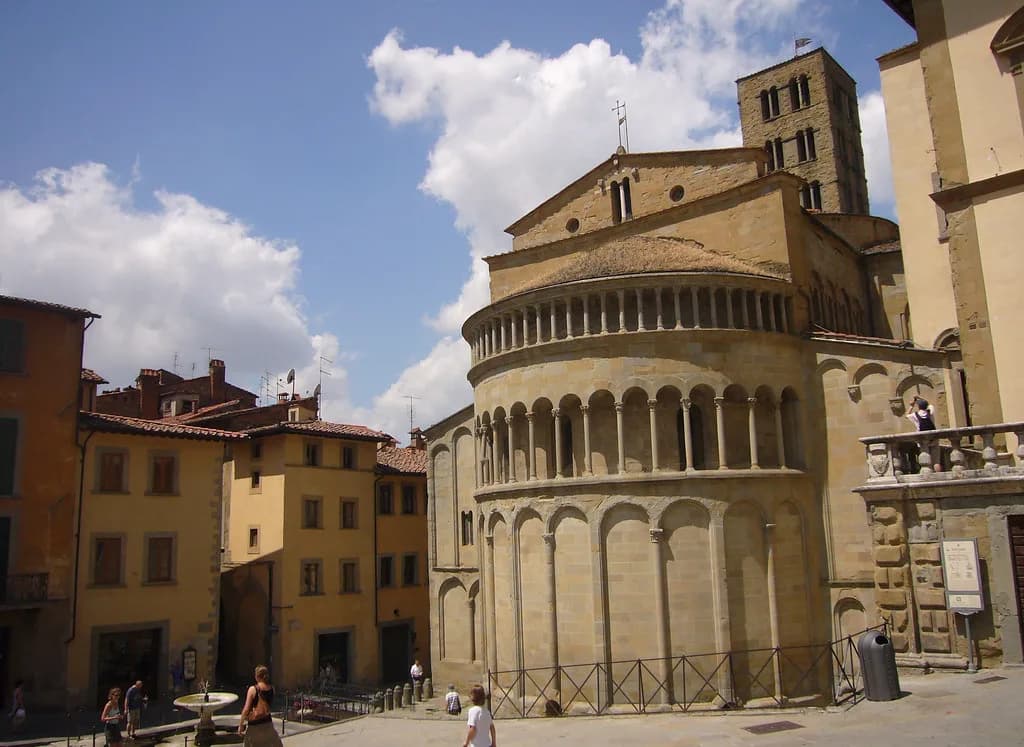
The Pieve occupies the southern edge of Piazza Grande, rising from the Corso Italia side, so the church's back and bell tower actually face the square while its main entrance fronts the shopping street. That means you can approach it twice in one walk: first from the sloping square beside the Vasari Loggia, then again from the Corso itself.
A sensible route is to start at Piazza Grande, continue along Corso Italia past the Pieve, and keep climbing toward the Duomo at the top of the hill. Arezzo's centre is compact enough to cover on foot, and this sequence avoids doubling back. If you want more context on the streets themselves, the Arezzo old town neighbourhood guide sets out the layout.
Because the church sits on the main street rather than a dedicated piazza, there is no grand forecourt to stand back in. Photographers should expect tight angles, and the most legible view of the facade is from slightly along the Corso rather than directly in front.
Reading the Facade Column by Column
The front is built as a series of stacked loggia arcades with small arches, and the columns above the portal are each carved differently rather than repeated from a mould. Look along the row instead of at the whole wall: the capitals and shafts change rhythm, which is exactly what makes this one of the most cited Romanesque fronts in Tuscany.
Above the main doorway sits a 13th-century relief cycle showing the months of the year, with a lunette of the Virgin between two angels. These are the details most people walk past; they sit at eye level once you step close, and they are worth a couple of minutes before you go in.
Treat the exterior as free and open to view at any hour, since it is a street-facing facade rather than a gated monument. That also means it is busy with ordinary foot traffic, so early morning is calmer if you want the carvings to yourself.
The Tower of a Hundred Holes
The square-plan bell tower is pierced by double orders of mullioned windows, and the count of openings gave rise to the nickname tower of a hundred holes. Some accounts put the number of apertures at around forty, which shows how loosely the nickname should be read: it is a description of effect, not an inventory.
Practically, the tower is what you see from Piazza Grande, where the church's Romanesque apse closes the southern side of the square. Standing on the sloping brick pavement and looking up gives you the second, less photographed view of the Pieve, and it explains why the church feels like part of the square even though its entrance is on the Corso.
No operator page describes visitor access to the bell tower, so plan to admire it from the street and the square rather than to climb it. Check at the church door if you want to confirm this on the day.
Inside: Nave, Aisles and Lorenzetti's Polyptych
The interior has a nave and two aisles with a transept added in the 13th century, and chapels and frescoes followed in the next century. The scale is substantial but not overwhelming, which makes a short visit genuinely satisfying rather than a rushed survey of a huge building.
The highlight for most art-minded visitors is Pietro Lorenzetti's polyptych of the Virgin with Child and Saints, dated in one account to around 1320. It is a key example of Sienese painting surviving in Aretine territory, and its presence here is the main reason the Pieve appears on serious art itineraries rather than only on walking routes.
Look also for the hexagonal baptismal font with panels depicting stories of Saint John the Baptist, carved by Giovanni d'Agostino, and a reliquary bust of Saint Donatus in the crypt. The church was later reworked under Giorgio Vasari in 1560, so the interior is a palimpsest rather than a single-period Romanesque room.
Entry, Hours and Church Etiquette
Published opening times for the church do not agree across listings, so no single figure should be treated as reliable for a given trip. One listing gives morning and afternoon windows that differ from another, so check locally or at the church door before building a day around it.
On admission, the Pieve is generally described as a parish church rather than a ticketed monument, and no ticket price appears on the visitor pages for the church itself. Do not assume guaranteed access at every hour, however, since services and local schedules can close the doors.
It is an active church, so keep voices low, avoid flash photography during services, and dress with shoulders and knees covered as you would in any Italian church. A suggested buffer of twenty to thirty minutes is sensible for facade, interior and polyptych; that is planning advice, not a published official duration.
Pairing the Pieve With Other Arezzo Sights
The one mistake to avoid is assuming the Pieve covers Arezzo's famous frescoes. Piero della Francesca's Legend of the True Cross is in the Bacci Chapel of the Basilica di San Francesco, which is a separate visit and, as reported in a two-day Arezzo itinerary, has historically required reservation, with timed slots that vary by season and day.
The Duomo at the top of the hill is another distinct stop with its own published hours and museum pricing, including a separate museum ticket and seasonal timetables set out by the cathedral's operator. Because these figures change by season and are published with specific dates, check the cathedral's own page rather than relying on older trip reports.
If you want a third quieter church stop, the Badia di Sante Flora e Lucilla combines a Vasari-era interior with an illusionistic painted dome, and it is a short walk from the centre.
Getting There and Getting Around
Arezzo sits on the Bologna-Rome railway line with Intercity and high-speed connections, and the station is roughly a ten-minute walk from the antique fair area and the lower edge of the historic centre. From there the Corso and the Pieve are uphill but continuous, so walking is the simplest option.
Drivers should know that the Pietri car park is described by an older local guide as free and linked to the upper town by escalators, which puts you close to the Duomo and a short descent from the Pieve. Treat the free status as reported rather than confirmed for your dates, and check current signage on arrival.
Road distances in the same guide put Florence about 74 km away, Cortona about 29 km and Perugia about 92 km, which makes Arezzo workable as a base rather than only a day trip. Within the walls, everything from Piazza Grande to the Pieve and the Duomo is walkable in a single morning.
Arezzo draws fewer visitors than Florence or Siena, as one regional guide notes, which means the Corso is busy with residents rather than tour groups and the Pieve rarely feels crowded. That relative calm is itself a reason to give the church a proper look instead of a snapshot.
Making the Pieve Part of Your Arezzo Day
Santa Maria della Pieve works best as a twenty-to-thirty-minute stop folded into a walk from Piazza Grande up Corso Italia to the Duomo, with the facade read closely before you step inside. Separate it mentally from the ticketed, reservation-based Piero della Francesca frescoes and from the cathedral museum, each of which needs its own check.
Before you go, confirm the church's opening hours locally, since published times conflict, and keep the visit flexible. The carved columns, the months reliefs and Lorenzetti's polyptych are the three things worth slowing down for.
Frequently Asked Questions
Is Santa Maria della Pieve free to enter?
The Pieve is described as a parish church rather than a ticketed monument, and no admission price is published on the visitor pages for the church itself. Do not assume the doors are always open, though: services and local schedules can close them, so check at the church or with the tourist office on the day.
How long should I allow for a visit to Santa Maria della Pieve?
Twenty to thirty minutes is a reasonable buffer for the facade, the interior and Lorenzetti's polyptych. That is planning advice rather than an official duration, and art-focused visitors often stay longer. Add time if you plan to read the carved columns and the months reliefs above the portal carefully.
Why is the bell tower called the tower of a hundred holes?
The nickname comes from the many mullioned windows piercing the square bell tower, which give it a perforated look. One account puts the number of apertures at around forty, so treat the name as a description of effect rather than an exact count. The tower is best seen from Piazza Grande, where the apse closes the square.
What should I look for inside Santa Maria della Pieve?
The main highlight is Pietro Lorenzetti's polyptych of the Virgin with Child and Saints, a significant example of Sienese painting in Aretine territory. Also look for the hexagonal baptismal font with panels of the life of Saint John the Baptist and the reliquary bust of Saint Donatus in the crypt. The interior was reworked under Vasari in 1560, so expect mixed periods.
Can I combine the Pieve with the Piero della Francesca frescoes in Arezzo?
Yes, but treat them as separate visits. The Legend of the True Cross is in the Bacci Chapel of the Basilica di San Francesco, and accounts of that visit describe reservation-based timed entry that varies by season and weekday. The Pieve is a short walk away, so see it while crossing the centre and book the frescoes separately.
Is Arezzo walkable for a short church-focused visit?
The historic centre is compact and continuous on foot, with the station roughly ten minutes from its lower edge and the Pieve, Piazza Grande and the Duomo all within one uphill walk. Drivers can use the Pietri car park, reported by an older local guide as free and connected to the upper town by escalators, though that status should be confirmed on arrival.
Sources
Continue exploring
More guides you'll find useful