San Frediano Lucca Guide: Mosaic, Font & St Zita
A visitor guide to Lucca's Basilica of San Frediano: the golden Ascension mosaic, the Robertus Magister font, Santa Zita's chapel and the bread legend.
On this page
At the end of Via Fillungo, a few steps from Piazza Anfiteatro, the small Piazza San Frediano opens up and the basilica's white limestone facade fills the view. The church is compact, so a visit centres on a handful of monuments rather than a long circuit of artworks. Expect to spend most of your time in front of the mosaic, around the font and at Santa Zita's chapel.
This guide is intentionally limited to what the building shows and to the stories attached to it. It does not list current opening hours, admission arrangements or Mass times, because those change and should be confirmed with the parish or the Lucca tourism office before you travel. Treat the sections below as a way to read the church, not as a schedule.
Where San Frediano Sits in Lucca
Piazza San Frediano is a small, enclosed square at the northern edge of the historic centre, and the basilica closes its view. Approaching along Via Fillungo, you pass the busy shopping street and then arrive at a quieter pocket dominated by the church. The position is useful for planning: you can combine San Frediano with Piazza Anfiteatro and the walls without a long detour.
The church began outside the Roman walls, according to ItalyGuides, which records a religious building on the site dedicated to Saints Stefano, Vincenzo and Lorenzo before Frediano built his basilica there. The city walls were rebuilt and expanded over centuries, and the current Renaissance circuit now encloses the basilica. That history explains why a church founded outside the defences now sits comfortably inside them.
For a broader look at how the basilica fits among the city's sights, the Lucca attractions hub lists other churches, towers and gardens within the walls. It is worth scanning before you fix an order of visits, since several sights cluster between Piazza San Michele and the amphitheatre square.
The Facade and the Ascension Mosaic
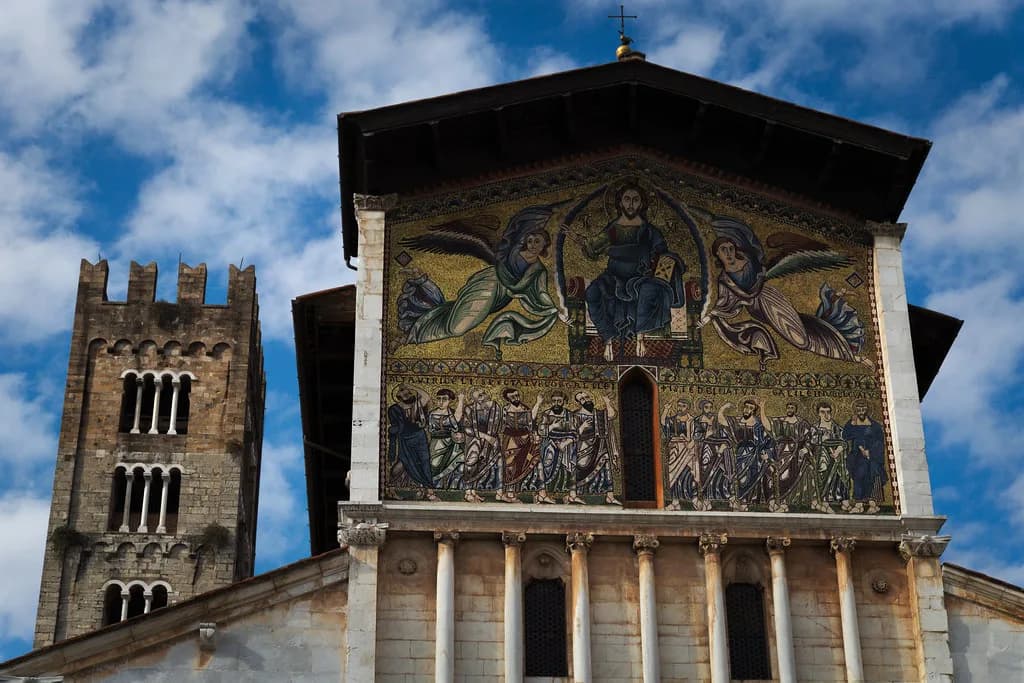
The facade is white limestone interrupted by a single large mosaic, a composition that makes the church instantly recognisable from the square. ItalyGuides describes the mosaic as a Byzantine-style Ascension showing Christ in an almond shape surrounded by the apostles. The Madonna originally appeared in the centre, but her image was cut away to open a single-light window, a detail that changes how you read the composition.
The mosaic is not original to the earliest church. ItalyGuides dates the present building's remaking to a consecration in 1147 and places the mosaic in the 13th and 14th centuries, when the facade was raised. A travel account from The Italian South also notes the gold mosaic was added in that later period. Read it as a medieval addition layered onto an older structure rather than as part of the first basilica.
A Church That Faced East
San Frediano's early plan was unusual: ItalyGuides says the first basilica had its facade to the east, unlike most churches, which faced west. The reason was practical. The entrance was too close to the second circle of city walls, which were still being built at the time, so the orientation was reversed to fit the available space.
That decision left traces in the fabric. The bell tower, which today stands near the apse, may once have been on the facade before the orientation changed; ItalyGuides suggests it could have mirrored the arrangement at San Martino. The tower's position near the walls also meant it served as a defence tower over the centuries, and its construction shows stages up to the addition of mullioned windows in the 13th century.
After the orientation change, the church was remade until its consecration in 1147, and the design provided for a lower church that was raised in the 13th century. The facade mosaic belongs to that later heightening. Keeping these phases in mind helps explain why the front and the interior do not read as a single moment of construction.
Inside: Reused Columns and Medieval Painting
The interior retains much of its medieval appearance despite later changes, especially in the 1500s. According to ItalyGuides, the columns and capitals are all reused material, much of it brought from Rome, following medieval practice. Look at the capitals as a set of mismatched fragments rather than a uniform design, because that is what they are.
Among the oldest paintings in the church is an early 12th-century work showing the three saints Lorenzo, Vincenzo and Stefano, the names the church originally carried. Frescoes and decorations inside range from the 14th to the 19th century, so the interior is a layered record rather than a single decorative scheme. In one chapel, a polyptych by Jacopo della Quercia stands out among the more prized works.
A crypt was added in the 8th century to receive the body of San Frediano, which explains why the church's plan developed in stages. For a comparison with another Lucchese church where white limestone and a sculpted facade do similar work, the Church of San Michele in Foro Lucca visitor guide covers the medieval heart of the city a short walk away.
The Robertus Magister Font
At the beginning of the right-hand nave stands a 12th-century basin, described by ItalyGuides as a baptismal font or perhaps a lustral fountain. It is signed by Robertus Magister, a detail that gives the object a named maker in a period when many sculptors remain anonymous. That signature is why the font matters for the study of Lucchese Romanesque sculpture.
Around the circular basin, biblical figures twist and overlap in a restless composition. ItalyGuides notes that the figures are sometimes disjointed, to the point that one horseman's leg appears to ride backwards. That oddity is worth seeking out: it shows how the sculptor arranged a crowded narrative around a curved surface rather than in a flat panel.
Santa Zita and the Bread Legend
Santa Zita is venerated in one of the oldest chapels of the church, built over the space where she was buried in 1278. ItalyGuides names her as the patron saint of domestic servants, housewives and bakers. Her body, exhumed and found intact, is displayed in a shrine inside a chapel decorated with scenes from her life, though the source explains the preservation may relate to mineral-rich ground rather than a miracle.
The legend varies between tellings. In one version, Zita was stopped by her master as she left the house with bread hidden in her apron for the poor, and when she opened it, flower petals fell out. Another version says the bread became roses, which is why she is associated with bakers. The Italian South recounts the petal version and notes she was canonized in 1696.
Because the shrine is inside a working church, visits should be treated with the usual respect for worshippers. This guide does not promise that the body is visible on any particular day, since chapel access can depend on services or conservation work. If seeing the chapel is a priority, ask the parish before you travel rather than assuming it will be open.
Practical Planning and What to Verify
Current opening hours, whether entry is free, and Mass times are not confirmed in the sources used here, and they should be checked directly with the parish or the Lucca tourism office. Do not rely on an old blog post for a schedule. If you plan to attend a service, confirm the time in advance, since tourist visits and worship may follow different patterns.
For a short visit, concentrate on the facade mosaic, the font and the Zita chapel. That covers the three features most closely tied to the church's identity and can be done without trying to absorb every fresco. If you have more time, add the reused columns and the early medieval painting, then walk the nearby walls to see the basilica from outside the historic centre.
Accessibility details for the church, chapel and crypt are not established here, so travellers with mobility needs should ask the parish directly. The same applies to guided tour availability or group arrangements. A short email or phone call before travelling is more reliable than guessing from a website that may not be updated.
Nearby Pairings Within a Few Minutes
Piazza Anfiteatro is a short walk away, and its elliptical shape follows the footprint of the Roman amphitheatre that once stood there. The square is now lined with cafes and shops, making it a natural stop before or after San Frediano. The Lucca.com page on Piazza Anfiteatro explains how the medieval buildings were built over the ancient structure and how the plaza was restored in the 18th century.
Palazzo Pfanner, on Via degli Asili, has a baroque garden attributed to Filippo Juvarra and a museum in the palace. It is a separate paid site with its own ticket, so do not expect a combined ticket with San Frediano. The official Palazzo Pfanner site states the garden is open from 15 March to 31 December, subject to extraordinary openings and closures, but current prices should be confirmed on the site.
The Renaissance walls form a pedestrian circuit of more than four kilometres around the historic centre, and walking a section near San Frediano gives a different view of the basilica's bulk. The walls are also the setting for events and are used as a park by locals and visitors. For practical route ideas, the Lucca City Walls visitor guide covers the gates, bastions and access points.
More Layers to Read in the Building
Beyond the main highlights, the church repays a slower look at its fabric. ItalyGuides mentions the 8th-century crypt added for San Frediano's body and the bell tower's defensive role near the walls. The frescoes and decorations span the 14th to 19th centuries, so a walk through the aisles is also a walk through changing tastes in Lucchese church decoration.
The church is one of several in Lucca that reward close looking rather than a quick checklist. Santa Maria Forisportam, for example, has a name meaning outside the gate and now sits well within the walls, a similar story of a city outgrowing its defences. The Church of Santa Maria Forisportam Lucca visitor guide explains that shift and the church's own medieval layers.
If you want a break from churches, the Orto Botanico di Lucca was founded in 1820 and holds living collections in a garden within the walls. The official garden site gives the address on Via del Giardino Botanico and lists seasonal highlights. It is a separate site with its own visiting arrangements, so check before setting out.
For a wider choice of overlooked corners and smaller sights, the hidden gems in Lucca guide covers places that sit outside the main church-and-tower circuit. It can help you balance San Frediano with quieter stops if you have a full day in the city. The Torre Guinigi is one of the better-known alternatives for views over the rooftops.
Plan Your Visit
San Frediano is best approached as a compact monument with three anchors: the Ascension mosaic on the facade, the signed Robertus Magister font and the chapel of Santa Zita. Give it enough time to look closely at the reused columns and the medieval painting, then step back outside to see how the church sits against the walls.
Before travelling, confirm opening arrangements and service times with the parish or the Lucca tourism office, and check Palazzo Pfanner separately if you plan to visit its garden. Pair the church with Piazza Anfiteatro and a short stretch of the walls, and leave the rest of the day for the city's other churches and squares.
Frequently Asked Questions
Is the Church of San Frediano in Lucca free to visit?
The sources used here do not state current admission arrangements for the basilica, so entry should be confirmed with the parish or the Lucca tourism office before you go. Do not assume it is free based on older travel accounts.
How long should I allow for a visit to San Frediano?
For a focused visit covering the facade mosaic, the font and Santa Zita's chapel, allow roughly half an hour to forty-five minutes. Add more time if you want to study the reused columns, the medieval painting and the later frescoes, or to sit quietly in the church.
Can you see Santa Zita's body in the basilica?
Sources describe her preserved body as displayed in a shrine in one of the chapels, decorated with scenes from her life. Visibility on a given day is not guaranteed, so ask the parish in advance if this is important to your visit.
Where is the Basilica of San Frediano located?
It stands on Piazza San Frediano at the end of Via Fillungo, a few steps from Piazza Anfiteatro and within Lucca's Renaissance walls. The church closes the view of the small square and is easy to reach on foot from the historic centre.
What is the story behind the golden mosaic on the facade?
The mosaic depicts the Ascension, with Christ surrounded by the apostles in a Byzantine style. The Madonna in the centre was later cut away to open a window, and the work is dated to the 13th and 14th centuries, when the facade was raised.
Is San Frediano worth visiting compared with Lucca Cathedral?
San Frediano offers a different experience from the cathedral: a compact interior with a signed 12th-century font, reused Roman columns and the chapel of Santa Zita. If you have time for both, they complement each other, but San Frediano works well as a shorter, focused stop.
Sources
Continue exploring
More guides you'll find useful