San Michele in Foro, Lucca: Facade and Interior Visitor Guide
Plan a visit to San Michele in Foro in Lucca: what to see on the Romanesque facade, the Archangel Michael statue, the Civitali Madonna and the art inside.
On this page
San Michele in Foro fills one side of Piazza San Michele in the middle of Lucca, on ground that once held the city's Roman forum. You visit it as a parish church rather than a ticketed monument, and most people come for the facade, which is one of the most photographed compositions in Tuscany. The square remains a working part of the historic centre, so the church sits within an ordinary morning or afternoon walk rather than a separate excursion.
Set aside roughly thirty to forty-five minutes: a slow read of the facade, a look inside, and time to step back across the piazza. That is a suggested pace, not an official one, and the church's own schedule can shorten it. Officially the building's history is documented from 795, when it was recorded on the forum site, and the present structure was ordered rebuilt in 1070 under Pope Alexander II.
Quick Orientation: Why This Church Matters
Until 1370 the church was the seat of the Consiglio Maggiore, the assembly that governed the commune, which is why it reads as a civic monument as much as a religious one. That detail explains the ambition of the facade: it was paid for by a city-state that wanted its main square to impress. Visiting with that in mind changes how you look at the sculpture, from decoration to political statement.
Do not confuse it with Lucca Cathedral, the Duomo di San Martino, which is a separate building a short walk away with its own works and its own visitor arrangements. San Michele is a parish church in a piazza, not a museum complex, and it is not ticketed in the way the cathedral's paid interiors are. If you plan to see both, start here for the outdoor sculpture, then move on to the Duomo.
Reading the Facade: Where to Look First
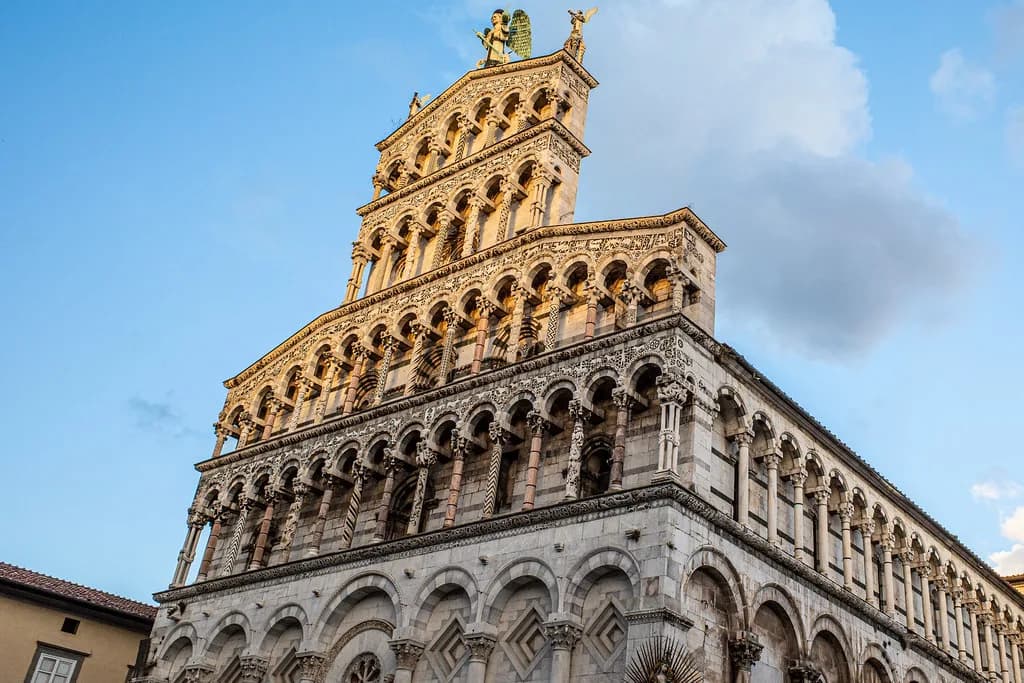
Stand in the square before walking forward. From there you see the whole composition at once: a lower level of blind arcades, the recessed central portal, and four stacked orders of small loggias above. The arcades sit under a series of arches, with the main doorway set within the central one, so the eye is pulled inward before it climbs.
The design belongs to the 13th century, but the facade was added to and restored in the 19th century to preserve the medieval scheme, so what you see is not untouched original stone. Read it as a preserved composition rather than a fossil. That distinction matters for anyone studying the carving closely, because some surfaces and details reflect later work.
A useful order is silhouette first, then portal, then details. Step back to see the roofline against the sky, approach to study the doorway and the small carved figures around it, then enter. Working in that sequence keeps the facade's scale in view instead of reducing it to isolated close-ups.
The Summit: Michael the Archangel and the Two Angels
The centre of the roofline is crowned by a statue of St Michael the Archangel, placed there as a dedication to the figure the church is named for. Two angels flank the summit, and the whole group is the first thing you should find when you look up. At that height the statue reads mainly as a silhouette, so look for it from across the piazza rather than from the doorway.
The upper section was originally engineered with a good deal of iron so the structure could withstand storms, rain and strong wind. That is a practical detail worth knowing when you consider how much weight sits above the arcades. The marble front is only part of the story; behind it is a deliberately reinforced frame.
The Civitali Madonna in the Lower Right Corner
Look down to the lower right corner of the facade for a statue of the Madonna, carved by the Lucchese sculptor Matteo Civitali. It was made to mark the end of the plague of 1476, which turns a devotional image into a record of civic relief. Finding it is a small hunt: most visitors scan the upper loggias and miss the corner at eye level.
The sculptor's name is worth carrying with you around Lucca, because Civitali's work appears in more than one of the city's churches. Once you have registered this figure, you will start noticing the same hand elsewhere. For a different Romanesque facade and a very different interior, the Church of San Frediano in Lucca makes a natural comparison nearby.
The Bell Tower Above the Southern Transept
The bell tower was built between the 12th and 14th centuries and rises from the southern transept rather than standing free of the church. Its openings are arranged as single, double and triple mullioned windows, which give the tower a stepped rhythm of light and shadow. Walk around to the side of the building to see it properly, since the facade tends to hold your attention from the piazza.
Inside: Nave, Aisles and the Art to Seek Out
The interior is laid out as a nave with two aisles ending in a semicircular apse, with the nave carried on arcades of monolithic columns. Because the exterior takes so much attention, the inside can feel like a bonus, but it is where the paintings are. Give yourself a few quiet minutes rather than a quick lap.
Two works are worth locating by name. Filippino Lippi's Pala Magrini, dated 1483, shows Saints Jerome, Sebastian, Rocco and Helen, and reflects the influence of Botticelli's workshop. A glazed terracotta Madonna and Child by Andrea della Robbia is also held here. Ask at the church or check locally if you cannot find them, as altarpieces are sometimes moved.
Practicalities and Church Etiquette
This is an active parish church rather than a ticketed attraction, so there is no admission desk to plan around; treat any visit as a church visit. Dress respectfully, keep voices low, and avoid wandering during a service. If a liturgy is underway, wait outside or return later rather than treating the nave as a sightseeing corridor.
Opening times are not something to rely on from a guide written in advance. Check the city's official tourism pages before you set out, particularly on Sundays and around religious feast days.
If you want to see the facade lit or the piazza at its calmest, early morning is usually the quieter choice, though this is a rhythm of the square rather than a published fact. Confirm any current access information with the city or parish rather than assuming the doors will be open when you arrive.
Pairing San Michele With the Rest of Lucca
San Michele sits within easy walking distance of most of the historic centre, which makes it a natural stop rather than a destination on its own. From Piazza San Michele you can wander to Piazza dell'Anfiteatro, whose oval ring of buildings follows the outline of a Roman amphitheatre. The square was reshaped in the 18th century by Lorenzo Nottolini, who restored the elliptical plan, and it now holds cafes and shops.
Climb the Guinigi Tower for a view over the rooftops if you want the city in plan rather than in elevation. For more of Lucca's less obvious corners, from quiet churches to overlooked walks, see our guide to hidden gems in Lucca. Both work well as an afternoon extension after the church.
The Renaissance walls form a pedestrian ring around the whole centre, and walking a stretch of them is an easy way to reset between sights. Our Lucca City Walls guide covers the gates and the underground passages that some tours open up. Combine that with a stop at the Orto Botanico, founded in 1820, if you want green space after the stone.
How San Michele Compares With Lucca's Other Churches
Lucca has an unusually dense collection of Romanesque churches, and San Michele is one of the most ornate on the outside. Santa Maria Forisportam, known as Santa Maria Bianca for its white limestone, shows a plainer version of the same tradition and holds two 17th-century paintings by Guercino. Its piazza carries the nickname Square of the Severed Column after a fragment of Roman granite.
San Frediano is a different experience again, with a facade mosaic and a distinctly monumental interior. Seeing two or three of these buildings in a day gives you a sense of how much variety a single city could produce within one architectural language. If you only have time for one, choose San Michele for exterior sculpture.
Plan Your Visit
San Michele in Foro rewards a slow look more than a quick stop. Read the facade from across the piazza, find the Archangel Michael and the two angels at the summit, then hunt for Civitali's Madonna in the lower right corner before going inside. Knowing that the design is 13th-century but the stonework was restored in the 19th century keeps you from misreading what you see.
Treat it as a parish church, check current access before you go, and let the rest of the centre fill the day around it. Our Lucca Attractions hub collects the surrounding sights so you can build a route that fits your time.
Frequently Asked Questions
Is the Church of San Michele in Foro free to enter?
The church is an active parish church rather than a ticketed monument, so there is no admission desk to plan around. Access can still be limited by services and by the building's own schedule, so check the official tourism or city website before you go rather than assuming the doors are open.
How long should I allow for a visit?
Allow roughly thirty to forty-five minutes: a slow read of the facade from across the piazza, a look at the summit statues and the Civitali Madonna, and a few quiet minutes inside. That is a suggested pace rather than an official figure, and a service will change it.
What is the statue on top of San Michele in Foro?
It is St Michael the Archangel, placed at the centre of the roofline as a dedication to the church's namesake. Two angels flank the summit, and the upper structure was originally reinforced with iron to withstand wind and weather.
Who carved the Madonna statue on the lower right of the facade?
The Madonna in the lower right corner was carved by the Lucchese sculptor Matteo Civitali. It was made to mark the end of the plague of 1476, so it functions as a record of the city's relief as well as a devotional image.
What artworks are inside San Michele in Foro?
Look for Filippino Lippi's Pala Magrini, dated 1483, showing Saints Jerome, Sebastian, Rocco and Helen, and a glazed terracotta Madonna and Child by Andrea della Robbia. Altarpieces can be moved, so ask locally if you cannot locate them.
Is San Michele in Foro the same as Lucca Cathedral?
No. San Michele in Foro is a parish church on Piazza San Michele, built on the site of the Roman forum. Lucca Cathedral, the Duomo di San Martino, is a separate building nearby with its own works and its own visitor arrangements.
Sources
- Chiesa di San Michele in Foro Lucca Tuscany - Church of San Michele in Foro, Italy
- Official event website
- Official event website
- Church of San Michele in Foro
- Squares - Piazza Anfiteatro (Amphitheatre Square in Lucca) - Piazza dell'Anfiteatro, Lucca, ,
- Lucca - Information and travel guide about visiting Lucca
Continue exploring
More guides you'll find useful