Guinigi Tower Visitor Guide: The Rooftop Oaks of Lucca
Plan a climb up Lucca's Guinigi Tower: where it stands, how many steps await, what you see from the rooftop oaks, and how to time your visit around crowds.
On this page
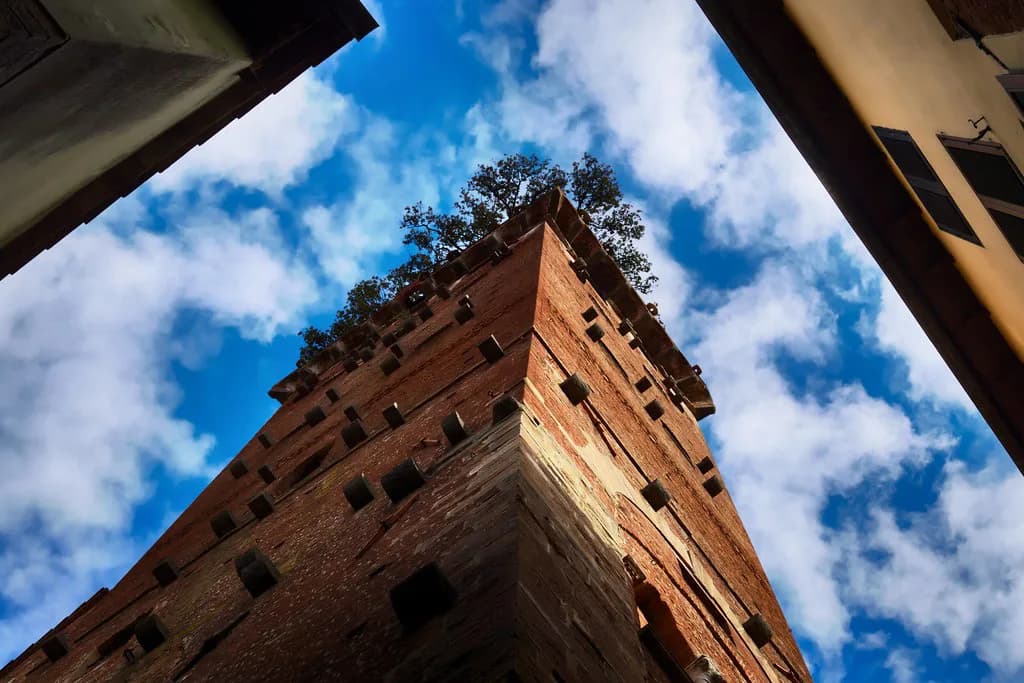
Lucca's skyline is still punctuated by medieval family towers, and the Guinigi Tower is the one everyone recognises, because a cluster of holm oaks grows from its roof. It sits in the heart of the historic centre, a short walk from Via Fillungo and the amphitheatre square.
A guide written by a Lucca tour guide describes the ascent as about 44 metres and 232 steps, with stone treads for most of the way and a narrower, see-through steel staircase near the top. Allow a suggested 45 to 60 minutes for the full visit, including time under the trees; that is a planning estimate, not an official figure. Further visitor details appear in Stunners in the sky: Lucca's top towers | Paola Moschini Tour Guide.
Treat prices, seasonal hours and combo tickets as things to confirm at the ticket office rather than fixed facts; published figures vary between sources and are not dated for the current year. The physical climb and the view, by contrast, are consistent across every account.
What the Guinigi Tower Is and Why It Stands Out
The tower belonged to the Guinigi family, bankers and silk merchants who were among Lucca's most powerful dynasties; a tour guide's history notes that Paolo Guinigi became Lord of Lucca in 1400. In the Middle Ages a tall tower was a statement of wealth and political weight, and the city's skyline was once crowded with them.
Historian estimates of how many towers medieval Lucca held vary between accounts and run into the hundreds, so treat any round number as an approximation rather than a documented count. What survives today is a handful of climbable examples, and the Guinigi is the most photographed of them.
The rooftop trees are the reason the tower appears on every Lucca postcard. Sources disagree on why they were planted, and it is not established that Paolo Guinigi himself ordered them, so enjoy the stories without treating any single explanation as settled.
The same debate surrounds the wider tower count in town: the published figure depends on which account you read. What matters for visitors is that only a few of these family towers can be entered and climbed today, so it is worth being deliberate about which ones you choose. For wider planning, see Hidden Gems in Lucca.
Where the Tower Is and How to Find It
The tower stands at the corner of Via Sant'Andrea and Via delle Chiavi d'Oro, in the dense medieval grid north of Via Fillungo, as the city's tourism listing confirms. Because surrounding buildings crowd it, the tower often appears suddenly above the rooftops rather than announcing itself down a long view.
For a full-height view, the tour guide suggests walking the short stretch of Via Canuleia toward Via delle Chiavi d'Oro, or pausing on Via Sant'Ansano near the church and looking up between the roofs. These are simple sightlines rather than official viewpoints, and they cost nothing.
The tower is inside the walled centre, so the easiest approach is on foot from anywhere in the old town. If you arrive by train, the station sits just outside the walls and the walk in takes you past the ramparts, which makes a natural first stop. For wider planning, see Lucca City Walls.
Height and Steps: What the Climb Is Really Like
Published figures put the tower at between 44 and 45 metres and the staircase at roughly 230 to 232 steps, so expect about the height of a tall building compressed into a tight spiral. The lower flight is stone and fairly easy, with the final section switching to a narrower steel staircase where you can see through the treads. For wider planning, see Torre delle Ore, Lucca.
There is no lift, and the stair is narrow enough that passing other visitors takes a moment of cooperation. Going slowly, keeping to one side and letting faster climbers pass makes the ascent far more pleasant for everyone.
One practical reward of the stone section is that windows open along the way, so the view unfolds gradually as you climb rather than arriving all at once. Look north for the Apuan Alps and south toward the Pisan Mountains when the air is clear. For wider planning, see Puccini Museum Lucca visitor guide.
The stair is genuinely narrow in places, and that detail shapes how you should dress and carry things: a backpack that swings wide is awkward on the spiral, and a small bag is easier to manage. It also means you should not plan a tight connection straight afterwards, because the descent can be slowed by the same traffic coming the other way.
The Rooftop Oaks
Seven holm oaks grow from the roof terrace, planted in soil held by the tower's brick shell. They are the tower's signature and the reason people queue, so give yourself a few minutes to sit beneath them rather than treating the top as a photo-and-go stop.
Explanations for the garden vary: a private retreat, a way to distinguish a family tower from a church bell tower, or a trick to make the tower look taller. The local guide who lists these theories notes they remain unconfirmed, so the honest answer is that the origin is debated and the legend is part of the appeal.
Space at the top is limited, so keep voices low, avoid blocking the stair exit and take turns at the railing. The terrace is a garden on a monument, not a picnic lawn, and treating it that way keeps it pleasant for the people behind you.
What You See From the Top
The terrace gives a 360-degree view over red-tiled rooftops, with the oval of Piazza dell'Anfiteatro and the arc of the city walls easy to pick out. The basilica of San Frediano and the squares of the historic centre also rise above the surrounding roofs.
Piazza dell'Anfiteatro is worth understanding before you look down on it: its elliptical form traces a Roman amphitheatre that once held thousands of spectators, and the medieval houses around it were built into the ancient structure. Seen from above, that borrowed shape is suddenly obvious.
Beyond the walls, the Apuan Alps frame the view to the north and the Pisan Mountains to the south. On hazy days the mountains fade, so a clear morning or a late-afternoon climb gives you the best chance of seeing them properly.
The view also works as a way of planning the rest of your day: the churches and squares you can pick out from the terrace are the same ones on the walking routes below. If a dome or tower catches your eye, note it and walk to it afterwards while the geography is still fresh.
Who Should Skip the Climb
If you use a wheelchair, travel with a pushchair, or struggle with stairs, this is not a comfortable climb: the staircase is narrow stone and steel with no lift. A rental company's blog describes it as unsuitable for reduced mobility and pushchairs, but that is not an official statement, so confirm current access arrangements with the operator rather than relying on any single account.
Anyone uneasy in tight, enclosed spaces should think twice, and people who dislike heights may find the see-through final staircase unsettling. Skipping the climb costs nothing: the tower is visible from many streets and squares, and the view from the city walls is free.
Families with small children should weigh the tight upper section carefully, and carrying a child up the narrow steps is tiring work. Older children who can climb steadily usually manage fine, provided everyone takes it slowly.
If stairs are ruled out, the Palazzo Pfanner garden offers a flatter, greener alternative nearby, and the cathedral square and the amphitheatre are both at ground level. None of these replaces the tower view, but together they keep a day in the centre enjoyable without a single climb.
Tickets, Combos and What to Confirm
Published ticket figures conflict and none of the sources is dated for the current season: the local tour guide lists one entry price with a reduced combo option, while the rental company's blog lists separate adult, child and family prices plus a combined ticket with the Torre delle Ore. Check the price at the ticket office before you commit.
The combined ticket covering the Guinigi Tower and the Torre delle Ore is worth considering if you plan to climb both, since the two are a short walk apart in the centre. Ask what the combination actually includes rather than assuming every nearby monument is bundled in.
No source in this research confirms that advance online booking is required, so treat any app or reseller offer with caution and check the official tourism pages for current ticketing. The same applies to seasonal opening hours, which vary in published accounts.
Timing Your Visit
Early morning and late afternoon are repeatedly recommended as the best slots, thanks to softer light and thinner crowds. Midday in summer is the hardest going, with heat, queues and the tightest conditions on the stair; these are editorial suggestions, not official rules.
Lucca's calendar affects crowds around the centre, notably during the comics and games festival at the end of October and the summer music festival in July. If your dates overlap these, climb early and expect competition for space at the top.
Seasonal opening hours are reported to shrink in winter and extend from spring into autumn, but sources differ and none is confirmed for the current year. Check the official tourism site or the door on the day rather than planning around a remembered schedule.
Comparing Lucca's Other Towers
The Torre delle Ore is the city's tallest tower and its clock still works, but the ascent has no windows until you reach the top, which makes it a tougher choice for anyone prone to claustrophobia. The Guinigi climb is friendlier because daylight and views arrive as you go. For wider planning, see Torre delle Ore, Lucca.
The bell tower of San Martino is a third option, opened to visitors after a long restoration and featuring a steep first stretch of stone steps before an easier iron staircase. Its reward is a view over the cathedral square and outward past the walls toward Nottolini's aqueduct.
Matching your tower to your taste matters more than climbing all three: Guinigi for the trees and a gentler ascent, Torre delle Ore for the clock machinery and altitude, San Martino for a close look at the cathedral. Each is a separate ticketed climb in most accounts.
Nearby After the Climb
Via Fillungo, Lucca's main shopping street, runs close by and leads you toward the Torre delle Ore and on to Piazza dell'Anfiteatro, which makes an easy walking loop from the tower. Cafés around the oval square are the natural place to rest after the steps.
The walls themselves are one of the most pleasant ways to end an afternoon in the centre: a wide tree-lined promenade surrounds the historic city for several kilometres and is free to walk. The underground passages beneath the walls are a separate guided experience, not something you can wander into independently. For wider planning, see Lucca City Walls.
For a greener detour, the Orto Botanico founded in 1820 occupies a quiet corner of the walled city and rewards a slow hour among its collections. One guide describes it as a quiet corner relative to the walls, churches and squares, which makes it a sensible pairing with the tower if you want a day that mixes stone and shade.
If you have more than a day, the tower slots naturally into a longer walking plan rather than a single stop: the Lucca attractions hub lists the churches and museums within easy reach of the centre, so you can build a route around what you have just seen from the roof. For wider planning, see Lucca Attractions: Visitor Guides to 14 Sights.
An Honest Take on the Guinigi Climb
The Guinigi Tower offers something no other viewpoint in Lucca can: a garden of oak trees on a medieval roof, with the city's red rooftops spread around you. It is a short climb by tower standards, but the narrow stair is real, and people with mobility needs or pushchairs should enjoy it from street level instead.
Go early or late, confirm prices and hours at the ticket office or on the official tourism site rather than trusting older published figures, and decide in advance whether the combo with the Torre delle Ore suits your plans. That way the steps feel like a small adventure rather than a chore.
Frequently Asked Questions
How many steps are there to the top of the Guinigi Tower?
Published counts vary slightly, with sources citing around 230 or 232 steps. Expect a narrow stone staircase for most of the way and a tighter steel section near the top. Take it slowly, and bear in mind that the ascent is not suitable for pushchairs or anyone who finds stairs difficult.
How tall is the Guinigi Tower in Lucca?
Sources give figures of approximately 44 to 45 metres. Either way, it is tall enough to lift you above most surrounding rooftops and give a wide view over the historic centre, the amphitheatre square and the walls.
Why are there trees on top of the Guinigi Tower?
Seven holm oaks grow on the roof terrace, but the reason is not settled. Explanations range from a private garden to a way of marking a family tower apart from a church bell tower. Treat the origin stories as legend rather than confirmed history.
How long does it take to visit the Guinigi Tower?
A suggested allowance is around 45 to 60 minutes, including the climb and time at the top; that is a planning estimate, not an official figure. The ascent itself is short, and the queues at busy times take longer than the steps.
Is the Guinigi Tower climb suitable for children or pushchairs?
The narrow stone and steel staircase makes it a poor fit for pushchairs and for anyone with reduced mobility. Steady older children usually manage, but confirm current access arrangements with the operator before you go, since published guidance varies.
Do you need to book Guinigi Tower tickets in advance?
Nothing in the available sources confirms that advance booking is required, so check the official tourism site or ask at the ticket office on the day. Be wary of resellers charging extra for what may be a simple walk-up entrance.
Can you buy a combined ticket for the Guinigi Tower and Torre delle Ore?
A combined ticket covering both towers is reported, and the two are within a short walk of each other. Prices change, so confirm what the combination includes and what it costs at the ticket office, since published figures are not reliable for the current season.
What is the best time of day to climb the Guinigi Tower?
Early morning and late afternoon are the most comfortable slots, with softer light and fewer visitors. Midday in summer is hot and busy, and festival periods around the comics and games event in late October or the July music festival fill the centre further.
Sources
- Stunners in the sky: Lucca's top towers | Paola Moschini Tour Guide
- The Guinigi Tower Lucca Travel Guide - Discover Tuscany | Our Journal
- Official event website
- Guinigi Tower - Lucca Tourism
- SPRING TREASURES: DISCOVER LUCCA’S BOTANICAL GARDEN IN FULL BLOOM - Paola Moschini
- Squares - Piazza Anfiteatro (Amphitheatre Square in Lucca) - Piazza dell'Anfiteatro, Lucca, ,
Continue exploring
More guides you'll find useful