Piazza Grande Arezzo: A Visitor Guide to the Sloping Square
Plan a visit to Piazza Grande in Arezzo: the sloping brick-and-limestone paving, the Vasari loggia, the antiques fair setting and the Giostra del Saracino.
On this page
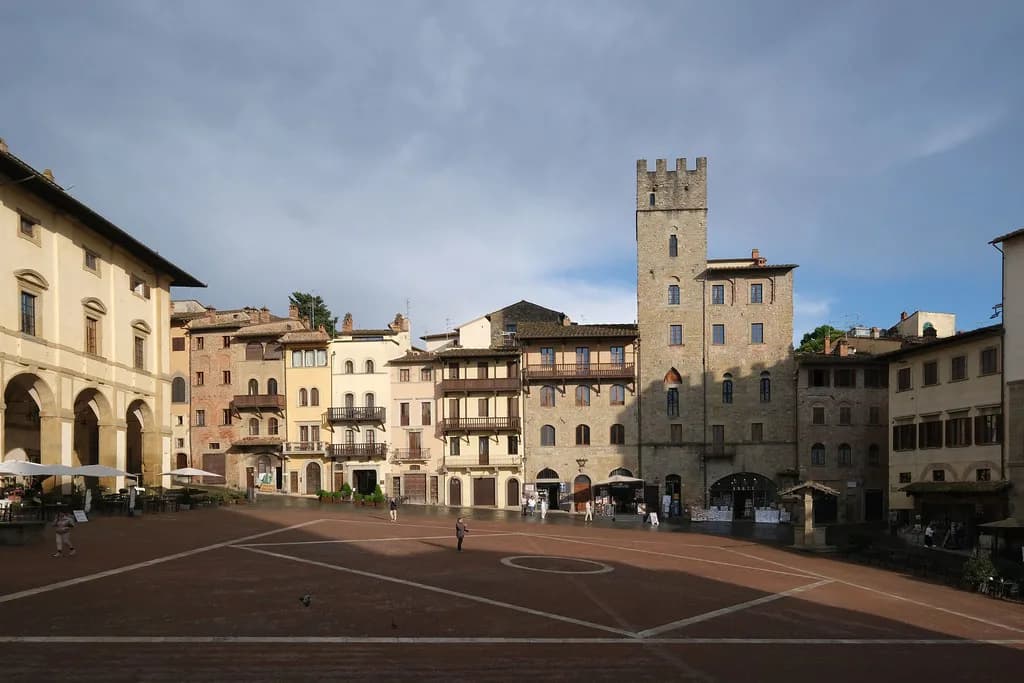
Piazza Grande is the square that explains Arezzo in a single lap. It is a sloping, red-brick and limestone-paved space ringed by medieval and Renaissance buildings, and it doubles as the stage for markets and medieval celebrations. The historic centre sits on a hill above the modern lower part of town, which is why the square rewards arrival on foot rather than by car.
For orientation, the square appears in online listings as a monument with an address in Arezzo, but it is not a gated sight with a single ticket. What you see on an ordinary weekday is very different from what you get during the antiques market or a medieval joust, so this guide keeps those three versions apart.
Treat recurring schedules as orientation, not confirmation. Visitor sources describe the antiques fair as a first-weekend fixture and the joust as a September event, but exact dates, hours and access arrangements come from the organiser, so check official Arezzo tourism information before booking travel around either.
Why Piazza Grande anchors a visit to Arezzo
Arezzo divides into an older upper town and a more modern lower part, and Piazza Grande is the social and ceremonial heart of the upper one. Its paving is inlaid with geometric limestone lines across red brick, which is why the ground itself is worth looking at rather than just walking over.
The slope is the defining feature. The square is described as a sloping red-brick space with limestone inlay, and that gradient shapes everything from how stalls are pitched to where you stand to watch a procession. Wear shoes you trust on brick, especially after rain, and expect to walk at an angle rather than on the flat.
For orientation, the square is a public urban space you can walk into without a ticket. What costs money are the separately ticketed interiors nearby, such as Casa Vasari and the city museums, so do not assume one purchase covers the square and its monuments.
What you are actually looking at
The most photographed element is the loggia on the northern side of the square, designed by Giorgio Vasari, which today houses shops, cafes and bars, some retaining original stone counters. Vasari was born in Arezzo in 1511 and worked at the court of Cosimo I, so this arcade is a piece of the city's most famous resident left in daily use rather than behind glass.
Across the square, the Palazzetto della Fraternita dei Laici is a 14th- to 15th-century palazzo, and the Episcopal Palace interior carries frescoes by artists including Salvi Castellucci and Pietro Benvenuti. In front of the palace stands the monument to the Medici grand duke Ferdinand, a reminder of the family whose fortress crowns the hill above.
The practical takeaway is that the square is not a single sight with a gate but an ensemble, so you read it by circling the edges and looking up at facades. A short, slow circuit of the perimeter, pausing under the loggia, is the most useful way to start.
How the square feels on an ordinary day
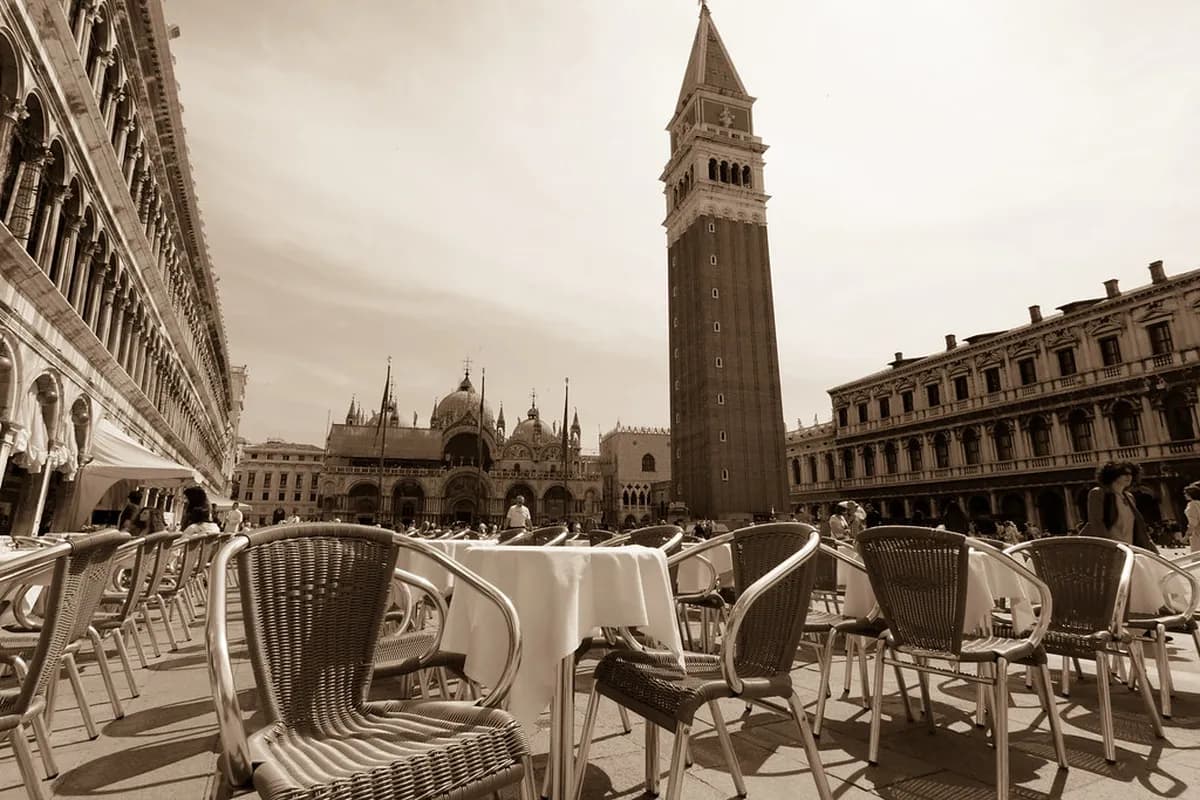
On a normal day the loggia is the place to slow down. The cafes and shops under the arcade make a natural perch for watching the square fill and empty, and the northern side gives you a view across the slope without climbing anything. Order something small, sit for a while, and let the geometry of the paving do the work.
Much of Arezzo's historic centre is pedestrianised, so the square is best approached on foot. That makes it an easy add-on to a walking loop through the old town rather than a destination you drive up to, and it keeps the slope manageable because you arrive already used to the hill.
Calling the square quiet at any hour would be a guess, and its character changes with season and hour. Aim for early morning or late afternoon if you want fewer people in your photographs, and accept that a market weekend or festival day will feel entirely different.
Market mode: the recurring antiques fair
Visitor sources describe the Fiera Antiquaria as a large antiques market that fills Piazza Grande and the central square with stallholders, recurring on the first weekend of each month. The fair is credited in one source to the collector Ivan Bruschi, who set it up in 1968, and his house museum, Casa Museo Ivan Bruschi, traces that history.
Treat the first-weekend pattern as a planning heuristic rather than a confirmed calendar. For a specific month, confirm with the organiser or the city's tourism body before locking in a hotel, because a shifted weekend changes the entire feel of the square and the surrounding streets.
If you come for the market, arrive with a plan for what you will carry. Stalls spread beyond the square into the centre, so a light bag and sensible cash habits matter more than a fixed route, and breaking the browsing with a stop in the loggia works better than marching the whole fair in one pass.
Event mode: the Giostra del Saracino
The Giostra del Saracino is a medieval-style jousting tournament staged in the city, described in visitor sources as taking place around the first Sunday in September. Four city quarters, each in its own colours, are represented by pairs of knights on horseback who score by striking a wooden effigy of a king, with a golden lance as the prize.
The day is more than the tournament itself: processions in medieval dress run through the city, so the historic centre becomes a route rather than a set of open lanes. Because the scheduling is not fixed to a date you can rely on from a blog, confirm the current edition with the organiser before planning around it.
The awkward truth about event day is that you see less of the square as a square. Barriers, crowds and processions change how you move through it, so if the architecture is your priority, visit on a non-event day and treat the joust as a separate experience.
Empty square versus event square: timing your visit
Think of the square in three modes and choose deliberately. Ordinary-day mode is for the loggia, the facades and the paving; market mode is for browsing and people-watching; joust mode is for spectacle and atmosphere, with the trade-off that the space itself is obscured.
Arezzo is compact and walkable, and one visitor source suggests a day is enough for the main sights in good weather, while two to three days lets you slow down and add the countryside. That is editorial advice rather than an official figure, and it argues for seeing the square on a normal day and treating any event as a bonus.
Before any date-sensitive trip, check the Fondazione Arezzo Intour site, the city's tourism body, for current notices rather than trusting a recurring pattern. It publishes city and event information, and it is the right place to confirm whether anything clashes with your plans.
Pairing the square with nearby sights
The Basilica of San Francesco holds Piero della Francesca's fresco cycle of the Legend of the True Cross, the city's headline artwork, and it sits within the same historic centre as the square. Fresco viewing is a controlled experience in the Bacci Chapel, which is exactly why you should not squeeze it between market stalls.
Elsewhere in the centre, the Romanesque Church of Santa Maria della Pieve has a tiered facade and a tall bell tower, while the Duomo sits at the highest point of town with stained glass and further frescoes. Plan these as separate stops rather than one combined visit, and check each church's current access rules on arrival.
Uphill from the Duomo, the Passeggiata del Prato stretches towards the Fortezza Medicea and gives views over the city and across the vineyards towards Casentino. It is a good way to end the loop: see the square, climb to the cathedral, then let the park absorb the rest of the afternoon. For wider planning, see Fortezza Medicea Arezzo visitor guide.
Getting there and orienting yourself
Arezzo has three stations, but the one simply called Arezzo is closest to the historic centre. From there it is roughly a kilometre along Via Guido Monaco to the main piazza, and the tourist information office sits just outside the main station, which makes it a sensible first stop for a map and current local notices.
Drivers should respect the ZTL, the limited-traffic zone marked by red no-entry signs and controlled by cameras, because entering without a permit brings a fine. One option described by a visitor source is parking on Via Pietri, connected to the centre by escalators; parking charges change, so read the signs on arrival rather than budgeting from an old figure.
Walking remains the simplest approach, and it suits the square's slope better than any vehicle. Build in time for the gradient between the station, Via Guido Monaco and the upper town, and let the old town be the container for your day rather than a list of pins. For wider planning, see Arezzo Old Town Neighbourhood Guide.
Where the square fits in a wider Arezzo or Tuscany itinerary
Arezzo is frequently paired with Florence and Siena as a day trip, and rail connections from Florence make that realistic without a car. The city's appeal is that it is less frenetic than those larger centres, which means the square works best as a pause rather than a photo stop.
If you have two or three days, use the square as the anchor of a slow morning, then branch out to the frescoes, the churches and the park. If you have one day, pick either the art or the atmosphere, because trying to fit both the chapel visit and a relaxed market browse usually ends in rushing the wrong thing.
Beyond the headline sights, Arezzo rewards a second pass: the Badia di SS Flora e Lucilla, whose interior was extensively remodelled by Vasari, and the quieter lanes around the centre are easy to add to a loop that starts at the square. Use the city's attraction guides to pick one or two extras rather than trying to see everything. For wider planning, see Arezzo Attractions: Visitor Guides to 10 Sights.
Plan Your Visit
Piazza Grande is free to walk into, slopes underfoot, and changes character completely across an ordinary day, a market weekend and a jousting day. Decide which version you want, confirm the date with official sources, and let the loggia be your base for watching the square work.
Check the Fondazione Arezzo Intour site for current notices before any date-led trip, and use the city's attraction guides to build the rest of the walking loop. If a market or event is the reason for your visit, verify it directly rather than trusting a recurring pattern.
Frequently Asked Questions
Is Piazza Grande in Arezzo free to visit?
The square is a public urban space, so walking into it is not a ticketed experience. The museums, Casa Vasari and church interiors nearby are separate sites, so do not assume one purchase covers everything around the square; check each place's own entry arrangements when you arrive.
When is the antiques fair in Piazza Grande, Arezzo?
Visitor sources describe the Fiera Antiquaria as recurring on the first weekend of each month and filling the square and surrounding centre. Treat that as orientation only, and confirm the specific weekend with the organiser or the city's official tourism information before you book travel or accommodation around it.
Can you visit Piazza Grande during the Giostra del Saracino?
The joust takes over the historic centre, with processions and a tournament that change how you move through the square and streets. Sources describe it as a September event rather than a fixed calendar date, so confirm the current edition with official sources before planning a trip, and expect a crowded event-day experience rather than a quiet architectural visit.
Is Piazza Grande worth visiting on a day trip to Arezzo?
Yes, because it is the historic centre's natural starting point and sits within an easy walk of the Basilica of San Francesco, Santa Maria della Pieve and the climb to the Duomo. One source suggests a day is enough for the main sights in good weather, but two or three days lets you slow down and add the countryside.
What is there to see around Piazza Grande?
Look for the Vasari-designed loggia on the northern side, the Palazzetto della Fraternita dei Laici, the Episcopal Palace and the monument to the Medici grand duke Ferdinand. Beyond the square, the Basilica of San Francesco and its Piero della Francesca frescoes, Santa Maria della Pieve, the Duomo and the Parco del Prato are all within a walking loop of the centre.
How do you get to Piazza Grande from the Arezzo train station?
Use the station simply called Arezzo, which is closest to the historic centre, then walk about a kilometre along Via Guido Monaco to the main piazza. The tourist information office sits just outside the main station, so stop there first for a map and current local notices before climbing into the old town.
Is the square hilly or difficult to walk?
The square itself is on a slope and much of the historic centre sits on a hill, so expect gradients and brick paving underfoot rather than flat ground. Wear stable shoes, take breaks in the loggia, and plan walking routes that account for the climb between the station and the upper town.
Sources
Continue exploring
More guides you'll find useful