Fortezza Medicea Arezzo: A Walk-Up Guide to the Hilltop Views
A practical guide to the Fortezza Medicea in Arezzo: the short climb from the old town, free access to the grounds, city views and what to expect.
On this page
Most Arezzo itineraries are built around frescoes: Piero della Francesca in the Basilica di San Francesco, the Cathedral on its hill, the Vasari loggia on the sloping main square. The Fortezza Medicea offers something different and cheaper in effort and planning: open ground on the top of the city with views back over the roofs and out to the Arno valley. Treat it as the breathing point of a walking day rather than a sight to be ticketed and scheduled.
A word of expectation management first. The fortress is a park-like hilltop enclosure, not a museum with rooms to file through, and the available travel sources do not establish current opening hours, ticket arrangements, event programmes, accessibility or safety rules. Anyone writing otherwise is guessing. Plan the visit around the climb and the view, then confirm the day-to-day situation with the city's tourism foundation before you go.
Where the Fortezza Sits and Why It Anchors the Day
The fortress occupies the top of Colle San Donato, the hill that holds the upper historic centre, so it is less a separate trip than the natural end of a walk you are already making. Approach it after the Cathedral and Il Prato rather than before them, because the climb is uphill once and downhill afterwards. That single decision saves you from re-climbing the same slopes twice in one day.
Arezzo is unusually well suited to this. It is a compact city whose major sights can be covered on foot in a day without the crowds that fill Florence or Siena in high season, which makes a slow finish on a high vantage point genuinely practical rather than a luxury. If you are arriving by train, the station sits below the centre and the whole old town is walkable from it, with the hill doing the rest of the work.
The fortress also fits a structured walking tour of the city: local historian-led walks typically finish the outward leg here before returning to the Cathedral and San Domenico, precisely because the fortress works as the open-air, slower-rhythm counterpoint to the churches. You can borrow that sequence even without a guide.
The Medici Story in Brief
The fortress you see is a sixteenth-century structure, commissioned as part of a revision of the Grand Duchy's defensive system and begun in 1538 under architects of the Sangallo family, with construction reaching completion in 1560. That is roughly two decades of building on a site already high above the city, which explains why the surviving plan reads as military engineering first and decoration second.
One caution on naming: sources do not agree on which Medici duke is credited with commissioning the work, with one roundup attributing it to Cosimo II. The dates on the ground belong to the sixteenth century, so read any specific attribution with that in mind rather than treating a single name as settled.
This matters for what you actually look at. The Medici fortresses across Tuscany were statements of control as much as practical defences, so the trapezoid plan and bastions are the exhibit, not the backdrop for one. Knowing the building phase turns an empty-feeling hilltop into a legible piece of engineering.
What You Actually See on the Ground
The defining feature is the shape. The fortress is laid out as a trapezoid with bastions, and some descriptions read it as a five-pointed star plan, an arrangement that shows the rationality of Renaissance defensive design rather than the picturesque irregularity of a medieval castle. Walk the perimeter and the geometry becomes clear in a way photographs flatten.
Below the current surfaces there are remnants of earlier structures that once stood on the site, so the hilltop is layered rather than a single construction date. Look for masonry that does not match the bastion walls; the fortress was built on a place that had already been fortified and rebuilt across centuries.
The views are the other exhibit. From the height you can take in Arezzo itself, the Arno valley and the surrounding countryside, which is why the fortress rewards a pause rather than a quick circuit. Bring something to sit on, or at least plan to stop, otherwise you will have walked up for thirty seconds of looking.
Grounds and Gardens: A Stroll, Not a Museum Circuit
The fortress is best understood as transformed open space: it now functions as a garden and public attraction where visitors stroll among greenery rather than follow a route through exhibitions. That framing is the most useful planning tool you can carry. Budget for wandering and sitting, not for reading panels in sequence.
Practically, this means the visit works in the gaps of a day. If a timed slot for the Piero della Francesca cycle in the Basilica di San Francesco has left you with an hour to fill, the hill is a reasonable destination, with the caveat that the walk up and back consumes part of that hour. Read the fresco logistics before committing to timing.
It also suits families and mixed groups better than another church interior, since there is space to move and no requirement to keep voices down. If half your party wants art and half wants air, splitting between the fresco sites below and the hilltop works well, with a fixed meeting point at the Cathedral square.
Free Grounds Versus Arezzo's Ticketed Interiors
The key distinction for budgeting is between open ground and enclosed collections. The fortress is described as open to the public for exploring the grounds, with no pay gate mentioned in the travel sources here, whereas several of Arezzo's headline interiors are separately ticketed and, in some cases, require timed entry. Do not assume one ticket covers the city's monuments.
For the Cathedral, the operators publish the visiting arrangements themselves: the church has set opening windows through the week, and the adjoining museum keeps different seasonal schedules with a closure day. Prices are listed separately for the museum and audioguide, and they can change, so check the official page on the day rather than relying on older trip reports.
Note too that timed tickets and online purchase are not always available for every site, which affects how you sequence a day. Older visitor accounts flagged exactly this problem for several fresco interiors, and while current online booking has improved in places, the underlying lesson holds: sort the fixed-time interiors first, then let free open ground like the fortress absorb the slack.
The Climb: Shoes, Water and Pacing
Arezzo's historic centre is built on a hill, and guided walks here cover roughly a kilometre and a half of up-and-down ground with elevation that cannot be avoided. The climb to the fortress is the same story in miniature. Comfortable shoes and a bottle of water are not fussy advice; they are the difference between enjoying the view and not.
Pacing matters more than speed. Break the ascent with the sights that sit partway up: the Cathedral and Piazza della Libertà near the top of the old town, Il Prato, or the Petrarch house on the way. Each stop lowers the gradient you face in one go and gives you a reason to stop rather than push through.
The available sources do not detail step-free routes, lift access or surface conditions on the climb and grounds, so if mobility is a concern, ask at the tourist office before setting out instead of discovering the problem at the foot of the hill. That is a five-minute question that protects an afternoon.
Timing, Light and What Is Not Confirmed
Spring and autumn are described as particularly pleasant for the fortress, with milder weather and colour in the surrounding landscape, and the fortress is treated as a year-round destination rather than a seasonal one. Late afternoon tends to suit a viewpoint: the light softens and the walk down is cooler, though you should leave enough daylight to descend comfortably.
The honest gap is scheduling. No source here confirms current opening hours, closing days or whether any part of the site is temporarily closed, and descriptions of events and exhibitions at the fortress are not reliable for planning. Before you build the hilltop into a tight itinerary, check with the city's tourism foundation rather than trusting a years-old blog post.
A sensible suggestion, not official guidance, is to allow somewhere between forty-five minutes and an hour and a half for the climb, the circuit and a proper sit-down, depending on how much you linger. People who treat it as a ten-minute photo stop usually regret the walk up; people who bring a snack rarely do.
Pairing the Fortress With Nearby Stops
Build the day downward from the hill. Start with the fresco interiors that carry fixed times, then climb to the Cathedral, cross to Il Prato, and finish at the fortress before descending through the old town for Piazza Grande and a meal. This sequence puts the uphill work early and leaves the evening flat. Browse the full set of Arezzo Attractions before you fix an order.
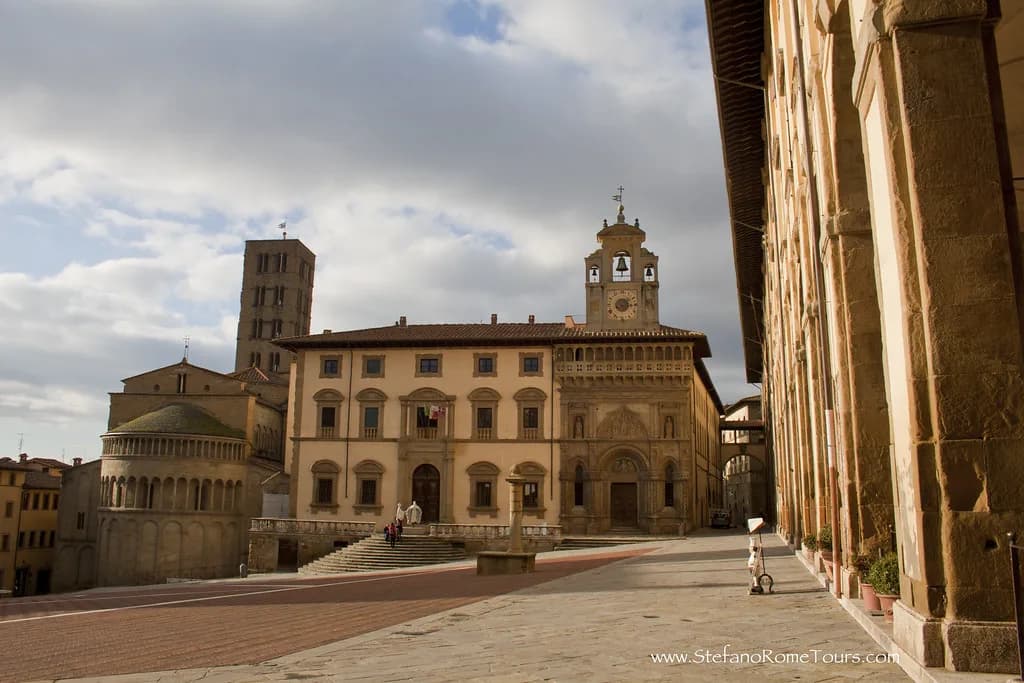
Piazza Grande itself deserves more than a pass-through: the sloping square, the Vasari loggia and the surrounding streets hold the city's daily life, and on the first weekend of the month the antiques fair fills the square and neighbouring streets. If your visit coincides with the fair, expect the centre to be busier and the walking slower.
For the art half of the day, plan around the two big fresco names rather than trying to see everything. The Basilica di San Francesco holds the Piero cycle, while San Domenico is known for Cimabue's crucifix and Spinello Aretino's wall paintings, and both sit close enough to the fortress route to be folded in without doubling back.
If you have a second day, the quieter religious sites repay the time: the Badia of Sante Flora and Lucilla, reworked by Vasari and holding a painted false dome above the main altar, is the kind of stop most short itineraries skip entirely. It pairs naturally with a slower morning before an afternoon on the hill.
Practical Planning Before You Go
Confirm two things the day before: that the grounds are open, and that any timed interior you want has a slot you can actually reach afterwards. The city's own tourism foundation publishes visitor information and contact details, including a telephone number and an email address, and it is the sensible first port of call for anything the fortress itself does not advertise.
Carry the practical minimum: comfortable shoes, water, a layer for the wind on exposed ground, and a charged phone for the map down. If you are combining the walk with a paid interior such as Casa Vasari or the Cathedral museum, book or check those first and let the fortress fill the remainder rather than the other way round.
Finally, resist the temptation to over-plan the hilltop. Its value is precisely that it is unstructured: open ground, a bit of history underfoot, and a view that makes sense of the city you have just walked through. Treat it as the pause, not the climax, and the day will run better.
The Hilltop as the Last Stop
The Fortezza Medicea earns its place in an Arezzo day not because it is elaborate but because it is free of the logistics that dominate the rest of the itinerary. Climb once, late, with the fresco sites already behind you, and the city reads differently from above than it does from any church pew.
Do the checks the sources cannot do for you: current access, any closures, and whether the interiors you want are bookable on your dates. Then walk up, sit down, and give the view the twenty minutes it deserves.
Frequently Asked Questions
Is the Fortezza Medicea in Arezzo free to visit?
The fortress is described as open to the public for exploring the grounds and enjoying the panoramic views, with no paid museum circuit. That said, current ticketing and access arrangements are not confirmed by the available sources, so treat free access to the grounds as the working assumption and verify locally before relying on it.
How long should I allow for the fortress?
A realistic suggestion, not official guidance, is somewhere between forty-five minutes and an hour and a half including the uphill walk, a circuit of the bastions and a proper stop for the view. Anyone treating it as a five-minute photo stop usually finds the climb harder to justify, so build in time to sit down.
How do I walk up to the fortress from the old town?
Head for the upper part of the historic centre near the Cathedral and Il Prato, then continue to the top of Colle San Donato. The centre is on a hill and the approach is uphill, so comfortable shoes and water matter. Specific step-free or accessible routes are not documented in the sources consulted, so ask at the tourist office if mobility is a concern.
What can you actually see at the fortress?
You see a sixteenth-century defensive layout with a trapezoid plan and bastions, remnants of earlier structures on the same site, and wide views over Arezzo, the Arno valley and the countryside. The grounds now function as a garden-like public space, so expect open ground and greenery rather than exhibition rooms.
Who built the Fortezza Medicea and when?
Construction began in 1538 under architects of the Sangallo family and was completed in 1560, as part of a Medici revision of the Grand Duchy's defences. Sources do not agree on which Medici duke is credited with commissioning it, so treat any single attribution cautiously.
Do I need tickets or advance booking for the fortress?
No booking requirement for the fortress is established by the sources available, and it is described as open ground rather than a ticketed complex. Other Arezzo sites do use timed entry, so sort those first and let the fortress absorb whatever time is left. Check current arrangements with the city's tourism body before a tightly scheduled visit.
When is the best time of year to visit the fortress?
Spring and autumn are described as particularly pleasant, with mild weather and colour in the surrounding landscape, and the fortress is treated as a year-round destination. Late afternoon gives softer light and a cooler descent, provided you leave enough daylight to walk down comfortably.
Is the fortress worth it if I only have one day in Arezzo?
Yes, if you place it at the end of a downward route rather than as a separate outing. Do the timed fresco interiors and the Cathedral first, cross Il Prato and finish on the hill before descending to Piazza Grande. It is the lowest-logistics stop of the day and gives the city a shape you cannot get at street level.
Sources
- FONDAZIONE AREZZO INTOUR - AREZZO DMO TUSCANY » Fondazione Arezzo Intour - DMO Arezzo ( Tuscany )
- A Look at Arezzo, City of Frescoes – Things to Do & Travel Guide ★ I Travel for the Stars - Art & History Travel Blog
- Visit Fortezza Medicea, Arezzo in Arezzo | Live the World
- Arezzo, Italy - An insider's guide to the town of Arezzo in Tuscany, Italy
- Welcome to Arezzo City Tour
- 10 Must See Attractions in Arezzo
- Vasari House in Arezzo: the history and new life of the museum
- Badia of Sante Flora and Lucilla - Le Rime Arezzo
- Chiesa di San Domenico, Arezzo: Guida per il visitatore 2026
- Duomo – Arezzo
Continue exploring
More guides you'll find useful